
Spiders are often among the first colonists on newly formed volcanic islands. Thanks to their aerial skills, they are able to travel nearly anywhere by ballooning on strands of their own silk. Exactly how spiders as large as 20 milligrams manage this is still relatively known. A new study shows that crab spiders, like any careful aviator, use a foreleg to monitor wind conditions for 5 or more seconds before attempting take-off. The spiders will only spool out ballooning threads if the wind is warm and gentle. Wind speeds higher than 3 meters per second are an automatic no-go. When the spider decides conditions are favorable, they release as many as 60 nanoscale fibers that are several meters in length. The wind catches the silks and lifts them away to their next adventure. (Image credit: Science Magazine, source; research credit: M. Cho et al.)
Search results for: “balloon”

Under Pressure


Pressure is a concept that can be unintuitive, but it’s incredibly important in physics and engineering. So I’m excited to debut a collaborative video series that @mostlyenginerd and I are producing all about hydrostatic pressure! Today’s video is one of our openers: it focuses on where pressure comes from and why it’s a function of height but not volume. And to show you just how pressure increases with depth, we teamed up with divers from the Oregon State University Scientific Diving Team and headed to the Oregon Coast Aquarium’s Halibut Flats exhibit. Ever seen what a balloon looks like 7 meters underwater? You’re about to! (Video and image credit: N. Sharp and A. Fillo)
Want to see how this was made? Support FYFD on Patreon, and you can get access to behind-the-scenes content and a chance to see upcoming videos early!

The Best of FYFD 2017

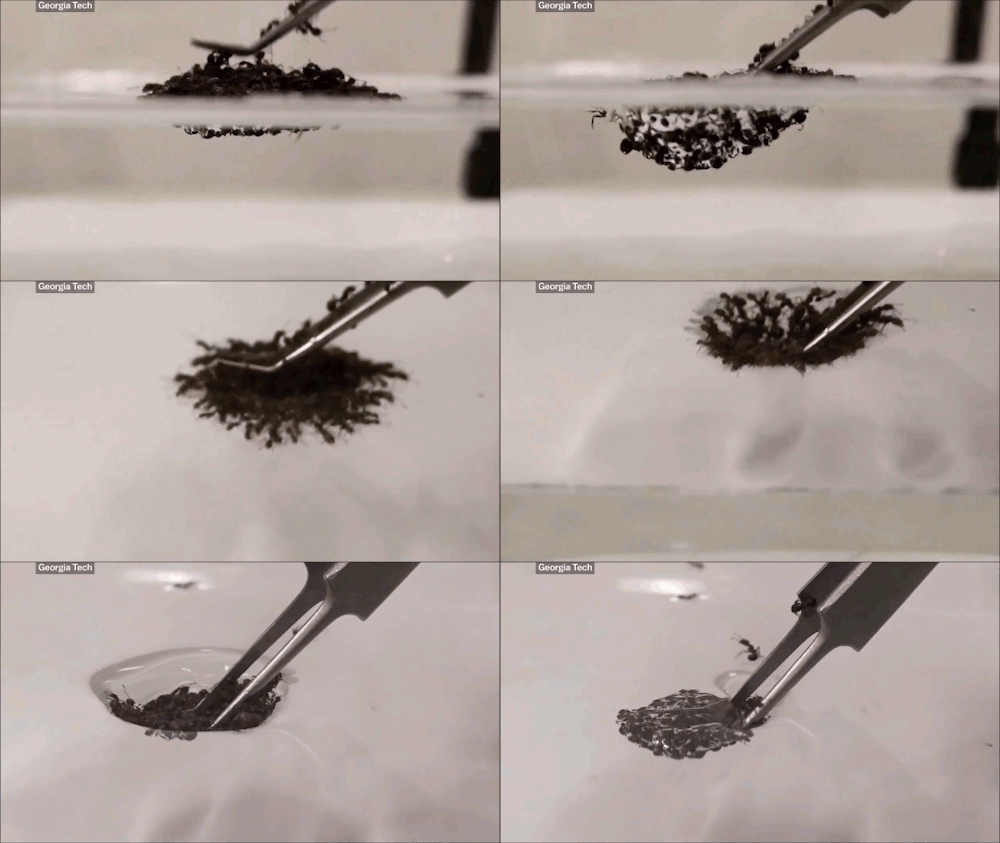
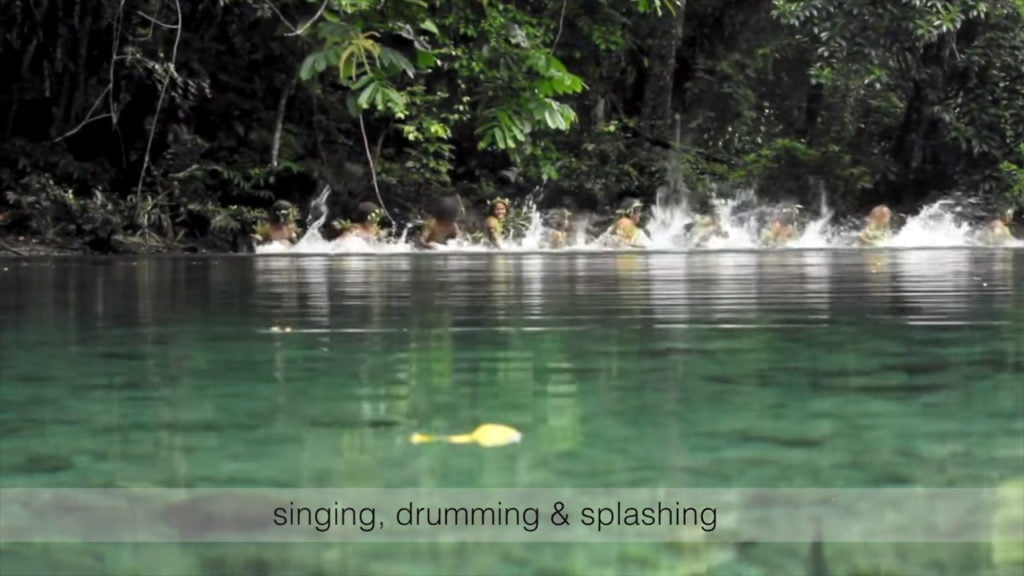


2017 was a busy, busy year here at FYFD, but a lot of that happened behind the scenes with multiple collaborations that were months in the planning. You’ll start to see the results of those collaborations here in January, starting this Friday. I’m really excited for you all to see what I’ve been up to!
In the meantime, we’ll take our traditional look back at the top 10 FYFD posts of 2017, according to you:
1. Cinemagraph of a breaking wave
2. Visualizing radiation in a cloud chamber
3. Fire ants as a fluid
4. The water music of Vanuatu
5. How hummingbirds drink nectar
6. When vortex rings collide
7. How water balloons can bounce off a bed of nails
8. Spinning ice disks form on freezing rivers
9. A hot-tub-sized fluidized bed
10. The physics of fluidized bedsLots of crazy, cool stuff in there! Special congrats to The Splash Lab for making the top 10 two years in a row. Stay tuned in 2018 for more exciting fluid dynamical developments, and if you’d like to help support FYFD, remember that you can always become a patron, make a one-time donation, or purchase some merch!
(Image credits: R. Collins / J. Maria; Cloudylabs; Vox/Georgia Tech; R. Hurd et al.; A. Varma; A. Lawrence; T. Hecksher et al.; K. Messer; M. Rober; R. Cheng)
Shadows of Flow
In the latest Veritasium video, Derek demonstrates how to see gas motions that are normally invisible using a schlieren photography set-up. Schlieren techniques have been important in fluid dynamics for well over a century, and Derek’s set-up is one of the two most common ways to set up the technique. (The other method uses two collimating mirrors instead of a single spherical or parabolic one.) As explained in the video, the schlieren optical set-up is sensitive to small changes in the refractive index, making density changes or differences in a gas visible. This makes it possible to distinguish gases of different temperatures or compositions and even lets you see shock waves in supersonic flows. (Video and image credit: Veritasium; submitted by Paul)

Crushing Oobleck
Oobleck is probably the Internet’s favorite non-Newtonian fluid. People vibrate it, run across it, shoot it, drop it, and even use it to fix potholes. But how does oobleck hold up to a hydraulic press? Fortunately, that’s been covered, too. Oobleck is a mixture of cornstarch and water, and it’s a bit unusual in that it is a shear-thickening material. That means that the faster you try to deform it, the more it will resist that deformation. Knowing this makes the above video’s results make more sense. When they try to crush the balloon full of oobleck, the deformation happens pretty slowly, so the fluid just flows away.
The same thing happens initially with the pot full of oobleck; it overflows much like any other liquid. But as the press pushes deeper, the oobleck gets confined by the pot’s walls and things change. Research has shown that the shear-thickening of oobleck comes from cornstarch particles jamming up in the fluid. By confining the oobleck, the pot and hydraulic press magnify this jamming effect, causing a spurt of semi-solid cornstarch fingers and leaving the press tool thoroughly trapped by the jammed particles. (Video credit: Hydraulic Press Channel)
Why Fishing with Dynamite is So Harmful
In some countries, there are still people using dynamite to catch fish. This practice is incredibly destructive, not just to adult fish but to the entire marine ecosystem. A blast wave traveling through air loses some its energy to the compression of the gas. Water, on the other hand, is incompressible, so the blast wave’s energy just keeps going, expanding its destructive radius. Many fish contain swim bladders, gas-filled organs the fish use to regulate their depth. When a shock wave passes through the fish, the gas in the swim bladder will expand and contract violently, much like the balloons shown underwater in the animation below. This typically ruptures the swim bladder and surrounding tissues.
Fish without swim bladders will often hemorrhage after being struck by a blast wave. The sudden changes in pressure create bubbles in the dissolved gases collected in their gills. Those bubbles tear apart the fish’s blood vessels.
Blasting is effective but entirely indiscriminate. It kills adults and juveniles of all species, not just the ones a fisherman can sell. Simultaneously, it destroys the slow-growing coral reefs that are key habitats for these populations. It’s an incredibly short-sighted practice that guarantees there will be no fish to catch in years to come. (Video credit: National Geographic; image credit: M. Rober, source; research credit: K. Dunlap, pdf)

A Rocket Launch From Above
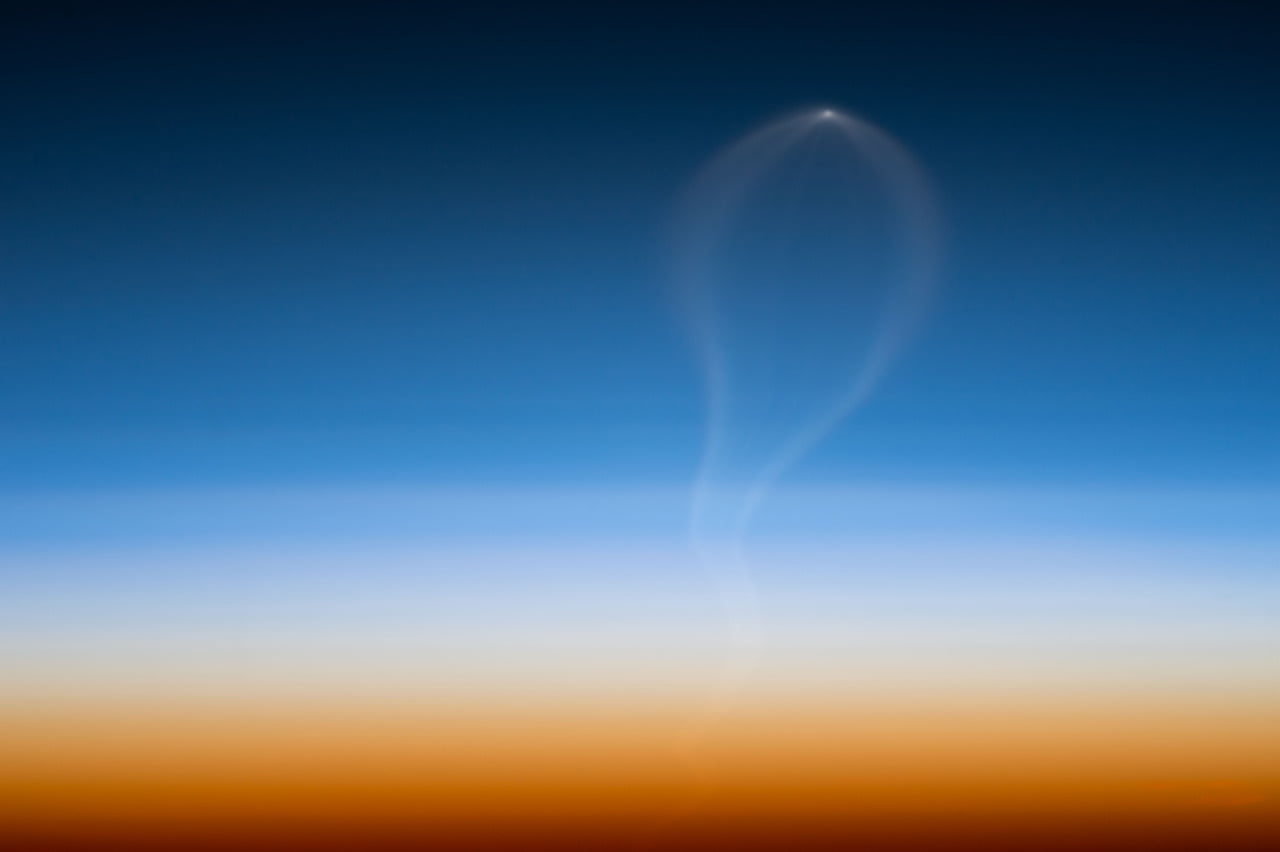
Rocket launches often produce spectacular imagery, but it’s rare to get a launch view quite like this one. The photograph above shows the recent launch of an Atlas V rocket as viewed from the International Space Station. The rocket itself is too small to be seen directly. Instead, that bright spot you see is the rocket’s exhaust. The smoky swooping curves mark the rocket’s exhaust plume. Because the gases leaving the rocket are at much higher pressure than the scant air pressure in the upper parts of the atmosphere, the exhaust expands rapidly, ballooning outward. Here the water vapor in the exhaust has frozen into crystals that catch the sunlight and make them stand out against the surrounding sky. (Image credit: NASA; via NASA Earth Observatory)
Underwater Explosions
Underwater explosions are incredibly dangerous and destructive, and this animation shows you why. What you see here are three balloons, each half-filled with water and half with air. A small explosive has been set off next to them in a pool. In air, the immense energy of an explosion actually doesn’t propagate all that far because much of it gets expended in compressing the air. Water, on the other hand, is incompressible, so that explosive energy just keeps propagating. For squishy, partially air-filled things like us humans or these balloons, that explosion’s force transmits into us with nearly its full effect, causing expansion and contraction of anything compressible inside us as our interior and exterior pressures try to equalize. The results can be devastating. To see the equivalent experiment in air, check out Mark Rober’s full video on how to survive a grenade blast. (Image credit: M. Rober, source)

Ignition
Shown here are the first instants after a bubble full of methane gas is ignited via laser. Using the schlieren optical method and a high-speed camera, scientists recorded the deflagration at 10,000 frames per second. Because schlieren imaging is very sensitive to small changes in density, we see not only the expanding flame front as the methane ignites but also the subtle waviness of the methane expanding into the surrounding air as the bubble bursts. (For comparison, check out what bursting a water balloon looks like at high-speed.) Be sure to head over to ScienceTake for the full schlieren video, and also check out this award-winning video of a match lighting made by the same researcher. (Image credit: V. Miller et. al.; full video: The New York Times; submitted by Rebecca M.)
ETA: An earlier version of this post mistakenly said the demo used a balloon full of methane rather than a bubble. Thanks to jump-first-think-later for the correction.
Early Rocket Launch
Pre-dawn launches provide some of the most dramatic rocket footage. This video is from an October 2nd Atlas V launch, and the really fun stuff starts at about 0:34. As the rocket climbs to higher altitudes, the atmospheric pressure around it decreases. As a result of this low pressure, the rocket’s exhaust gases balloon outward in a giant plume many times larger than the rocket. This happens in every launch, but it’s visible here because the rocket is at such a high altitude that its exhaust is being lit by sunlight while the observers on the ground are still in the dark. The ice crystals in the exhaust–much of the rocket’s exhaust is water vapor–reflect sunlight down to the earth. Around 0:47, a cascade of shock waves ripples through the plume just before the first-stage’s main engine cuts off. Once the engine stops firing, there’s no more exhaust and the plume ends. (Video credit: Tampa Bay Fox 13 News; submitted by Kyle C)