Search results for: “balloon”

  • Featured Video Play Icon

    Tranquilizer Darts in Slow Mo

    Like most syringes, tranquilizer darts use pressure to drive flow. But where a typical syringe has that pressurization provided by a human driving the piston, tranquilizer darts must deploy without any hands-on action. As shown in the video above, this is achieved by pressurization prior to firing.

    The tranquilizer dart has a few key features. Its needle, though sharp, does not have a hole in the end. Instead, it has a hole partway down the barrel of the needle, which is covered before launch by a rubber sleeve. The dart also contains two chambers. One is filled with the medicine being deployed. The other gets pressurized with air through a one-way valve. As long as the rubber sleeve stays over the needle’s hole, the dart is then pressurized, but the fluid has nowhere to go.

    Until it’s fired, of course. On impact, the rubber sleeve is pushed away, and the higher pressure inside the air chamber drives the medicine out of the needle and into the animal. (Video and image credit: The Slow Mo Guys)

  • Recreating Volcanic Lightning

    Recreating Volcanic Lightning

    Some natural phenomena, like volcanic eruptions or tornado formation, don’t lend themselves to fieldwork — at least not at the height of the action. The danger, unpredictability, and destructiveness of these environments is more than our equipment can survive. And so researchers find clever ways to recreate these phenomena in controllable ways. The latest example comes from a lab in Germany, where researchers are recreating volcanic lightning.

    To do so, they heat and pressurize actual volcanic ash in an argon environment and let the mixture decompress into a jet, like a miniature eruption. The lightning that accompanies the jet is thought to depend on friction between ash particles, which build up electric charges when rubbed, just like a balloon rubbed against one’s hair. When the charges get large enough, lightning discharges the build-up.

    Small-scale experiments like this one allow researchers to vary the temperature and water content of the ash and observe how this changes the lightning. Drier ash generates more lightning, but it’s hard to distinguish whether this is inherent to the ash or the result of the denser jets that form without the added eruptive force of steam. (Image credit: eruption – M. Szeglat, lab lightning – Sönke Stern/Ludwig-Maximilians-Universität München/Gizmodo; research credit: S. Stern et al.; via Gizmodo)

  • Adapting to the Flow

    Adapting to the Flow

    Simulating fluid dynamics computationally is no simple task. One of the major challenges is that flows typically consist of many different lengthscales, from the very large to the extremely tiny. In theory, correctly capturing the physics of the flow requires computing all of those scales, and that means having a very close, dense grid of points at which the physics must be calculated during every time step of a simulation. Even for a relatively simple flow, this quickly balloons into a prohibitively expensive problem. It simply takes a computer far too long to calculate solutions for so many points.

    One technique that’s been developed to save time is Adaptive Mesh Refinement. You can see an example of it above. The background is a grid of points that are far from one another in places where the flow isn’t changing and are tightly spaced in areas where the rising flames are most changeable. Adaptive Mesh Refinement algorithms automatically change these grid points on the fly, adding more where they’re needed and subtracting them where they aren’t. The end result is a much faster computational result that doesn’t sacrifice accuracy. Check out the videos below for some examples of this technique in action. (Video and image credit: N. Wimer et al.)

  • The Bouncing Drop

    The Bouncing Drop

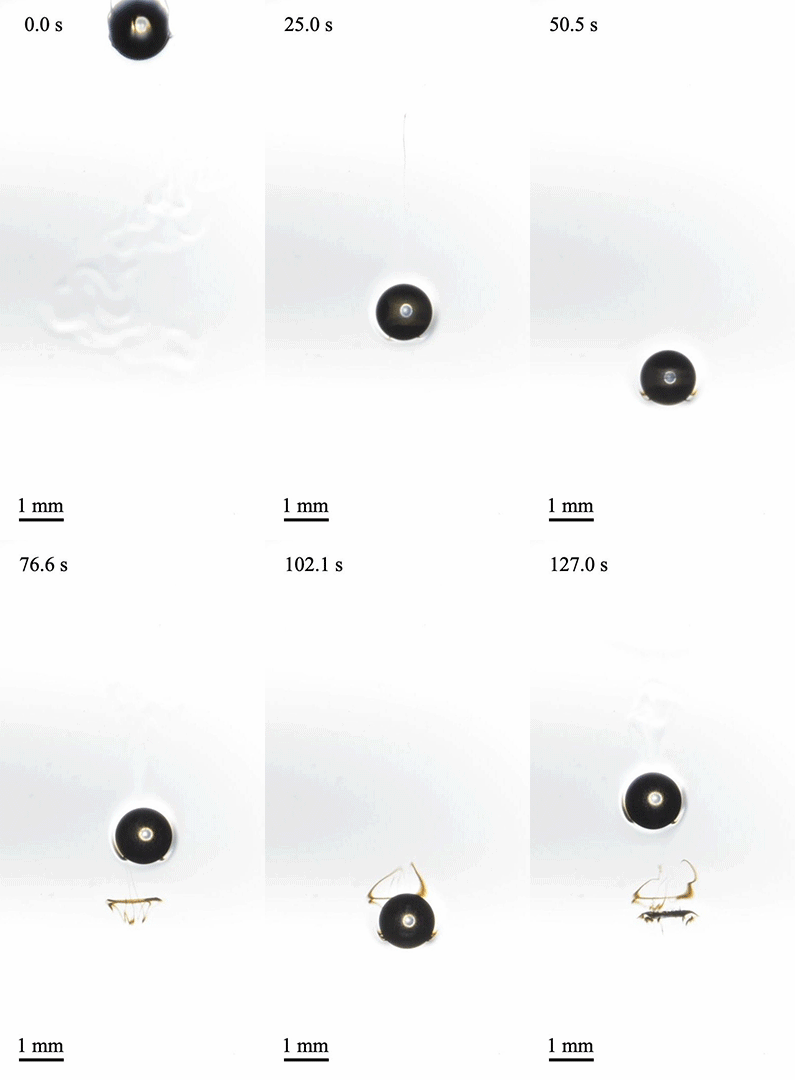
    For a droplet to bounce, we expect it to hit a wall or a sharp interface of some kind. But in a new study, researchers demonstrate a droplet that bounces with neither. Shown above is an oil droplet sinking through a stratified mixture of ethanol (toward the top) and water (toward the bottom). Because the oil is heavier than ethanol, it initially sinks, dragging some of the ethanol with it as it falls. Over time, some of that ethanol rises again, forming what’s known as a buoyant jet.

    Simultaneously, the gradient of ethanol to water between the top and bottom of the drop creates an imbalance in surface tension. The ethanol near the top of the drop has a lower surface tension than the water at the bottom. This creates a downward Marangoni flow along the drop interface.

    The bounce itself happens quickly after a long, slow sinking period. As the drop’s sinking slows, the buoyant jet weakens until it disappears completely. At the same time, the downward Marangoni flow pulls fresh ethanol-rich fluid toward the top of the drop. That increases the surface tension difference and strengthens the Marangoni flow, creating a positive feedback loop. In less than a second, the Marangoni flow increases by two orders of magnitude, pulling so hard that the drop shoots upward.

    That resets the cycle by weakening the Marangoni flow and strengthening the buoyant jet. The droplet can continue bouncing for about 30 minutes until the concentration gradient is so well-mixed that the cycle can’t continue. (Image and research credit: Y. Li et al.; via APS Physics; submitted by Kam-Yung Soh)

  • Avoiding Ice

    Avoiding Ice

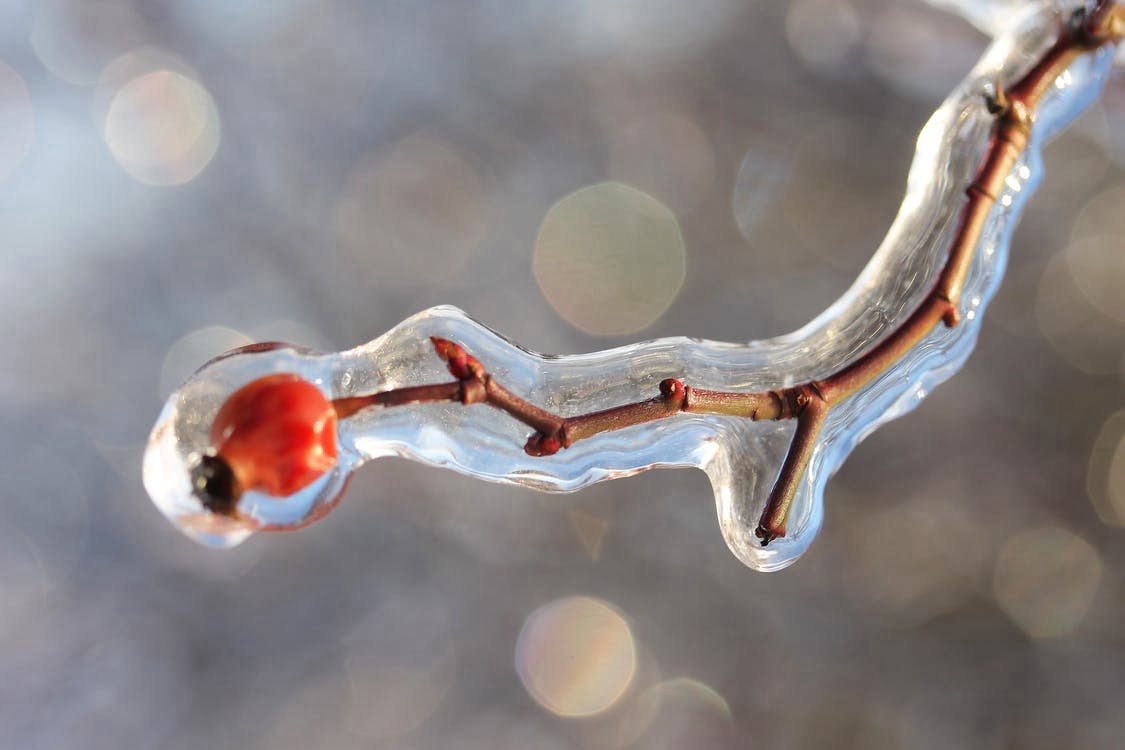
    Keeping ice from forming on a surface is a major engineering challenge. Typically, there’s no controlling certain factors – like the size and impact speed of droplets – so engineers try to tame ice by changing the surface. This can be through chemicals – as with deicing fluids used on aircraft – or by tuning the surface itself.

    One way to do this is by making the surface superhydrophobic – or extremely water repellent. These surfaces are rough on a nanoscale level, but they’re delicate, and once ice gets a grip on them, it’s even harder to remove. In a recent study, however, researchers used particles with both hydrophobic and hydrophilic – water-attracting – properties to create a superior ice-resistant surface. The combination of hydrophobic and hydrophilic aspects to the particles made supercooled droplets break up on contact with the surface. This made the drops smaller and decreased their contact time, making it harder for them to stick and freeze. (Image credit: Pixabay; research credit: M. Schwarzer et al.; via Chembites; submitted by Kam-Yung Soh)

  • Featured Video Play Icon

    The Actual Shape of Raindrops

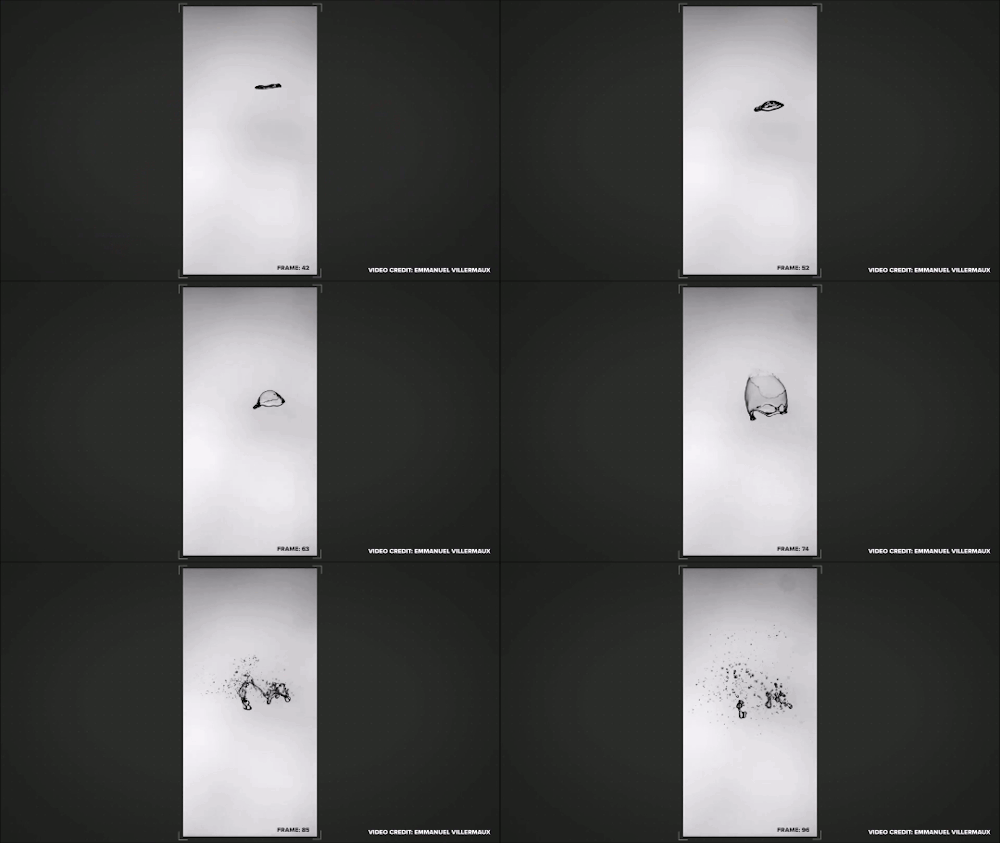
    If you imagine the shape of a raindrop, you probably think of a tear drop shape, but the reality of rain is much more complicated. It’s Okay to Be Smart has a great primer on the subject that takes a look at the forces on a raindrop and shows you the actual shape they take, which depends largely on their size.

    Small raindrops tend to coalesce together over time and get larger and progressively flatter. When the drop’s volume gets too large (below), it balloons up like a parachute. Researchers call this a bag. Stretched into a film, the drop’s surface tension is no longer able to win its fight against aerodynamic forces, and the drop shreds into smaller droplets. (Video and image credit: It’s Okay to Be Smart)

  • Bouncing Off a Moving Wall

    Bouncing Off a Moving Wall

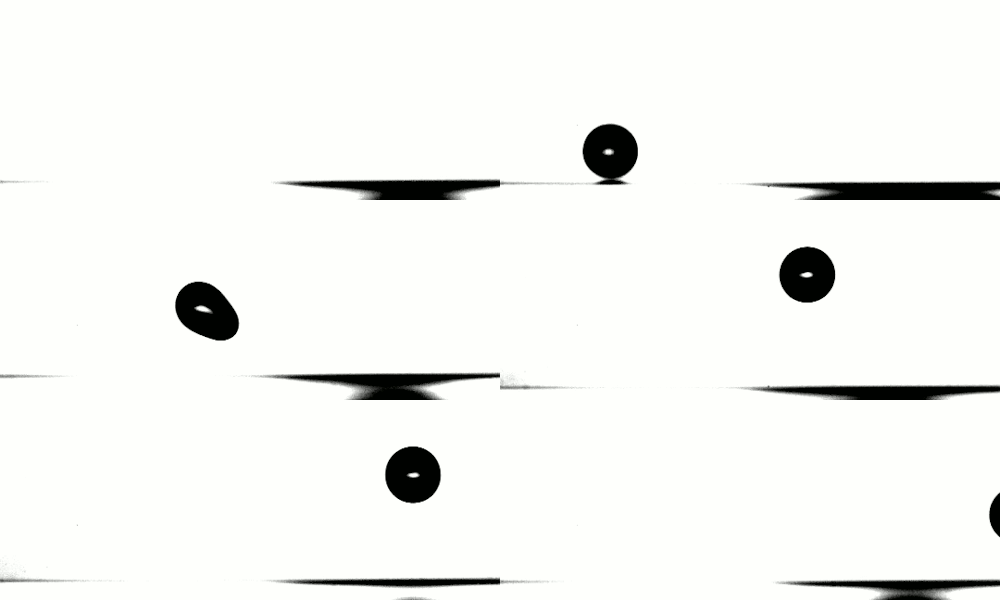
    There are many ways to repel droplets from a surface: water droplets will bounce off superhydrophobic surfaces due to their nanoscale structures; a vibrating liquid pool can keep droplets bouncing thanks to its deformation and a thin air layer trapped under the drop; and heated surfaces can repel droplets with the Leidenfrost effect by vaporizing a layer of liquid beneath the droplet. But all of these methods will only work for certain liquids under specific circumstances. 

    More recently, researchers have begun looking at a different way to repel droplets: moving the surface. The motion of the plate drags a layer of air with it; how thick that layer of air is depends on the plate’s speed. (Faster plates make thinner air layers.) Above a critical plate speed, a falling droplet will impact without touching the plate directly and will rebound completely. This works for many kinds of liquids – the researchers used silicone oil, water, and ethanol – across many droplet sizes and speeds. The key is that the air dragged by the plate deforms the droplet and creates a lift force. If that lift force is greater than the inertia of the droplet, it bounces. (Image and research credit: A. Gauthier et al., source)

  • Plasma From a Jet of Water

    Plasma From a Jet of Water

    There aren’t many naturally occurring plasmas in our daily lives; by far the most common one is lightning. So it’s something of a surprise that a stream of water hitting a material like glass is able to produce a toroid of plasma like the one above. The key here, though, is that the jet has to be fast – to the tune of 200 meters per second or faster. When a jet of deionized water strikes a surface at that speed, the water has to take a very sharp, 90-degree turn, and, thanks to the polar nature of water, this causes a (negative) charge to build up at that turn. It’s akin to rubbing a balloon to build up a static charge, and it’s known as a triboelectric effect. At rest (and without high shear rates), water and glass in contact tend to create in a positive charge in the water. The plasma is created when an arc forms through air between those two charged areas.

    Experiments in helium environments create a different color of plasma, confirming that the arc definitely travels through the gas. Similarly, if you use regular water instead of deionized water, the conductivity of the dissolved salts in the water is enough to prevent the necessary build up of charge. (Image and research credit: M. Gharib et al.; video credit: Applied Science; submitted by Kam-Yung Soh)

  • Fly Away!

    Fly Away!

    Spiders are often among the first colonists on newly formed volcanic islands. Thanks to their aerial skills, they are able to travel nearly anywhere by ballooning on strands of their own silk. Exactly how spiders as large as 20 milligrams manage this is still relatively known. A new study shows that crab spiders, like any careful aviator, use a foreleg to monitor wind conditions for 5 or more seconds before attempting take-off. The spiders will only spool out ballooning threads if the wind is warm and gentle. Wind speeds higher than 3 meters per second are an automatic no-go. When the spider decides conditions are favorable, they release as many as 60 nanoscale fibers that are several meters in length. The wind catches the silks and lifts them away to their next adventure. (Image credit: Science Magazine, source; research credit: M. Cho et al.)

  • Featured Video Play Icon

    Under Pressure

    Pressure is a concept that can be unintuitive, but it’s incredibly important in physics and engineering. So I’m excited to debut a collaborative video series that @mostlyenginerd and I are producing all about hydrostatic pressure! Today’s video is one of our openers: it focuses on where pressure comes from and why it’s a function of height but not volume. And to show you just how pressure increases with depth, we teamed up with divers from the Oregon State University Scientific Diving Team and headed to the Oregon Coast Aquarium’s Halibut Flats exhibit. Ever seen what a balloon looks like 7 meters underwater? You’re about to! (Video and image credit: N. Sharp and A. Fillo)

    Want to see how this was made? Support FYFD on Patreon, and you can get access to behind-the-scenes content and a chance to see upcoming videos early!