
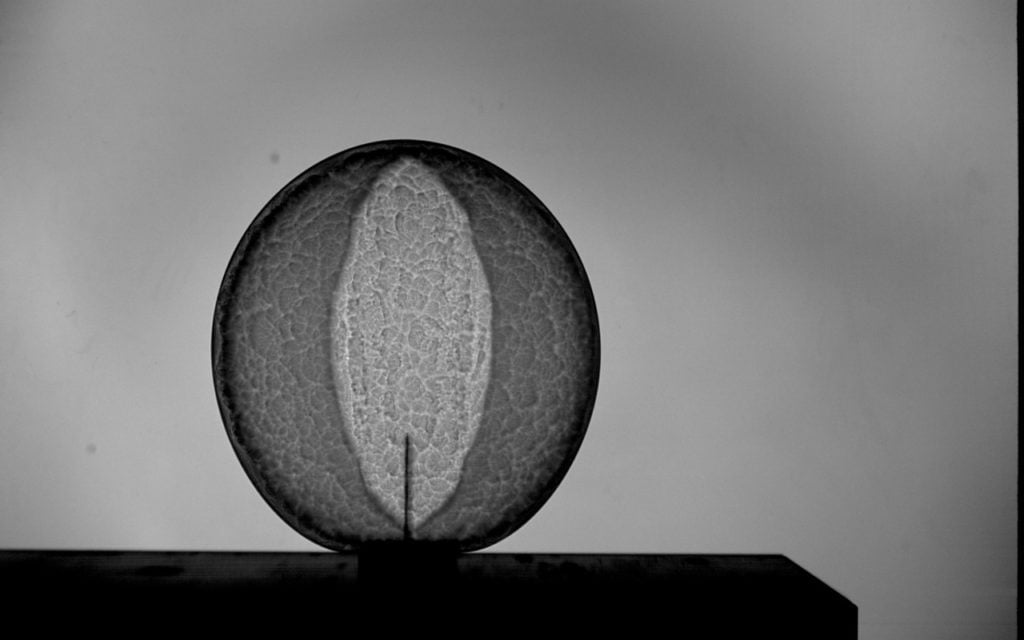
The pop of an overfilled balloon is enough to make anyone jump, but you’ve probably never seen it like this. The photo above uses an optical technique known as schlieren photography that reveals changes in density of a transparent gas like air. The shredded rubber of the balloon is still visible in black, and around the balloon there’s an expanding spherical shock wave. It’s the sudden release of energy when the balloon ruptures and the gas inside begins to expand that causes the shock wave. Notice, though, that the gas from the balloon is still clearly visible and balloon-shaped–much like a water balloon that’s just popped. From that clear delineation, I would say that this balloon was filled with a different gas than air–otherwise the density shouldn’t be different enough to make the interior gas distinguishable. (Image credit: G. Settles)
Search results for: “balloon”

Balloon Explosion




These photos are shadowgraphs of a hydrogen flame exploding inside a balloon. The shadowgraph optical technique highlights density and temperature variations through their effect on a fluid’s refractive index. Here we see that the hydrogen flame has a strong cellular structure and is more turbulent than a methane flame. The cellular structure is a sign of an instability in the curved flame front. The instability and accompanying cellular appearance are a result of the complicated transport and reaction of fuel and oxidizer inside the flame. (Photo credits: P. Julien et al.)

Balloons in the Car
Destin from Smarter Every Day has just made a video on one of my favorite fluids brain teasers: what happens to a helium balloon when you accelerate in a car? Take a moment to think about the answer before watching or reading further…
Okay, so what happens? Contrary to what you may expect, hitting the accelerator with a balloon in the car will make it shift forward. This is a matter of buoyancy. As Destin demonstrates with the water bottle, when two fluids are accelerated forward, the denser one will shift backwards, which pushes the lighter one forward. Because the helium is lighter than the air filling the car, accelerating pushes the air backward (just as it does the pendulum and the car’s inhabitants) and that shifting of the air pushes the helium in the balloon forward. (Video credit: Smarter Every Day)
Shooting a Bullet Through a Water Balloon
This high-speed video of a bullet fired into a water balloon shows how dramatically drag forces can affect an object. In general, drag is proportional to fluid density times an object’s velocity squared. This means that changes in velocity cause even larger changes in drag force. In this case, though, it’s not the bullet’s velocity that is its undoing. When the bullet penetrates the balloon, it transitions from moving through air to moving through water, which is 1000 times more dense. In an instant, the bullet’s drag increases by three orders of magnitude. The response is immediate: the bullet slows down so quickly that it lacks the energy to pierce the far side of the balloon. This is not the only neat fluid dynamics in the video, though. When the bullet enters the balloon, it drags air in its wake, creating an air-filled cavity in the balloon. The cavity seals near the entry point and quickly breaks up into smaller bubbles. Meanwhile, a unstable jet of water streams out of the balloon through the bullet hole, driven by hydrodynamic pressure and the constriction of the balloon. (Video credit: Keyence)
Microgravity Water Balloons
When a water balloon pops in microgravity, waves propagate from the initial point of contact and the final point of contact (where the balloon skin peels away). As these waves come inward toward one another, the water is compressed from its original potato-like shape into a pancake-like one. In most cases, surface tension will provide a damping force on this oscillatory motion, eventually making the water into a sphere. On Earth, in contrast, a water balloon seems to hold its shape after popping. This is because the effect of gravity on the water is much larger than the effect of the propagating waves. This is one reason that it is useful to have a laboratory in space! Without a microgravity environment, it is much harder to study and observe secondary and tertiary-order forces on a physical event. (Video credit: Don Pettit, Science Off The Sphere)
Water Balloon Physics
[original media no longer available]
This video explores some of the physics behind the much-loved bursting water balloon. The first sections show some “canonical” cases–dropping water balloons onto a flat rigid surface. In some cases the balloon will bounce and in others it breaks. The bursting water balloons develop strong capillary waves (like ripples) across the upper surface and have some shear-induced deformation of the water surface as the rubber peals away. Then the authors placed a water balloon underwater and vibrated it before bursting it with a pin. They note that the breakdown of the interface between the balloon water and surrounding water shows evidence of Rayleigh-Taylor and Richtmyer-Meshkov instabilities. The Rayleigh-Taylor instability is the mushroom-like formation observed when stratified fluids of differing densities mix, while the Richtmyer-Meshkov instability is associated with the impulsive acceleration of fluids of differing density.

High-Altitude Balloon Flight


Tangentially fluids-related, but SpaceWeather has a fun video of a high-altitude helium balloon bursting. Although this balloon carried a space-related payload, it’s the same type of set-up used for weather balloons. With only a few basic assumptions, it’s possible to do some neat calculations on the buoyancy, loading capacity, and behavior of such balloons.
Giant Water Balloon Physics
Playing with a giant water balloon and high-speed cameras is like a giant experiment in surface tension, right up until the tensile strength of the balloon comes into play. The rippling in the balloon is reminiscent of the motion of droplet breakup or impact on superhydrophobic surfaces. (submitted by Daniel B)
Reader Question: Hot Air Balloon Physics
lazenby asks:
and boyancy in air? is the lifting capacity of a hot air balloon equal to the modulo of the weight of the air in the balloon with the weight of the same volume of air outside the balloon?
for that matter, does the lift of a big helium weather balloon decrease as air pressure, and so weight of the air outside the balloon, drops? and is this exactly counterbalanced by the lessening density of the helium in the balloon?
all of these things keep me awake.
Hopefully you won’t be sleepless much longer. Buoyancy in air follows the same principles as buoyancy in water. Determining the lifting capacity of a balloon is a matter of determining how heavy the balloon can be before the buoyant force is equal to the weight. See the free body diagram and little derivation below to see what the maximum payload mass is for a helium balloon. You can click on the picture to enlarge it.

The second part of your question raises some interesting points. As a balloon’s altitude increases, the atmosphere around it gets colder and less dense, all of which should reduce the buoyant force. At the same time, the balloon itself expands to equalize the pressure inside and outside of the balloon, which should increase the buoyant force. (At some point the pressure drops sufficiently that the tensile strength of the balloon material is unable to cope with that expansion and the balloon bursts, but we’ll ignore that here.) For this problem, we’d want to know what payload the balloon can carry without losing lift, and, with a couple assumptions, that’s pretty easy to figure out. I’ve done that derivation below.

The real key to the calculation is assuming that the helium in the balloon maintains the same temperature as the air outside. Since balloons rise slowly, this seemed a more reasonable assumption than imagining that the balloon remains warm compared to its surroundings. That calculation is doable as well but requires more than a couple lines, unfortunately! Thanks for your questions!

Water Balloon Photography
Photographer Edward Horsford uses high-speed photography to capture water balloons as they burst. On Earth, of course, gravity wins over surface tension, but the results are very different in microgravity. See the technical description for how Horsford gets his shots and look at more of his work on Flickr. (via NPR)