Tag: contact angle

  • How Water Droplets Charge Up

    How Water Droplets Charge Up

    Rubbing a balloon on your hair can build a significant electrical charge. Water droplets have the same issue when they slide across a hydrophobic, electrically-insulated surface. A new study models why these charges build up and tests the model both experimentally and through simulation. They focused their theory on three effects that determine how much charge builds up. The first is a two-way chemical reaction that continuously creates charge at the interface, with positive charge building in the drop. Secondly, the drop’s contact angle with the surface sets how many protons can build up at the contact line, thereby affecting the electrical field they generate. And, finally, fluid motion at the rear of the drop deflects protons upward, shifting the electrical field. In particular, their model predicts that the higher contact angles of hydrophobic surfaces should increase charge build-up and faster sliding velocities should slow charge build-up, both of which agree with experiments.

    The model should help researchers understand various charging scenarios, like those found on self-cleaning surfaces, in inkjet printing, and in semiconductor manufacturing. In the last scenario, rinsing semiconductor wafers in ultrapure water can build up charges in the kilovolt range, which is enough to damage the product. (Image credit: D. Carlson; research credit: A. Ratschow et al.; via APS Physics)

  • Featured Video Play Icon

    Rattlesnakes Sip Rain From Their Scales

    Getting enough water in arid climates can be tough, but Western diamondback rattlesnakes have a secret weapon: their scales. During rain, sleet, and even snow, these rattlesnakes venture out of their dens to catch precipitation on their flattened backs, which they then sip off their scales.

    Researchers found that impacting water droplets tend to bead up on rattlesnake scales, forming spherical drops that the snake can then drink. Compared to other desert-dwelling snakes, Western diamondbacks have a far more complicated microstructure to their scales, with labyrinthine microchannels that provide a sticky, hydrophobic surface for impacting drops. (Video and image credit: ACS; research credit: A. Phadnis et al.; via The Kid Should See This)

  • Building Liquid Circuits

    Building Liquid Circuits

    Building microfluidic circuits is generally a multi-day process, requiring a clean room and specialized manufacturing equipment. A new study suggests a quicker alternative using fluid walls to define the circuit instead of solid ones. The authors refer to their technique as “Freestyle Fluidics”. As seen above, the shape of the circuit is printed in the operating fluid, then covered by a layer of immiscible, transparent fluid. This outer layer help prevent evaporation. Underneath, the circuit holds its shape due to interfacial forces pinning it in place. Those same forces can be used to passively drive flow in the circuit, as shown in the lower animation, where fluid is pumped from one droplet to the other by pressure differences due to curvature. Changing the width of connecting channels can also direct flow in the circuits. This technique offers better biocompatibility than conventional microfluidic circuits, and the authors hope that this, along with simplified manufacturing, will help the technique spread. (Image and research credit: E. Walsh et al., source)

  • Superhydrophobic Coatings

    Superhydrophobic Coatings

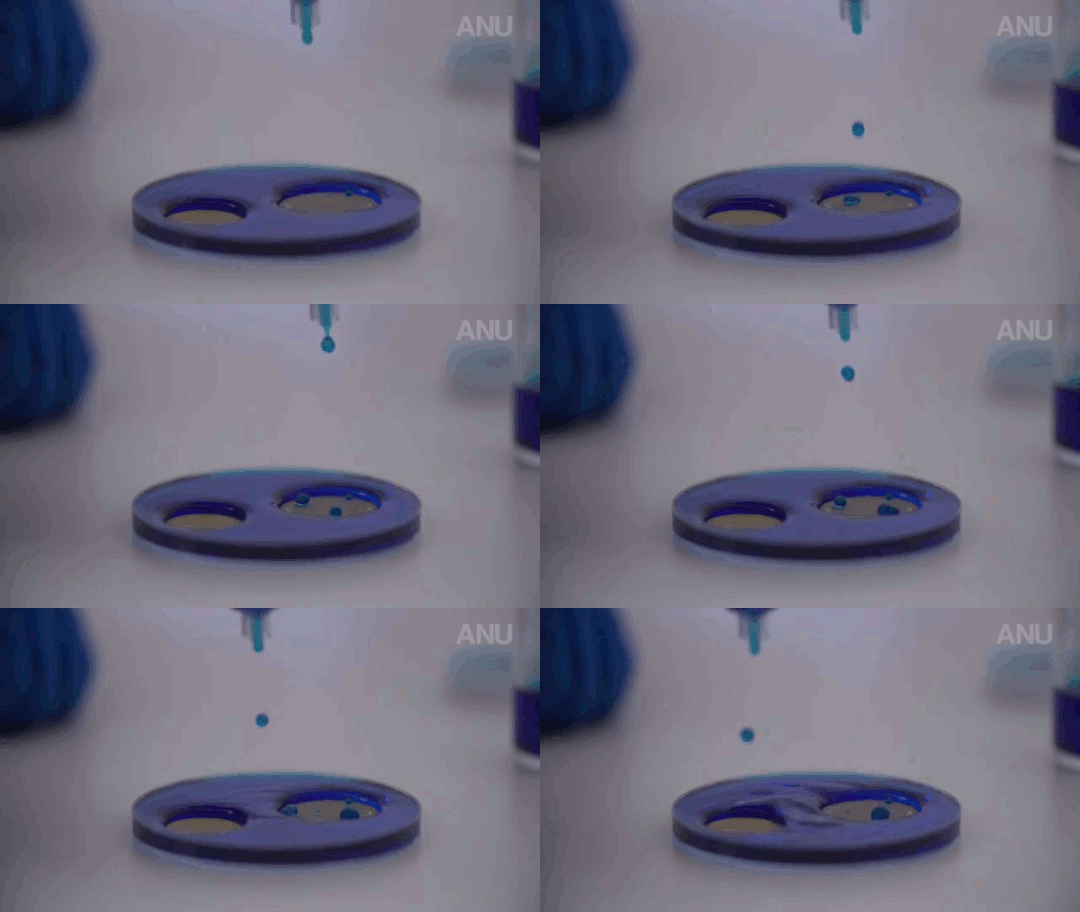
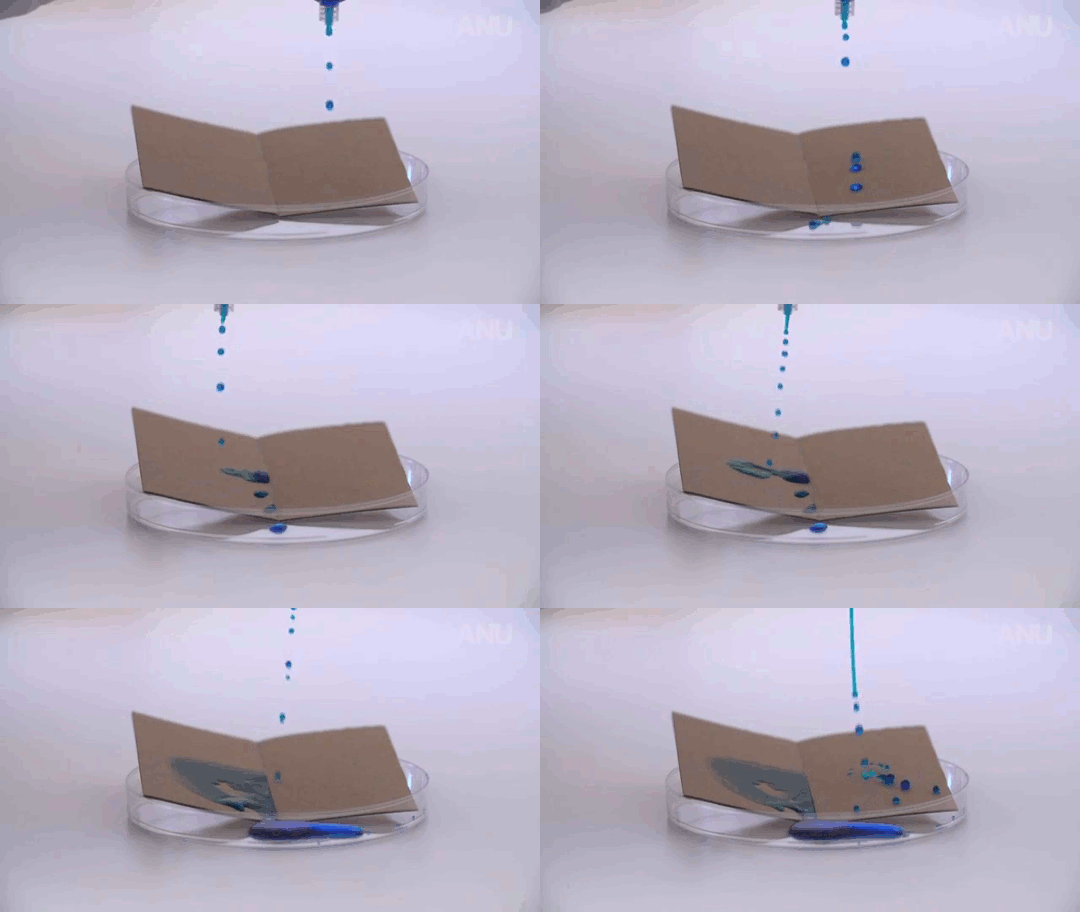
    Superhydrophobic–or water repellent–materials are much sought after. Their remarkable ability to shed water is actually mechanical in nature–not chemical. Surfaces with a highly textured microstructure, like a lotus leaf or a butterfly wing, shed water naturally because air trapped between the high points prevents the water from contacting most of the solid surface. The result is that a drop sitting on the surface will have a very high contact angle and be nearly spherical. Instead of wetting the surface and spreading out, it can slide right off, as seen in the animations above. Here researchers have treated the coins and the right half of the cardboard with a spray-on coating that creates superhydrophobic microscale roughness. Similar coatings are commercially available, but such coatings are delicate and lose their hydrophobicity over time as the microstructure breaks down. (Image credits: Australian National University, source)

  • Pinning a Drop

    Pinning a Drop

    The shape of a droplet sitting on a surface depends, in part, on its surface tension properties but also on the nanoscale roughness of the surface. Small variations in the height and shape of the surface will change the area a drop contacts as well as the contact angle the edge of the drop makes with the surface. If the contact line between the drop and surface stays the same as a droplet evaporates into the surrounding gas or dissolves into the surrounding liquid, then we say the drop is pinned. A pinned drop’s contact angle will decrease as the drop’s volume decreases. This strains the ability of the nanoscale roughness to keep the drop’s edge pinned. As individual points of contact fail, the drop’s edge may jump inward to a new contact point. This set of discrete jumps between pinned states is called a stick-jump or stick-slip mode. (Image credit: E. Dietrich et al., source; see also: E. Dietrich et al. 2015)

  • Featured Video Play Icon

    Water and Aerogel

    Aerogel is an extremely light porous material formed when the liquid inside a gel is replaced with gas. When combined with water, aerogel powders can have some wild superhydrophobic effects. Here water condensed on a liquid nitrogen cooler has dripped onto a floor scattered with aerogel powder from the nitrogen’s shipping container. The result is that the water gets partially coated in aerogel powder and takes on some neat properties. Its contact angle with the surface increases – in other words, it beads up – which is typical of superhydrophobicity. When disturbed, the water breaks easily into droplets which do not immediately recombine upon contact. With sufficient distortion, they can rejoin. You can see some other neat examples of aerogel-coated water behaviors in this second video as well. (Video credit: ophilcial; submitted by Jason I.)

  • Evaporation and Surface Effects

    Evaporation and Surface Effects

    Surface properties can have surprising effects on fluid behavior. This image shows the evaporation of several droplets over time. All of the initial droplets are of the same volume, but they are placed on a surface which is a) superhydrophobic, b) hydrophobic, or c) hydrophilic. The more hydrophobic the surface, the larger the initial contact angle between the droplet and surface and the smaller the wetted area of the surface. Yet despite this seemingly large surface area exposure to air, the droplet on the superhydrophobic surface is the slowest to evaporate. (Photo credit: C. Choi)

  • Featured Video Play Icon

    Bouncing Off

    A water droplet falling onto a superhydrophobic surface will rebound and bounce without wetting the surface. Capillary and internal waves reflect in the drop until it comes to rest at a high contact angle, formed at the boundary where the liquid, solid, and air meet. Such surfaces can have interesting interactions with water, as when two droplets coalesce on a surface and then begin bouncing or when superhydrophobic objects are dropped into a bath. (Video credit: Gangopadhyay Group, University of Missouri)