As dangerous as explosions are in air, they are even more destructive in water. Because air is a compressible fluid, some part of an explosion’s energy is directed into air compression. Water, on the other hand, is incompressible, which makes it an excellent conductor of shock waves. In the video above we see some simple underwater explosions using water bottles filled with dry ice or liquid nitrogen. The explosions pulsate after detonation due to the interplay between the expanding gases and the surrounding water. When the gases expand too quickly, the water pressure is able to compress the gases back down. When the water pushes too far, the gases re-expand and the cycle repeats until the explosion’s energy is expended. This pulsating change in pressure is part of what makes underwater explosions so dangerous, especially to humans. Note in the video how the balloons ripple and distort due to the changing pressure. Those same changes in pressure can cause major internal damage to people. (Video credit: The Backyard Scientist; submitted by logicalamaze)
Search results for: “balloon”

Hawk in Flight
For a little more than century, mankind has taken flight in fixed-wing aircraft. But other species have flown for much longer using flapping techniques, the details of which humans are still unraveling. To really appreciate flapping flight, it helps to have high-speed video, like this beautiful footage of a goshawk attacking a water balloon. The motion of the hawk’s wings is far more complex than the simple up and down flapping we imitate as children. On the downstroke, the wings and tail stretch to their fullest, providing as large an area as possible for lift. During steady flight, the bird flaps while almost horizontal for minimal drag, but as it approaches its target, it rears back, allowing the downstroke to both lift and slow the bird. In the upstroke, the bird needs to avoid generating negative lift by pushing air upward. To do this, it pulls its wings in and simultaneously rotates them back and up. Its tail feathers are also pulled in but to a lesser extent. Leaving them partially spread probably maintains some positive lift and provides stability. At the end of the upstroke, the hawk’s wings are ready to stretch again, and so the cycle continues. (Video credit: Earth Unplugged/BBC; h/t to io9)
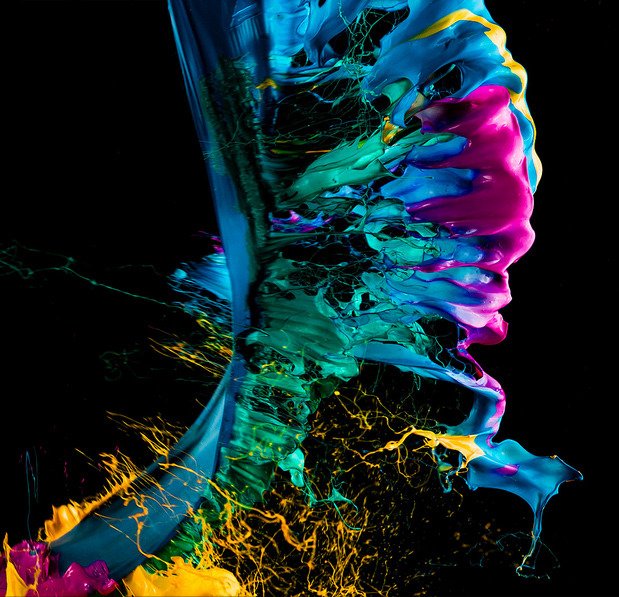
“Liquid Jewel”
Just a reminder that today is your last chance to participate in our reader survey. If you haven’t had a chance yet to fill it out, please do. The data are very important to us, not just for this site, but for improving science outreach online in general. Thank to those who have filled out the survey and especially those who left suggestions. You guys have some great ideas!
Today’s image is from artist Fabian Oefner’s “Liquid Jewel” series, featuring paint-filled balloons moments after rupture. Oefner has several series displaying physical forces as visual media, including the previously featured “Black Hole” and “Millefiori” photos. (Photo credit: F. Oefner)
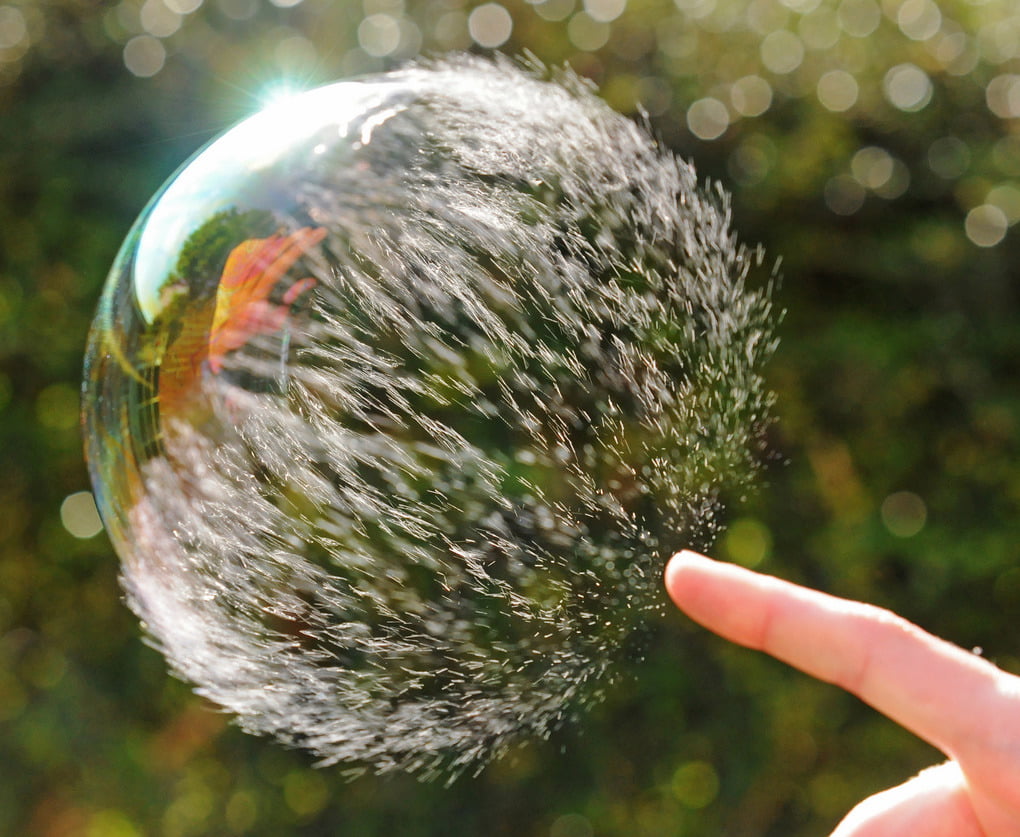
Bursting Bubble
Originally posted: 24 Aug 2011 That soap bubbles burst in the blink of an eye is a pity considering how fascinating their disappearing act is. This photo set from photographer Richard Heeks captures the bubbles mid-burst. Once the bubble’s film is breached, surface tension rips the smooth film back like a broken balloon, causing the liquid that used to be part of the bubble to erupt into droplets. (Photo credit: Richard Heeks)
Reminder: Many thanks to those who have filled out the survey! There are some great responses so far. If you haven’t done so, won’t you please fill out our reader survey?
Soap Bubble Burst
High-speed video of a soap bubble being popped reveals the directionality of the process. Like a the rubber of a bursting balloon, the soap film rushes away from the point of rupture, disintegrating as the information about a sudden lack of surface tension is propagated across the remaining film surface. In this regard, it is much like what happens when you drop a slinky toy.
Bill Nye Demos
[original media no longer available]
Have a little science enthusiasm from Bill Nye to brighten your Tuesday! This video includes demonstrations on thermodynamics (sucking the balloon into the flask), the Marangoni effect (driving the powder off the water surface and powering the glue boat by creating gradients in surface tension), and buoyancy (floating cans of cola).

Reader Question: Surface Tension vs. Viscosity
lazenby asks:
How can superfluid liquid Helium have zero viscosity while retaining surface tension? (assuming something like surface tension is required for a liquid to form drops)
The short answer is that surface tension and viscosity are two totally separate properties for a fluid. To illustrate how one can exist without the other in a superfluid, we’ll imagine two different scenarios. For the first, imagine that you have a narrow vertical pipe. Any fluid you put in the pipe will flow downward due to the force of gravity. If you put water through the pipe, you’ll get some rate of outflow. Now imagine putting something like molasses through the pipe. Even with the same external forces on it, the molasses will never move through the pipe as quickly as the water does. This is because the molasses has higher viscosity and resists flowing. In a force balance, viscosity would act like friction, opposing the downward motion of the fluid.
Surface tension arises from a different balance of forces. Now imagine that you have a stationary droplet of one fluid (A) floating in a different fluid (B). Deep inside the droplet, each molecule of Fluid A is being pulled on all sides by other identical molecules of Fluid A. A molecule at the surface of the droplet, though, doesn’t experience that neighborly pull on all sides; it experiences different intermolecular forces from Fluid B. Our imaginary droplet is stationary, though, so all the forces on it and all the forces on its individual molecules have to balance, otherwise there’d be acceleration. Surface tension acts along the interface by pulling molecules of Fluid A in toward one another–much like the elastic of a balloon–thereby balancing the forces in the droplet and equalizing the force across the interface between Fluid A and Fluid B. (Illustration credit: Wikipedia)
In the superfluid, this balance of forces across the interface between air and helium-3 must still exist, despite the superfluid’s lack of viscosity.
The GE Show
[original media no longer available]
While this video is not strictly about fluid dynamics, there are some pretty cool high-speed fluids moments in it. Watch the reaction of the gelatins as objects hit them and observe the deformation of the water balloons as they strike. (via JetForMe)

The ABCs of Physics
b=buoyancy is part of Ashley JM’s photo set The ABCs of Physics. In her words:
Buoyancy is what causes less dense objects to float in a more dense fluid, such as a helium balloon in air. There is a buoyant force that pushes up on the object, equal to the weight of the displaced fluid.
That little diagram up there is called a force diagram, they can be even more daunting than equations at times. This one shows that the buoyant force up on the balloon is equal to the force of tension in the string, this keeps the balloon in equilibrium.
Be sure to look at the rest of her physics photos! # (via physicsphysics)
