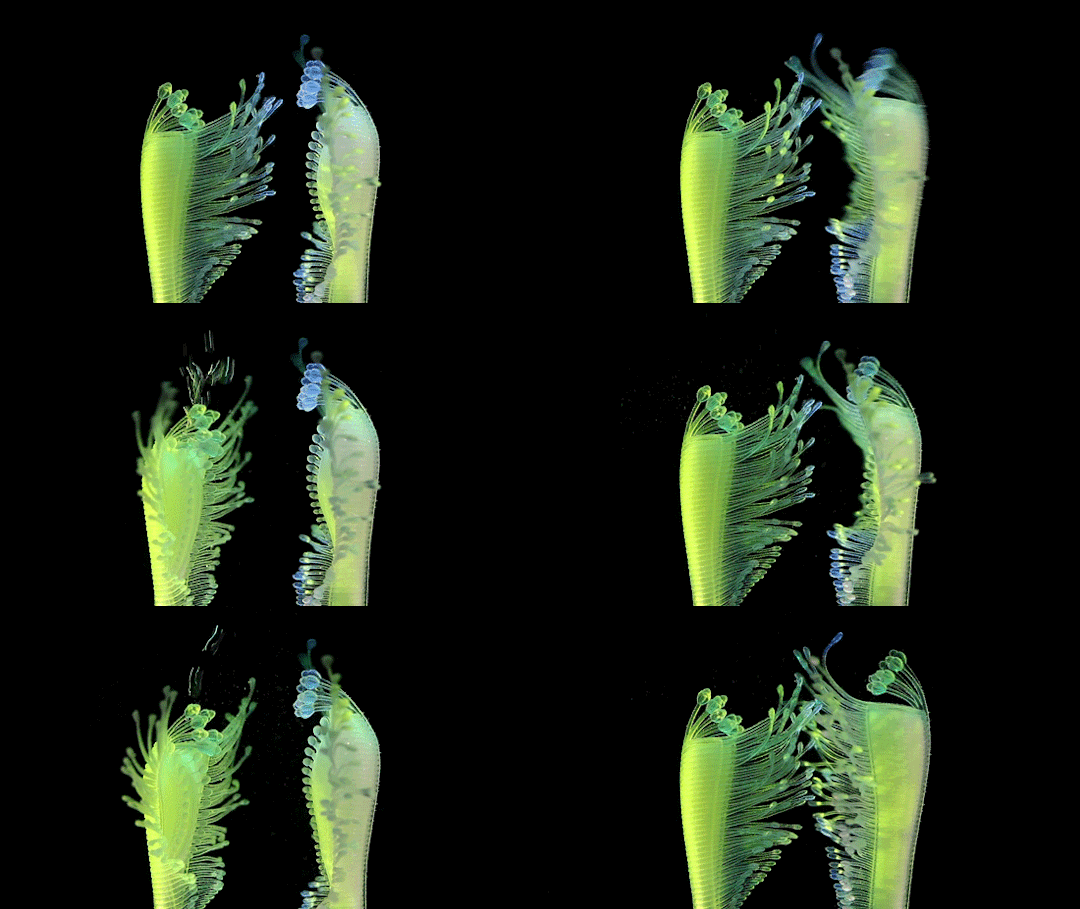
In “Liquid Calligraphy,” artist Rus Khasanov’s letters dissolve once he draws them. At first, the white ink spreads in narrow fingers, probably driven by a combination of surface tension gradients, capillary action, and simple diffusion. But then, in flashes, the letters morph faster and flow outward. My best guess is that each jump is a spray from a bottle full of a low surface tension liquid like alcohol. The spray triggers faster outflows than before, like those seen when a strong difference in surface tension activates the Marangoni effect. It’s a beautiful and different artistic take on these important fluid forces. Check out more of his videos here or enjoy high-resolution stills and wallpapers in this style from his Behance page. (Image and video credit: R. Khasanov; submitted by TBBQoC)
Search results for: “art”

Turbulence and Star Formation
Space, as I’ve discussed previously, is surprisingly full of matter, especially clouds of dust. And yet the rate of star formation we observe is bizarrely low; the Milky Way, for example, produces only about one solar mass worth of new stars every year. If gravity were the sole force driving star formation, we’d see far more stars forming. Recent research suggests that turbulence plays a major role in regulating the star formation process, both by countering gravity’s attempts to collapse gases into a proto-star and by creating supersonic shocks that drive material together to jump-start star formation. There seem to be other important ingredients as well: young stars tend to form jets that blow material back into the interstellar clouds they’re forming in, feeding the turbulent background. For more, check out Physics Today. (Image credit: ESA/NASA/Hubble/ESO, via APOD; research credit: C. Federrath)

The Coexistence of Order and Chaos
One of the great challenges in fluid dynamics is understanding how order gives way to chaos. Initially smooth and laminar flows often become disordered and turbulent. This video explores that transition in a new way using sound. Here’s what’s going on.

The first segment of the video shows a flat surface covered in small particles that can be moved by the flow. Initially, that flow is moving in right to left, then it reverses directions. The main flow continues switching back and forth in direction. This reversal tends to provoke unstable behaviors, like the Tollmien-Schlichting waves called out at 0:53. Typically, these perturbations in the flow start out extremely small and are difficult or even impossible to see by eye. So researchers take photos of the particles you see here and analyze them digitally. In particular, they are looking for subtle patterns in the flow, like a tendency for particles to clump together with a consistent spacing, or wavelength, between them. Normally, researchers would study these patterns using graphs known as spectra, but that’s where this video does something different.
Instead of representing these subtle patterns graphically, the researchers transformed those spectra into sound. They mapped the visual data to four octaves of C-major, which means that you can now hear the turbulence. When the audio track shifts from a pure note to an unsteady warble, you’re hearing the subtle disturbances in the flow, even when they’re too small for your eye to pick out.

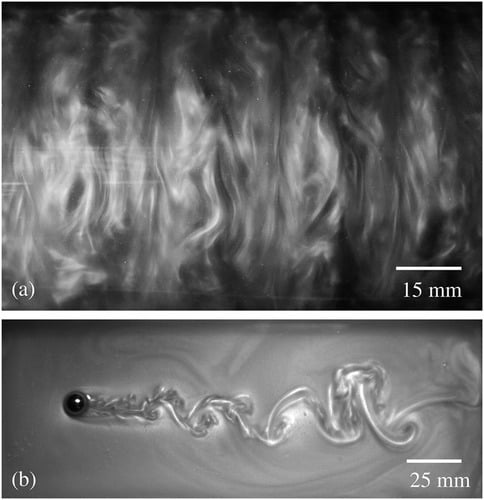
The last part of the video takes this technique and applies it to another flow. We again see a flat plate, but now it has a roughness element, like a tiny hockey puck, stuck to it. As the flow starts, we see and hear vortices form behind the roughness. Then a horseshoe-shaped vortex forms upstream of it. Aside from the area right around the roughness, this flow is still laminar. But then turbulence spreads from upstream, its fingers stretching left until it envelops the roughness element and its wake, making the music waver. (Video and image credit: P. Branson et al.)

Psychedelic Faraday Waves
Vibrate a pool of water and above a critical frequency, a pattern of standing waves will form on the surface. These are known as Faraday waves after Michael Faraday, who studied the phenomenon in the early half of the nineteenth century. The kaleidoscopic view of them you see here comes from photographer Linden Gledhill, who used a high-speed camera and an LED ring light reflecting off the water to capture the changing motions of the waves. The wave patterns oscillate at half the frequency of the driving vibration, and, as the driving frequency changes, the wave patterns shift dramatically. Higher frequencies create more complicated patterns. (Image and video credit: L. Gledhill)

Jupiter’s Swirls
Sometimes it amazes me that the Juno spacecraft was originally designed without any cameras onboard. The JunoCam instrument has produced stunning imagery of Jupiter thus far and shows no signs of stopping soon. The latest wonder is this false-color, high-contrast animation showing the motion of Jupiter’s clouds swirling and flowing past one another.
Now, this is not Jupiter as you would see it by eye. This animation is derived from two images taken 8 minutes and 41 seconds apart. In that time, Juno covered a lot of distance, so the two images had to be mathematically re-projected so that they appeared to be taken from the same location. Then, by comparing relative positions of recognizable features in the two photos and applying some understanding of fluid mechanics, observers could calculate the probable flow between those two states. Although this is a coarse example, it’s the same kind of technique often used in fluid dynamical experiments when measuring how flows change between two images. (Image credit: NASA/JPL/SwRI/MSSS/G. Eichstädt, source; via EuroPlanet; submitted by Kam-Yung Soh)

Using Air to Break Up Jets
One method of breaking a liquid into droplets, or atomizing it, uses a slow liquid jet surrounded by an annulus of fast-moving gas. The gas along the outside of the liquid shears it, creating waves that the wind blowing past can amplify. This draws the liquid into thin ligaments that then break into droplets. This is a popular technique in rocket engines, where cryogenic liquid fuels often need to be atomized for efficient combustion. When things aren’t working exactly right, however, the liquid jet may start flapping instead of breaking up. In this case, the jet will swing back and forth, but only part of it will atomize. For a rocket engine, this would mean slower and less efficient combustion – never desirable outcomes! (Image credit: A. Delon et al.)

Sandy Wrinkles
Water flowing back and forth over sand quickly forms a field of dune-like wrinkles. On the upstream side, the flow is a little faster, and it picks up grains of sand. When the flow slows on the downstream side of a bump, the sand gets deposited. In this way, small bumps in the sand continue growing larger. A similar process between wind and sand forms enormous dunes here on Earth and on Mars. These smaller water-driven wrinkles are very common in tidal areas and in sandy creeks. They can even build up and break down such that they create periodic waves that surge down the stream. (Image and video credit: amàco et al.)

“Water Ballet”
Artist Kamiel Rongen uses common substances like paint, oil, eggs, and even air freshener to create what he calls “water ballet.” His videos are full of ethereal and surreal landscapes full of color and motion. Buoyancy (or the lack thereof) plays a major role in his work – fluids often spurt upward like alien creatures emerging from a chrysalis. I’ve been debating with myself whether the fluids are actually rising or if they’re falling in front of an upside-down camera, and I’m not completely certain either way! I think that’s a testament both to Rongen’s artistry and to the awesome physics involved. Check out the full video below and you can see many more examples of Rongen’s work on his website. (Image and video credit: K. Rongen; h/t to James H.)

Kilauea’s Lava Lake
Hawaii’s Kilauea Volcano continues to erupt, sending magma flowing through multiple fissures. The U.S. Geological Survey has sounded a warning, however, that the volcano could erupt more explosively. Hot spot volcanoes like Hawaii’s generally have more basaltic lava, which has a lower viscosity than more silica-rich magmas like those seen on continental plates. That makes Hawaii’s volcanoes less prone to explosive detonations like the 1980 Mt. St. Helens eruption. With less viscous lava, there’s less likelihood of plugging a magma chamber and causing a deadly buildup of pressure from toxic gases.
But that doesn’t mean that there’s no risk. In particular, officials are concerned by the rapid draining of a lava lake near Kilauea’s summit. As illustrated below, if the lava level drops below the water table, that increases the likelihood of steam forming in the underground chambers through which lava flows. The rapid drainage has destabilized the walls around the lava lake, causing frequent rockfalls into the chamber. If those were to plug part of the chamber and cause a steam buildup, then there could be an explosive eruption that releases the pressure. To be clear: even if this were to happen, it would be nothing like the explosiveness of Mt. St. Helens. But it would include violent expulsions of rock and widespread ash-fall. (Image credits: USGS, source; via Gizmodo)


Dissolving Candy
In nature, solid surfaces often evolve over time in conjunction with the flows around them. This is how stalactites, canyons, and hoodoos all form and change over time. Here researchers examine a surface formed from hard candy that is dissolving from below. Over time, the initially flat surface develops a pitted appearance (top image, scale bar is 1 cm) with roughness that is approximately 1 mm in scale. Flow visualization (bottom row) suggests that these pits result from local flow where narrow, millimeter-sized dense plumes fall away from the surface.
As material dissolves from the candy, it forms a dense layer of sugar-water mixture near the solid surface. Once that layer grows to a critical thickness, it will be too unstable for viscosity to counter. At that point, the Rayleigh-Taylor instability takes over, causing the dense sugar-water layer to break up into narrow, sinking plumes. Although each area is evolving independently, the rate at which material dissolves is uniform everywhere, so the dissolving body retains the same shape over time. (Image and research credit: M. Davies Wykes et al., source)