Granular mixtures with particles of different sizes will often segregate themselves when flowing. In this half-filled rotating drum large red particles and smaller white ones create a stable petal-like pattern. As the drum turns, an avalanche of small particles flows down, forming each white petal. When the avalanche hits the drum wall, a second wave – one of the larger, red particles – flows uphill toward the center of the drum. If the uphill wave has enough time to reach the center of the drum before the next avalanche of smaller particles, then the petal pattern will be stable. Otherwise, the small particles will tend to fall between the larger ones, disturbing the pattern. (Image and research credit: I. Zuriguel et al., source; via reprint in J. Gray)
Search results for: “art”

The Challenges of Blowing Bubbles

Although every child has experience blowing soap bubbles with a wand, only in recent years have scientists dedicated study to this problem. It turns out to be a remarkably complex one, with subtleties that can depend on the size of the wand relative to the jet a bubble-blower makes as well as the speed at which the air impacts the film. A recent study found that, at low or
moderate speeds, the film takes on a stable, curved shape (top image), but once you increase to a critical speed, the film will overinflate and burst. The key to forming a bubble, the authors suggest, is hitting that critical speed only briefly; if you slow down before the film ruptures, then the bubble has a chance to disconnect and form a sphere without breaking.The work also suggests there are two reliable methods for bubble making in this way. One is to impulsively move the wand through the background fluid, as shown in the lower animation. The other is the one familiar to children: blow a jet just fast enough to overinflate the film, then let up so the bubble forms without breaking. (Image and research credit: L. Ganedi et al.; via Ars Technica; submitted by Kam-Yung Soh)

Breaking Up Drops
Lots of applications – from rocket engines to ink jet printing – require breaking large droplets into smaller ones, so there are many methods to do this. Some techniques rely on fluid instabilities, others use ultrasonic vibration. But one of the most effective methods may also be the simplest: placing a mesh between large drops and their target.
That’s the idea at the heart of this new study, which uses a wire mesh to break large droplets into a spray of finer ones 1000 times smaller. The target application is agricultural spraying, and the researchers argue that their method would allow farmers to treat their crops effectively with fewer chemicals and less run-off. Drops impacting the mesh form a narrow cone over the plant, and the smaller, slower droplets are better at sticking to the plant instead of bouncing away. They’re also less likely to injure crops, since they don’t disturb the leaves the way larger drops do. (Image and research credit: D. Soto et al.; via MIT News; submitted by Omar M.)

Foam and Flow
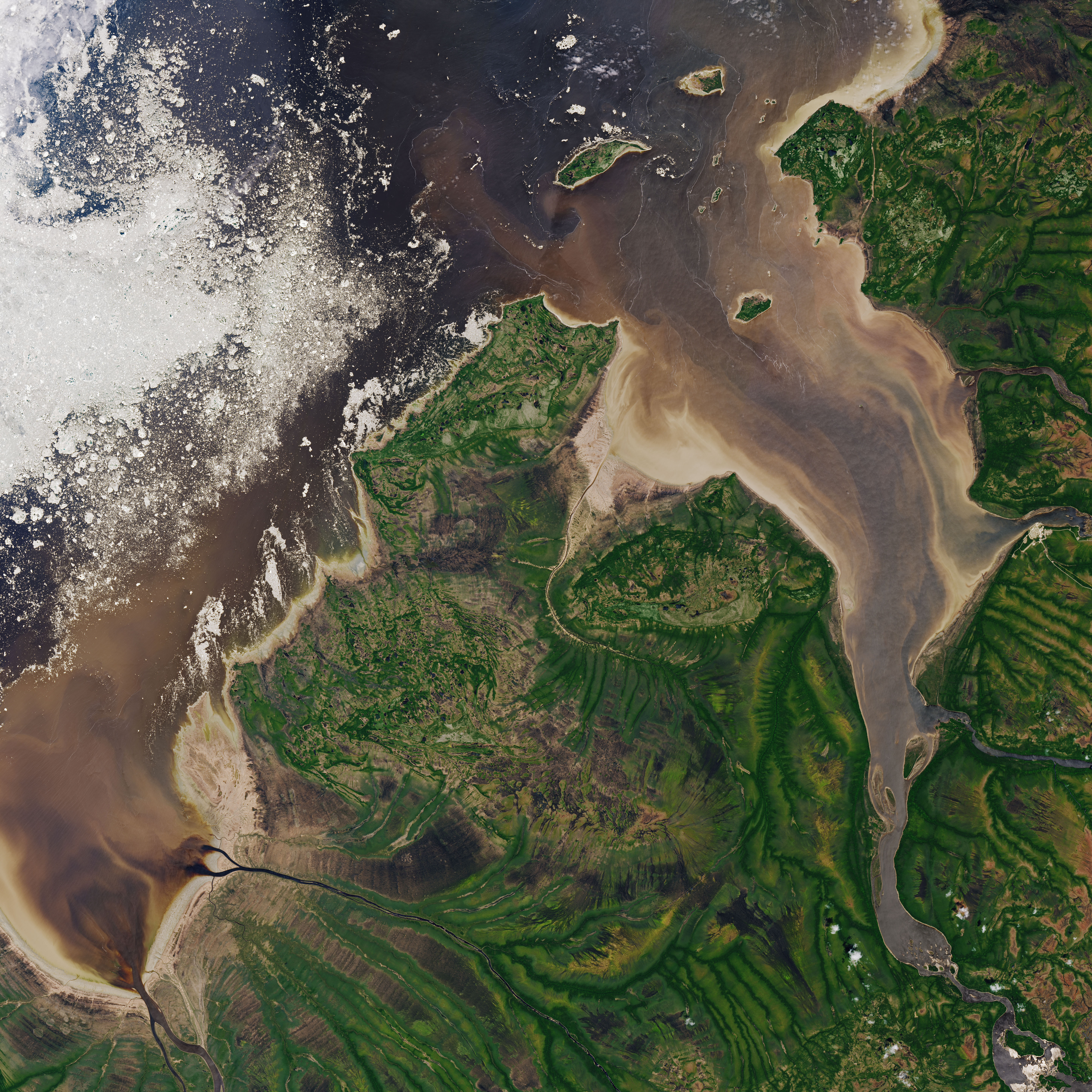
Fluid dynamics often play out on a scale that’s difficult to appreciate from our earthbound perspective, but fortunately, we have tools to aid us. This natural-color satellite image shows Rupert Bay in Quebec, where fresh water stained with sediments and organic matter (right) flows into the saltier water of James Bay (left). White filaments at the edges of these mixing regions are likely foam floating atop the water. The turbulence caused at the intersection of the two bodies of water whips up organic films to form bubbles. The white on the far left of the image is ice chunks still floating in James Bay when the image was taken in early June. Click through to admire the high-resolution version. (Image credit: U.S. Geological Survey; via NASA Earth Observatory)

Icy Penitentes
At high, dry altitudes, fields of snow transform into rows of narrow, blade-like formations as tall as 2 meters. Known as penitentes – due to their similarity to kneeling worshipers – these surreal snow sculptures form primarily due to solar reflection. Surrounded by dry air and intense sunlight, the snow tends to sublimate directly into water vapor rather than melt into water. This turns an initially flat snowfield into one randomly dotted with little depressions. The curved surface of those depressions helps reflect incoming sunlight, causing the indentations to grow deeper and deeper over time. Although the high Andes are best known for their penitentes, they form elsewhere as well. Recent work has even identified them on Pluto! (Image credit: G. Hüdepohl; research credit: M. Betterton)
Soap Film Filter
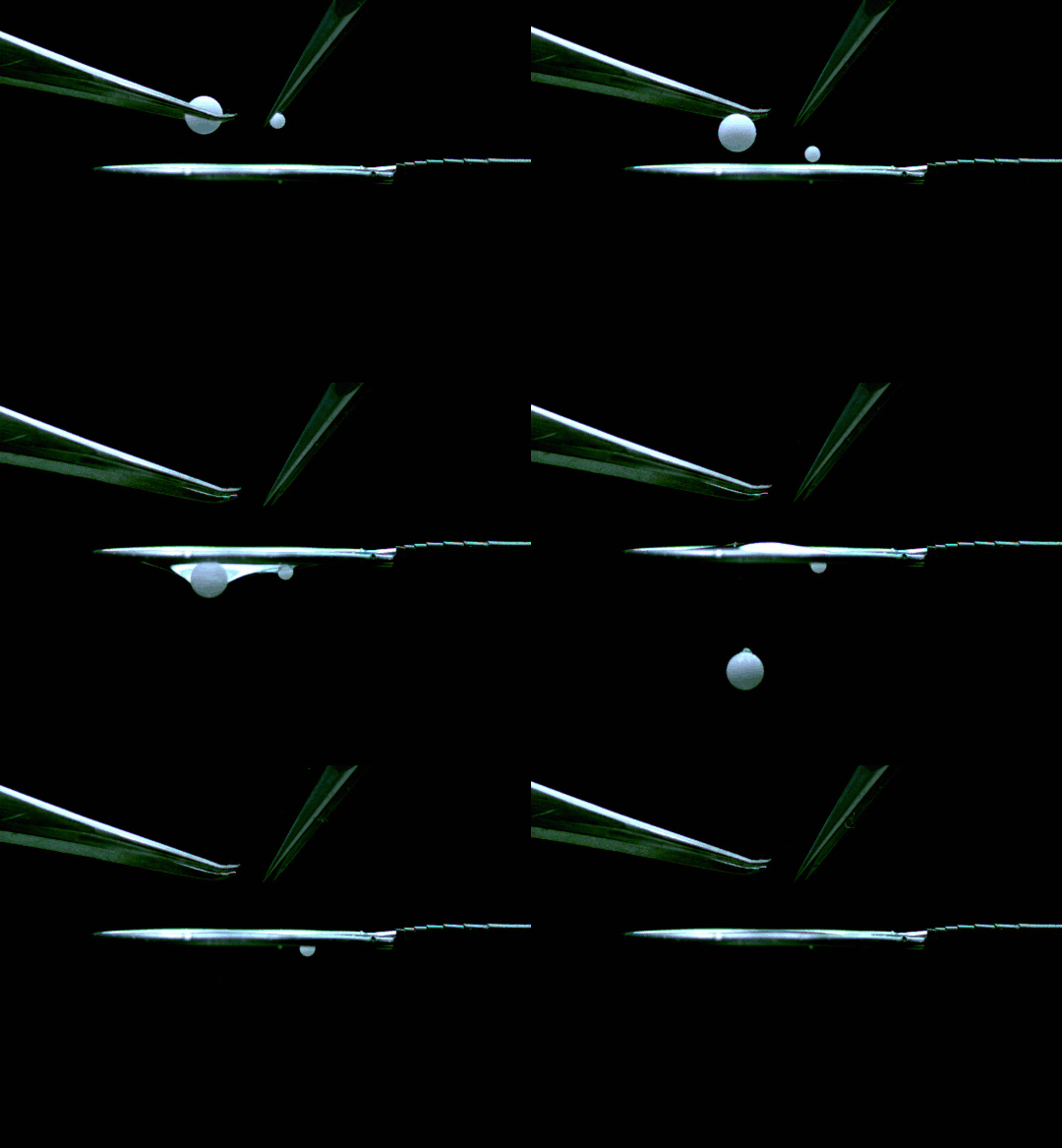
Inspired by the self-healing properties of soap films, scientists have created a liquid filter capable of trapping small particles while allowing larger ones to pass through. Instead of filtering particles by size, as conventional filters do, this liquid membrane filters particles by kinetic energy; only large, fast-moving objects pass through while slower and smaller ones get trapped. The membrane is a mixture of deionized water and sodium dodecyl sulfate, which allows researchers to finely tune the membrane’s surface tension and, therefore, how the filter behaves. Unlike soap films, the membrane is quite long-lived and robust. The team poked one for more than 3 hours without rupturing it.
The researchers envision some pretty neat applications for these membranes, including a surgical membrane that would keep out dust and bacteria while doctors work or a membrane in a waterless toilet that could trap odors inside. (Image and research credit: B. Stogin et al.; video credit: Science; submitted by Kam-Yung Soh)

Shock Waves in the Solar Wind
The empty space of our solar system is not truly empty, as we’ve discussed previously. For one, there’s a fast-moving flux of charged particles – the solar wind – that flows constantly from the Sun. Sometimes these solar wind particles encounter their interstellar equivalents – charged ions from outside our solar system – and exchange energy.
One predicted mechanism for this energy swap is a solar wind shock wave, which occurs when a faster-moving clump of charged particles plows into a slower-moving one. Scientists hypothesized in the mid 1990s that far from the Sun, solar wind shock waves would lose their energy by passing it to these interstellar ions, in a process known as pickup. Data from the New Horizons spacecraft has finally provided evidence for this theory.
In October 2015, instruments on the spacecraft recorded a shock wave when the speed of solar wind ions nearby jumped from 380 km/s to 440 km/s. Comparing the energies of solar and interstellar ions before and after the event, researchers found that interstellar pickup ions became 30% more energetic while solar ions lost 85% of their energy. It’s an important confirmation of theoretical predictions and should help us better understand high-energy particle physics at the edges of our solar system. (Image credit: NASA; research credit: E. Zirnstein et al., via J. Ouellette)
Different Kinds of Boiling

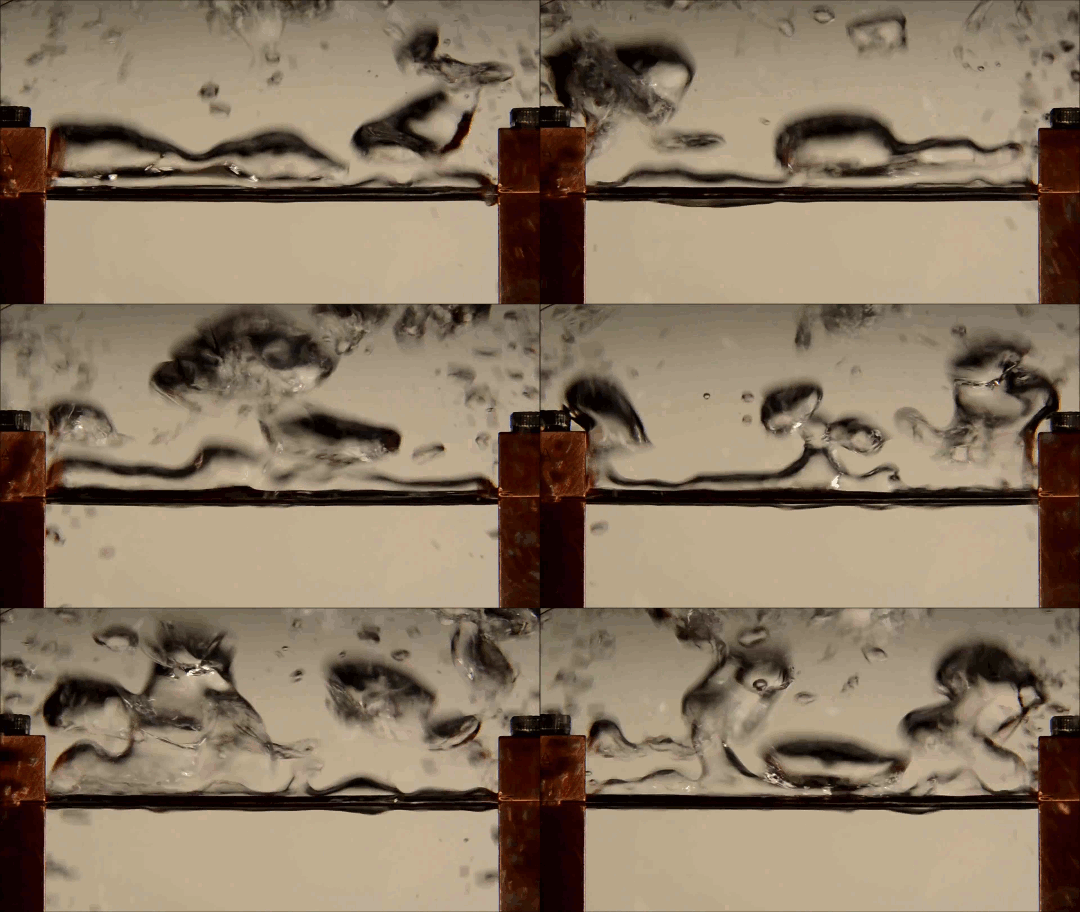
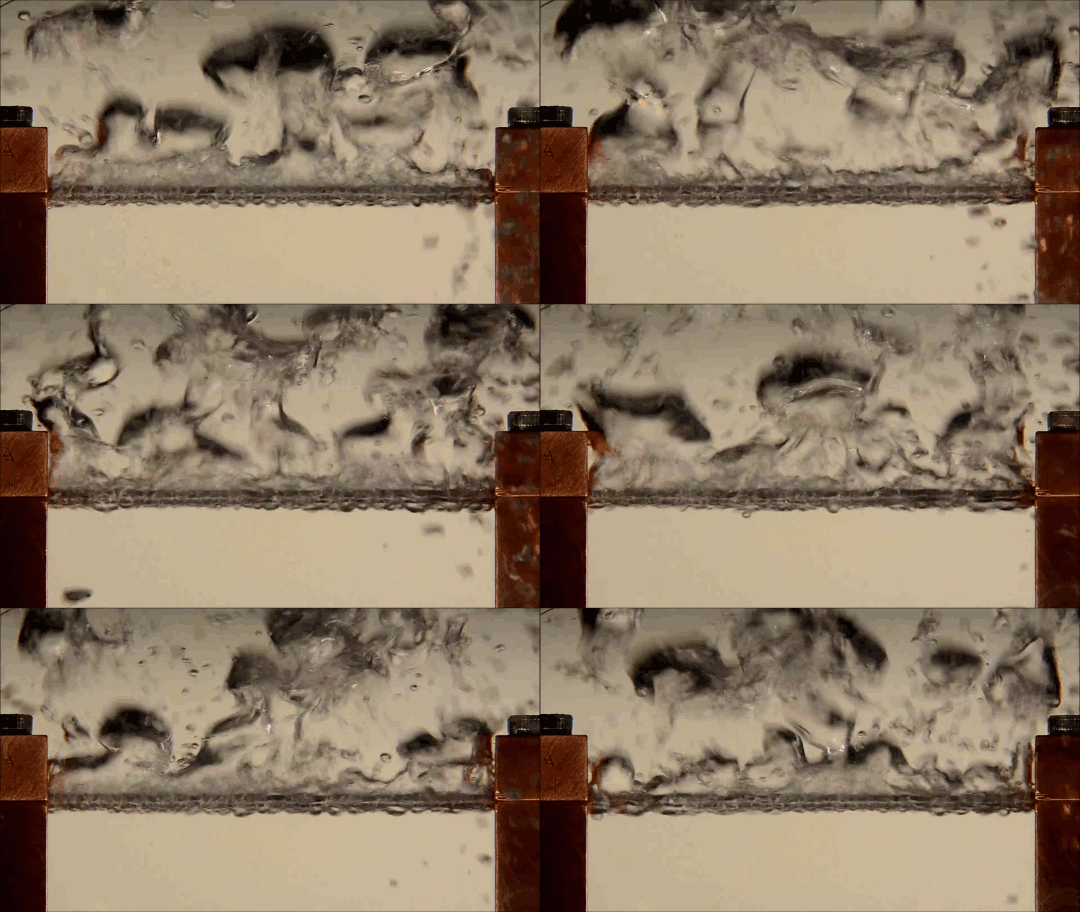
When you put a pot of water on to boil, you probably don’t give much thought to the process. In our daily lives, we pretty much only see one kind of boiling: the sort where lots of small bubbles form on a hot surface and then rise. That’s nucleate boiling (top image), and it’s typical when you have a surface close to the boiling point of a liquid.
But when you continue raising the temperature of the surface, you get a transition to a different boiling regime (middle image). In this final regime (bottom image), a film of vapor envelopes the heated surface; hence its name: film boiling. Because vapor is less efficient for heat transfer than a liquid, a surface undergoing film boiling can become much, much hotter because it cannot transfer its heat away efficiently. In this experiment, the tube starts at 375K during nucleate boiling and rises to a temperature nearly three times higher during film boiling. (Image credit: TSL, source)
Heating from Cavitation
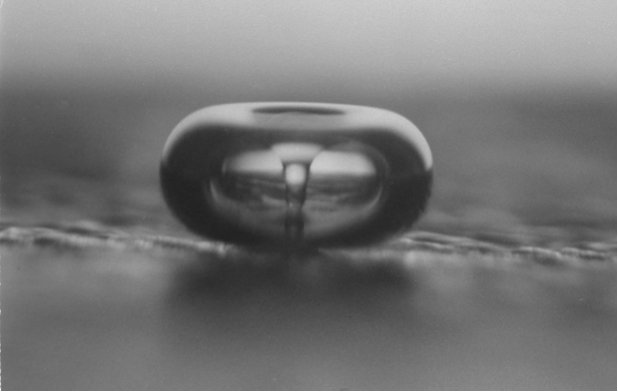
When cavitation bubbles collapse, they can produce temperatures well over 2,000 Kelvin. Since cavitation near a surface can be so destructive, researchers have long wondered whether the high temperatures inside the bubble can be transmitted to nearby surfaces. A new set of numerical simulations provides some insight into that process. The researchers found that collapsing cavitation bubbles raised nearby wall temperatures in two ways: bubbles that were further away sent shock waves that heated the material, and nearby bubbles could contact the surface itself as they collapsed.
Heat transfer requires time, however; this is part of why quickly dunking your hand in liquid nitrogen and pulling it out likely won’t damage you. (Still, we don’t recommend it.) The cavitation bubbles could only transmit these high temperatures for less than 1 microsecond, which means that most materials won’t actually heat up to their melting temperature. The researchers did conclude, however, that softer materials exposed to frequent bubble collapses could show localized melting under the barrage. (Image credit: L. Krum; research credit: S. Beig et al.)
Visualizing Aerosols
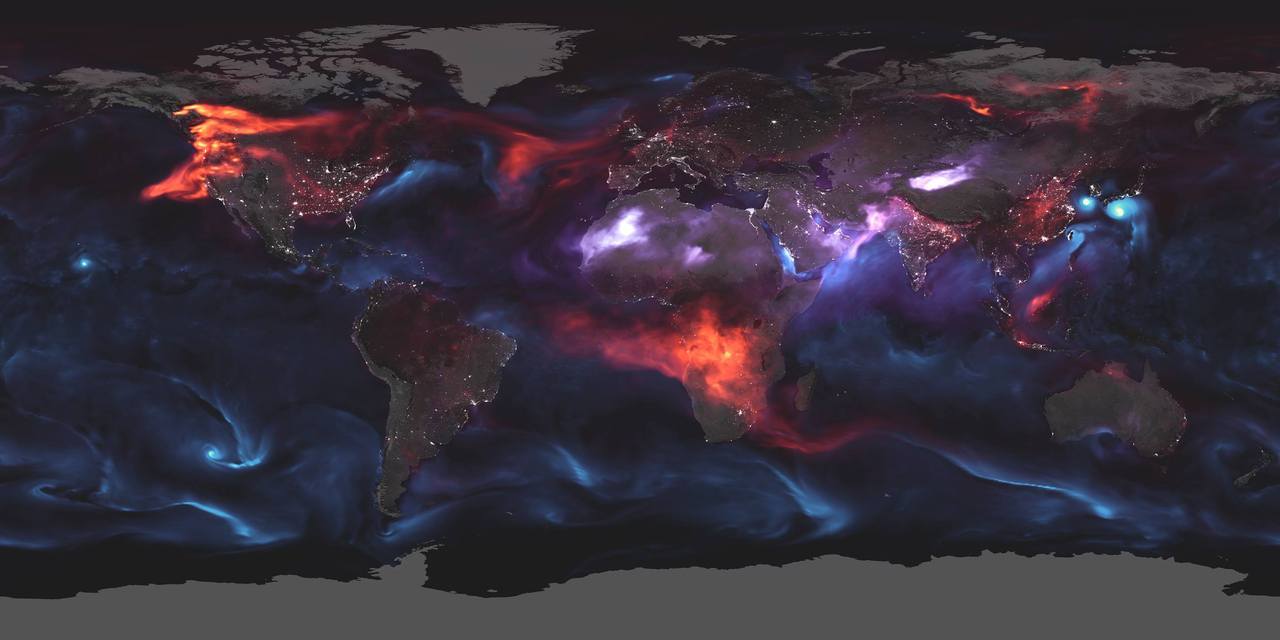
Aerosols, micron-sized particles suspended in the atmosphere, impact our weather and air quality. This visualization shows several varieties of aerosol as measured August 23rd, 2018 by satellite. The blue streaks are sea salt suspended in the air; the brightest highlights show three tropical cyclones in the Pacific. Purple marks dust. Strong winds across the Sahara Desert send large plumes of dust wafting eastward. Finally, the red areas show black carbon emissions. Raging wildfires across western North America are releasing large amounts of carbon, but vehicle and factory emissions are also significant sources. (Image credit: NASA; via Katherine G.)