In addition to looking outward, NASA constantly monitors our own planet using a suite of satellites. In this video, they visualize data taken by the Global Precipitation Measurement Core Observatory of Hurricane Maria two days before it hit Puerto Rico. Instruments on board the satellite measure both liquid and frozen precipitation, giving scientists – and now the public – a glimpse into the heart of a developing hurricane. Be sure to take a look around; it’s a 360-degree video, and I bet it’s even more spectacular in VR. Having a trove of data like this helps researchers better understand the processes that influence a strengthening hurricane, which ultimately allows them to make better predictions about hurricane behavior in order to save lives. (Video credit: NASA; via Francesco C.)
Search results for: “art”
A Splat is Born
One day calligrapher Mae Nguyen accidentally squeezed a droplet out of her waterbrush pen, and a fun, new technique was born. Nguyen sometimes uses the arrays of droplets to paint and other times blows on them to create colorful splatters, like in the video above. I’d love to see the latter technique, in particular, in slow motion! I expect there is some really cool mixing as the droplets coalesce. Check out more of Nguyen’s work on her website and Instagram account. (Video credit: M. Nguyen)

Solar Prominence
Near the surface of the sun, the interplay of magnetic fields and plasma flow creates solar prominences that appear to dance. The prominence shown here was recorded in 2012 by the NASA Solar Dynamics Observatory, and its arc is large enough to easily surround the Earth. This is fluid dynamics – specifically magnetohydrodynamics – on a scale difficult for us earthbound humans to imagine. Scientists are still working to understand the complex processes that drive flows like this one. Fortunately, we can appreciate their beauty regardless. (Image credit: NASA SDO, source; via APOD; submitted by jpshoer)
Stall with Pitching Foils
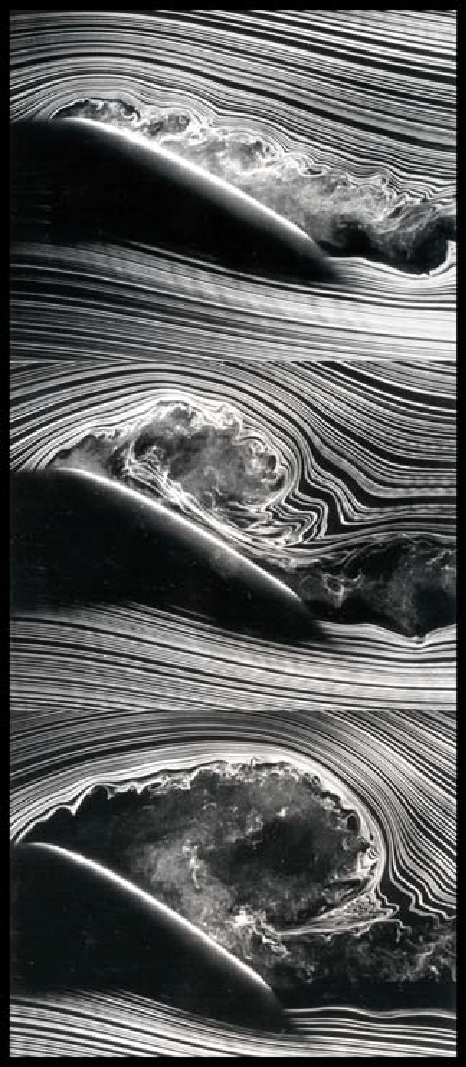
For a fixed-wing aircraft, stall – the point where airflow around the wing separates and lift is lost – is an enemy. It’s the precursor to a stomach-turning freefall for the airplane and its contents. But the story is rather different when the wing is actively pitching through these high angles of attack. In this case, you get what’s known as dynamic stall, illustrated in three consecutive snapshots above.
In the top image, the flow has clearly separated from the upper surface of the wing, but this isn’t a cause for panic. As the middle image shows, there’s a vortex that’s formed in that separated region and it’s moving backward along the wing as the angle of attack continues to increase. That vortex causes a strong low-pressure region on the upper surface of the wing, allowing it to maintain lift.
In the final image, the vortex is leaving the wing, taking its low-pressure zone with it. This is the point where the pitching wing loses its lift, but if the vortex’s departure is immediately followed by a pitch down to lower angles of attack, the aircraft will recover lift and carry on. (Image credit: S. Schreck and M. Robinson, source)
Phytoplankton Swirl
During the warm summer months, phytoplankton blooms pop up in waters around the world. This natural-color satellite image shows a bloom in the Gulf of Finland. The tiny phytoplankton serve as tracker particles for the flow, revealing large-scale features like the spectacular vortex in the center of this image. The presence of the phytoplankton here suggests that this vortex could be pumping nutrients up from the deep.
Researchers also use particles for flow visualization. This can be as simple as adding small, neutrally buoyant particles, illuminating smoke, or even using natural snowfall to see what’s happening in the flow. (Image credit: NASA/USGS/J. Stevens/L. Dauphin)

Oobleck Under Impact
Fluids like air and water are Newtonian, which means that the way they deform does not depend on how the force on them gets applied. Many other fluids, however, are non-Newtonian. How they behave depends on how force is applied to them. The Internet’s favorite non-Newtonian fluid is probably oobleck, a mixture of cornstarch and water with some fairly extreme properties. When deformed quickly, like when struck with a bat, oobleck doesn’t flow; it shatters.
What’s happening at the microscopic level is that the cornstarch particles in the oobleck are jamming together. They simply cannot move quickly and avoid one another. When they jam together, the friction between them goes way up and so does the apparent viscosity of the oobleck. Because it doesn’t have time to flow, all that energy goes into breaking off “solid” chunks instead. Once they hit the ground, the pieces of oobleck will puddle, just like any other liquid. (Image and video credit: Beyond the Press; via Nerdist)

Flying on Flexible Wings


Bats are incredible and rather unique among today’s fliers. Like birds, they flap to produce their lift and thrust, but where birds have relatively stiff wings, a bat’s wings are flexible. The thin webbing of skin stretched between the bat’s finger joints has muscles inside it that fire as the mammal flaps. This means that the bat may actively control just how stiff its wing is as it flies.
Compared to other natural and manmade fliers, the bat is incredibly agile and stable, able to recover from wind gusts in less than a full wingbeat cycle. They also have some incredible acrobatic capabilities. When preparing to perch, a bat loses almost all of its aerodynamic lift but still manages to maneuver itself so it flips over and grabs hold. Check out the full video above to learn more about these fascinating animals. (Video and image credit: Science Friday; research credit: S. Swartz and K. Breuer)
Editor’s Note: I’ll be travelling through the end of the month with limited email access. The blog should continue posting uninterrupted, but if you contact me, just know it may be awhile before I can get back to you. Thanks! – Nicole

Inside Avalanches
Avalanches have traditionally been difficult to model and predict because of their complex nature. In the case of a slab avalanche, the sort often triggered by a lone skier or hiker, there is a layer of dense, cohesive snow atop a layer of weaker, porous snow. The presence of the skier can destabilize that inner layer, causing a fracture known as an anticrack to propagate through the slab. Eventually, it collapses under the weight of the overlying snow and an avalanche occurs.
What makes this so complicated is that the snow behaves as both a solid – during the initial fracturing – and as a fluid – during the flow of the avalanche. Researchers are making progress, though, using new models capable of simulating the full event (shown above) by leveraging techniques developed and used in computer animation for films. That’s right – the physics-based animation used in films like Frozen is helping researchers understand and predict actual avalanche physics! (Image and research credit: J. Gaume et al.; via Penn Engineering; submitted by Kam-Yung Soh)

Merging Black Holes
At the heart of many galaxies, including our own, lies a supermassive black hole millions of times the mass of our sun. Scientists have yet to observe the merger of two such black holes, but using simulations, they are trying to learn what such collisions might look like. Simulations like the one shown here require combining relativity, electromagnetism, and, yes, fluid dynamics to capture what happens during the in-spiral.
Supermassive black holes like these are surrounded by gas disks that flow around them. Magnetic and gravitational forces heat the gas, causing it to emit UV light and, at times, high energy X-rays, both of which may be observable.
Gravitational wave detectors, similar to LIGO, may also measure evidence of supermassive black hole mergers, but physicists expect that will require a next-generation observatory, like the space-based LISA to be launched in the 2030s. (Image and video credit: NASA Goddard; research credit: S. d’Ascoli et al.; submitted by @lh7)
The Actual Shape of Raindrops
If you imagine the shape of a raindrop, you probably think of a tear drop shape, but the reality of rain is much more complicated. It’s Okay to Be Smart has a great primer on the subject that takes a look at the forces on a raindrop and shows you the actual shape they take, which depends largely on their size.
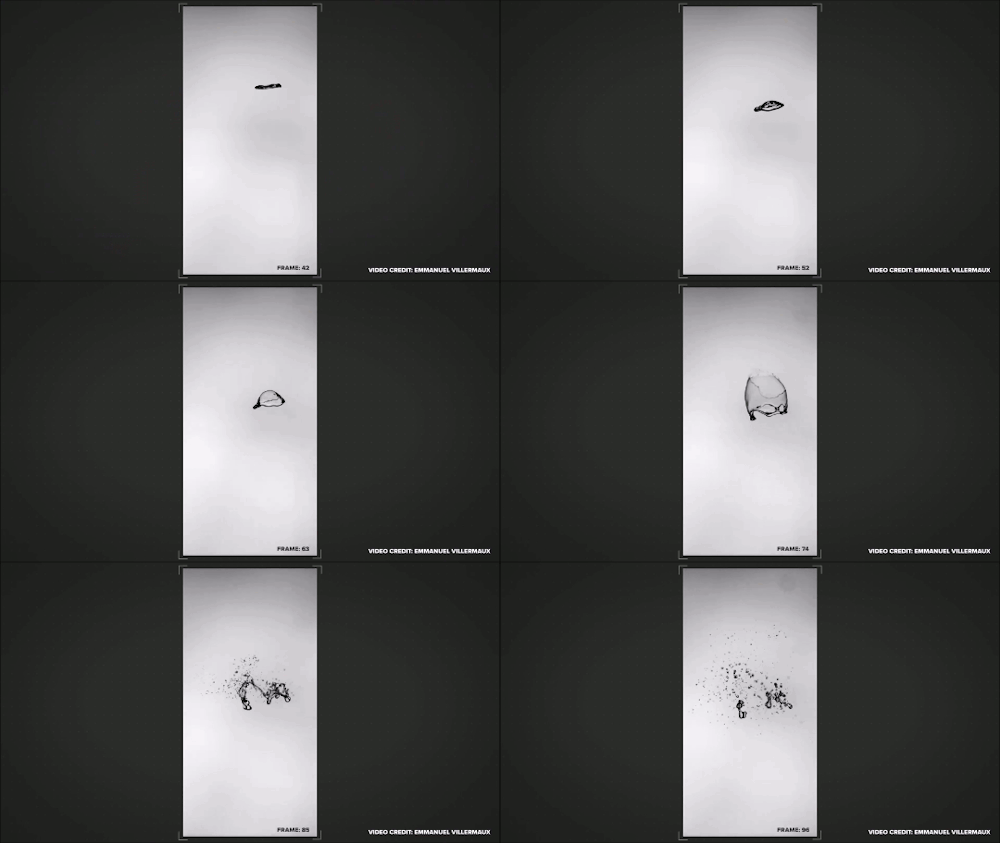
Small raindrops tend to coalesce together over time and get larger and progressively flatter. When the drop’s volume gets too large (below), it balloons up like a parachute. Researchers call this a bag. Stretched into a film, the drop’s surface tension is no longer able to win its fight against aerodynamic forces, and the drop shreds into smaller droplets. (Video and image credit: It’s Okay to Be Smart)