
Antibubbles are peculiar and ephemeral creations. A bubble typically encloses a gas within a thin layer of fluid. As the name suggests, an antibubble does the opposite: it’s a thin film of gas enclosing a liquid droplet within a larger background liquid. That thin gas film makes antibubbles extremely delicate. Disturb it at all – as the thinning jet at the top of the animation above does – and that film will break apart, much like a soap bubble. To see more antibubble action, check out some of our previous entries, including antibubbles in a vortex and a simple way to create antibubbles. (Image credit: C. Kalelkar and S. Phansalkar, source)
Search results for: “art”

Why Fish Don’t Freeze
Have you ever wondered why it is that fish in a pond or lake don’t freeze during the winter? The secret is due to a peculiarity of water that’s vital for life here on Earth. In general, cold things are denser than warmer ones. This is why, for the most part, cold fluids tend to sink and warmer ones rise here on Earth. So as fall moves into winter and water near the surface of a pond cools, it sinks. But only to a point.
Water is at its densest at 4 degrees Celsius. Any colder and the water will actually expand and become less dense. This is why you can’t fill ice cube trays to the very top before putting them in the freezer. In the pond it means that buoyant convection shuts down at 4 degrees Celsius. When the water at the top keeps cooling down to the freezing point, it doesn’t sink. Instead, the fish and other pond life get to spend the winter at a chill – but not freezing – 4 degrees. (Video credit: A. Fillo)

Bringing the Stars Home
One of my favorite aspects of fluid dynamics is the way that the same patterns and phenomena appear over and over again – sometimes in the most unexpected places. That’s the theme of my new article in American Scientist, which focuses on the connections between our daily lives and the stars:
“Solar energy arises from nuclear fusion reactions in the core, but that energy is buried hundreds of thousands of kilometers beneath the surface, and most of the Sun’s overlying gas is nearly opaque; it hinders light from passing through, like a blanket thrown over a flashlight. Clearly the Sun does shine—but how? For the answer, you can simply go to your kitchen, fill a kettle, and flip on a burner.” #
Click-through to read the full article. (Image credit: N. Sharp, Big Bear Solar Observatory, J. Blom, NASA/ESA, J. Straccia, NASA/JPL/B. Jonsson)
The Jumping Flea
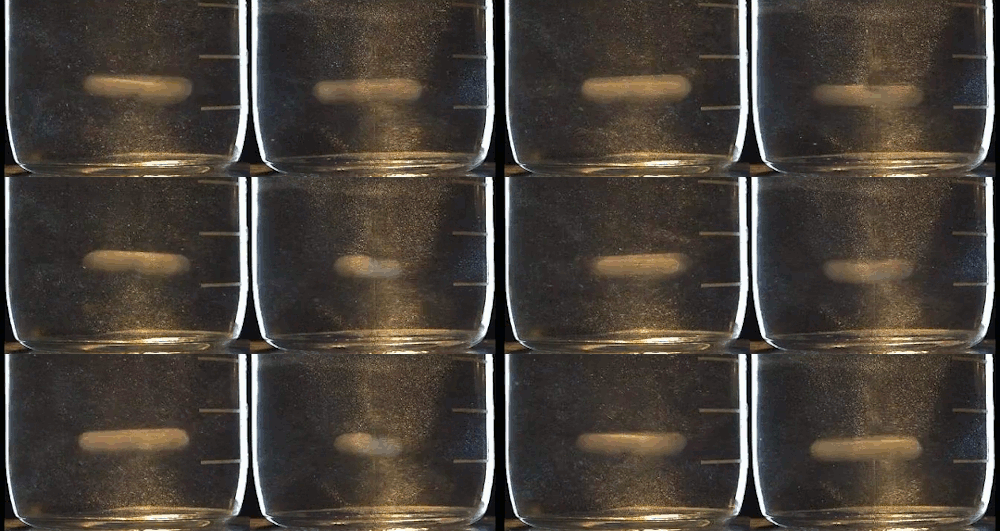
Nearly every lab has a magnetic stirrer for mixing fluids, but this ubiquitous tool still holds some surprises, like its ability to unexpectedly levitate. Magnetic stirrers consist of two main parts, a driving magnet that creates a rotating magnetic field, and a bar magnet – commonly referred to as the flea – that is submerged in the fluid to be stirred. When the driver’s rotating field is active, the flea will spin at the bottom of its container, keeping its magnetic field in sync with the driver.
But if you place the flea in a viscous enough fluid, the drag forces on the flea can pull it out of sync with the driver’s field. Above a certain speed, the flea will jump so that its field repulses the driver’s. That makes the flea levitate as it spins. Depending on the interplay of viscous and magnetic forces, that spin can be unstable (left) or stable (right). The researchers suggest that this peculiar behavior could help artificial swimmers propel themselves or lead to new methods for measuring fluid viscosity. (Image and research credit: K. Baldwin et al.; via APS; submitted by Kam-Yung Soh)

Zones and Stars
Large-scale rotating flows, like planetary atmospheres, tend to organize themselves into zones. Within a zone, flow remains essentially in an east-west direction and serves as a barrier that keeps heat or other elements from mixing from one zone to another. This is, for example, how the tropical trade winds work here on Earth.
Stars, on the other hand, don’t show this kind of zonal behavior. The reason, it turns out, is their magnetic fields. When there’s no magnetic influence, even weak shear in a rotating flow is enough to start organizing turbulent fluctuations and grow a zonal flow. This tendency toward growth is known as the zonostrophic instability. But when you add a magnetic field, instead of organizing the hydrodynamic disturbances, that weak shear strengthens the magnetic ones, which in turn suppress the flow fluctuations. As a result, the hydrodynamic disturbances cannot grow and no zonal flow forms.
Researchers think this mechanism can explain both why stars have no zonal flows and just how deep zones can penetrate inside the atmospheres of gas giants like Jupiter and Saturn before their planet’s magnetic field suppresses them. (Image credit: NASA; research credit: N. Constantinou and J. Parker, arXiv; via LLNL News; submitted by Stephanie N.)

Swirling the Wrong Way
When you swirl wine, you create a rotating wave that travels in the direction that you’re moving the glass. You would expect that anything floating atop that fluid would travel in the same direction of rotation. But it turns out, for a large, thin raft floating atop the rotating fluid, that’s not the case.
Above you can see a swirling container, rotating counter-clockwise, with a raft of foam. This is from a timelapse where only one photo is taken per rotation, so that it’s easier to see how the foam is rotating relative to the container. And, once enough foam covers the surface, it starts rotating in a clockwise direction – opposite the container! It works for more than foam, too. The researchers show that the same holds for powders or beads. The key to the counter-rotation is that the raft needs to be coherent; it has to be able to transmit friction and internal stress among its constituents. Otherwise, the raft will just drift along with the swirling wave. (Image and research credit: F. Moisy et al., source, arXiv; via Improbable Research; submitted by David H. and Kam-Yung Soh)
“Volumes”

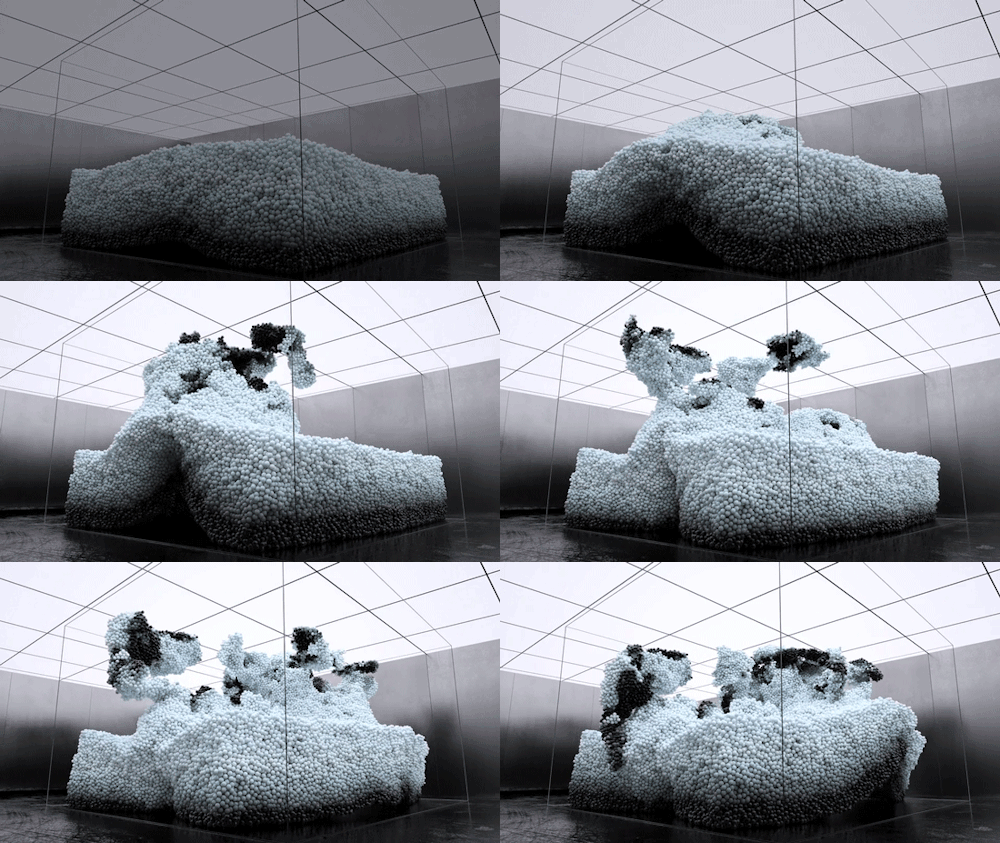
“Volumes” is an experimental art film by Maxim Zhestkov using physics-based particle animation. Waves and unseen forces send billions of color-changing particles aloft in the film. The motions – especially the way the particles seem to tear themselves – are reminiscent of a complex fluid, like yogurt. These substances have both liquid-like (viscous) and solid-like (elastic) properties depending on the forces they experience. Zhestkov’s particles are similar; they move like a fluid but tear more like a solid.
I particularly like the sequence beginning at 1:30. The upwelling of particles leaves behind a lower layer that looks like a snapshot of convection in a planetary mantle while the upper layer resembles the clash of ocean waves. The whole film is quite mesmerizing. Check it out! (Video and image credit: M. Zhestkov; GIFs via Colossal)

Using Paper to Avoid Splashback


Daily life and countless pool parties have taught us all that objects falling into water create a splash. Sometimes that splash is undesirable, and while there are many ways to tune a splash – by adding surfactants or changing the fluid’s viscosity – there’s a relatively common one that’s escaped scientific study until now. Researchers looked at how splashes change when you add a thin, penetrable fabric – commonly known as toilet paper – to the water surface.
Now, the common assumption is that adding a sheet of toilet paper can prevent splashback, but the story is not quite that simple. On the left, you see a splash generated without toilet paper. Because the ball is hydrophilic (water-loving), it does not pull any air into a cavity as it passes. There’s a nice axisymmetric Worthington jet formed, and it doesn’t splash very high, although some of the satellite droplets go quite a bit higher.
On the right, we see a splash with a single sheet of toilet paper. In this case, the impact of the sphere penetrates the paper, and the way the paper deforms causes air to get sucked down into a cavity behind the ball. That creates a wider, amorphous jet that rebounds higher than the jet in clean water, though it does not shed satellite drops.
The researchers found that single and even double sheets of toilet paper can actually increase the height of the splash jet if the object penetrates them. The hole the object makes actually helps focus the jet. Adding a couple more layers, though, can eliminate splashing completely. (Image and research credit: D. Watson et al.)

The Protection of the Peloton

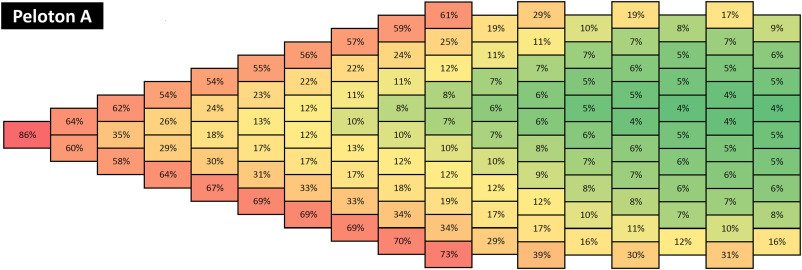
It’s well-known by professional cyclists that sitting in the middle of the peloton requires little effort to overcome aerodynamic drag, but now, for the first time, there’s a scientific study to back that up. Researchers built their own quarter-scale peloton of 121 riders to investigate the aerodynamic effect of cycling in such a large group versus riding solo. Through wind tunnel studies and numerical simulation, they found that riders deep in the peloton can experience as little as 5-10% of the aerodynamic drag of a solo cyclist.
Tactically, this means teams should aim to position their protected leader or sprinter mid-way in the pack, where they’ll receive lots of shelter without risking one of the crashes common near the back of the peloton. It also suggests that teams wanting to isolate another team’s leader should try to push them toward the outer edges of the peloton rather than letting them sit in the middle. It will be interesting to see whether pro teams shift their race strategies at all with these numbers in hand.
Of course, this study considers only a pure headwind. But other groups are looking at the effects of side winds on cyclists. (Image credit: J. Miranda; image and research credit: B. Blocken et al.; submitted by 1307phaezr)

Reducing Viscosity With Bacteria
Conventional wisdom – and the Second Law of Thermodynamics – require all fluids to have viscosity, with the noted and bizarre exception of superfluids, which can flow with zero viscosity. In essence, you cannot have work (i.e. flow) for free. Some effort has to be lost to resistance.
But scientists have discovered, bizarrely, that adding bacteria to water can result in zero or even negative viscosities – meaning that effort is required to keep the flow from accelerating. Before you ask, no, this is not a recipe for a perpetual motion machine. What happens when the bacteria-filled fluid is sheared is that the bacteria align and start collectively swimming. The local effects of each bacteria combine en masse to create a fluid that seemingly flows on its own. In the end, though, it’s the bacteria that are supplying that work. It certainly raises interesting prospects, though, for harnessing the power of bacterial superfluids. See the links below for more. (Image credit: M. Copeland, source; research credit: S. Guo et al., A. Loisy et al.; via Quanta; submitted by Kam-Yung Soh)