Search results for: “art”

  • Swirling Blooms

    Swirling Blooms

    Every summer, as the ice melts, the waters of the Chukchi Sea off the Alaskan coast come alive with phytoplankton blooms. In satellite images like this one, they can look like abstract paintings formed from swirling colors. In the Chukchi Sea, two main currents collide. One, water from the Bering Sea, is cold, salty, and nutrient-rich. This is the preferred home to phytoplankton known as diatoms, which are responsible for some of the greenish hues seen here.

    Coccolithophores, another variety of phytoplankton, prefer the warmer, less salty Alaskan coastal waters. Despite a relative lack of nutrients, the  coccolithophores thrive, creating the milky turquoise color seen in the image. Knowing these characteristics of the phytoplankton, observing the growth of blooms over time may tell scientists about how the flows in these areas shift and change from year to year. (Image credit: NASA; via NASA Earth Observatory)

  • Pyrocumulus on the Horizon

    The Cranston wildfire in California is intense enough that it’s creating its own weather. This timelapse video shows the formation and growth of a pyrocumulus cloud, also associated with volcanoes, over the wildfire. In both instances, the extreme heat causes a massive column of hot, turbulent air to rise. Because ash and smoke are carried upward as well, there are many places for any moisture in the atmosphere to nucleate, forming the cloud we see. In timelapse, the roiling nature of the air’s motion is especially apparent. This turbulence can be dangerous, as it may contribute to high winds and even lightning, both of which can spread the fire further. (Video credit: J. Morris; via James H.)

  • Featured Video Play Icon

    What Keeps a Foam Intact

    Beer, soda, soap, meringue – foams are everywhere in our lives. But have you ever wondered why some foams disappear so quickly while whipped egg whites stick around? That’s the subject of this Gastrofisica video, which is in Spanish but has English captions.

    Foams form when air gets introduced into a liquid, but for those bubbles to stick around, they need a certain special something. With soapy water, that ingredient is surfactants, molecules with both hydrophobic (water-fearing) and hydrophilic (water-loving) ends, which line up at the interface of the foam and help hold it together. But surfactants are relatively weak, especially compared to to the albumin proteins in an egg white. By whipping egg whites, you’re effectively untangling those proteins, and, like surfactants, they line up at the interface of the foam so that their hydrophobic and hydrophilic parts can hang out in their preferred mediums. With so many similar molecules crowded together, the proteins coagulate, adding extra strength and stiffness to your whipped egg whites. (Video and image credit: Tippe Top Physics; h/t to MinutePhysics)

  • A Viscous Splash

    A Viscous Splash

    The splash of a drop may be commonplace, but it is still a mesmerizing and fertile phenomenon. When it comes to splashing, scientists are still learning how to predict the outcome. Here a drop of silicon oil impacts a film of silicon oil with an even higher viscosity. The momentum of that impact creates a crater and a splash curtain that rises and expands from the initial point of impact. Because the film viscosity is higher than the drop’s, the evolution of the corona slows down. Eventually, surface tension and gravity start pulling the splash curtain back down as the crater collapses. Meanwhile at the top of the splash, capillary forces pull fluid into the rim, which becomes unstable and grows cusps that eventually eject a cloud of smaller droplets. (Image and research credit: H. Kittel et al., source)

  • Featured Video Play Icon

    The Kaye Effect

    Allow a stream of shampoo to fall into a pile and you’ll catch a glimpse of the bizarre Kaye effect. A jet of shampoo will briefly rise up before becoming chaotic and falling. The key to this behavior is the shear-thinning of the shampoo. When the shampoo is just sitting on a surface, it’s quite viscous, but slide your hand across it, and the shampoo will become much less resistant to flowing.

    When the jet of falling shampoo hits the pile, it creates a little dimple. Sometimes the incoming jet hits that dimple and slips along it, thanks to a sudden decrease in viscosity. That can send an outgoing jet of shampoo riding off the dimple like a ramp. As the dimple deepens, the outgoing streamer rises up until it hits the incoming jet and becomes unstable. The shampoo streamer collapses, only to be restarted when a new dimple forms. (Image and video credit: S. Mould; h/t to Guillaume D.)

  • When Sound Makes You Vertiginous

    When Sound Makes You Vertiginous

    For some people, a musical tone is enough to induce vertigo and feelings of being drunk. These individuals often have a small hole or defect in the bone that surrounds the canals of the inner ear. Normally, the fluid inside these canals reacts when we rotate our heads, triggering a counterrotation of our eyes that helps stabilize the image on our retinas. But when there’s a defect in the bone surrounding the canal, certain acoustic tones may pump that fluid directly. The patient’s eyes then try to correct for a rotation that’s not occurring, thereby inducing dizziness and vertigo. (Image credit: M. Moiner; research credit: M. Iversen et al.; submitted by Marc A.)

  • Manipulating Droplets Remotely

    Manipulating Droplets Remotely

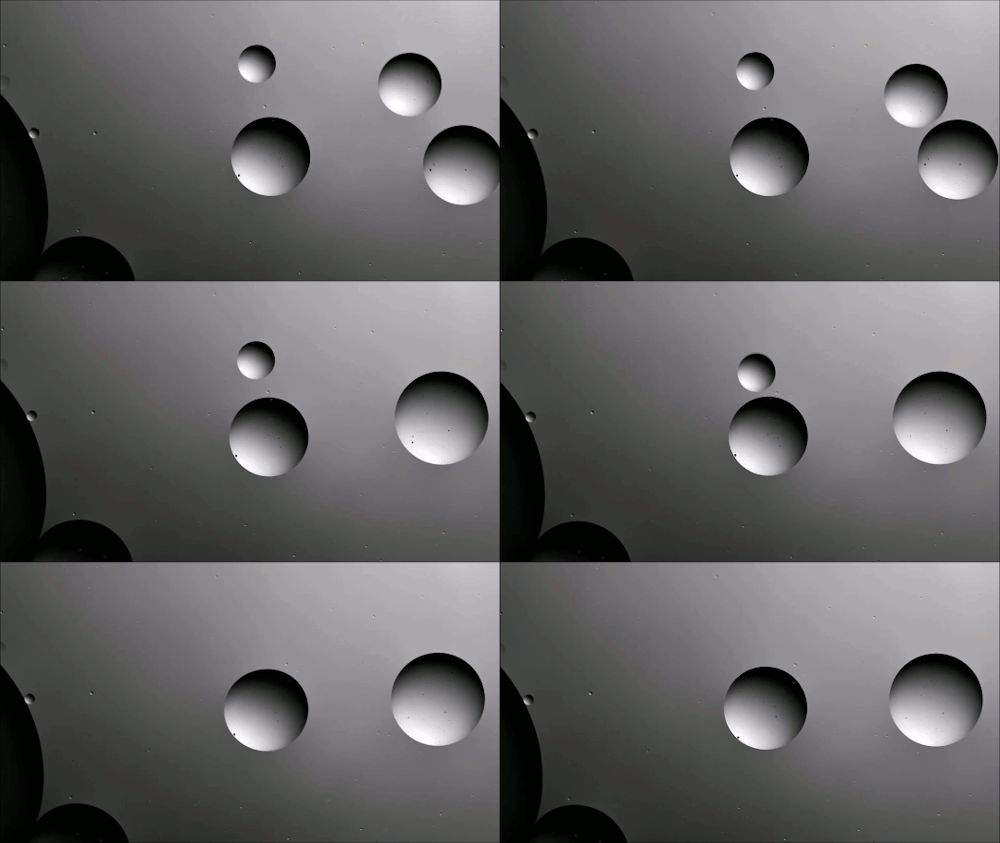
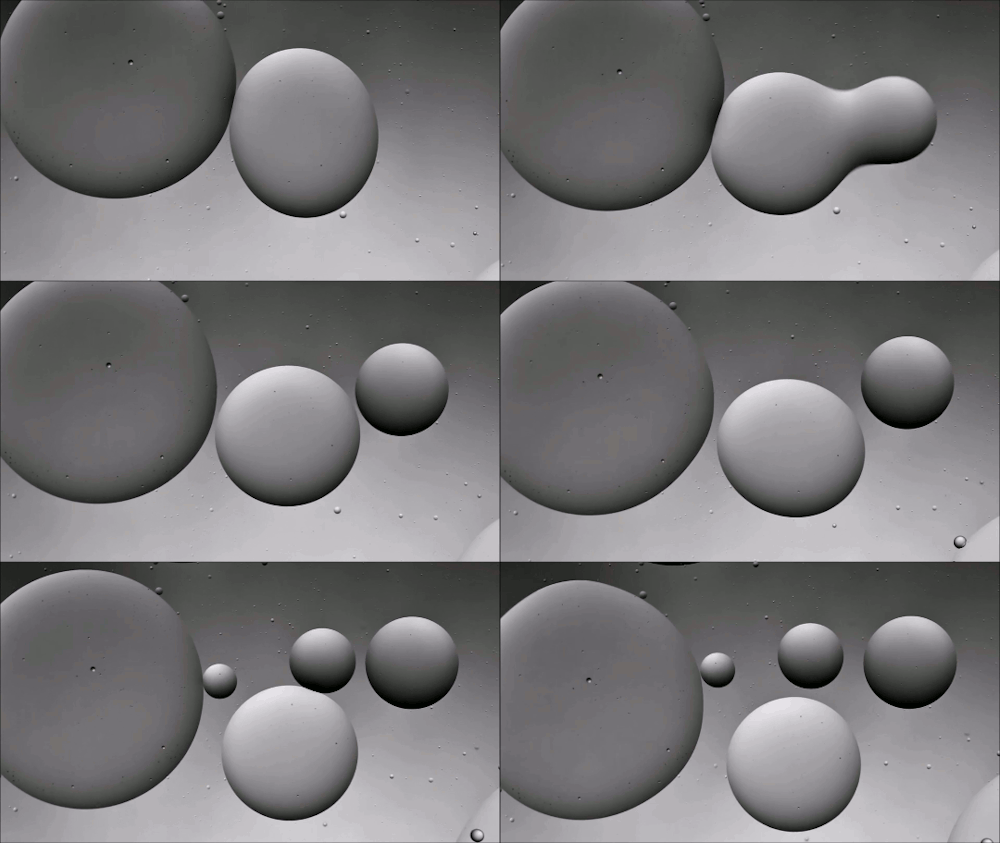
    Using acoustic levitation and an array of carefully-placed speakers, researchers can manipulate droplets without touching them. This lets scientists study the physics of droplet coalescence (top) without interference from solid surfaces, but it also provides opportunities for mixing two different substances in the final droplet. 

    On the bottom left, we see a droplet formed from the coalescence of a dyed droplet (visible as gray) and an undyed droplet. The swirling and mixing in the levitating droplet is fairly slow. By contrast, the droplet on the right is vibrated by manipulating the sound waves holding it aloft. This mixes the droplet quite efficiently, allowing it to reach a uniform state more than six times faster than the other droplet. (Image and research credit: A. Watanabe et al., source)

  • Meteoroids

    Meteoroids

    Meteoroids are debris from earlier eras in our solar system. They can be leftovers from planets that never formed or remains of ancient collisions. When these bits rock and metal enter our atmosphere, they become meteors. Since they travel at speeds of several kilometers per second, they create incredibly strong shock waves off their bow once they’re in the atmosphere. These shock waves are so strong that they rip the air molecules apart and create a hot plasma that can scorch the outside of the meteor. That plasma also glows, which is why meteors look like a streak of light from the ground. Any remains that make it to the ground are known as meteorites, and they have some pretty awesome features. Check out the full Brain Scoop episode below to learn some of the typical (and not so typical!) characteristics of meteorites. (Image and video credit: The Brain Scoop/Field Museum)

  • Spinning Droplet Galaxies

    Spinning Droplet Galaxies

    Water flung from a spinning tennis ball takes on a shape reminiscent of a spiral galaxy. As it detaches, water leaves the surface with both the tangential velocity of the spinning ball and a radial velocity due to the centrifugal force flinging it. The continued spin of the ball makes the thin ligaments of water still attached to it spiral and stretch. Eventually, surface tension can no longer hold the water together against the centrifugal forces, and the ligaments split into a spray of droplets. (Image credit: W. Derryberry and K. Tierney)

  • Flying Backwards

    Flying Backwards

    Spend a summer afternoon floating in a kayak and chances are you’ll see some impressive aerial acrobatics from dragonflies. One of the dragonfly’s superpowers is its ability to fly backwards, which helps it evade predators and take-off from almost any orientation. To do this, the dragonfly rotates its body so that it is nearly vertical, thereby changing the direction it generates lift. In engineering terms, this is “force-vectoring,” similar to the techniques used by helicopters and vertical-take-off jets. 

    Scientists found that backwards-flying dragonflies could generate forces two to three times their body weight, in part due to the strong leading-edge vortices (bottom image) formed on the forewings. They also found that the hind wings are timed so that their lift is enhanced by catching the trailing vortex of the first pair of wings. Engineers hope to use what they’re learning from insect flight to build more capable flying robots. (Image and research credit: A. Bode-Oke et al., source; via Science)