Category: Research

  • Droplet Bounce

    Droplet Bounce

    A droplet falling on a liquid bath may, if slow enough, rebound off the surface. Its impact sends out a string of ripples — capillary waves — on the bath’s surface and sends the droplet itself into jiggling paroxysms. A new pre-print study delves into this process through a combination of experiment, simulation, and modeling. Impressively, they find that the most of the droplet’s initial energy is not dissipated during impact. Instead it’s fed into the capillary waves and droplet deformation that follow. (Image and research credit: L. Alventosa et al.; via Dan H.)

    A droplet falls on a bath, partially coalesces and rebounds. The process repeats until the droplet is small enough to coalesce completely.
    A droplet falls on a bath, partially coalesces and rebounds. The process repeats until the droplet is small enough to coalesce completely.
  • Turbulence in Accretion Disks

    Turbulence in Accretion Disks

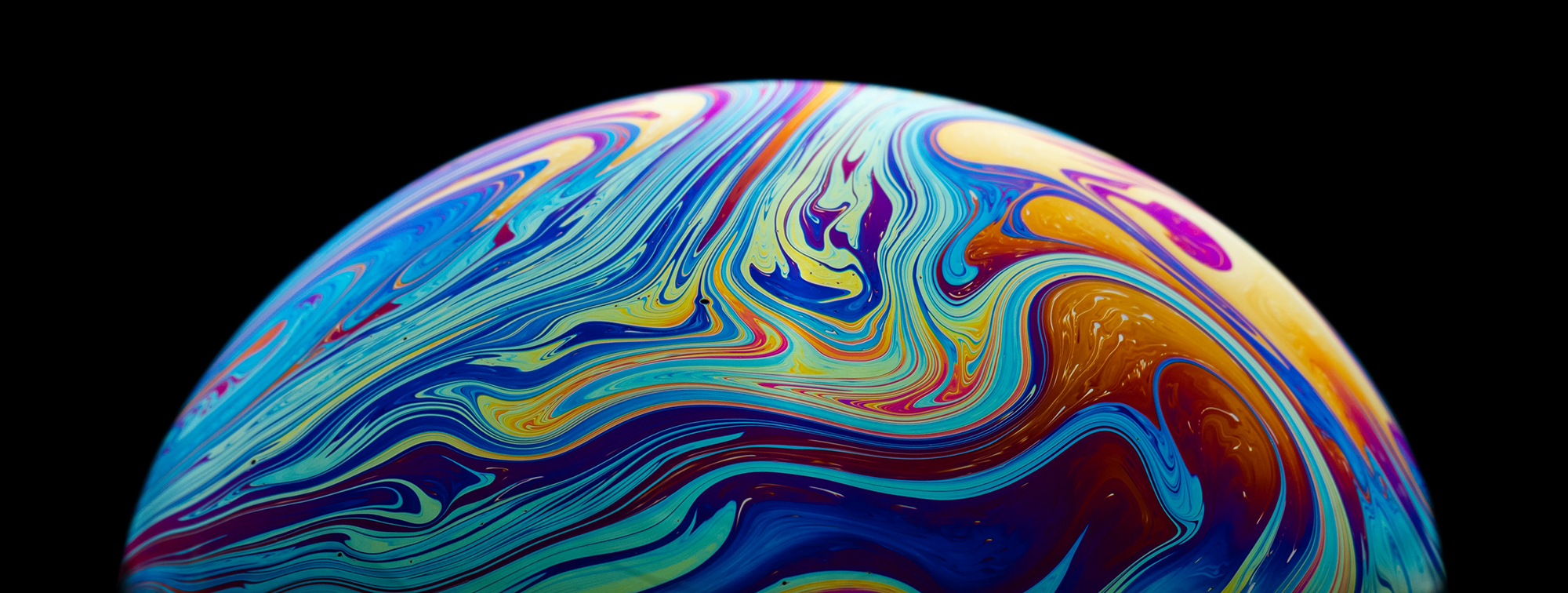
    Accretion disks form everywhere, from around young, planet-building stars to massive black holes. As matter circles in the disk, it slowly loses angular momentum and falls inward toward the central gravitational body. But the details of this process have long vexed astronomers. The low-viscosity environment of gas and dust in accretion disks simply is not sufficient to account for the level of angular momentum lost. Turbulence is expected to provide a boost to the effect, but neither astronomical observations or Taylor-Couette experiments have shown how.

    A new study uses a liquid metal, confined in a disk using radial and vertical electrical fields. Unlike prior experiments, this set-up creates a more gravity-like force to rotate the liquid. With it, researchers can tune both the rotation speed and the level of turbulence. They found that turbulence is, indeed, responsible for the loss of angular momentum that transports mass inward — even at the limit of zero intrinsic viscosity.

    Unfortunately, the apparatus isn’t a perfect analog for astrophysical disks; in the experiment, the turbulence originates from secondary flows that aren’t present in real systems. So while the team demonstrated that turbulence can drive the accretion disk’s behavior, it can’t pinpoint where that turbulence originates in real accretion disks. (Image credit: NASA; research credit: M. Vernet et al.; via Physics World)

  • Landslide-Triggered Tsunamis

    Landslide-Triggered Tsunamis

    After the 2018 Anak Krakatoa eruption, a tsunami that ricocheted through the surrounding waters, killing hundreds on nearby islands. The source of that tsunami was a small landslide. Once the air cleared and researchers could assess how much material slid into the ocean, they were shocked that such a small volume created so much destruction.

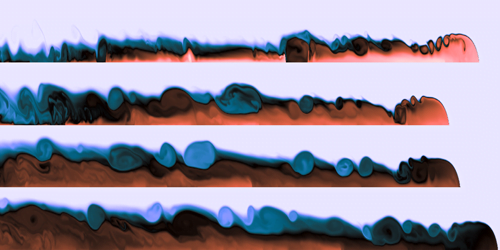
    Now new efforts are revealing the linkage between landslides and the waves they make. Researchers released glass beads into a tank of water, observing the waves that form as the beads run out. Depending on the relative initial height of the beads compared to the water depth, they observed three different kinds of waves. Not only that, they were able to connect the granular mechanics of the landslide to the hydrodynamic formation of waves, allowing predictions of the waves that will form for a given landslide.

    Currently, the predictive model isn’t sophisticated enough to handle a geometry as complex as that of the Anak Krakatoa landslide, but it’s an important step toward understanding — and potentially mitigating the damage of — future oceanside landslides. (Image and research credit: W. Sarlin et al.; via APS Physics; submitted by Kam-Yung Soh)

  • Aerosols and Instruments

    Aerosols and Instruments

    Although COVID has disrupted all of our lives, orchestras saw particular disruption, as little was known about how instruments spread aerosol droplets. In this recent study, a team looked at many wind instruments, as played by professional musicians, for the aerosol load and air flow each instrument creates. They found that, on the whole, wind instruments — like flutes, clarinets, trumpets, and others — create aerosol loads comparable to normal speech. The air flow from each instrument comes primarily from the bell (for brass instruments) or tone holes (for woodwinds) and has a much lower velocity than coughing or sneezing. As a result, the flow decays away to the background air-flow after about 2 meters. (Image credit: trumpet – E. Awuy, trombone – Q. Brosseau et al.; research credit: Q. Brosseau et al.)

    Flow from the bell of a trombone disrupts artificial fog.
    As a musician plays a scale on their trombone, flow from the bell is revealed through artificial fog and laser illumination.
  • Free Contact Lines

    Free Contact Lines

    How a simple drop of water sits on a surface is a strangely complicated question. The answer depends on the droplet’s size, its chemistry, the roughness of the surface, and what kind of material it’s sitting on. Vetting the mathematical models that describe these behaviors is especially difficult since droplets often get stuck, or “pinned,” along their contact line where water, air, and surface meet.

    To get around this issue, researchers sent their experiment to the International Space Station, asking astronauts to run the tests for them. Without gravity‘s influence squishing drops, the astronauts could use much larger droplets than they could on Earth. Larger drops are less likely to get pinned by a stray surface defect, so on the space station, astronauts could place droplets on a vibrating platform and observe their contact line freely moving as the drop changed shape. Under these conditions, the experiment tested many surfaces with different wetting characteristics, thereby gathering data to test models we cannot easily confirm on Earth. (Image and research credit: J. McCraney et al.; via APS Physics)

  • Martian Glaciers

    Martian Glaciers

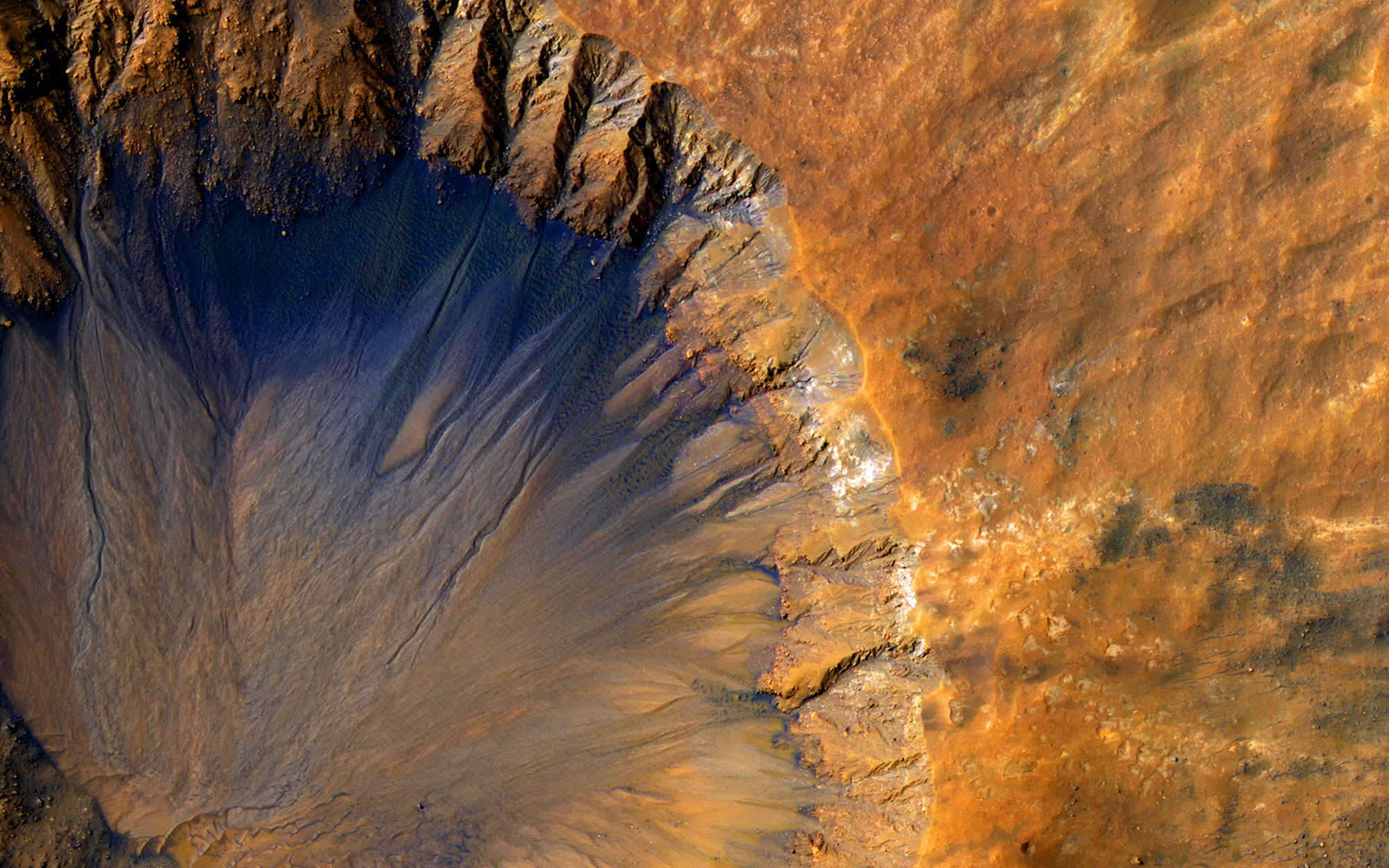
    On Earth, glaciers slide on lubricating layers of water, leaving complex landscapes like fjords and drumlins in their wake. Mars — though once home to enormous ice masses — lacks those geological features. Scientists assumed, therefore, that Martian ice stayed frozen and unmoving. But a new study demonstrates that is not the case.

    Researchers used computational modeling to simulate two identical glaciers: one under Earth-like conditions and one under the lower gravity of Mars. They found that Martian glaciers did indeed move, but Mars’s lower gravity, combined with better water drainage beneath the ice, meant that they moved exceedingly slowly. Martian glaciers did erode the landscape but into different features than on Earth. Instead of forming moraines and drumlins, a large Martian glacier would instead carve channels and eskar ridges, geological features found on Mars today. (Image credit: NASA/JPL-CalTech/Uni. of Arizona; research credit: A. Grau Galofre et al.; via AGU; submitted by Kam-Yung Soh)

  • Rising Through Turbulence

    Rising Through Turbulence

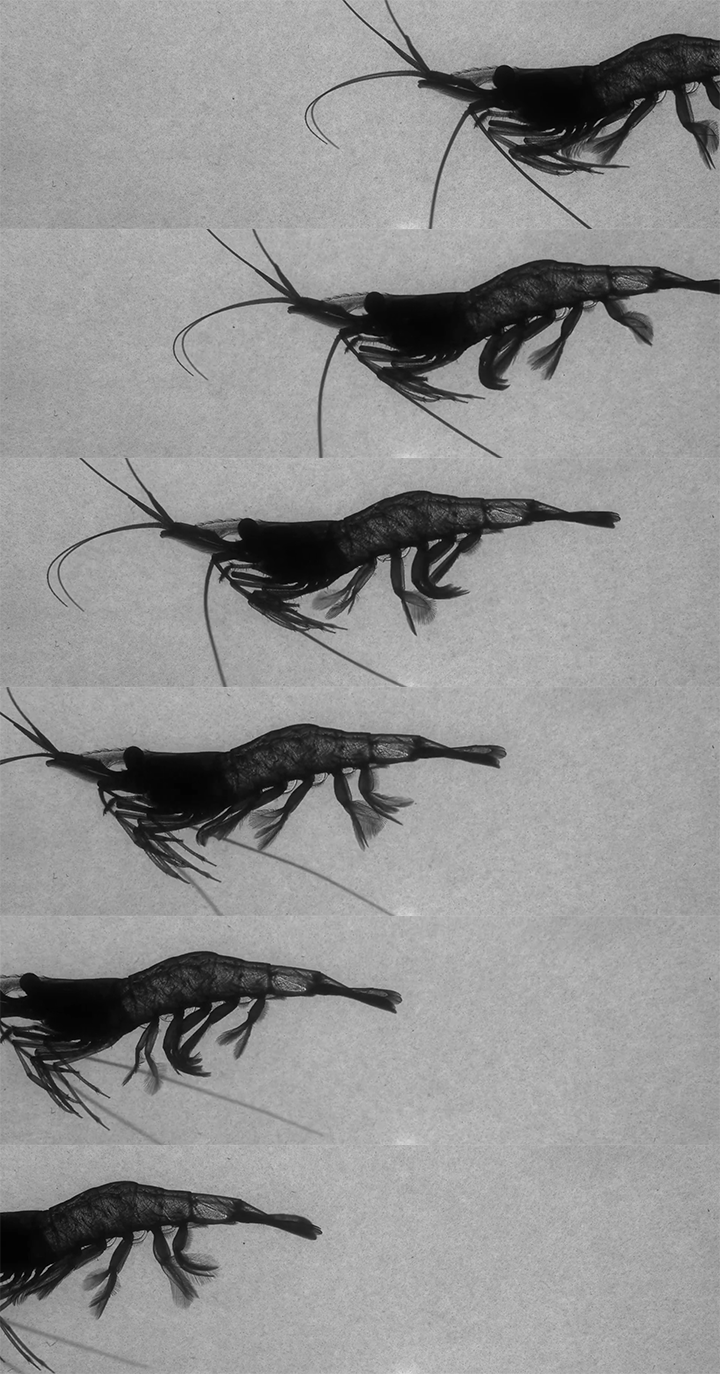
    Plankton — microscopic creatures with often limited swimming abilities — can face daily journeys of hundreds of vertical meters in the ocean. That’s a daunting prospect for any tiny swimmer. A new mathematical model suggests that plankton can have an easier time of it, though, by riding turbulent currents.

    The researchers modeled an individual planktar (singular of plankton) capable of sensing nearby velocity gradients and rotating its body to control its swimming direction. With this simple set of controls, their simulated planktar was able to “surf” turbulent currents, covering vertical distances at twice its normal swimming speed despite its curvy path.

    Currently, there’s no direct experimental evidence that plankton do this, but it does seem to make sense of experimenters’ observations. With the model’s results to guide them, experimentalists are looking for microswimmers actively orienting themselves based on turbulence. (Image credit: top – B. de Kort, illustration – R. Monthiller et al.; research credit: R. Monthiller et al.; via APS Physics)

  • Mixing the Perfect Batter

    Mixing the Perfect Batter

    In baking, there’s a point when wet and dry ingredients get combined to form the batter (or dough) that eventually becomes a tasty treat. Experienced bakers know that the ratio of wet-to-dry must be just right for the final product. Too dry and the mixture won’t come together; too wet and the final product is a soggy mess.

    Mixing liquids and powders is ubiquitous outside the kitchen, too. Ceramics, concrete, laundry detergent, chocolate — all involve this critical step. To understand how these mixtures transition from fluid to clustered granules to granulations (think wet sand), researchers carefully studied a mixture of glass spheres and glycerol. When there were relatively few particles in the mixture (in technical terms, a smaller “particle volume fraction”), the mixture was fully fluid (top image, orange background). When the ratio of particles-to-liquid was high, the mixture was granular (blue background). And in-between these ratios, whether the mixture formed clumps, or granules, depended on how it was mixed (green background). Vigorous mixing (top row) formed large granules, which consisted of a wet, jammed interior and an outer layer of dry particles (lower image).

    Their observations allowed the researchers to predict what ratio of liquid and powder is needed, and how much mixing is necessary, to create a desired outcome. (Image and research credit: D. Hodgson et al.; via Physics Today)

    A cross-section of a granule, showing the wet, jammed interior (left) surrounded by a region of dry particles (center, enclosed between red dashes).
    A cross-section of a granule, showing the wet, jammed interior (left) surrounded by a region of dry particles (center, enclosed between red dashes).
  • Zen Stones

    Zen Stones

    On Lake Baikal, where Siberian winters are long and cold but have little precipitation, you can find a strange phenomenon: stones that balance on a thin spire of ice. Known as Zen stones — thanks to their visual similarity to stacks of balanced stones in Japanese Zen gardens — these natural oddities rely on time and sublimation, a transition from ice to vapor without melting.

    The process is simple. Toss a stone on the ice and wait. As the sun shines, the ice will sublimate, transforming from ice directly to vapor at an estimated rate of ~2 mm per day, for Lake Baikal’s typical weather. But the stone’s presence acts like an umbrella, protecting some of the ice beneath it from the sunlight that is critical for sublimation. As a result of this umbrella effect, a thin column of ice remains beneath the stone.

    In the lab, researchers were able to recreate the process in less time by tweaking the temperature, humidity, and irradiance to enhance sublimation. Instead of stones, they used metal disks, but their Zen stones made their ice columns just the same. (Image and research credit: N. Taberlet and N. Plihon; via Physics Today)

    A lab Zen stone, formed from a disk of aluminum atop a column of ice.
    A lab Zen stone, formed from a disk of aluminum atop a column of ice.
  • Anoles Revisited

    Anoles Revisited

    Longtime readers may recall seeing this little bubble-crowned anole previously. This species dives underwater to escape predators and will breathe and rebreathe a bubble of air for as much as 18 minutes before resurfacing. At the time of my original post, I speculated that the reptile’s hydrophobic skin might provide a large enough bubble surface area to provide some diffusion of fresh oxygen from the surrounding water.

    Since then, there’s been at least one study of this anole rebreathing process. Researchers found that many anole species share this behavior, but aquatic species use it more regularly. They noted that the plastron — that flat, silvery bubble that’s spread over the lizard’s skin — helps hold the bigger, exhaled bubble in place and might facilitate a little of the diffusion I speculated about but the results are unclear on that last point. The authors note that it’s unlikely that the anoles could support their full metabolism through rebreathing and diffusion but that the plastron may yet support some rejuvenation of oxygen, which would help prolong anoles’ dives. (Image and research credit: C. Boccia et al.)