Category: Research

  • Dance of the Coral Polyps

    Dance of the Coral Polyps

    Coral reefs are made of up small organisms, called coral polyps, that live together in a colony. Individual polyps can expand, contract, and wave in the flow around them, and, in a recent study, researchers looked at whether changing conditions in temperature and light wavelength can affect polyp movement. To do so, they built a little flow control tank around a coral nubbin containing several polyps.

    Under normal light and temperature conditions, they found the polyps’ motions are correlated. (Scientists don’t know why this is the case, but it could help with foraging or photosynthesis for the organisms.) When temperatures rise and light levels shift to bluer wavelengths — simulating warmer and rising oceans — the polyps lose their coordination. Without knowing the purpose behind the motion, scientists can’t yet say what that lack of coordination means, but the team believes their experimental methods can be adapted to help answer those questions, perhaps even in natural, rather than lab-created, circumstances. (Image credit: S. Ravaloniaina; research credit: S. Li et al.; via APS Physics)

  • Optimizing Wind Farms Collectively

    Optimizing Wind Farms Collectively

    In a typical wind farm, each wind turbine aligns itself to the local wind direction. In an ideal world where every turbine was completely independent, this would maximize the power produced. But with changing wind directions and many turbines, it’s inevitable that upstream wind turbines will interfere with the flow their downstream neighbors see.

    So, instead, a research team investigated how to optimize the collective output of a wind farm. Their strategy involved intentionally misaligning the upstream wind turbines to improve conditions for downstream turbines. They found that the loss in power generation by upstream turbines could be more than recovered by improved performance downstream.

    After testing their models over many months in an actual wind farm, they reported that their methodology could, on average, increase overall energy output by about 1.2 percent. That may sound small, but the team estimates that if existing wind farms used the method, it would generate additional power equivalent to the needs of 3 million U.S. households. (Image credit: N. Doherty; research credit: M. Howland et al.; via Boston Globe; submitted by Larry S.)

  • Predicting Alien Ice

    Predicting Alien Ice

    Europa is an ocean world trapped beneath an ice shell tens of kilometers thick. To better understand what we might find in those oceans, researchers turn to analogs here on Earth, looking at Antarctica’s ice shelves. Beneath those shelves, ice forms via two mechanisms: the first, congelation ice, freezes directly onto the existing ice-water interface. The second, frazil ice, forms crystals in supercooled water columns, which drift upward in buoyant currents and settle on the ice shelf like upside-down snow (pictured above).

    Based on Europa’s conditions, the researchers conclude that congelation ice would gradually thicken the ice shell as the moon’s interior cools. But in areas where the shell is thinned by local rifts and Jovian tidal forces, frazil ice is likely to form. (Image credit: H. Glazer; research credit: N. Wolfenbarger et al.; via Physics World)

  • Finger Painting Physics

    Finger Painting Physics

    Spreading paint with a brush or with fingers is familiar activity for most people. It’s also similar to processes used in industry for spreading thin layers of paint and other complex fluids. In a recent study, researchers took a look at how a soft, elastic blade (similar to a paintbrush or one’s fingers) spreads shear-thinning fluids (like paint) and Newtonian fluids (like water). Surprisingly, they found that it actually takes 30% more mechanical work to spread a shear-thinning fluid than the same volume of an equivalent Newtonian one. That’s pretty much the opposite of what we’d expect since the action of spreading (and shearing) the complex fluid should reduce its viscosity. However, they did find that the shear-thinning fluid spreads to a thin layer more consistently than the Newtonian fluid does. (Image credit: A. Kolosyuk; research credit: M. Krapez et al.)

  • Recycling Urban Heat

    Recycling Urban Heat

    In urban areas, buildings and concrete surfaces create a heat effect that can make temperatures in the city substantially higher than in nearby rural areas. That heat isn’t just above ground, either. It seeps into the subsurface, measurably increasing groundwater temperatures. In a recent study, authors suggest this excess subsurface heat could be reclaimed and recycled (via heat pumps and other heat exchangers) in urban areas to offset peoples’ needs and to help groundwater return to its normal temperature. They found that even focusing on heat stored in the top meter of the subsurface could provide green heating for much of the world’s urban populations. (Image credit: J. Dylag; research credit: S. Benz et al.)

  • Eroding Grains

    Eroding Grains

    When a spacecraft comes in for a landing (or a tag similar to what OSIRIS-REx did), there’s a turbulent jet that points straight into a bed of particles. How those particles react — how they erode and the crater that forms — depends on many factors, including the cohesion between particles. In these experiments, researchers investigated such a jet (in air) and its impact on particles with differing amounts of cohesion.

    When there is little cohesion between particles, erosion takes place a single particle at a time (Image 1). Once there’s some cohesion, the jet’s velocity has to be higher to trigger erosion (Image 2). Once erosion does begin, it includes both singular and clumped particles. In highly cohesive beds, velocities must be even higher to create erosion, which takes place with large clusters of particles flying off together (Image 3). (Image and research credit: R. Sharma et al.)

  • Hydrophobic Ice

    Hydrophobic Ice

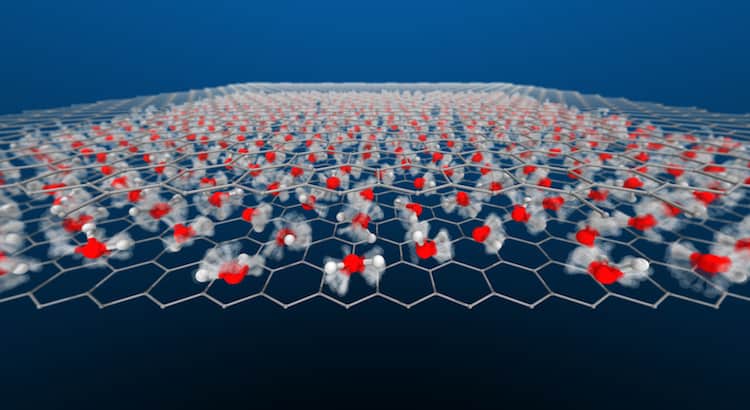
    Water is an endlessly peculiar substance, eager to adopt many configurations. Each molecule can form up to four, highly-directional bonds. In this study, researchers found an unexpected configuration, a 2D type of ice known as bilayer hexagonal ice, on a corrugated gold surface. Bilayer hexagonal ice has been known since the late 1990s, but it was thought to be comparatively rare. In this form, water molecules assemble in an ice only two molecular layers thick, with hydrogen bonds between neighboring molecules taking up nearly all possible binding sites. With nowhere to bind, additional water cannot add to the ice’s thickness, making the ice as a whole hydrophobic or “water-fearing”.

    Illustration of 2D hydrophobic ice.
    This illustration shows a type of 2D ice, known as bilayer hexagonal ice, as it forms on a corrugated gold surface. From above (top half), the water molecules align to the surface with some molecules (red) in the troughs and others (pink) along the ridges. Viewed from the side (lower half), most of the molecules bind with their neighbors, leaving few H-bond sites available where more water layers of water could attach. This inability to add more vertical layers is why the ice appears hydrophobic.

    Previously, this type of ice had only been found on hydrophobic, flat surfaces. In the latest research, though, researchers found that surface corrugations allowed the ice to form, even on a surface that was only slightly hydrophobic. Observations like these help theorists modeling water and its interactions with surface. (Image credit: top – E. McKenna, illustration – APS/A. Stonebraker; research credit: P. Yang et. al.; via APS Physics; submitted by Kam-Yung Soh)

  • When Rivers Jump

    When Rivers Jump

    Avulsions — sudden changes in the course of a river — are a river’s equivalent of an earthquake, and they can be similarly devastating for those in the river’s path. In a recent study, authors combed through 50 years’ worth of satellite data to catalog over 100 avulsions and categorize them into three regimes. About a quarter of the observed avulsions took place in the river delta’s fan, where the river spreads out once it exits a canyon or valley. These avulsions, they found, occur when rivers lose confinement and sediment can build up.

    This animation of satellite images shows the sudden avulsion -- a dramatic change in the river's course -- that took place on the Kosi River in 2008.
    This animation of satellite images shows the sudden avulsion — a dramatic change in the river’s course — that took place on the Kosi River in 2008.

    Among the other observations, the team linked avulsion location to the river’s flow properties. Most of these remaining avulsions took place in the river’s backwater region, where the river begins to slow down before its outlet. The last category of avulsion took place far upstream of the backwater region on rivers with high sediment flows. During flood conditions, erosion can travel far upstream on these rivers, causing avulsions in unexpected places. Changes in sediment load due to human activities, like deforestation, could even cause rivers to change from the backwater regime to the high-sediment load one. (Image credit: top – R. Simmon/USGS, bottom – S. Brooke et al.; research credit: S. Brooke et al.; via AGU Eos; submitted by Kam-Yung Soh)

  • Liquid-in-Liquid Printing

    Liquid-in-Liquid Printing

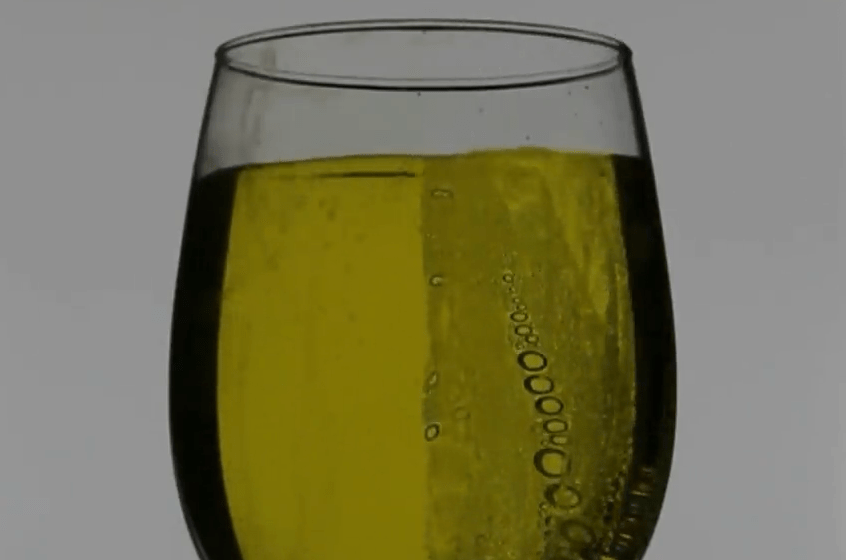
    With 3D printing and other recent technologies, manufacturing options are always in flux. Here, researchers explore a method for printing a liquid inside of a liquid. Their materials are specially chosen such that the injected liquid forms an emulsion at its interface with the surrounding fluid. Once injection ends, the interface forms a wrinkly, viscoelastic skin that acts like a tube. As shown below, the tube is robust enough that it can be pumped full of yellow-dyed water without any loss of structure. (Image and research credit: P. Bazazi et al.)

  • Inhibiting Marine Lightning

    Inhibiting Marine Lightning

    Thunderstorms over the ocean have substantially less lightning than a similar storm over land. Scientists wondered whether this difference could be due to lower cloud bases over the ocean or differences in the cloud droplets’ nuclei. But a new study instead implicates coarse sea spray as the deciding factor. By tracking the full lifetime of storm systems through remote sensing, the team found that fine aerosols can increase lightning activity over both land and ocean. But adding coarse sea salt from sea spray reduced lightning by 90% regardless of fine aerosols. With sea salt in the mix, clouds seem to develop fewer but larger condensation droplets, providing less opportunity for the electrification necessary to generate lightning. (Image credit: Z. Tasi; research credit: Z. Pan et al.)