Clean-up of accidents like the 2010 Deepwater Horizon oil spill can be complicated by what goes on beneath the ocean surface. Variations in temperature and salinity in seawater create stratification, stacked layers of water with differing densities. When less dense layers are on top, the fluid is said to be stably stratified. Since oil is less dense than water, one might assume that buoyancy should make an oil plume should rise straight to the ocean surface. But the presence of additives or surfactants in the oil mixture plume can prevent that. With surfactants present, an oil mixture tends to emulsify, breaking into tiny droplets like a well-mixed salad dressing. Even if the density of the emulsion is smaller than the surrounding fluids, such a plume can get trapped at a density boundary, as seen in the photo above. Researchers report a critical escape height, which depending on the plume’s characteristics and stratification boundary, determines whether a plume escapes or becomes trapped. (Image credit: R. Camassa et al.)
Category: Research

Bounce or Freeze?
Icing is a major problem for aircraft. When ice builds up on the leading edge of a wing it creates major disruptions in flow around the wing and can lead to a loss of flight control. One of the important factors in predicting and controlling ice building up is knowing when and where water droplets will freeze. The video above shows how surface conditions on the wing affect how an impacting droplet freezes. On a subzero hydrophilic surface, a falling droplet spreads and freezes over a wide area, which would hasten ice buildup. A hydrophobic surface is slightly better, with the droplet freezing over a smaller area, whereas a superhydrophobic surface shows no ice buildup. Unfortunately, at present superhydrophobic surfaces and surface treatments are extremely delicate, making them unsuitable for use on aircraft leading edges. (Video credit: G. Finlay)
Shooting Droplets with Lasers
Last week we saw what happens when a solid projectile hits a water droplet; today’s video shows the impact of a laser pulse on a droplet. Several things happen here, but at very different speeds. When the laser impacts, it vaporizes part of the droplet within nanoseconds. A shock wave spreads from the point of impact and a cloud of mist sprays out. This also generates pressure on the impact face of the droplet, but it takes milliseconds–millions of nanoseconds–for the droplet to start moving and deforming. The subsequent explosion of the drop depends both on the laser energy and focus, which determine the size of the impulse imparted to the droplet. The motivation for the work is extreme ultraviolet lithography–a technique used for manufacturing next-generation semiconductor integrated circuits–which uses lasers to vaporize microscopic droplets during the manufacturing process. (Video credit: A. Klein et al.)

Hydrofoil Cavitation
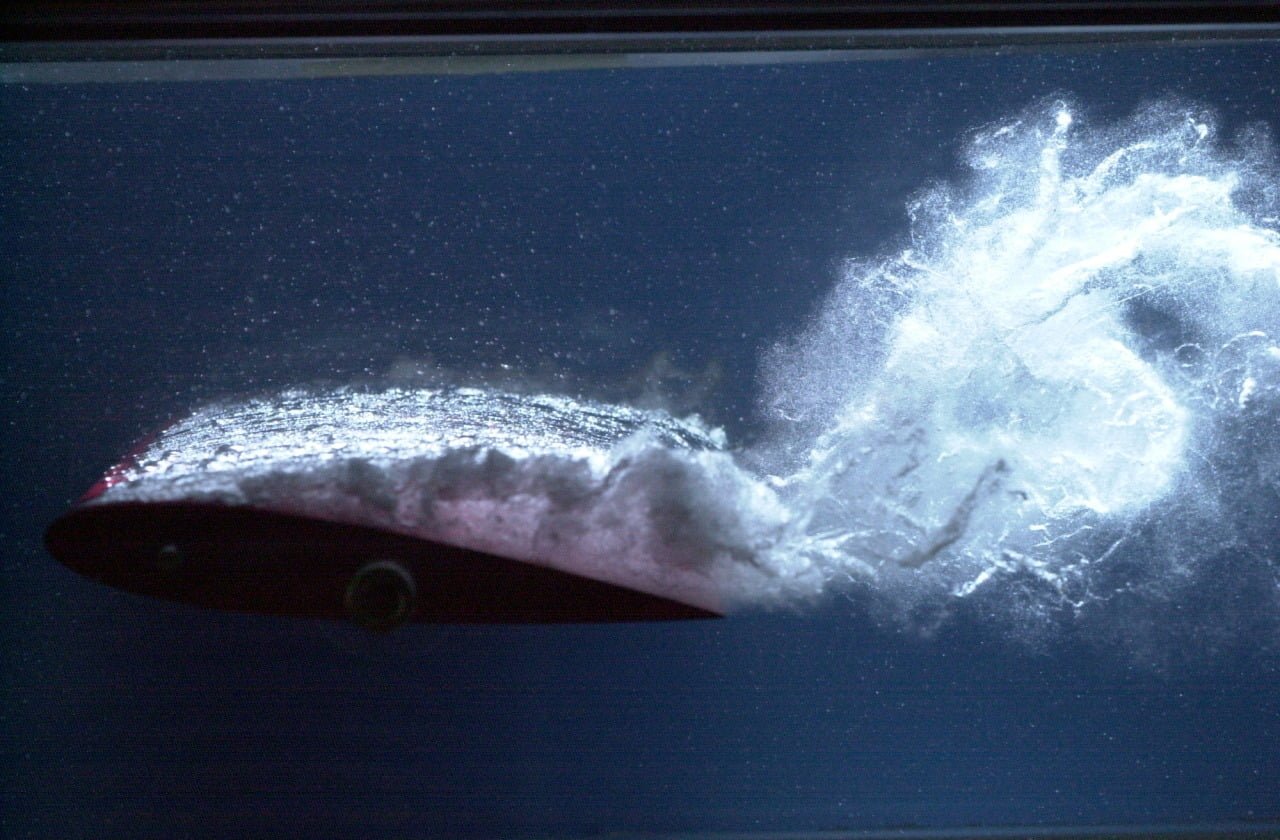
A cavitation-induced bubbly sheet flows over the upper surface of a hydrofoil in the image above. Cavitation can occur when local pressure in a liquid drops below the vapor pressure, causing a cavity to form. Due to its angle of attack, water flowing over the upper surface of the hydrofoil is accelerated. The high flow velocities and accompanying low pressures over the top of the hydrofoil produce cavitation bubbles which continue to flow over and off the surface. Because cavitation bubbles implode when the pressure again increases, they can cause serious damage to solid surfaces. This is why generating cavitation can damage propellers or shatter a bottle. (Photo credit: R. Arndt et al.)

Shooting Droplets
This animation shows high-speed video of a polystyrene particle striking a falling water droplet. Under the right conditions, the particle rips through the droplet, stretching the water into a bell-shaped lamella extending from a thicker rim. When the particle detaches, surface tension rapidly collapses the lamella into a ring which destabilizes. Thin ligaments and droplets fly off the crown-like ring as momentum overcomes surface tension’s ability to hold the droplet together. Be sure to check out the full video on YouTube or later next month at the APS Division of Fluid Dynamics meeting. (Yes, I will be there!) (Image credit: V. Sechenyh et al., source video)
Bouncing with Liquids and Grains
Bouncing a ball partially filled with a liquid can create chaotic results when the motion of the ball, fluid, and vibration plate couple. The behavior of a grain-filled ball is a bit different, though. Large grains will tend to bounce with the same frequency as the ball, even across a range of vibration conditions. A ball filled with smaller grains displays a variety of responses depending on the vibration conditions. Among these is a localized wave-like form called an oscillon which oscillates with a period different from but coupled to that of the vibration plate. All these different behaviors inside the bouncing sphere have noticeable effects on its outward motion, too. The chaotic activity of the fluid inside a bouncing ball makes it unstable, and, if not confined, it will bounce itself off the vibration platform. The grain-filled ball, on the other hand, remains bouncing on the platform even after being perturbed. This seems to be a result of the energy dissipation provided by the many inelastic collisions inside the ball as it bounces. (Video credit: F. Pacheco-Vazquez et al.)

Supernova Simulation
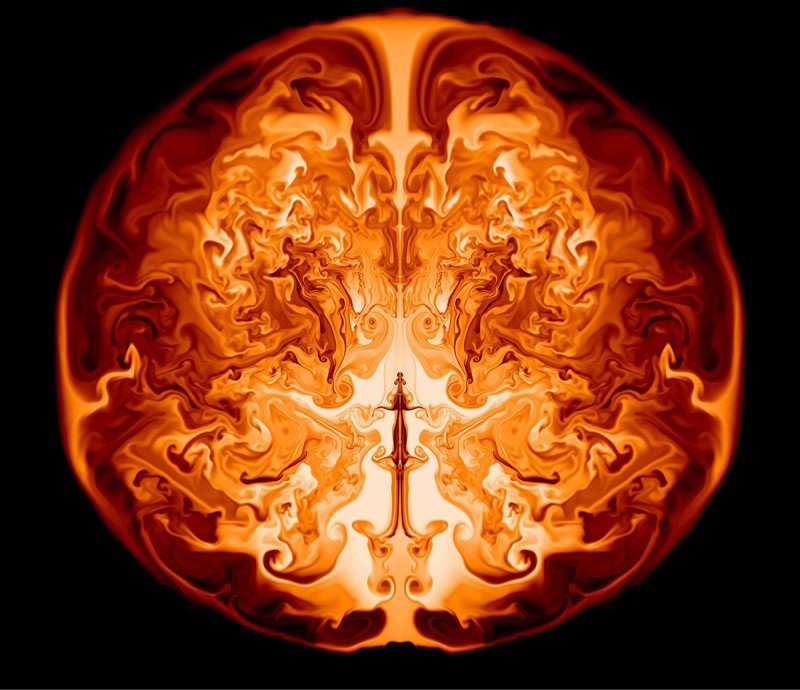
New research shows that supermassive first-generation stars may explode in supernovae without leaving behind remnants like black holes. The work is a result of modeling the life and death of stars 55,000 to 56,000 times more massive than our sun. When such stars reach the end of their lives, they become unstable due to relativistic effects and begin to collapse inward. The collapse reinvigorates fusion inside the star and it begins to rapidly fuse heavier elements like oxygen, magnesium, or even iron from the helium in its core. Eventually, the energy released overcomes the binding energy of the star and it explodes outward as a supernova. The image above is a slice through such a star approximately one day after its collapse is reversed. Hydrodynamic instabilities like the Rayleigh-Taylor instability produce mixing of the heavy elements throughout the expanding interior of the star. The mixing should produce a signature that can be observed in the aftermath as these stars seed their galaxies with the heavy elements needed to form planets. For more, see Science Daily and Chen et al. (Image credit: K. Chen et al., via Science Daily; submitted by mechanicoolest)
City Winds Simulated
Anyone who has spent much time in an urban environment is familiar with the gusty turbulence that can be generated by steady winds interacting with tall buildings. To the atmospheric boundary layer–the first few hundred meters of atmosphere just above the ground–cities, forests, and other terrain changes act like sudden patches of roughness that disturb the flow and generate turbulence. The video above shows a numerical simulation of flow over an urban environment. The incoming flow off the ocean is relatively calm due to the smoothness of the water. But the roughness of an artificial island just off the coast acts like a trip, creating a new and more turbulent boundary layer within the atmospheric boundary layer. It’s this growing internal boundary layer whose turbulence we see visualized in greens and reds. (Video credit: H. Knoop et al.)

The Chelyabinsk Meteor
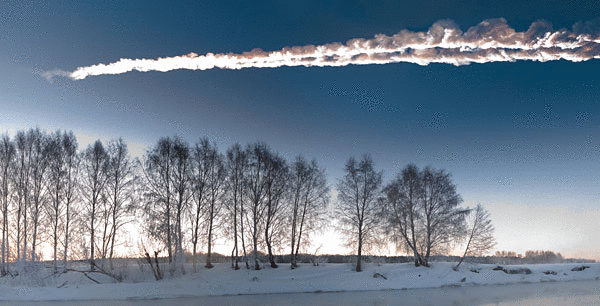
In February 2013 a meteor streaked across the Russian sky and burst in midair near Chelyabinsk. A recent Physics Today article summarizes what scientists have pieced together about the meteor, from its origins to its demise. The whole article is well worth reading. Here’s a peek:
The Chelyabinsk asteroid first felt the presence of Earth’s atmosphere when it was thousands of kilometers above the Pacific Ocean. For the next dozen minutes, the 10 000-ton rock fell swiftly, silently, and unseen, passing at a shallow angle through the rarefied exosphere where the molecular mean free path is much greater than the 20-m diameter of the rock. Collisions with molecules did nothing to slow the gravitational acceleration as it descended over China and Kazakhstan. When it crossed over the border into Russia at 3:20:20 UT and was 100 km above the ground, 99.99997% of the atmosphere was still beneath it.
Because the asteroid was moving much faster than air molecules could get out of its way, the molecules began to pile up into a compressed layer of high-temperature plasma pushing a shock wave forward. Atmospheric density increases exponentially with depth, so as the asteroid plunged, the plasma layer thickened and its optical opacity rapidly increased. About one second later, at 95 km above the surface, it became bright enough to be seen from the ground. That was the first warning that something big was about to happen. #
How often are scientific articles that gripping?! Kring and Boslough provide some excellent descriptions of the aerodynamics of the meteor and its airburst. Be sure to check it out. (Photo credit: M. Ahmetvaleev; paper credit: D. Kring and M. Boslough; via io9)
Reconfigurable Liquid Metal
Terminator 2’s T-1000, a liquid metal robot capable of changing its shape at will, just became a little less far-fetched. Researchers at NC State have reported a new method for controlling the form of a liquid gallium alloy. Surface tension governs the shape a liquid assumes when it is not confined by a container, and, although adding surfactants can slightly lower the surface tension, it does not substantially alter the liquid’s shape. Adding soap to water lets one make bubbles, but surface tension keeps the bubbles spherical no matter how much soap you add. Instead, these researchers control the surface tension of the liquid metal using a mild voltage. Applying a voltage creates (or removes) an oxide layer on the liquid metal’s surface, thereby altering the surface tension. By controlling the formation of the oxide layer, the researchers can change the surface tension from approximately 7x that of water to nearly zero. The video above demonstrates some of the liquid shape control this lets them achieve. (VIdeo credit: M. Dickey et al.; research: M. Khan et al.; via PopSci)