Shovel-nosed snakes and sandfish lizards both swim through granular materials like sand. Researchers at Georgia Tech used x-rays to observe their subsurface motions. Despite their different shapes, the long, slender snake and the shorter, wider lizard both move under the sand by projecting traveling waves along their bodies. The snake’s long, skinny body allows it to have more bends along its length, which increases its transport efficiency because it allows the snake to move mostly through the tunnel created by its head’s passage. In contrast, the sandfish’s motions fluidize the sand around it, enabling it to swim. Although the snake is faster, both animals have optimized their motions for fast, low-energy transit according to their body type. (Video credit: Georgia Tech; research credit: S. Sharpe et al.; via io9)
Category: Research

A Toast!
When you lift a glass of champagne or sparkling wine at midnight tonight, your nose and mouth will be greeted by a plethora of aromas, flavors, and sensations propagated by the tiny bubbles in the drink. Carbon dioxide dissolved in the wine gathers in a stream of tiny bubbles that rise at the center of the glass. (The bubbles form at the center because champagne glasses are often etched in a ring there to provide nucleation points where the bubbles can grow.) This stream of rising bubbles generates vortical motion in the glass that helps carry the carbon dioxide to the surface, where it is released when the bubbles burst. In the tall, thin champagne flute these vortices mix the entire contents of the glass, but, in a wider coupe, the vortices are confined to the center, leaving a stiller region along the glass’s edges. For those who find that a freshly poured flute of champagne stings their noses–a side effect of the high gaseous carbon dioxide concentration just after decanting–the wider coupe lowers the concentration at the glass’s lip and may provide a more pleasant experience for toasting the new year. (Image credit: F. Beaumont et al.)

Manipulating Fluids
Combining water-repelling superhydrophobic surfaces with water-loving hydrophilic surfaces allows scientists and engineers to manipulate common fluids. Here a hydrophilic track surrounded by a superhydrophobic background collects and distributes drops of dyed water. The wetting characteristics of the surface combined with surface tension in the liquid drives the flow. No pumping or power input is necessary. This kind of manipulation of droplets can be especially useful in biomedical applications where fast-acting, low-cost devices could be used to diagnose diseases or measure blood glucose levels. (Image credit: A. Ghosh et al., via NSF; see also source video)

Viscous Droplet Impacts
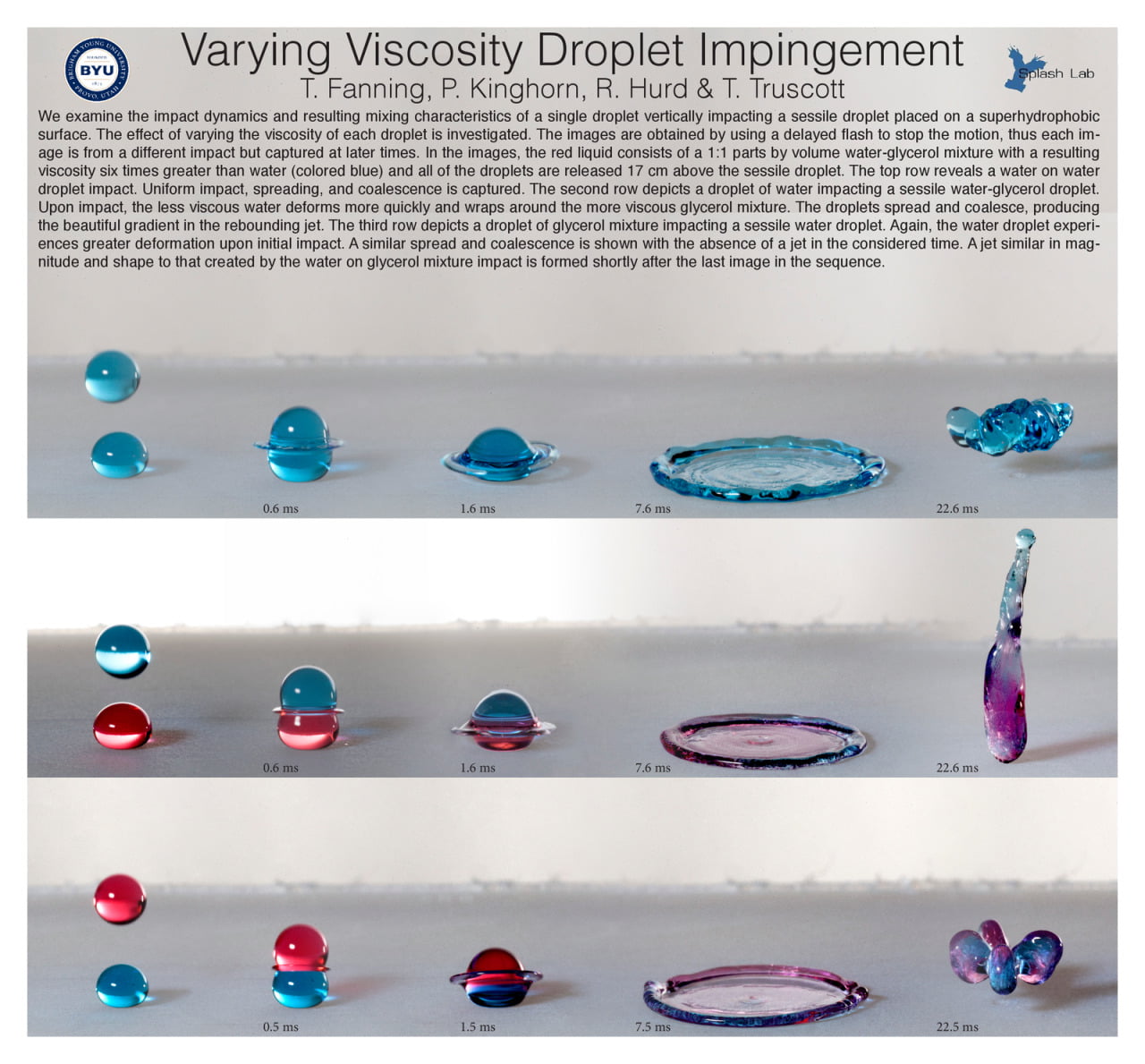
Viscosity can have a notable effect on droplet impacts. This poster demonstrates with snapshots from three droplet impacts. The blue drops are dyed water, and the red ones are a more viscous water-glycerol mixture. When the two water droplets impact, a skirt forms between them, then spreads outward into a sheet with a thicker, uneven rim before retracting. The second row shows a water droplet impacting a water-glycerol droplet. The less viscous water droplet deforms faster, wrapping around and mixing into the other drop before rebounding in a jet. The last row switches the impacts, with the more viscous drop falling onto the water. As in the previous case, the water deforms faster than the water-glycerol. The two mix during spreading and rebound slower. In the last timestep shown, the droplet is still contracting, but it does rebound as a jet thereafter. (Image credit: T. Fanning et al.)

Propagating Flames
Like many flows, flames can be unstable and undergo a transition from orderly laminar flow to chaotic turbulent flow. The timelapse image above shows the propagation of a flame front travelling downward. Each blue line represents the forwardmost position of the flame at a specific time. The flame is essentially two-dimensional, held between two glass plates separated by a 5-mm gap. The V-like points in the flame front are called cusps, and if you look closely, you can see cusps forming and even merging as the flame moves downward. Also notice how the flame front is more uniform near the top of the image, but, by the bottom, it has split into many more cusps. This is one of the indications that the flame is unstable. Check out the full poster-version of the image in the Gallery of Fluid Motion. (Photo credit: C. Almarcha et al., original poster)

Jumping Droplets
When droplets on a superhydrophobic surface coalesce with one another, they jump. Individually, each drop has a surface energy that depends on its size. When two smaller droplets coalesce into a larger drop, the final drop’s surface energy is smaller than the sum of the parent droplets. Energy has to be conserved, though, so that excess surface energy gets converted to kinetic energy, causing the new droplet to leap up. Smaller droplets have higher jumping velocities. For more, see the original video. (Image credit: J. Boreyko and C. Chen, source video)

Vertical-Axis Wind Turbines
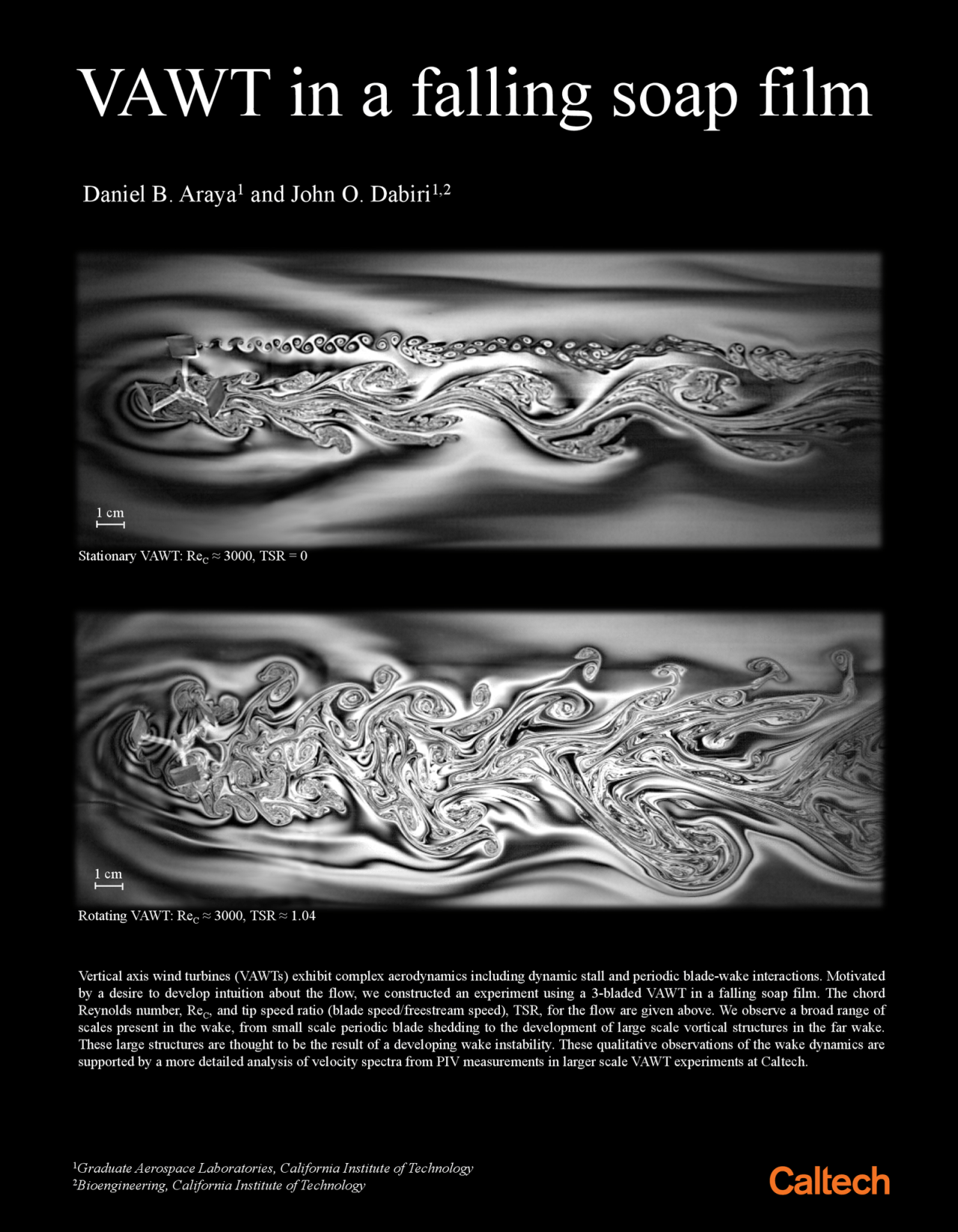
Vertical-axis wind turbines (VAWT) are an alternative to traditional wind turbine designs. Unlike their more common cousins, VAWTs rotate about a vertical axis and are omni-directional, meaning that they do not have to be pointed into the wind to produce power. While their size allows VAWTs to be packed much closer to one another than traditional turbines, a clear understanding of the flow around the turbines is needed in order to place the turbines for effective and efficient operation. The images above show the complicated and turbulent wake of a three-bladed VAWT when stationary (top) or rotating (bottom). The flow is visualized using a gravity-driven soap film (flowing left to right in the images) pierced by a model VAWT (seen at the left). The wakes contain many scales from simple, periodically-shed vortices off a blade to very large-scale vortical structures forming downstream of the turbine. This work originally appeared as a poster in the Gallery of Fluid Motion at the 2014 APS DFD Annual Meeting. (Image credit: D. Araya and J. Dabiri)
Cavitation
[original media no longer available]
Cavitation–the formation and collapse of vapor-filled cavities within a liquid–occurs in a variety of natural and manmade applications. It can shatter bottles, wreak havoc with boat impellers, is used as a hunting mechanism by several shrimp species, and can even generate light and sound. It is the collapse of the cavitation bubble that can be so damaging, and this video shows how. In the experiment, researchers generate a cavitation bubble near the free surface–or, in other words, near the air-water interface. Pressure in the bubble is much lower than the pressure of the surrounding liquid, so the bubble collapses after the momentum from its initial generation is spent. Interaction with the surface generates a jet that projects downward and pierces the cavitation bubble as it collapses. As seen from 0:54 onward, the bubble’s collapse generates a shock wave that propagates outward from the bubble site. It’s this shock wave that so effectively damages materials and stuns underwater prey. (Video credit: O. Supponen et al.)

Crown Sealing
Objects falling into a liquid pool create a beautiful splash, and, in this beautiful, award-winning video, the Splash Lab explores a peculiar instability that occurs just as the splash closes. The buckling instability they describe involves distinctive ridges that form along the splash’s ejecta sheet as it domes over and closes. The number of ridges depends both on the object size and the liquid’s properties. (Video credit: J. Marston et al.)

Beverage Bubbles Bursting
Fizzy drinks like soda and champagne have many bubbles which rise to the surface before bursting. When the film separating the bubble and the air drains and bursts, it leaves a millimeter-sized cavity that collapses on itself. That collapse creates an upward jet of fluid which can break into tiny aerosol droplets that disperse the aroma and flavor of the drink. Similar bubble-bursting events occur in sea spray and industrial applications, too. Researchers find that droplet ejection depends on bubble geometry and fluid properties such as viscosity. More viscous liquids, for example, generate smaller and faster droplets. Learn more and see videos of bubble-bursts at Newswise. (Image credit: E. Ghabache et al.)