For those from colder climates, icicles are a familiar part of winter. They come in a multitude of shapes and sizes, many of which have been captured and cataloged in the Icicle Atlas project. The site contains images, videos, and measurements of more than 230 icicles grown in the lab over the course of four years of research into how and why icicles form the way they do. One interesting result of the work was the discovery that the ripples commonly found on icicles are directly related to impurities. Icicles grown with pure water remain smooth, and only those with ionic impurities, like salt, develop ripples. Check out more images and icicle research at the Atlas. (Video credit: A. Chen and S. Morris/The Icicle Atlas; via Discover)
Category: Research

Make Your Own Dancing Droplets
As a follow-up to last week’s “dancing droplet” post, here’s a video that describes how to recreate the experiment yourself at home. The droplet motion is driven by the two-component structure of the droplets, where differing evaporation rates and surface tension values between the two fluids in the drop cause the attractions and chasing behavior you see. To demonstrate this at home, you’ll need glass, fire (for sterilization), tweezers, a pipette, water, and food coloring. Looks like a fun way to spend a weekend afternoon! (Video credit: M. Prakash et al.; via io9)
Lab-borne Tornadoes
Conventional wind tunnels are great, but some aerodynamic testing requires facilities of a different nature. The video above is from the WindEEE dome, a hexagonal chamber with sixty fans on one wall, eight directional fans on the other five walls, and six fans in the upper chamber. Each is individually computer controlled, allowing the researchers to create straight flows as well as complex vortical ones. The video shows their tornado flow, which stands 5 m tall and swirls at 30 m/s. They can also move the tornado around the chamber at 2 m/s. This capability enables a kind of scale-model analysis of tornadoes and their impact that’s not possible in most facilities. You can read more about the dome at New Scientist or the WindEEE website. (Video credit: New Scientist/WindEEE; submitted by entropy-perturbation)

Rowing Water Striders

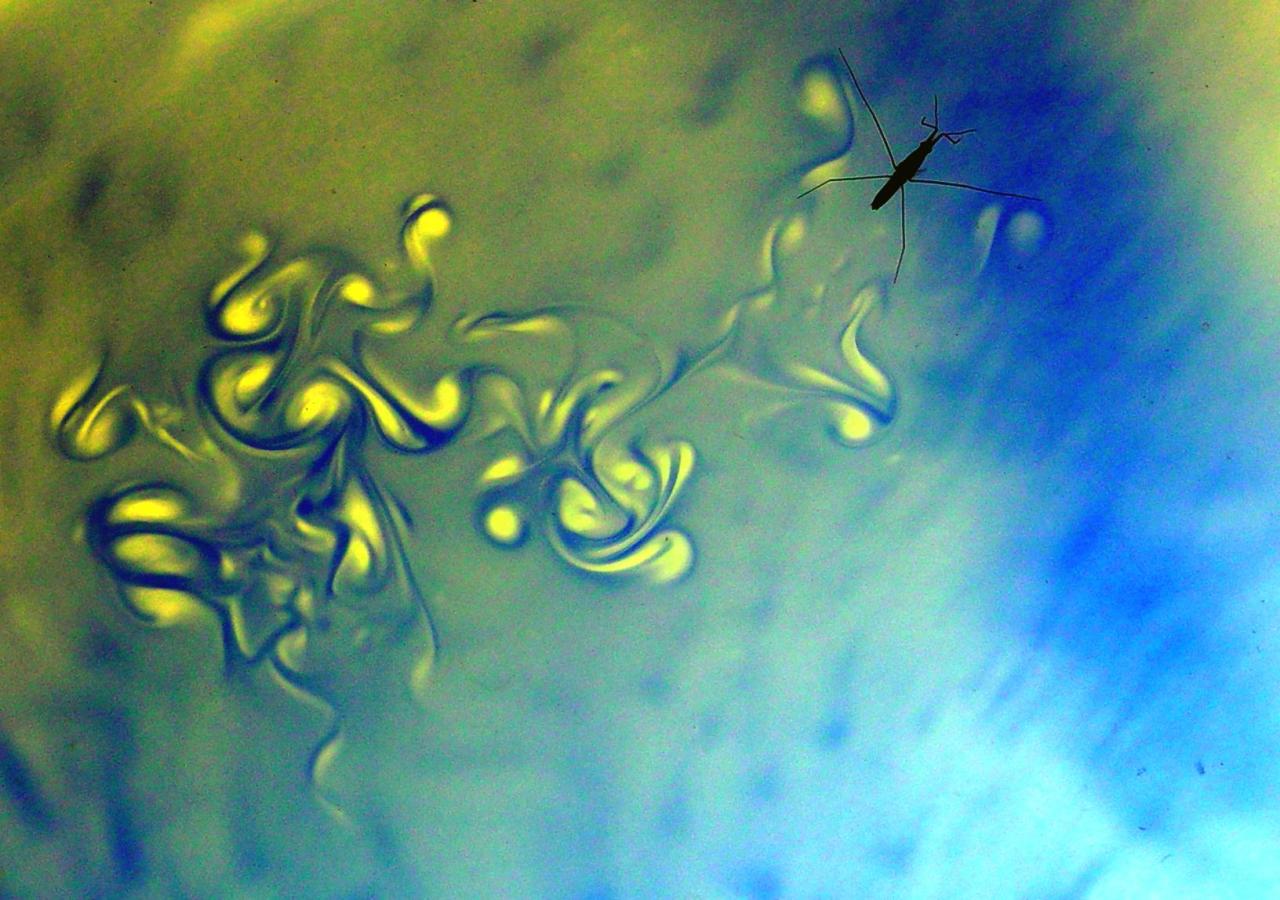
Water strider insects are light enough that their weight can be supported by surface tension. For some time, they were thought to propel themselves by using their long middle legs to generate capillary waves–ripples– that pushed them forward, but juvenile water striders are too small for this technique to work. Instead researchers found that water striders move by using their middle legs like oars. The leg motion creates vortices about 4 mm below the water surface, and this water moving backward propels the insect forward. In the photos above, the scientists visualized the flow by sprinkling thymol blue on the water and letting the striders move freely. You can learn more about the work here or in this Science Friday episode. (Photo credits: J. Bush et al.)

Dancing Droplets


What makes drops of food coloring able to dance, chase, sort themselves, or align with one another? This unexpected behavior is a consequence of food coloring consisting of two mixed liquids: water and propylene glycol. Both have their own surface tension properties and evaporation rates, which ultimately drives the behavior you see in the animations above. Both long-range and short-range interactions are observed. The former are due to vapor from each droplet adsorbing onto the glass around the droplet, thereby changing the local surface tension and causing nearby drops to feel an attractive force. The short-range effects are also surface-tension-driven. Droplets with lower surface tension will naturally try to flow toward areas of higher surface tension, which causes them to “chase” dissimilar adjacent drops. You can learn more about the research in the videos linked below (especially the last two), or you can read about the work in this article or the original research paper. (Image credit: N. Cira et al., source videos 1, 2, 3, 4; GIFs via freshphotons; submitted by entropy-perturbation)

Encapsulating Drops

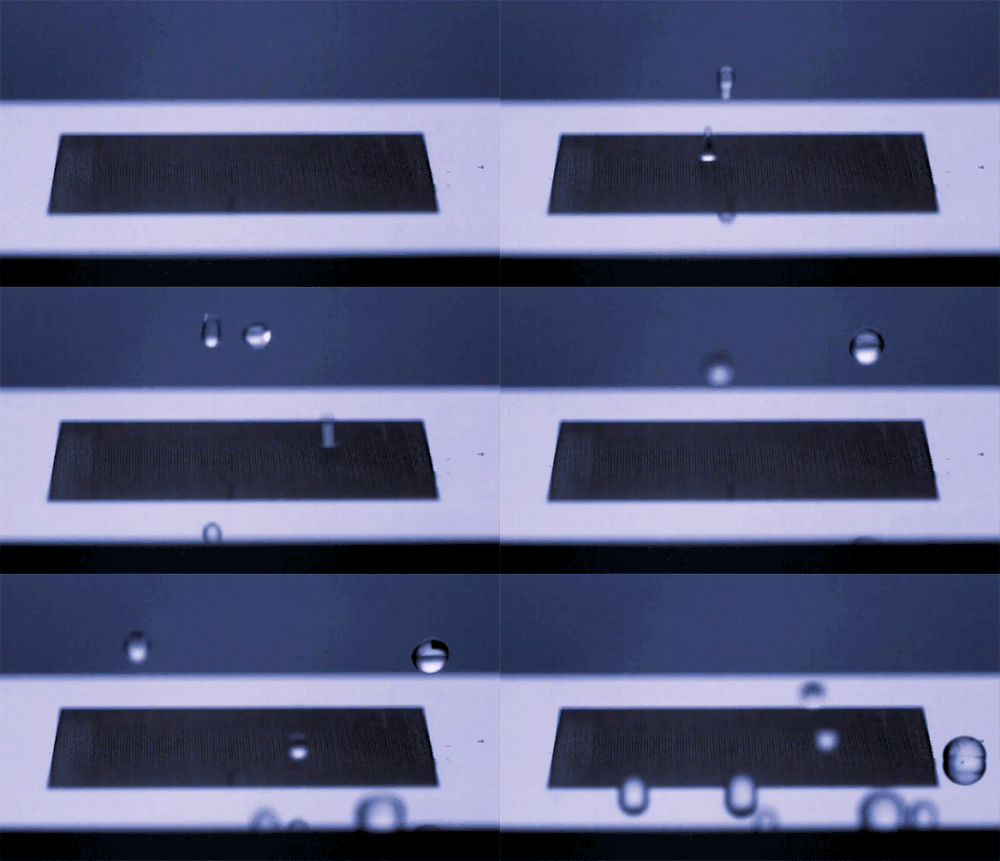
Building and manipulating drops containing multiple chemicals is useful in pharmaceutical applications. But it can be a challenge to encapsulate multiple fluids without mixing them immediately. The research poster above describes a clever and simple method of building these compound drops. It uses a crosswise array of fibers, as seen in the top image. Dyed water droplets are placed at each intersection, pinning them in place. Then a larger drop of oil is added to the vertical fiber. As it runs down the fiber, it collects and encapsulates the individual droplets, creating the compound drop seen in the bottom photo. (Photo credit: F. Weyer et al.)
Popcorn Popping
The familiar popping behavior of popcorn is the combination of several events. When heated, unpopped kernels act like pressure vessels, managing to contain their boiling water content until a critical temperature of 180 degrees Celsius. At this temperature, nearly all kernels fracture. Popcorn’s jump doesn’t come from the fracture, though. Most of its acrobatics occur when a leg of starch branches out of the popping kernel. The starch acts somewhat like a muscle – after being compressed against the ground, it springs back, propelling the corn upward. Finally, by synchronizing high-speed video and audio recordings of popping corn, researchers determined that the pop in popcorn is not caused by fracture or rebound but instead is the result of the release of water vapor. (Image credit: TAMU NAL, source; research credit: E. Virot and A. Ponomarenko; submitted by Chad W.)

How Eyelashes Work
New research shows that eyelashes divert airflow around the eye, serving as a passive filter that reduces dust collection and controls evaporation. Mammal hairs in places like the nose act as ram filters that trap the particles that hit them and which require regular cleaning via sneezing. Eyelashes, on the other hand, prevent dust collection by altering airflow at the surface of the eye. At the optimal length of roughly 1/3rd the width of an eye, eyelashes create a stagnation zone near the eye surface that forces air to travel above rather than through the eyelashes. This results in lower shear stress and lower flow speeds at the eye surface, both of which help reduce evaporation and shield the eye from dust. Lashes can get too long, though; the researchers found that longer lashes tended to channel higher flow speeds toward the eye surface, leading to faster evaporation rates. Thus, donning longer fake eyelashes may dry out your eyes. (Image credit: G. Diaz Fornaro; research credit: G. Amador et al.; via skunkbear)

Laser-Made Superhydrophobics

Superhydrophobic surfaces are so repellent to water that liquids often cannot wet them. Today these surfaces are usually created with chemical coatings or deliberate manufacturing to create micro- and nanoscale structures that trap air between the drop and the surface in order to prevent adhesion. Researchers recently announced they’ve made metals superhydrophobic with laser treatments. The process is still time-consuming, but they hope it can be scaled up for wider applications. Because drops bounce so readily off the treated surfaces, it takes very little water to clean them, which may be especially useful for sanitation purposes in the developing world. Superhydrophobic materials are also good for preventing icing on aircraft wings. To learn more about the research, check out the University of Rochester’s video explanations. (Image credit: C. Guo et al., source videos 1,2; submitted by entropy-perturbation and buckitdrop)
How Rain Gets Its Smell
Light rain after a dry spell often produces a distinctive earthy scent called petrichor that is associated with plant oils and bacteria products. How these chemicals get into the air has been unclear, but new research suggests that the mechanism may come from the rain itself. When water falls on a porous surface like soil, tiny air bubbles get trapped beneath the drop. These bubbles rise rapidly due to buoyancy and, upon reaching the surface, burst and release tiny droplets known as aerosols. Depending on the surface properties and the drop’s impact speed, a single drop can produce a cloud of aerosol droplets. The research team is now investigating how readily bacteria or pathogens in the soil can spread through this mechanism. Other human-focused research has already shown that these tiny aerosol droplets can persist in the air for remarkably long periods and may help spread diseases. (Video credit: Massachusetts Institute of Technology; research credit: Y. Joung and C. Buie; submitted by Daniel B and entropy-perturbation)