Sound waves often interact with many objects before we hear them. Understanding and controlling those interactions is a major part of acoustic engineering. The animations above show shock waves–sound–from a trumpet interacting with different objects. The sound is made visible using the schlieren optical technique, allowing us to observe the reflection, absorption, and transmission of sound as it hits different surfaces. Fiberboard, for example, is highly reflective, redirecting the sound waves along a new path without a lot of damping. In contrast, the metal grid is only weakly reflective and a small portion of the incoming sound wave is transmitted through the grid. To see more examples, check out the full video, and, if you want to learn more about acoustics, check out Listen To This Noise. (Image credits: C. Echeverria et al., source video)
Category: Research

Pineapple Cavity
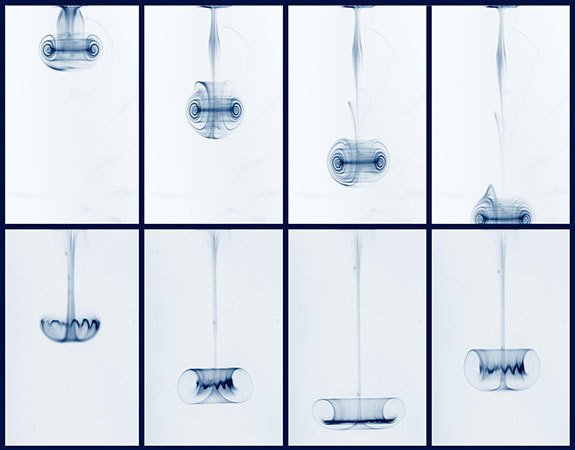
Objects falling into a quiescent fluid leave an air-filled cavity in their wake. The cavity collapses quickly due to the pressure of the surrounding fluid; but while it lasts, the cavity carries a signature of the object that made it. The collage above shows a series of snapshots of the formation and collapse of a cavity created by a 20-petal disk. Although the disk is essentially circular with only a small variation along its circumference, the effects of those perturbations appear soon after formation in the sidewalls of the cavity and persist until after its pinch-off and collapse. For more cavity dynamics, see here. (Image credit: O. Enriquez et al.)

Colonial Life
Hydroids are small underwater animals that often live in colonies made up of individual polyps. The colony is interconnected through the gastrovascular system, which is responsible for both digestion and respiration. In the images above, a single polyp in the colony has been fed food dyed with a fluorescent tracer. The polyp serves as a circulating pump and, as the food is digested and the tracer released, more and more of the colony becomes visible. Watch the full video and read more about the experiment. (Video credit and submission: L. Buss Lab)

Jet Impact

Viscoelasticity can generate some bizarre fluid behaviors. Viscoelastic fluids are special class of non-Newtonian fluid in which the response to deformation is both viscous, like a fluid, and elastic, like rubber. Above, a jet of viscoelastic fluid impacts a plate as viewed from the side (top image) and beneath (bottom image). When the jet impacts the plate, elastic stresses in the fluid destabilize the cylindrical symmetry of the jet. The jet instead becomes webbed, with an odd, asymmetric number of webs. The number of webs depends on the viscoelastic properties of the fluid as well as the jet’s speed and distance from the plate. (Image credit: B. Néel et al.)

Fine-Tuning Flight
We humans generally use fixed wings for flight, but in nature, flapping flight dominates. As an animal flaps, it extends or draws in its wings during key points of the cycle in order to change its aerodynamics. But this control can be more than just a matter of stretching their wings. Recent work on bats shows that they can fine-tune the stiffness of their wings’ membrane using tiny, hair-thin muscles. Each muscle is too slight to change a wing’s shape on its own, but by firing synchronously–tensing on the downstroke and relaxing on the upstroke–the bat can manipulate its membrane stiffness and thereby affect its wing shape. Moreover, the timing of the muscles’ action changes with flight speed, suggesting that the bats are actively controlling their aerodynamics during flight. (Video credit: Swartz-Breuer lab/Brown University; via Futurity; submitted by Boris M)

Turbulence and Star Formation

Galaxy clusters are objects containing hundreds or thousands of galaxies immersed in hot gas. This gas glows brightly in X-ray, as seen in the Perseus (top) and Virgo (bottom) clusters above. Over time, the gas near the center of the clusters should cool, generating many new stars, but this is not what astronomers observe. New research suggests turbulence may prevent this star formation. The supermassive black holes near the center of these galaxy clusters pump enormous amounts of energy into their surroundings through jets of particles. Those jets churn the gas of the cluster, generating turbulence, which ultimately dissipates as heat. It is this turbulent heating astronomers think counters the radiative cooling of the gas, thereby keeping the gas hot enough to prevent star formation. You can read more about the findings in the research paper. (Image credits: NASA/Chandra/I. Zhuravleva et al.; via io9)

The Kaye Effect
Those who have poured viscous liquids like syrup or honey are familiar with how they stack up in a rope-like coil, as shown in the top row of images above. What is less familiar, thanks to the high speed at which it occurs, is the Kaye effect, which happens in fluids like shampoo when drizzled. Shampoo is a shear-thinning liquid, meaning that it becomes less viscous when deformed. Like a normal Newtonian fluid, shampoo first forms a heap (bottom row, far left). But instead of coiling neatly, the heap ejects a secondary outgoing jet. This occurs when a dimple forms in the heap due to the impact of the inbound jet. The deformation causes the local viscosity to drop at the point of impact and the jet slips off the heap. The formation is unstable, causing the heap and jet to collapse in just a few hundred milliseconds, at which point the process begins again. (Image credit: L. Courbin et al.)

Inside the Strait of Gibraltar
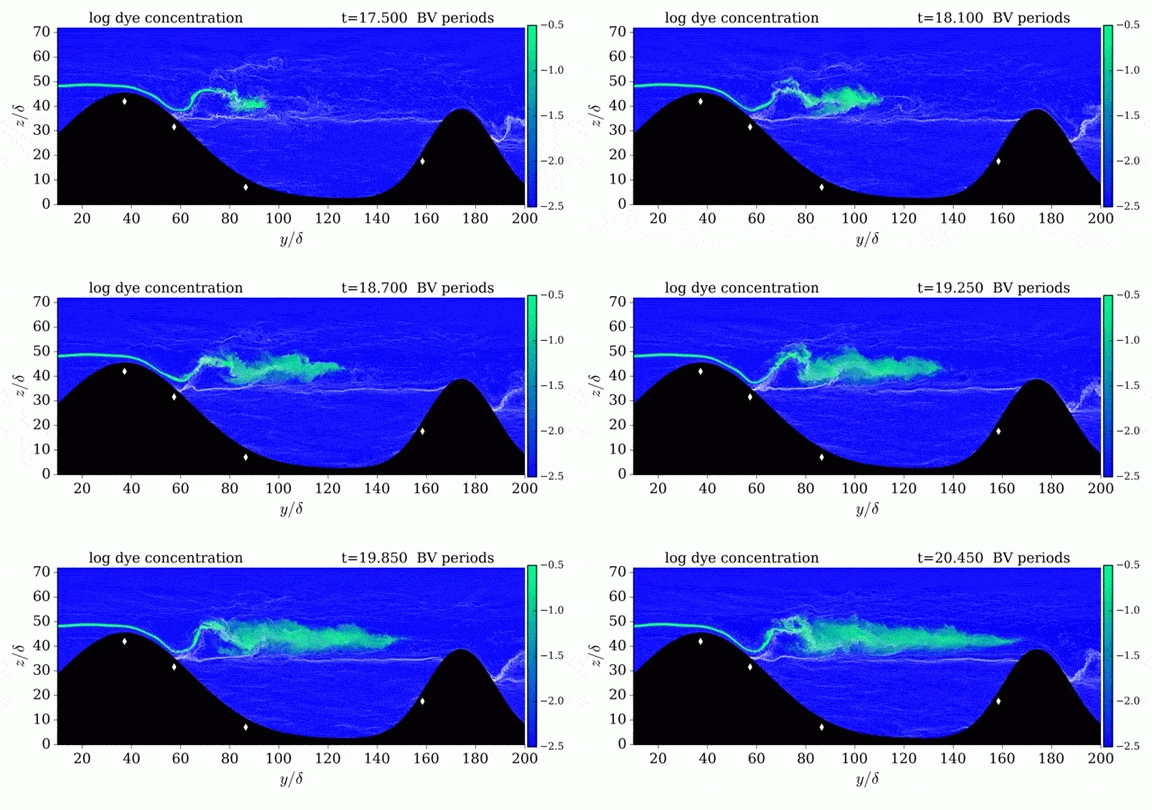
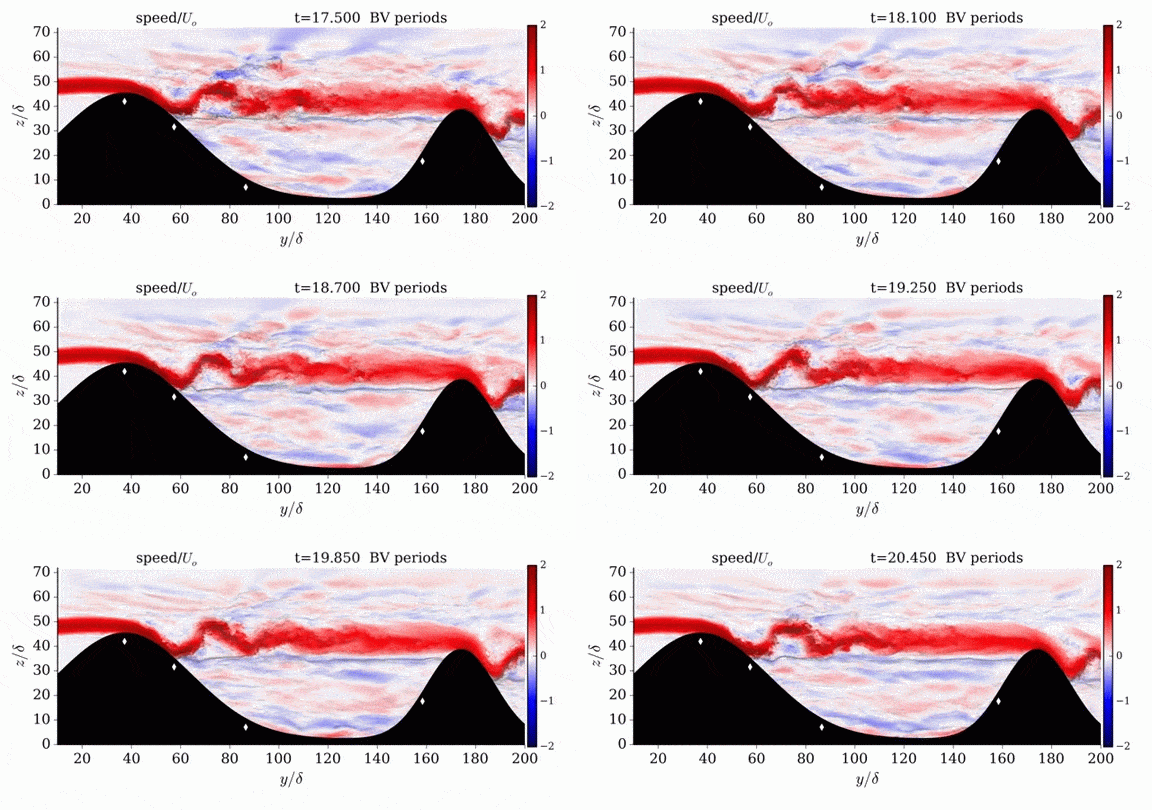
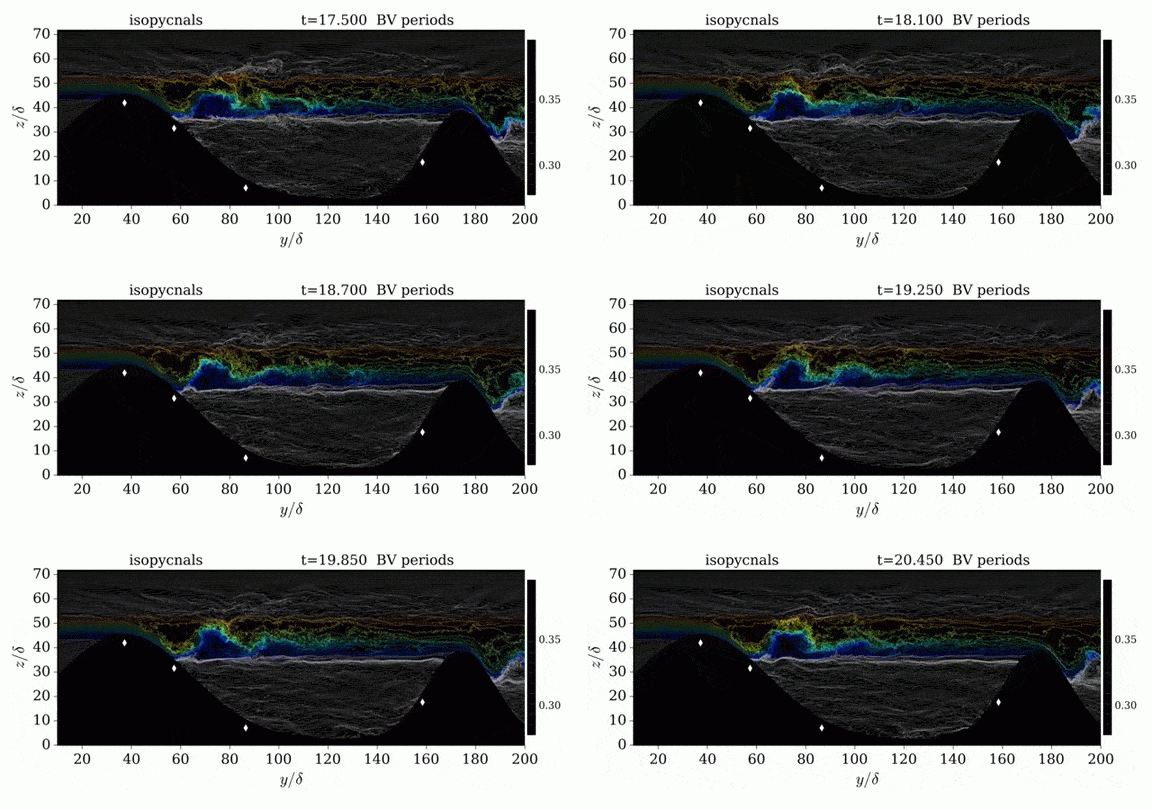
When a fluid is stratified into layers, it’s possible to have waves generated and transmitted along the interface between layers. Because these waves remain inside the bulk fluid, they are called internal waves. They often occur in the atmosphere or the ocean as fluids with different properties move past changing terrain. The Strait of Gibraltar is an excellent source of internal waves. The tidal exchange of waters between the Mediterranean Sea and Atlantic Ocean takes place through a narrow corridor interrupted by the peak of Camarinal Sill. The internal waves generated by the constriction are large enough that their effect on the surface flow is visible to satellites. The video above visualizations data from a numerical simulation of flow through the Strait, showing the obstacles, flow, and wave structures generated. (Video credit: J.C. Sanchez Garrido et al.)

Levitating Droplets with Motion
There are many ways to levitate a droplet – heating, vibration, and acoustic levitation all come to mind – but this video demonstrates a simpler method: a moving wall. Depositing a drop on a moving wall keeps it aloft with a thin, constantly replenished layer of air. The thickness of this lubricating air film is directly measurable from interference fringes created by light reflecting off the surface of the drop. Incredibly, the air layer is only a few microns thick, but the resulting pressure in the air film is high enough to levitate millimeter-sized droplets! (Video credit: M. Saito et al.; via @AlvaroGuM)

Plume Stratification
Clean-up of accidents like the 2010 Deepwater Horizon oil spill can be complicated by what goes on beneath the ocean surface. Variations in temperature and salinity in seawater create stratification, stacked layers of water with differing densities. When less dense layers are on top, the fluid is said to be stably stratified. Since oil is less dense than water, one might assume that buoyancy should make an oil plume should rise straight to the ocean surface. But the presence of additives or surfactants in the oil mixture plume can prevent that. With surfactants present, an oil mixture tends to emulsify, breaking into tiny droplets like a well-mixed salad dressing. Even if the density of the emulsion is smaller than the surrounding fluids, such a plume can get trapped at a density boundary, as seen in the photo above. Researchers report a critical escape height, which depending on the plume’s characteristics and stratification boundary, determines whether a plume escapes or becomes trapped. (Image credit: R. Camassa et al.)