Mussels live in rough conditions, constantly pummeled by waves and turbulent currents. They hold themselves fast in the flow using dozens of byssel threads (commonly called a mussel’s beard) that anchor them to rocks and other mussels. The threads get built within the mussel’s foot, the tongue-like protrusion mussels use to drag themselves. The threads are similar to our ligaments: strong and stretchy. Each one is cemented securely using an adhesive that hardens in water. If engineers could replicate that adhesive, it would be fantastic for use in medicine. (Video and image credit: Deep Look)
A cylinder in a flow produces a series of alternating vortices known as a von Karman vortex street. Changing the flow speed and rotating the cylinder both allow researchers to tune the frequency of these shed vortices. What happens to an object in the wake?
For a simple hydrofoil tethered to the cylinder, the object wends back and forth along the vortices. But when that hydrofoil sits at the end of a double-pendulum, something very interesting happens. The whole apparatus follows a consistent trajectory similar to a human walking gait. Researchers are using this motion to build a robot that will help physical therapy patients regain a natural walking style. (Image and video credit: A. Carleton et al.)
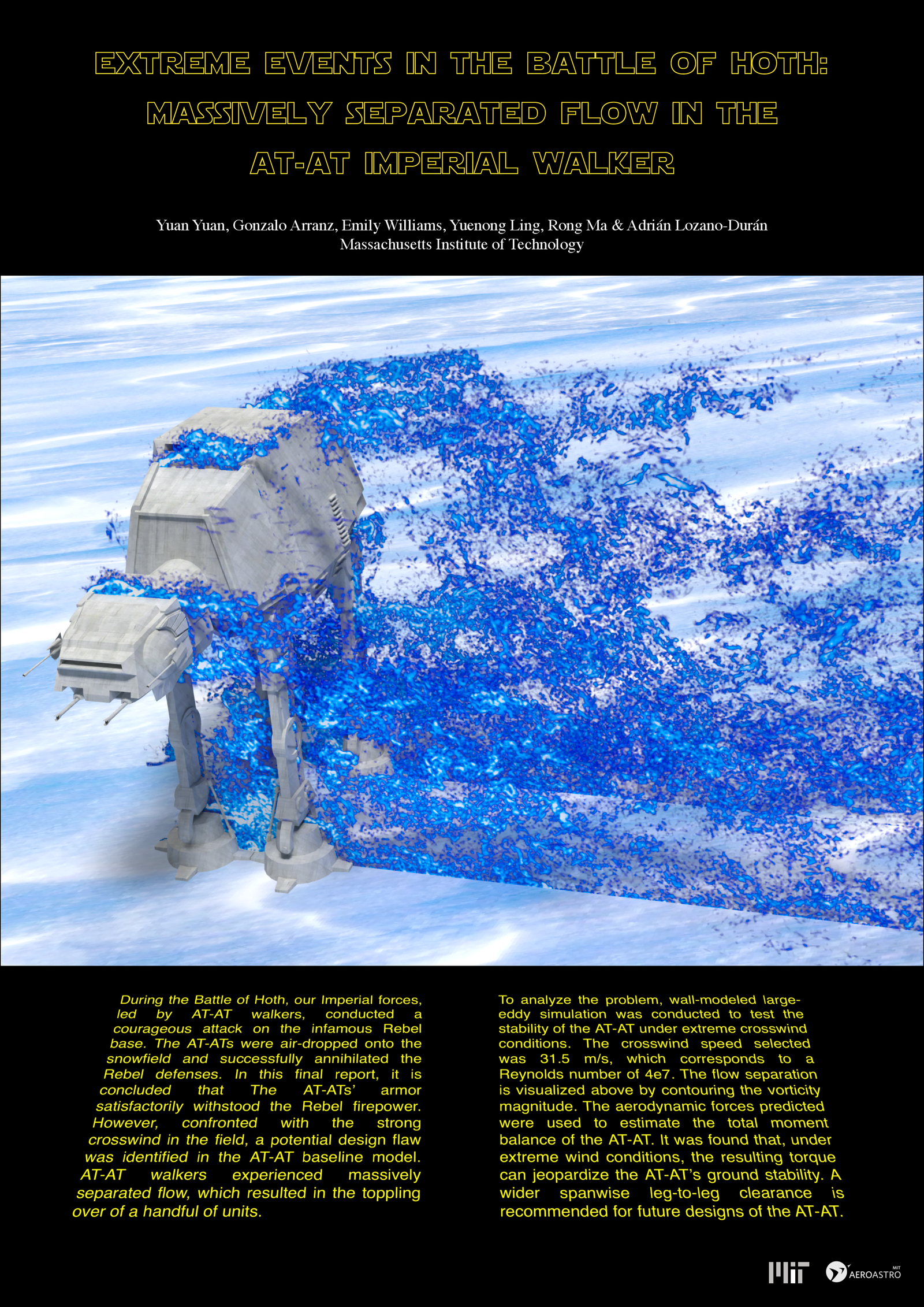
Having previously examined the re-entry characteristics of an X-Wing, a group of engineers are back to look at Imperial vehicle physics. In this poster, they look at what happens to the AT-AT walker when strong crosswinds, like those seen in the Battle of Hoth, blow across the vehicle’s path. Given its boxy body and gangly legs, it will come as no surprise that the AT-AT is not at all streamlined and instead causes lots of separated flow. Those flow separations come with strong side forces that can tip the walkers.
Be sure to take a closer look at the text on the poster. It’s written from the perspective of Imperial engineers, complete with recommendations for the next generation of AT-AT. (I don’t think those got built, at least not by the Empire!) May the 4th be with you! (Image credit: Y. Yuan et al.)
When droplets get larger than 0.27 cm, they no longer stay spherical as they fall. Here, researchers look at very large droplets (equivalent to 3.06 cm in diameter) falling into water. On their way to the pool, the droplets oscillate — some lengthening, some flattening, and some bulging into a bag. The droplet’s shape at impact (and its speed) determine what shape of splash and cavity form. Wider drops make wider and shallower cavities. (Image credit: S. Dighe et al.)
Mammatus clouds are fairly unusual and often look quite dramatic. Most clouds have flat bottoms, caused by the specific height and temperature at which their droplets condense. But mammatus clouds have bubble-like bottoms that are thought to form when large droplets of water or ice sink as they evaporate. Although they can occur in the turbulence caused by a thunderstorm, mammatus clouds themselves are not a storm cloud. They appear in non-stormy skies, too. The clouds are particularly striking when they’re lit from the side, as in the image above. (Image credit: J. Olson; via APOD)
In their natural state, rivers are variable in their course, shifting and meandering. Sometimes they deposit sediment, and sometimes they erode it. In this video, Grady from Practical Engineering digs into the principles behind these changes. With help from Emriver‘s stream tables, which demonstrate years of changes in a river over minutes, Grady shows how changing the sediment load, flow rate, and other factors in a river affect its course. (Video credit: Practical Engineering)
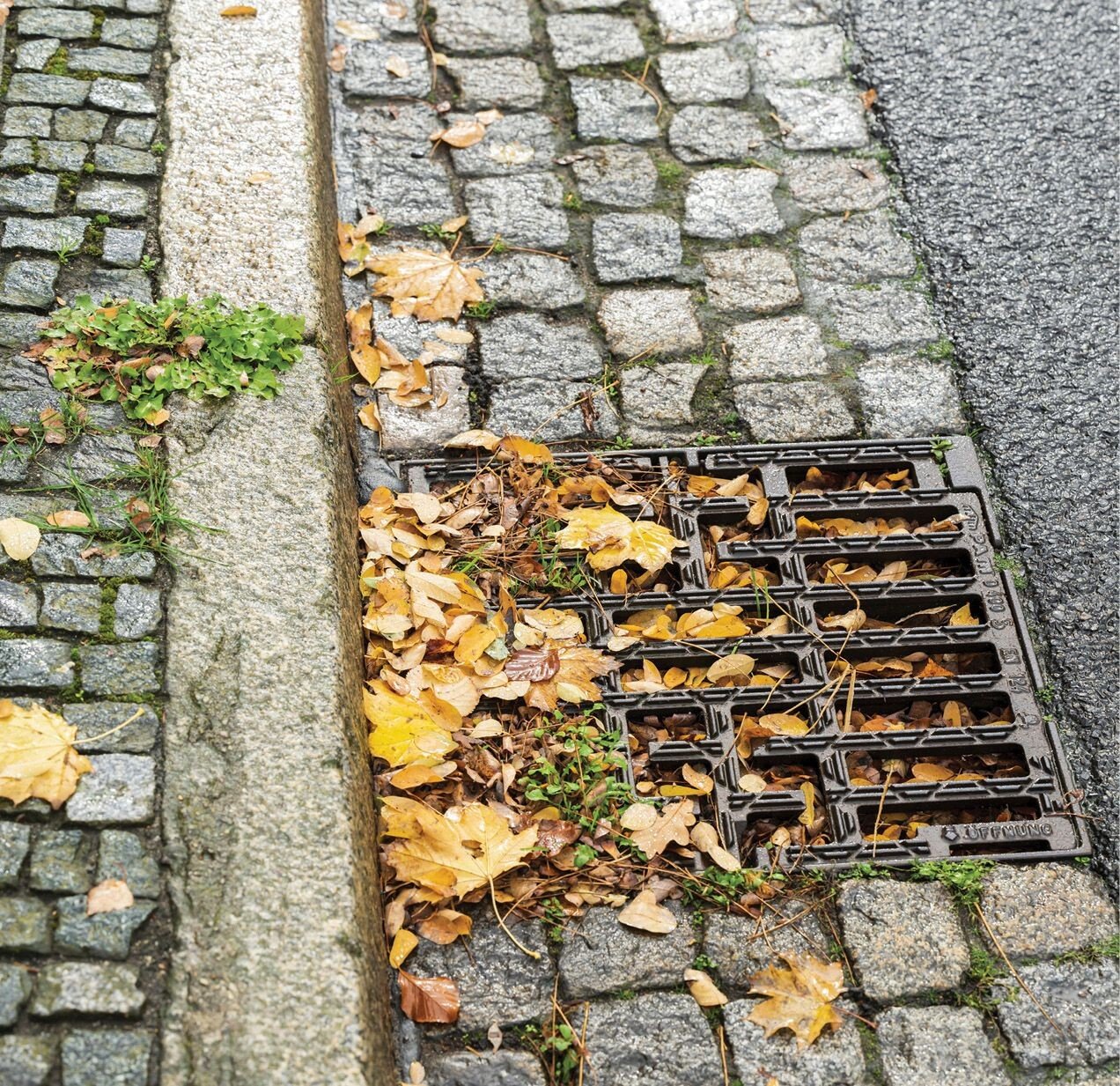
Clogging is one of those phenomenons that we encounter constantly, from overflowing storm drains to the traffic jam at the door when a lecture ends. It happens at all scales, too; ink-jet cartridges and microfluidic circuits can jam up just as thoroughly as a grain silo. Although there are many complexities to clogging, the basic mechanisms fall into three categories: sieving, bridging, and aggregation.
Of these, sieving is the most familiar; it occurs when a particle too large for the constriction gets stuck. That includes both a rock too large to fit down a storm drain and a leaf that gets caught in the wrong orientation.
Bridging, on the other hand, occurs when too many small particles reach a constriction at the same time. Although each one is small enough to fit on its own, their simultaneous arrival means that they jam together into a bridge that blocks the constriction. Given time, all flow comes to a stand still, as seen in the images below.
Sequence of images showing the formation of a particle bridge and subsequent clogging of the entire constriction.
The last mechanism, aggregation, is a more gradual blockage, formed as individual particles begin sticking to a surface, making the constriction progressively smaller. Think of those hard-water buildups that eventually block your shower head.
Some of these mechanisms are easier to prevent or clear than others, but researchers are making progress. For an overview of the field’s current standing, check out this Physics Today article. (Image credit: drain – R. Rampsch, bridging – D. Jeong et al.; see also B. Dincau et al. at Physics Today)
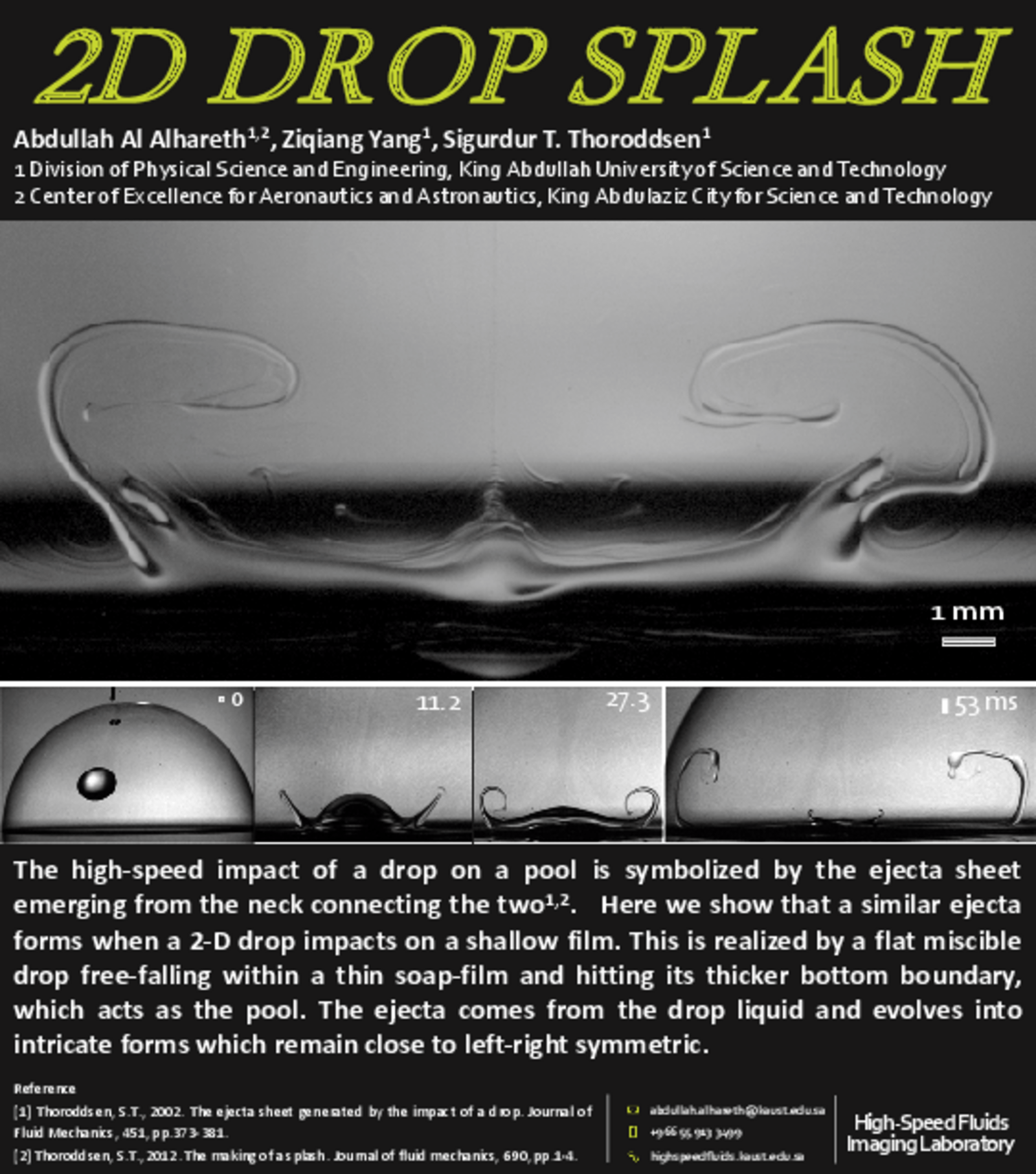
We see plenty of droplets splash when they fall into a pool, but what happens when the drop and pool are two-dimensional? Here researchers captured the familiar process of a splash in an unfamiliar way by looking at a falling drop contained within a soap film. As the drop reached the thicker lower boundary of the soap film (which acts like a pool), its impact sent up ejecta that stretch and curl, much like the three-dimensional splashes we’re accustomed to. (Image credit: A. Alhareth et al.)
In the United States, we expect clean water from our taps, but the experiences of Jackson, Mississippi over the last several years are a reminder that we cannot take that water for granted. Since 2020, aging infrastructure, chronic underfunding, and extreme weather have placed the city in a state of emergency. Residents are often under boil water notices, if they have water pressure at all. In this video, Grady from Practical Engineering dissects the engineering side of this crisis and what’s needed to keep a city’s residents supplied with clean water. Check out the video’s links for more on the racism and politics that impact the crisis. (Video credit: Practical Engineering)
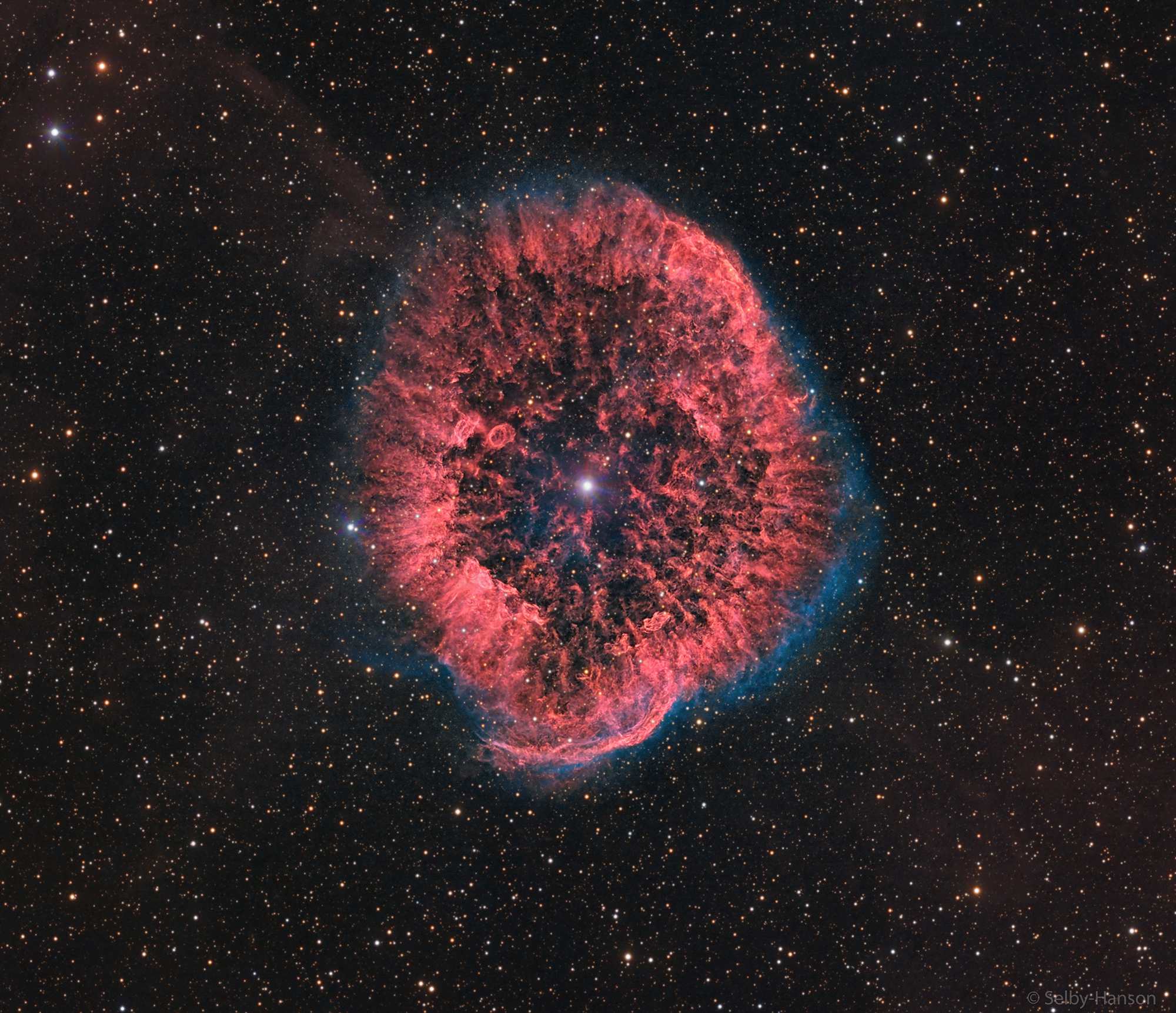
Stars about 100 times more massive than our sun live fast and die young. They burn through their hydrogen supply quickly, then start fusing heavier elements. As they do, their strong stellar winds start blowing off the exterior layers of the star. That’s the story behind WR 40, the star at the center of Nebula RCW 58. The nebula itself is made up of material blown off the star, carved into turbulent filaments by stellar winds. (Image credit: M. Selby and M. Hanson; via APOD)