With the right shot, it’s possible to skip a bullet off water, as shown in this video from the Slow Mo Guys. The angle of the bullet relative to the water needs to be quite shallow, as this sets the bullet up for the hydrodynamic lift needed to skip. Physically, the mechanism for skipping a bullet is similar to rock-skipping. The bullet’s impact creates a cavity that the bullet rides. With the right conditions, the cavity orients the bullet upward, creating the lift needed to skip. (Video and image credit: The Slow Mo Guys)
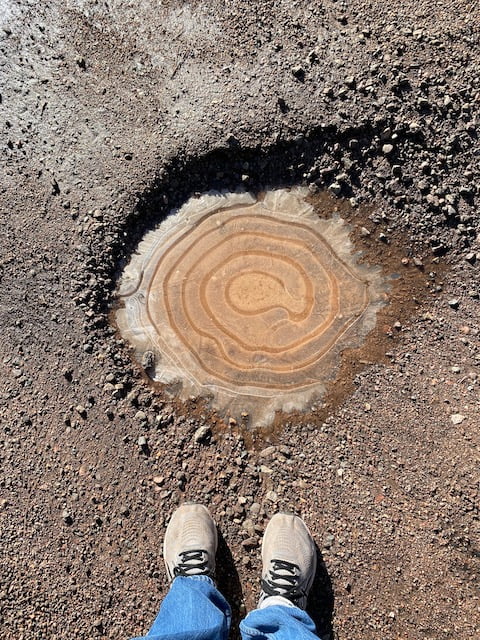
This odd puddle was found in Arizona after a night with low temperatures around -8 degrees Celsius (18 degrees Fahrenheit). Unlike the concentric rings sometimes seen on ice, this puddle formed one spiraling crack. It’s hard to know exactly what factors played into this formation since it was only found after the fact, but one possibility is that the puddle was initially frozen in a continuous sheet. Then, as the temperature cooled overnight, the ice contracted, forming a crack. As the ice kept cooling and contracting inward, the crack grew, spiraling toward the center of the puddle. (Image credit: M. Hendrickson; via EPOD; submitted by Kam-Yung Soh)
Iridescent clouds shine bright over this Finnish sunset. These colorful clouds are nacreous clouds, also known as mother-of-pearl clouds. Formed from ice crystals during frigid conditions in the lower stratosphere, these clouds are most visible before dawn and after sunset, when their high altitude catches sunlight while the lower atmosphere doesn’t. These rare clouds form mostly in high latitudes during winter. While they appear similar to other iridescent clouds that occur all over the world, nacreous clouds are far brighter and more vivid. (Image credit: D. Lehtonen; via APOD)
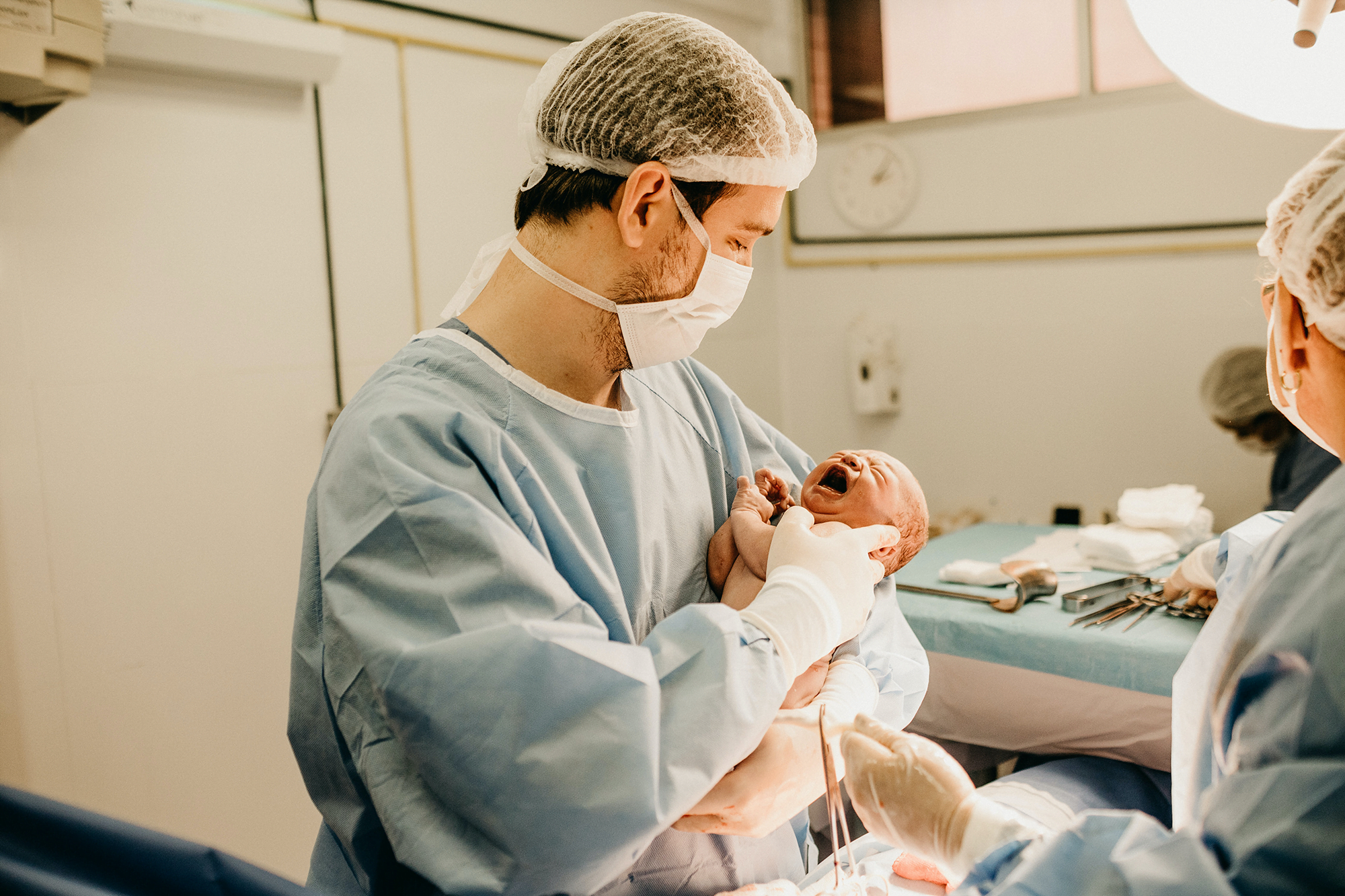
The placenta, critical as it is to human life and development, is likely the least-studied organ in the body. Reasons for that abound, from the ethics of studying pregnant people to the historical marginalization of female bodies in medical studies. But what little we do know shows that the placenta is quite incredible.
Shaped somewhat like a flattened cake, the placenta contains a tangle of fetal blood vessels — an estimated 550 kilometers’ worth — bathed in maternal blood. The enormous surface area — nearly 13 meters squared — enables the exchange of oxygen, glucose, and urea through diffusion. These exchanges don’t take place in still conditions, though; blood is always flowing through the vessel network. This means that each exchange depends on both the speed of diffusion and the speed of the flow, a relationship that’s captured with the dimensionless Damköhler number.
Illustration of the intertwined blood vessels of the placenta.
Some exchanges, like carbon monoxide and glucose, are diffusion-limited, meaning that increased blood flow cannot speed up the process (though additional blood vessel surface area could). In contrast, carbon dioxide and urea are flow-limited exchanges. Fascinatingly, oxygen is close to being both diffusion- and flow-limited, suggesting that the organ has optimized for this exchange. Since pregnancy also involves a large increase in maternal blood volume and changes in lung capacity to help provide oxygen, it seems like the pregnant body heavily emphasizes delivering oxygen to the developing fetus. (Image credit: newborn – J. Borba, placenta – iStock/Sakurra; via Physics World; submitted by Kam-Yung Soh)
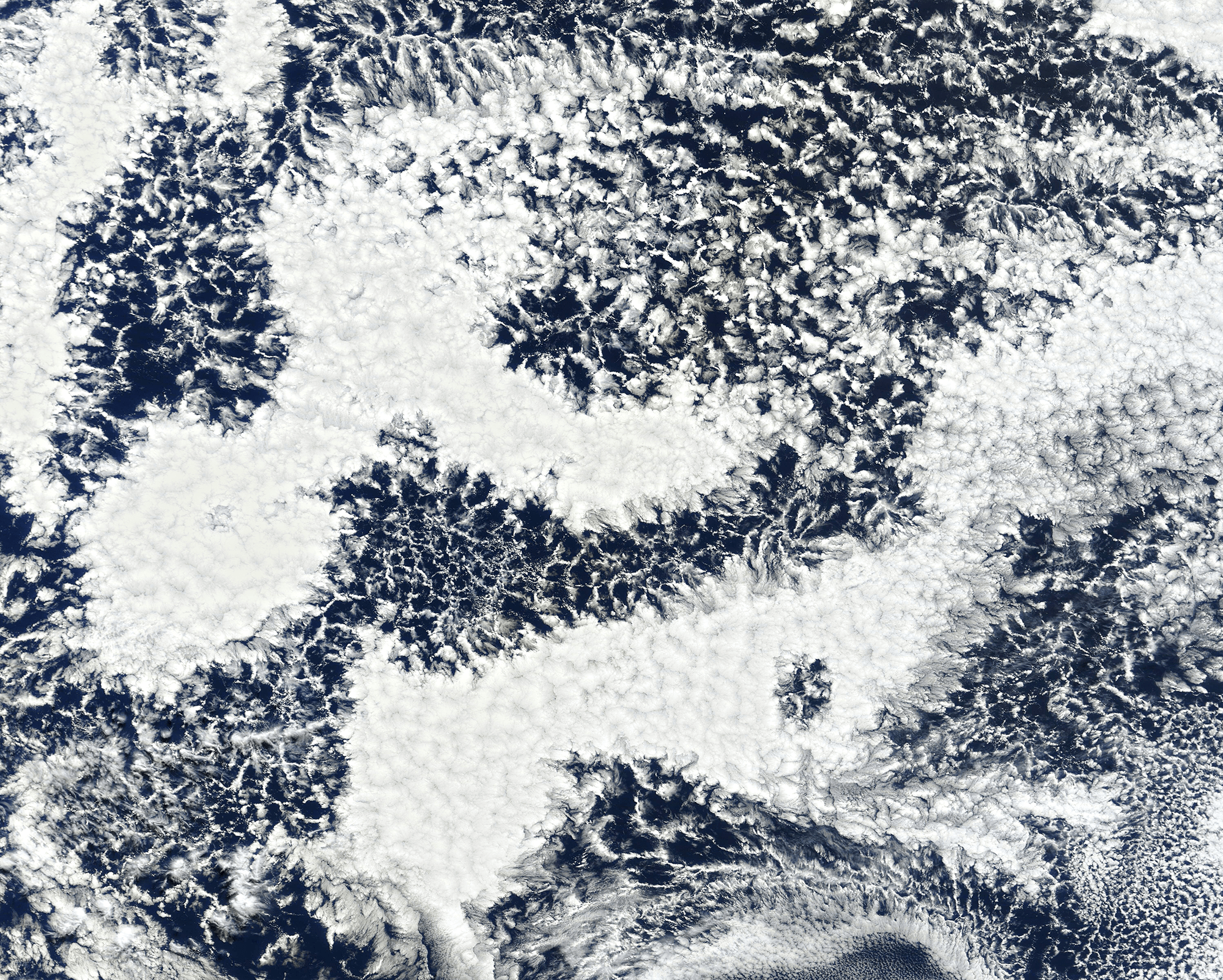
Though tough to make out from the surface, our oceans are often covered by cell-shaped clouds stretching thousands of kilometers. This satellite image shows off two such types of marine stratocumulus cloud. Open-celled clouds appear as thin wisps of vapor around an empty middle; in these clouds, cool air sinks through the center while warm air rises along the edges. Open-celled clouds are good rain producers.
On the flip side, closed-cell clouds have a vapor-filled center and breaks in the cloud cover along each cell’s edge. These clouds don’t produce much rain, but they do lift warm, moist air through their middles and let cool air sink along their edges. Closed-cell clouds tend to last much longer than their open-celled counterparts; they can stick around for half a day, whereas open-celled clouds break up in only a couple hours. (Image credit: J. Stevens; via NASA Earth Observatory)
Soap films naturally thin over time as fluid evaporates and differences in film thickness cause surface-tension-driven flows. In this video, researchers experiment with adding magnetic nanoparticles to the soap film. In the second image, the white structures near the center of the film contain nanoparticles, and they’re drawn toward the magnet that sits (out-of-frame) to the left of the film. With more nanoparticles and a stronger magnetic field (Image 3), the entire soap film takes on a distinctive profile that thins from left to right. The effect is so strong that the film quickly thins to the point of rupture. (Image and video credit: N. Lalli et al.)
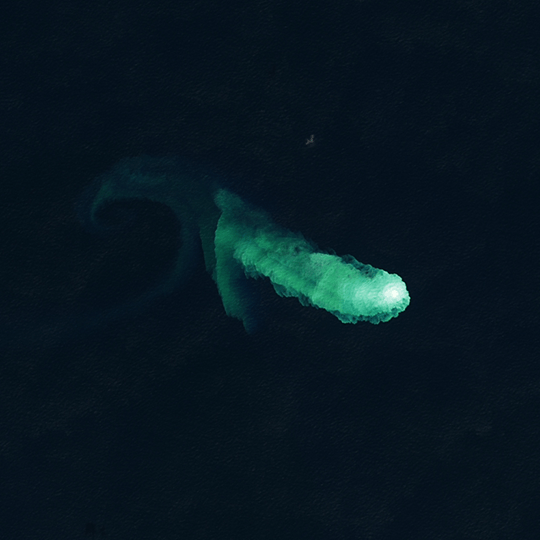
This pale green plume signals the activities of Kaitoku, an underwater seamount near Japan. Periodic activity picked up there in August 2022 and continued into the new year. The rising plume likely consists of superheated acidic seawater mixed with particulates, sulfur, and rock fragments. Underwater volcanoes like this one are thought to account for up to 80 percent of our planet’s volcanic activity. (Image credit: L. Dauphin; via NASA Earth Observatory)
In the ocean, waves often curl over and trap air, becoming plunging breakers. How do surfactants like soap or oil affect this process? That’s the question behind this video, where researchers visualize breaking waves with differing amounts of added surfactant. In the case of pure water, the wave forms a smooth jet that curls over and traps air when the wave breaks. As more and more surfactant gets added, the shape of that jet and cavity change. In one case, they become irregular. In another, they disappear entirely, and with the most surfactant added, the wave suddenly looks just like the water-only case.
The key to these behaviors, it turns out, is not how much surfactant there is, but how much the concentration of surfactant varies along the length of the wave. When there are significant changes in the surfactant concentration along the wave, local Marangoni flows try to even out the surface tension, causing the wave to break up in an irregular fashion. (Image and video credit: M. Erinin et al.)
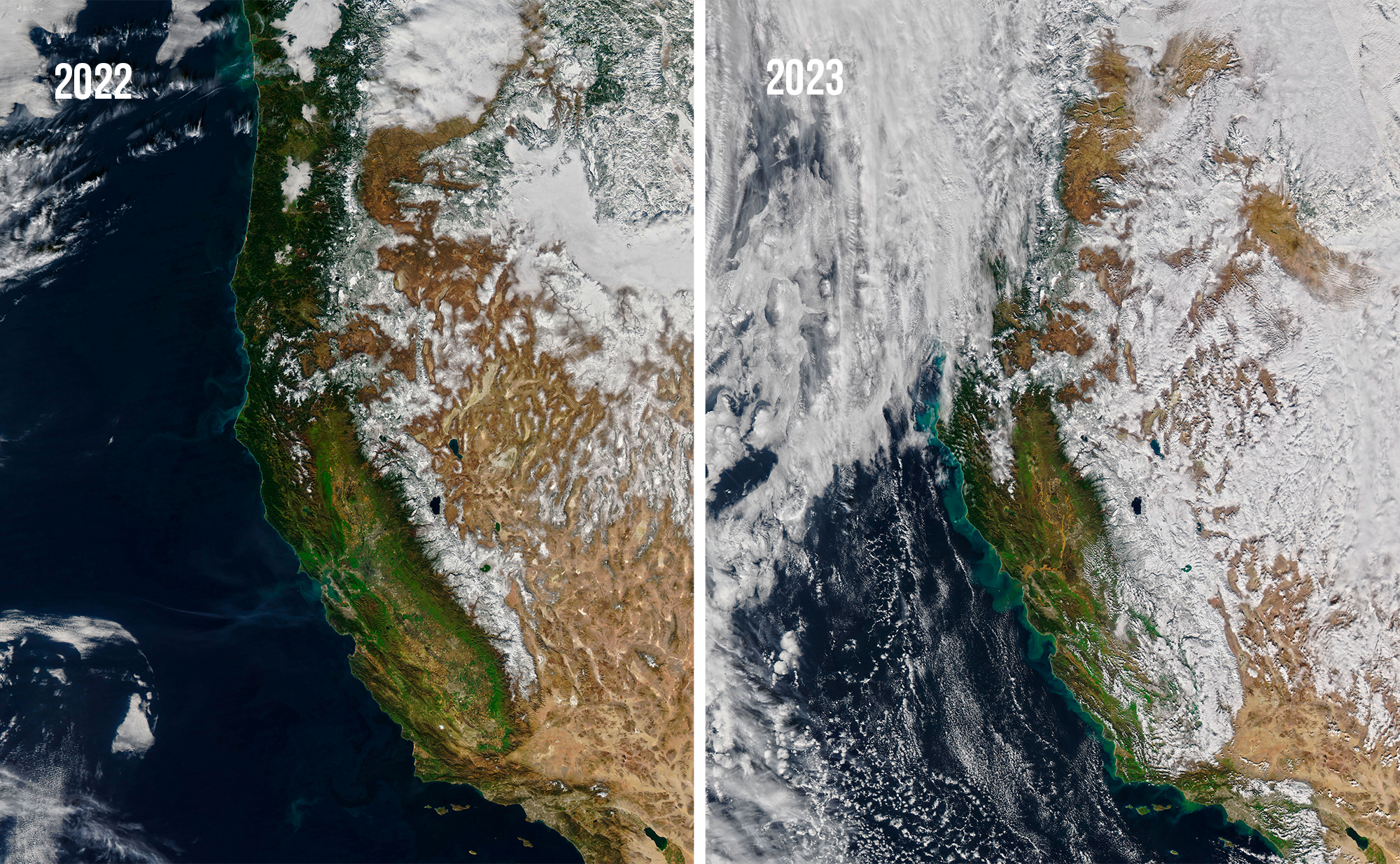
The new year brought California a series of atmospheric rivers that poured record amounts of water onto drought-stricken lands. While the precipitation refreshed snowpacks and reservoirs, much of it washed away as soils oversaturated. Those flows carried sediment with them, creating swirls of brown and green along the coastline.
Compare the two satellite images above to see how different January 2022 looked from January 2023, post-deluge. The snow levels in January 2023 were about 248 percent of their average level for that part of the season. But the sediment levels in the ocean are also drastically increased, indicating high levels of erosion. (Image credit: J. Stevens; via NASA Earth Observatory)
When a water drop hits a surface that’s much hotter than its boiling point, part of it will vaporize immediately. Depending on the temperature, this Leidenfrost effect can be a relatively gentle process — or not. Here, the surface is so hot that the entire drop is boiling before it’s even finished spreading from impact. The vapor in contact with the surface is trying to escape, bubbling up so violently that it rips the original droplet into a spray of tiny droplets. (Video and image credit: L. Gledhill)