Category: Phenomena

  • Featured Video Play Icon

    Cleaning the Skies

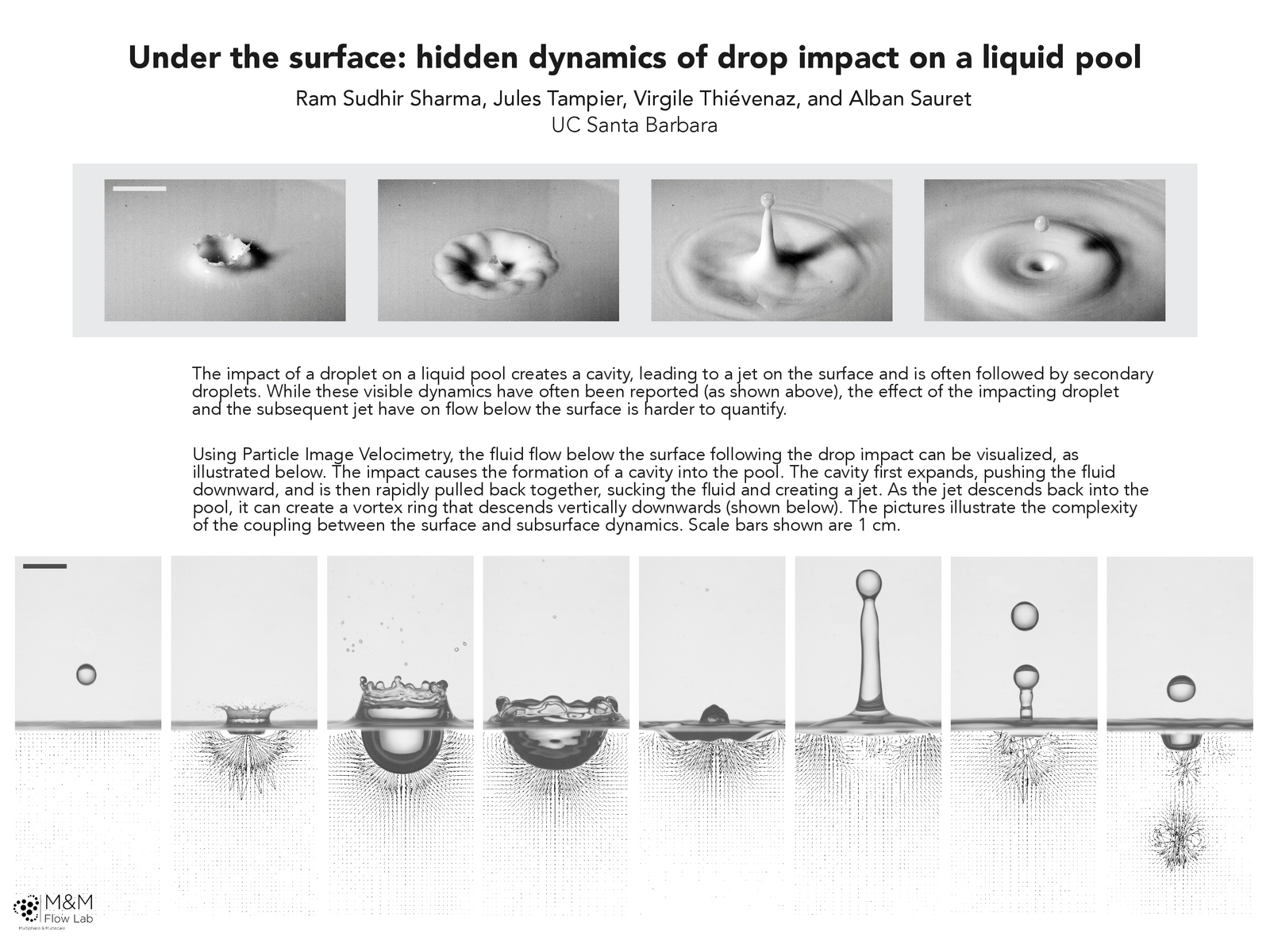
    Those of us who live in urban environments have experienced the clear, pollution-free air that comes after a rainstorm. But how exactly does rain clean the air? Air pollution typically has both gaseous and particulate components to it. As a raindrop falls, it experiences collision after collision with those particles. Depending on the particle’s surface characteristics — is it hydrophilic or hydrophobic? — and its momentum during impact, it can get trapped in the raindrop, skip off, or even pass through entirely. The physics, it turns out, are identical to those of a rock falling into or skipping off a lake — even though the raindrop and particle might be 1000 times smaller! (Image and video credit: N. Speirs et al.)

  • Featured Video Play Icon

    Flow Between Fibers

    Two vertical fibers, with a gap left between them, form a playground for flow in this Gallery of Fluid Motion video. If the fiber spacing is small enough, the flow will form a stable liquid sheet that runs the full length of the fibers. With a little more distance, though, the fluid forms intermittent bridges, whose spacing depends on flow rate. And when the fibers are not perfectly vertical, even more complex flows are possible. I love how a seemingly simple situation begets such complexity! (Image and video credit: C. Gabbard and J. Bostwick)

  • Featured Video Play Icon

    Recreating the Rings of Power Opening

    Everyone loves a good title sequence, especially when they feature neat visuals. Many who watched “The Rings of Power” zeroed in immediately on their use of cymatics — visuals born from the vibrations of sound. In the video above, Steve Mould delves into the physics behind cymatics and recreates patterns similar to those in the show’s opening, which was a mixture of CGI and live action.

    For Tolkien fans, the opening sequence holds additional layers of meaning; in Tolkien’s mythology, the universe is born from song, and many of the patterns shown in the opening — the two trees, Fëanor’s star, and the Silmarils themselves — are drawn directly from Tolkien’s myths. In a way, the opening sequence tells the story of the creation of Arda and the rise of Sauron’s predecessor, Melkor/Morgoth, and all the events that led to the show itself. It’s incredibly cool, both from a physics perspective and a literary one. (Image and video credit: S. Mould)

  • Featured Video Play Icon

    Moths and Beetles in Flight

    Watching insects take flight in high-speed video is always mesmerizing. So often their wings look too small and fragile to lift their bulbous bodies, but they manage the feat easily. I especially like to watch how much their wings flex during each up- and downstroke. So often we think that stiffer wings — like those on airplanes — are better for flight, yet nature demonstrates at so many sizes that flexibility is better, especially in flapping flight. A flexible wing can maximize lift in the downstroke and curl to minimize drag on the upstroke. Even wings that fold away, as many beetle wings do, can do the job of lifting an insect once shaken out. (Image and video credit: Ant Lab)

  • Featured Video Play Icon

    Chemical Flowers

    These “flowers” blossom as two injected chemicals react in the narrow space between two transparent plates. The chemical reaction produces a darker ring that develops a streaky outer edge due to competition between convection and chemical diffusion.

    To show how gravity affects the instability, the researchers repeated the experiment on a parabolic flight. In microgravity conditions, no instability formed. That’s exactly what we’d expect if convection (i.e. flow due to density differences) is a major cause. No gravity = no convection. In contrast, under hypergravity conditions, the instability was initially spotty before developing streaks. (Image and video credit: Y. Stergiou et al.)

  • Summer Melt

    Summer Melt

    A warm summer in 2022 has resulted in record melting on Svalbard. Located halfway between the Norwegian mainland and the North Pole, more than half of Svalbard is normally covered in ice. But with glaciers in retreat and firn — a surface layer of compressed porous snow — melting, pale blue ice is getting direct exposure to the sun and warm air temperatures. The result has been melting 3.5 times larger than the average melt between 1981 and 2010. Look closely and you’ll find deep blue meltwater ponds dotting the ice, too. The run-off of meltwater has likely carried extra sediment into the surrounding waters, accounting for some of the paler water colors along the coast. (Image credit: J. Stevens/USGS; via NASA Earth Observatory)

  • Featured Video Play Icon

    Fire Ant Rafts

    When you run into a fire ant, you’re in for a bad day. But if you run into a colony-sized raft of fire ants, well, that’s going to be a very bad day. These insects evolved to survive Amazonian floods, and that prowess has helped them spread far from their original homes. When waters start rushing into their home, the ants set out on a rescue mission, pulling their young out. The ants lash themselves and the youngsters together with their own bodies and form a floating raft. Thanks to the hydrophobic hairs on the larvae and ants, they trap a layer of air near their bodies. This helps them breathe, even if they’re on the bottom of the raft. Learn lots more about fire ants, including how they act as fluid, over here. (Image and video credit: Deep Look)

  • “Keeping Our Sheet Together”

    “Keeping Our Sheet Together”

    When two liquid jets collide, they form a falling liquid sheet. Here researchers explore how that sheet breaks up when the liquids involved contain polymers. The intact areas of the sheet show as dark red or almost black. The edges of the sheet appear in brighter red and yellow, outlining the holes that form and grow during breakup. The type of breakup observed depends on the concentration of polymer in the liquid. (Image credit: C. Galvin et al.)

  • Featured Video Play Icon

    Pistol Shrimp Snaps

    Gram for gram, few animals can match the power of a pistol shrimp’s snap. When its claw closes, the shrimp ejects a jet of water so fast that the water pressure drops below the vapor pressure, causing a cavitation bubble. Like other cavitation bubbles, this one is short-lived, growing and collapsing (and sending out shock waves!) in less than a millisecond. That’s enough to knock any predator or prey for a loop. (Image and video credit: Ant Lab)

  • Jupiter’s Frosted Clouds

    Jupiter’s Frosted Clouds

    This 3D rendering of Jupiter's cloud tops is based on flyby data from the JunoCam instrument. It's not a true physical image of the cloud tops, though scientists are working on a calibration for that. Instead, the elevations shown here are based on the intensity of visible light registered by the instrument. This measure correlates with cloud height, but there are exceptions.
    This 3D rendering of Jupiter’s cloud tops is based on flyby data from the JunoCam instrument. It’s not a true physical image of the cloud tops, though scientists are working on a calibration for that. Instead, the elevations shown here are based on the intensity of visible light registered by the instrument. This measure correlates with cloud height, but there are exceptions.

    New 3D renderings of Jovian clouds show textured swirls akin to a cupcake’s sculpted frosting. The images are based on flyby data from the JunoCam instrument. Because illumination of the clouds is generally brightest for the highest clouds, the team has rendered elevation based on brightest. While this is somewhat physical, it’s not exactly what Jupiter looks like. For that, Juno scientists are working on a calibration that will translate these initial renderings into a truer physical model. Nevertheless, the results are stunning, especially the flyover video embedded over here! (Image credit: 3D renders – NASA / JPL-Caltech / SwRI / MSSS / G. Eichstädt, image pair – G. Eichstädt et al.; via phys.org; submitted by Kam-Yung Soh)

    Cross your eyes to see this image pair as a 3D image of Jupiter's cloud tops.
    Cross your eyes to see this image pair as a 3D image of Jupiter’s cloud tops. The brighter regions will appear closer than the darker ones.