Zooplankton are tiny creatures found throughout Earth’s oceans. During the daytime, they linger in the twilight depths, where they are harder for predators to spot. But once the sun sets, zooplankton migrate hundreds of meters upward to reach the abundant food near the surface. When sunrise comes, they migrate back downward. Given their size, this feat is astounding; equivalent to a human running two 10-kilometer races a day at Olympic marathon speeds. And, despite their tiny size, these motions leave a mark; researchers have shown that the collective action of all these tiny swimmers is large-scale turbulence with serious mixing potential. (Video and image credit: Be Smart)
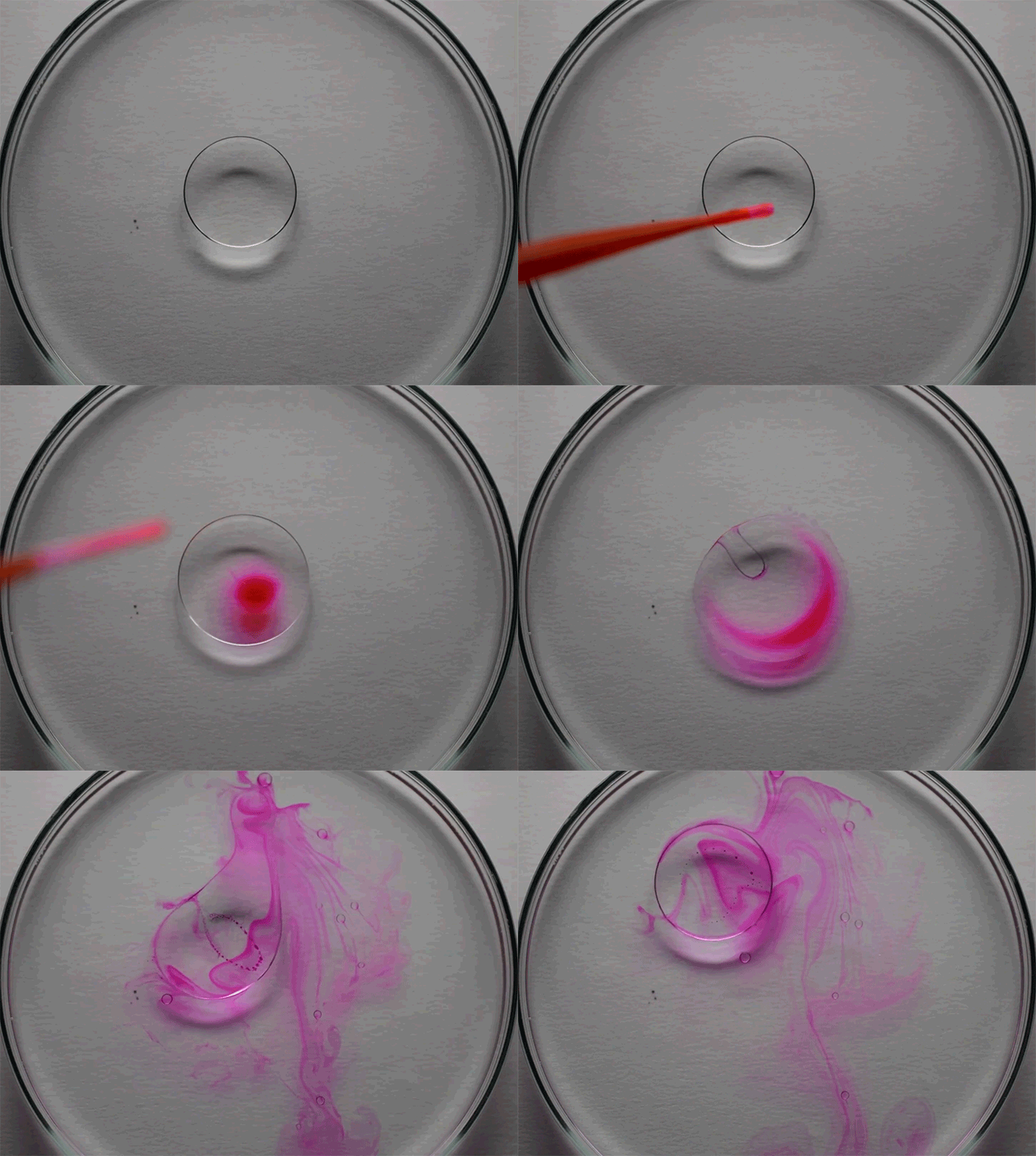
A blob of sunflower oil floating on soapy water forms a disk known as a liquid lens. But add some dyed ethanol and things take a turn. The lens rapidly expands and distorts as the ethanol and soapy water meet. These surface flows are driven by the imbalance of surface tension between the different liquids. The liquid lens deforms and abruptly ruptures, releasing dye and ethanol before rebounding into a stable lens again. Adding more ethanol to the lens will repeat the cycle. (Image credit: C. Kalelkar and P. Dey; research credit: D. Maity et al.)
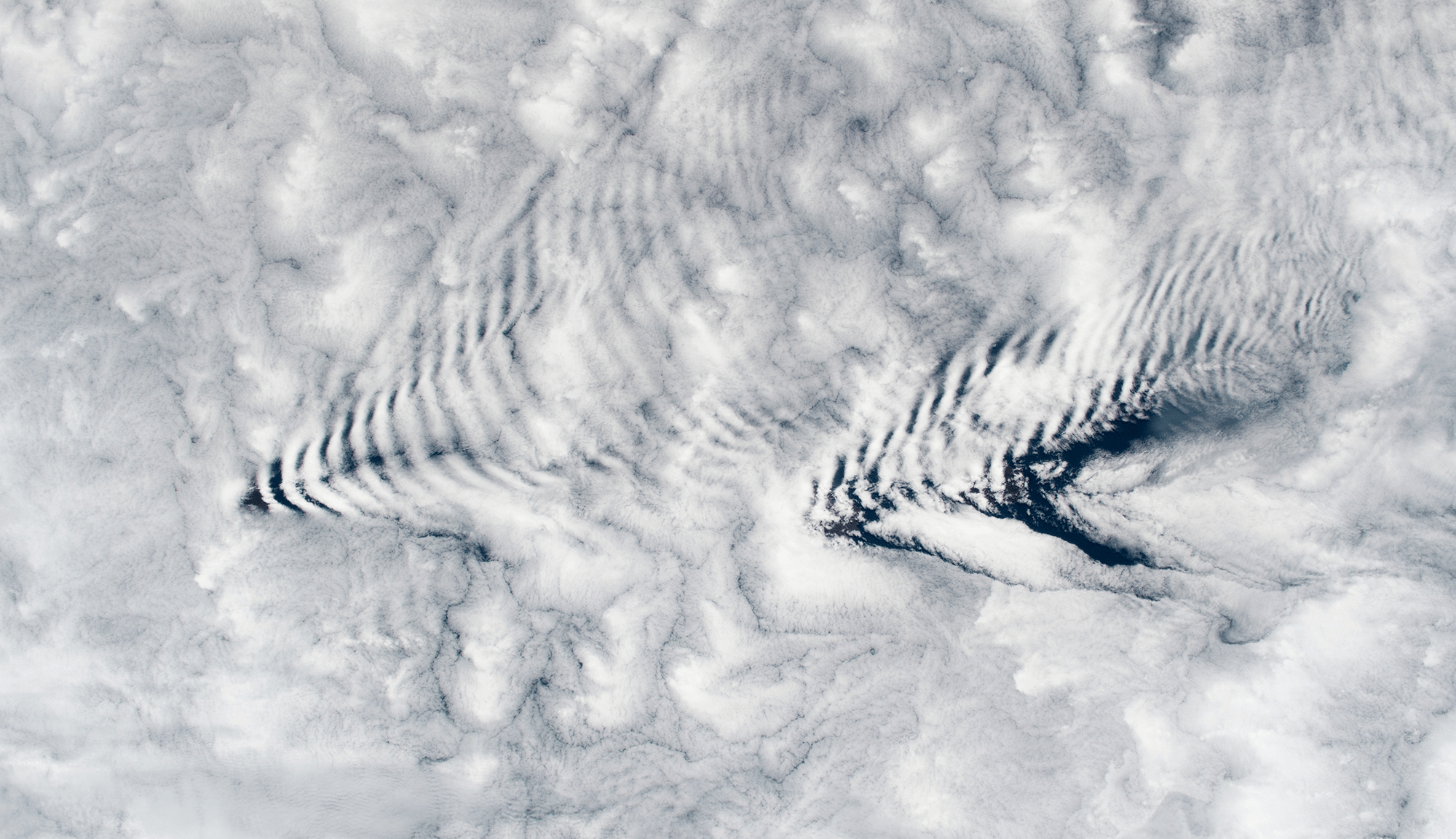
An astronaut snapped this image of wave clouds formed around the Crozet Islands, which lie between South Africa and Antarctica. Clouds like these form when warm, moist air gets pushed up and over a mountain. As it rises, the air cools and its pressure decreases, causing condensation. Pushed out of equilibrium, gravity then pulls the air back downward in the wake of the mountain. That warms the air, causing evaporation. Like a mass bouncing on a spring, the air continues to yo-yo up and down, forming cloudy stripes and clear ones until the energy from its mountain climb is spent. (Image credit: NASA; via NASA Earth Observatory)
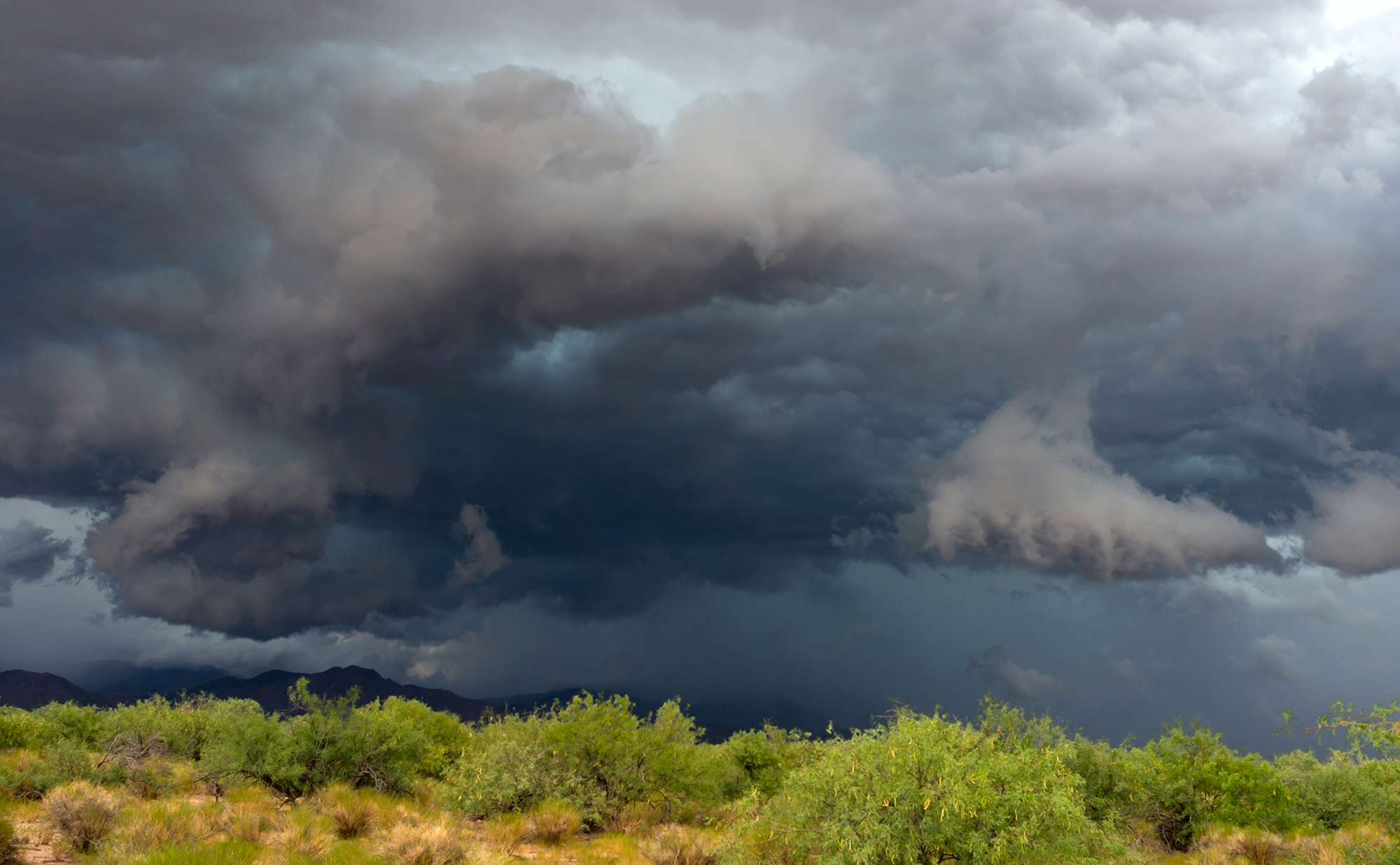
Summertime in the middle U.S. means thunderstorms, many of which can form long lines of storms known as squall lines. Complex convective dynamics feed such storms. Here is an illustration of one part of a squall’s lifecycle:
As rain falls and evaporates, it fuels the formation of a cold pool of air below the cloud. Incoming wind (gray arrows) blocks the cold pool from spreading. In turn, the cold pool acts as a ramp that redirects this warm, moist air upward. The vertical variation in wind speed (wind shear, shown with pink arrows) creates a positive vorticity. Together with the negative vorticity in the cold pool, this induces a vorticity dipole that lifts air and moisture, feeding the growing line of storms.
As it falls, rain evaporates, cooling air near the ground and forming a cold pool. If incoming winds block the cold pool from spreading, the pool will act instead as a ramp that redirects the wind upward, carrying any warmth and moisture up into the storm cloud. Wind shear — a vertical variation in wind strength with altitude — creates positve vorticity that opposes the negative vorticity inherent to the cold pool. Together these two regions of opposing vorticity lift more air and moisture into the squall, generating more clouds and more rainfall. (Image credit: top – J. Witkowski, illustration – C. Muller and S. Abramian; see also C. Muller and S. Abramian)
Researchers are hard at work developing needle-free alternatives to injection, but devices like the EpiPen — used in anaphylactic emergencies for food and insect allergies — aren’t going anywhere yet. In this Slow Mo Guys video, they show what happens when an EpiPen fires into ballistic gel.
An EpiPen’s needle is extremely narrow and about 15 millimeters long. It enters the gel (and presumably the human body) at a modest speed of ~6 m/s, releases the medication, and retracts. Despite its relatively slow speed, the needle is visibly blunted after use (and, no, the EpiPen is not reusable, for this and other reasons).
Injections like this may be tough for some people to see, but as Dan’s mother attests, they’re absolutely life-saving for the patients that need them. (Video and image credit: The Slow Mo Guys)
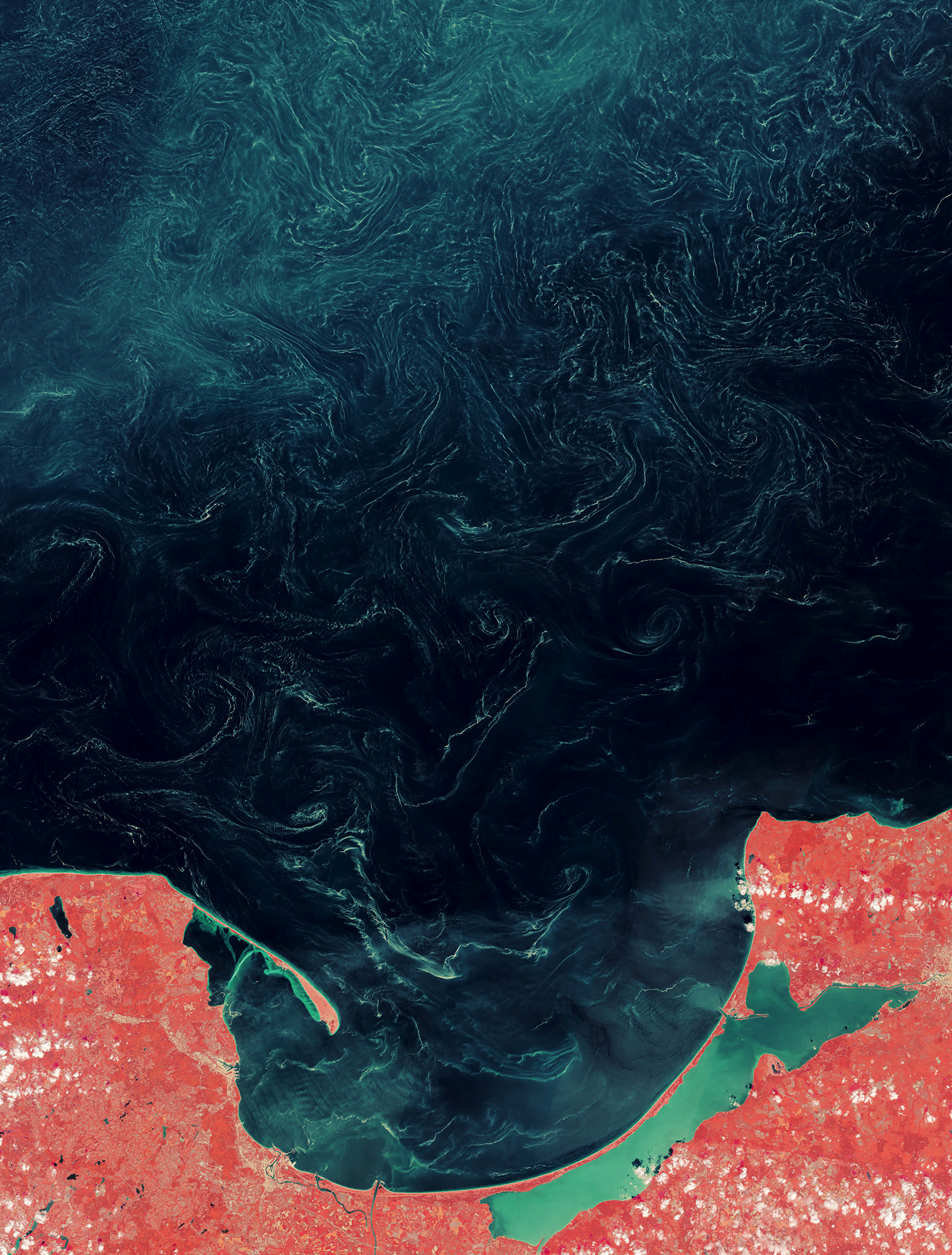
Fellow allergy sufferers, beware! This false-color satellite image of the Baltic Sea shows massive slicks made up of pine pollen. I don’t know about you, but the mere thought of enough pollen that it’s visible from space makes me want to double — triple?! — my antihistamines. The swirling patterns in the pollen come from wind-driven currents and waves moving the pollen on the surface of the water.
It took some sleuthing for scientists to identify these slicks as pollen rather than bacteria or plankton. But by combining experimental results, ground-based observations, and satellite image processing, scientists discovered that the pine pollen has a particular spectral signature. Using that, the team could trawl through older satellite imagery and locate pine pollen in previous seasons. They identified pine pollen slicks in 14 of the last 20 springs. The size of the slicks is growing over time, too, consistent with other observations of longer pollinating seasons. (Image credit: L. Dauphin; via NASA Earth Observatory)
Bird’s nest fungi are tiny — only about a centimeter wide. When mature, they form a curved splash cap containing spore sacs known as peridioles. Then they await rain. When a lucky drop hits the mushroom, it flings the peridioles out of their nest. Some will use sticky cords to cling to nearby blades of grass, setting them up to eventually hitch a ride to elsewhere with a grazing herbivore. It’s an impressive journey for a teeny spore sac, and it all starts with a single drop of rain. (Image and video credit: Deep Look)
The canyons of a city’s streets form a complex flow environment. To better understand the risks of a spreading contaminant, researchers simulated a release in lower Manhattan’s urban jungle. The released particles spread due to the dominant wind pattern of the area. Initially, the particles follow the street pattern and stay at a low elevation. But updrafts on the downwind side of skyscrapers lift the particles higher, spreading them to lower concentrations at more elevations.
Public officials study simulations like these to understand what response is needed to protect people in the event of an accidental or intentional release of harmful materials. (Image and video credit: W. Oaks and A. Khosronejad)
The human placenta functions as a life-support system for a growing fetus. Despite its frisbee-like appearance, the organ is packed with nearly 10 square meters of blood vessels. On the fetal side, these blood vessels form villous trees where diffusion across the placental boundary exchanges molecules with the maternal blood that fills the space between villous trees. This setup allows oxygen, glucose, carbon dioxide and other key chemicals to cross between the parent and fetus while (ideally) keeping diseases out.
Views of the placenta. Beige areas show the intervillous space where maternal blood flows while pink areas show villous trees where exchanges between the fetus and mother take place. The first three images show a) preeclamptic, b) normal, and c) diabetic placentas. The final image d) shows a 3D view of placental tissue taken with x-ray tomography.
But when diseases directly affect the structure of the placenta, flow to the fetus gets disrupted. The image above shows cross-sections of placental tissues, with villous trees marked in pink, under (a) preeclamptic, (b) normal, and (c) diabetic conditions. Preeclampsia is associated with reduced density of villous trees, which restricts the amount of nutrients a fetus receives and can lead to reduced growth or stillbirth. In contrast, with gestational diabetes villous trees can proliferate, causing a high resistance to flow that also affects exchanges.
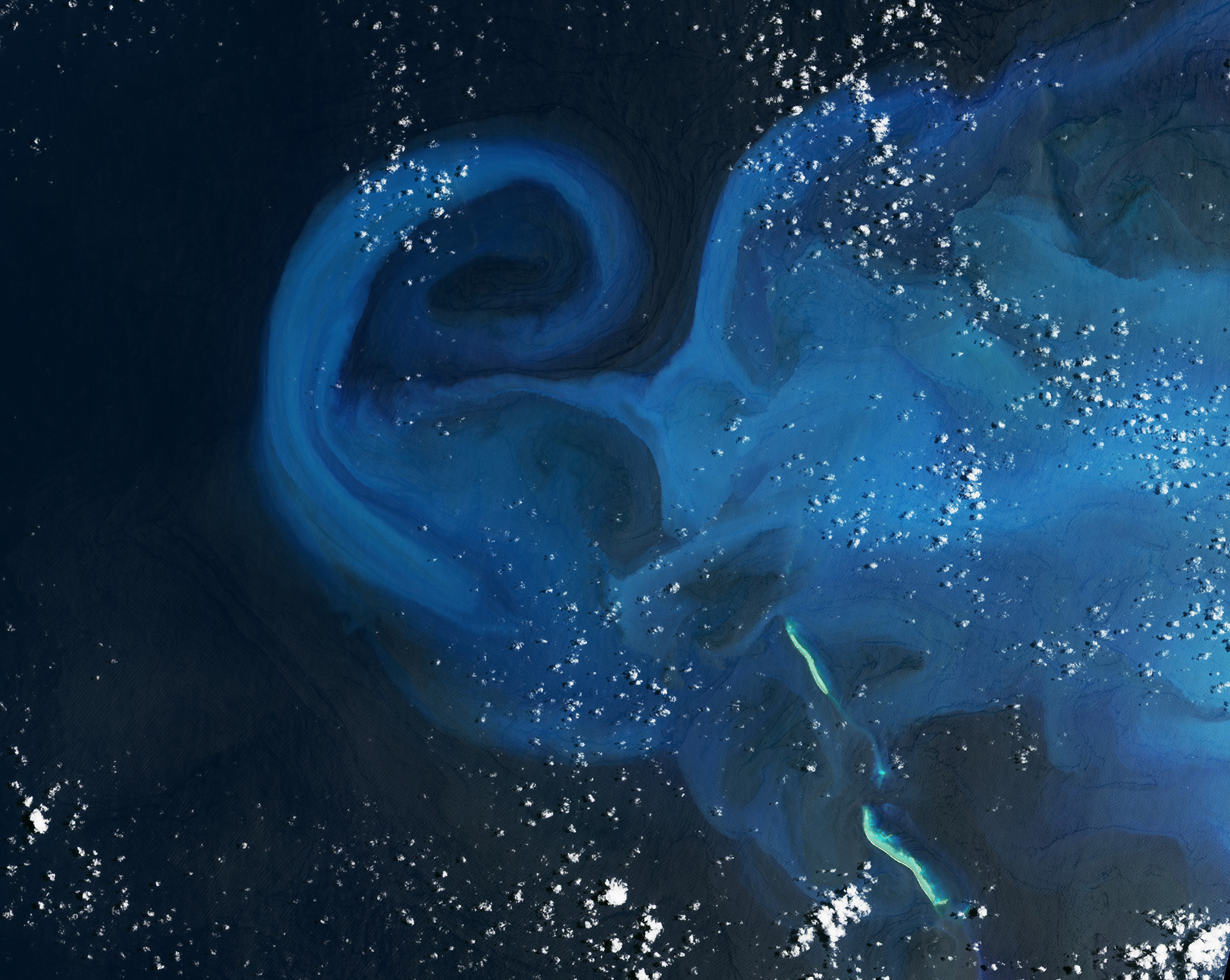
In early February, Tropical Cyclone Gabrielle passed over the Bellona Plateau in the Coral Sea, stirring up sediment from the shallow reefs there. Once the storm cleared, large swirls of carbonate sediment mixed into the deeper waters around the plateau. As the sediment sinks to depths of kilometers, it will dissolve into the deep ocean waters, eventually getting captured as part of sedimentary rocks. This is a critical step in the ocean’s carbon capture cycle.
Unfortunately, climate change is disrupting the ocean’s ability to capture carbon. An excess of carbon dioxide acidifies ocean waters, making it harder for creatures like corals and crabs to incorporate carbon into their bodies. That reduces sources for carbonate sediments like those seen here. Changes in ocean chemistry also affect where and how much carbonate can get dissolved. In short, ocean carbon capture has been an important process for Earth’s carbon cycle in the past, but the process is a slow one, and human activity has overloaded the ocean’s system in ways we don’t fully understand. (Image credit: A. Nussbaum; via NASA Earth Observatory)