Month: April 2013

  • SpaceShipTwo Lights It Up

    SpaceShipTwo Lights It Up

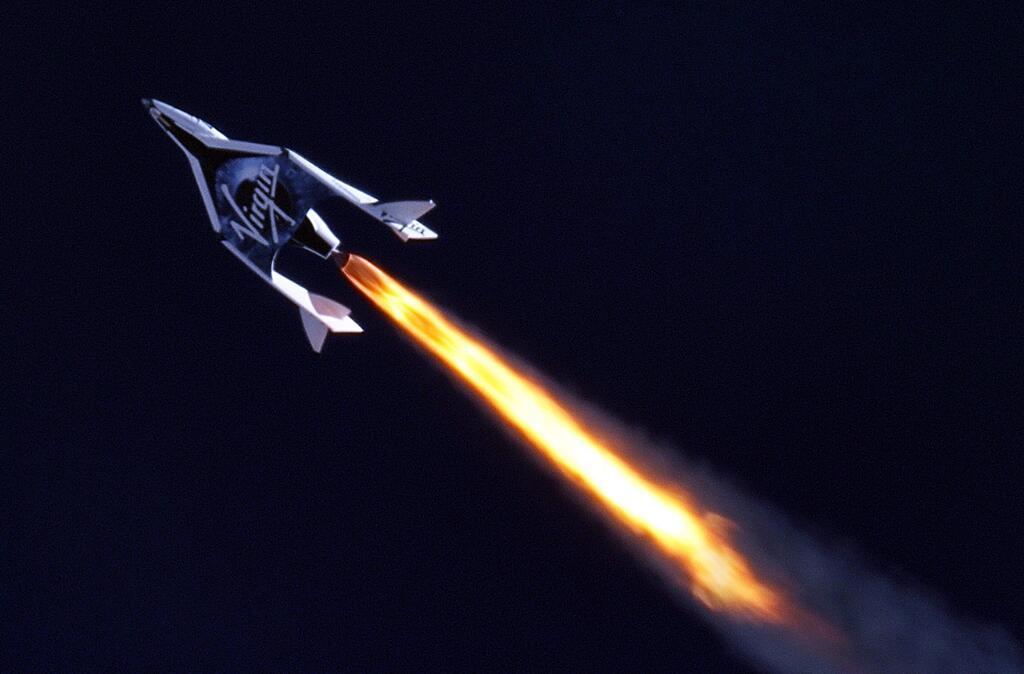
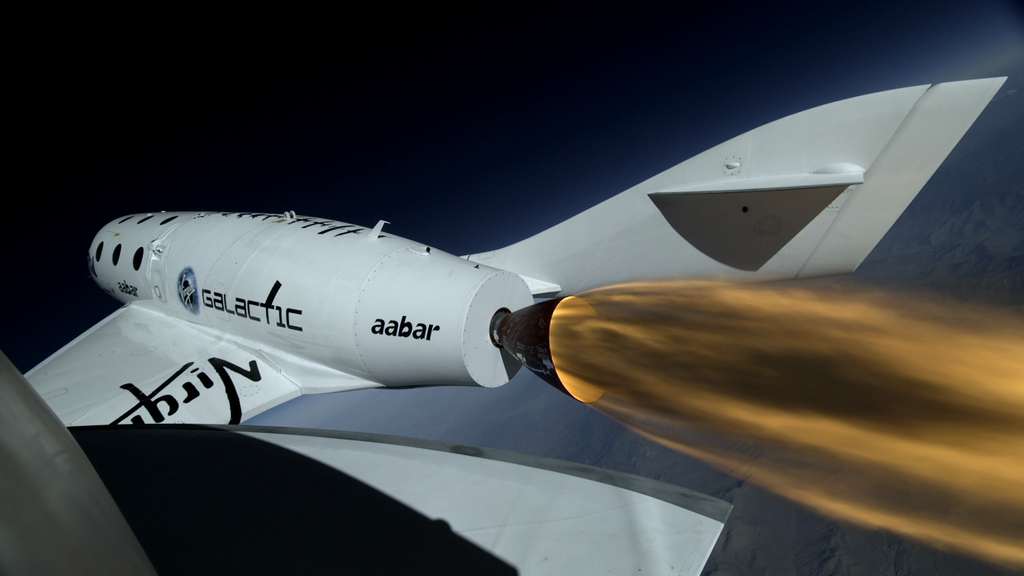
    Monday morning Virgin Galactic and their partners at Scaled Composites reached a new milestone in their commercial sub-orbital spaceflight program, firing SpaceShipTwo’s main engine for the first time and accelerating to supersonic speeds. The upper image shows hints of Mach diamonds, formed by a series of shock waves and expansions, in its exhaust. This is very common for rockets since most have a fixed geometry, and, by extension, a fixed Mach number and exhaust pressure. (Photo credits: Virgin Galactic and Mars Scientific)

  • Evaporation and Surface Effects

    Evaporation and Surface Effects

    Surface properties can have surprising effects on fluid behavior. This image shows the evaporation of several droplets over time. All of the initial droplets are of the same volume, but they are placed on a surface which is a) superhydrophobic, b) hydrophobic, or c) hydrophilic. The more hydrophobic the surface, the larger the initial contact angle between the droplet and surface and the smaller the wetted area of the surface. Yet despite this seemingly large surface area exposure to air, the droplet on the superhydrophobic surface is the slowest to evaporate. (Photo credit: C. Choi)

  • Featured Video Play Icon

    Lifting Liquids

    At very small scales, the interaction of solids and liquids is governed by molecular forces. Here researchers demonstrate how carbon nanowires of only a few nanometers in diameter draw liquid up in a film or bead when inserted in a pool. Capillary action is the name we give this gravity-defying force generated between the liquid and solid molecules. Although this behavior was predicted theoretically, it had not been previously observed at this scale due to the need for electron microscopy. Such microscopes require a vacuum, which boils off almost any liquid instantaneously. Researchers used a special fluid that remained in a liquid state even under near-vacuum pressures in order to make these observations. (Video credit: J. Li et al/MIT News; submitted by 20percentvitaminc)

  • Featured Video Play Icon

    Wake Vortices at Night

    The ends of an airplane’s wings generate vortices that stretch back in the wake of the plane. Most of the time these vortices are invisible, even if their effects on lift are distinctive. Here an A-340 coming in for a foggy landing demonstrates the size and strength of these vortices. Notice how the fog gets swept up and away by the vortices. Pilots will sometimes use this effect to their advantage in clearing a runway of fog by making repeated low-passes to clear the fog before landing. (Video credit: A. Ruesch; submitted by Jens F.)

  • Featured Video Play Icon

    Tears of Wine

    Wine drinkers may be familiar with the “tears of wine” often seen on the wall’s of a glass. The effect is a combination of evaporation and surface tension. As the low-surface-tension alcohol evaporates from the wine film left by swirling the glass, the higher local surface tension draws wine up the walls of the glass. Eventually enough wine gathers that droplets form and slide back down. This timelapse video shows how the beads form and move, almost dancing around the glass. The video’s author, Dan Quinn, has a second video with an awesome visual explanation of the behavior that’s well worth watching, too! (Video credit and submission: D. Quinn)

  • Featured Video Play Icon

    Entering a Viscous Liquid

    When a solid object impacts on a liquid a cavity typically forms, entraining air into the pool. But this behavior varies widely according to the surface of the solid as well as the fluid’s properties. This video shows a sphere impacting a highly viscous liquid. The sphere stops shortly after impact while the cavity continues expanding in its wake. With a fluid like water, a long and thin cavity will typically pinch off before the object is decelerated, causing bubbles to form. No such behavior here. Instead the wide cavity pinches off at the surface of the motionless sphere and begins its rebound upwards. It even appears to pull the sphere partially back towards the surface! (Video credit: A. Le Goff et al.)

  • Featured Video Play Icon

    Internal Wave Demo

    This video has a fun and simple demonstration of the importance of fluid density in buoyancy and stratification. Fresh water (red) and salt water (blue) are released together into a small tank. Being lighter and less dense, the red water settles on top of the blue water, though some internal waves muddy their interface. After the water settles, a gate is placed between them once more and one side is thoroughly mixed to create a third fluid density (purple), which, when released, settles between the red and blue layers. In addition to displaying buoyancy, this demo does a great job ofaa showing the internal waves that can occur within a fluid, especially one of varying density like the ocean. (Video credit: UVic Climate Modeling Group)

  • Featured Video Play Icon

    Washing Your Face in Space

    What happens to a wet washcloth when wrung out in space? Astronaut Chris Hadfield answers this question from students with a demonstration. Without gravity to pull the water downward, surface tension effects dominate and the wrung cloth forms a tube of water around it. Surface tension and capillary action draw the fluid up and onto Hadfield’s hands as long as he holds the cloth. After he lets go, we see that the water remaining around the cloth soaks back in (again due to capillary action) and the wet, twisted washcloth simply floats without releasing water or relaxing its shape. While pretty much what I would have expected, this was a very cool result to see! (Video credit: C. Hadfield/CSA; submitted by Bobby E)

  • Turning Sound Into Imagery

    Turning Sound Into Imagery

    The acoustic signatures of many animals contain features we humans cannot appreciate, given the limited range of frequencies we can hear. In fluid dynamics and many other fields, scientists and engineers have to find ways to analyze and decompose time-series data–like acoustic pressure signals–into useful quantities. Mark Fischer uses one tool for such analysis, a wavelet transform, to turn the calls of whales, birds, and insects into the colorful snapshots seen here. Wavelet transforms are somewhat similar to Fourier transforms but represent a signal with a series of wavelets rather than sinusoids. They’re also widely used for data compression. (Image credits: M. Fischer/Aguasonic Acoustics; via DailyMail)

  • Featured Video Play Icon

    Explosions Underwater

    Underwater explosions are, in general, much more dangerous than those in air. This video shows an underwater blast at 30,000 fps. During the initial blast, a hot sphere of gas expands outward in a shock wave. In air, some of the energy of this pressure wave would be dissipated by compressing the air. Since water is incompressible, however, the blast instead moves water aside as the bubble expands. Eventually, the bubble expands to the point where its pressure is less than that of the water around it, which causes the bubble to collapse. But the collapse increases the gas pressure once more, kicking off a series of expansions and collapses. Each bubble contains less energy than the previous, thanks to the loss of pushing the water aside. (Video credit: K. Kitagawa)