This high-speed video captures the impact of liquid droplets onto a granular surface. While there is some similarity to liquid-solid and liquid-liquid impacts, the permeability of the granular surface helps to “freeze” the splash rather quickly. Energy is dissipated in the initial impact, causing a splash of grains. Then the surface tension, viscosity and inertia of the droplet compete in causing the deformations seen in the video. The deformation appears strongly dependent on the kinetic energy with which the droplet hits the surface (i.e. proportional to the height from which it is dropped). (Video credit: G. Delan et al)
Year: 2012

Flow Around Traffic
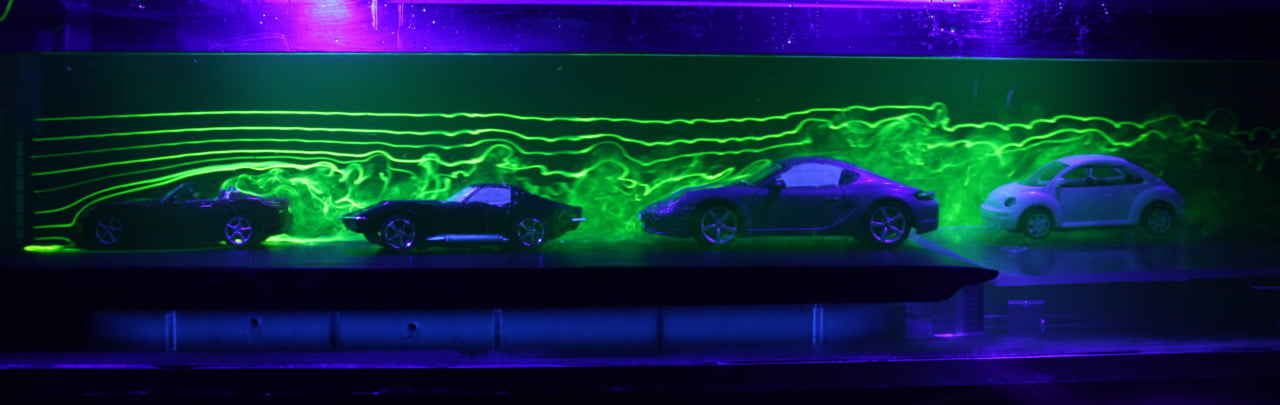
Flow visualization in a water tunnel shows what the flow around a line of traffic looks like. Note the progressively more turbulent flow around each car as it sits in the wake of the car before it. Turbulent flow is usually associated with increased drag forces, but because turbulence can actually help prevent flow separation it is sometimes desirable as a method for decreasing drag. In the case of these cars drafting on one another, it is clear that the cars further back in the line cause less effect on the fluid–and thus have less drag to overcome–than the front car. (Photo credit: Rob Bulmahn)

Wind Tunneling Testing for BASE Jumpers
While we usually think of wind tunnel testing airplane models, the truth is that wind tunnels today test a much wider array of subjects. From oil rigs and skyscrapers to athletes and police sirens, if you can imagine it, it’s probably been stuck in a wind tunnel. This video shows some wind tunnel testing of a tracking suit used for BASE jumping. The primary focus seems to be on lift and drag at angle of attack–which can be used to determine glide ratios for the pilot–but there is also some study of localized turbulence generation, as evidenced by the use of smoke generators and the streamers attached to the suit’s arms and legs. (submitted by Jason C)
Pāhoehoe Lava
Lava flows come in many varieties but one of the most captivating is the pāhoehoe flow, meaning “smooth, unbroken lava” in the native Hawaiian. This type of basaltic lava features a smooth or undulating surface formed by the fluid lava beneath a cooler, congealing surface crust. They often feature low viscosity (by the standards of lava) and very high temperatures between 1100 and 1200 degrees Celsius. Here the flow shows features of viscous fluids like honey, including rope-coiling motions.
Smoke Flow Viz
Smoke visualization, illuminated by a laser sheet, shows a 2D slice from an axisymmetric jet as it breaks down to turbulence. The flow is laminar upon exiting the nozzle, but the high velocity at the edge of the jet and low velocity of the surrounding air causes shear that leads to the Kelvin-Helmholtz instability. This instability leads to the formation of small vortices that grow as they are advected downstream until they are large enough to interrupt the jet and it breaks down into fully turbulent flow. (Video credit: B. O. Anderson and J. H. Jensen)

Reader Question: Rocket Propulsion
staunchreality-deactivated20120 asks:
Hey there – Love the blog. Most interesting science blog I follow 🙂 This may be a silly question – is propulsion through space purely a function of exit velocity and catching gravity slingshots around planets, or is there enough of anything to push against for rocket propulsion?
Thanks! Glad you enjoy the blog. And your question is not silly at all.
Whether in the atmosphere or not, rocket engines always operate on the same principle: Newton’s 3rd law. For every force exerted, there is an equal and opposite reaction force. For a rocket, this means that the momentum of the rocket exhaust provides forward momentum–thrust–for the rocket. When acting in an atmosphere, the exhaust doesn’t push against the atmosphere in order to move the rocket–in fact, rockets have to overcome aerodynamic drag when in the atmosphere, which opposes their thrust.

While the operating principle of a rocket remains the same regardless of its surrounding, the ambient pressure (essentially zero in space and non-zero in an atmosphere) does affect the efficiency of the rocket’s nozzle, which can affect the exit velocity of the exhaust, and, thus, the efficiency of the rocket. Under ideal conditions, the exhaust should exit the nozzle at the same pressure as the ambient conditions–whatever they are. If the exhaust pressure is lower than the ambient, the exhaust can separate from the nozzle, causing instabilities in the flow and potentially damaging the nozzle. On the other hand, if the exhaust pressure is too high, then there is exhaust that could be turned into thrust that is going to waste. Unfortunately, matching the exhaust pressure to the ambient pressure is a function of the geometry of the nozzle, which is usually fixed. Engineers of rockets intended to fly from within the atmosphere to space usually have to pick a particular altitude to design around and deal with the inefficiencies while the rocket flies at other ambient conditions.
Outside of the physical mechanics of how thrust is produced, propulsion in space is dominated by the influence of orbital mechanics. Once in an orbit, a spacecraft will stay on that orbital path without expending any thrust. To change between orbits, it is necessary for the spacecraft–rocket or otherwise–to change its velocity–typically referred to as delta-v–by firing an engine or thruster. It’s also possible to change orbits using the gravity of other celestial bodies (Jupiter is a popular one) to change a spacecraft’s delta-v without expending propellant. However, fluid dynamics don’t play a big role in the process aside from the problems of fuel sloshing aboard the spacecraft and the actual mechanism by which thrust is produced.

That said, if anyone is interested in getting a better feel for how orbit mechanics work, I have two recommendations. The first is to watch this video of water droplets “orbiting” a charged knitting needle aboard the ISS. And the second is to play the game Osmos. It is like rocket propulsion and orbit mechanics in action!
(Photo credits: NASA, The Aerospace Corporation, Hemisphere Games)

Seeing Shock Waves
In this still image from a video of a 2008 demonstration of a U.S. Navy railgun, the shock waves in front of the projectile are momentarily visible. When travelling faster than the speed of sound in air, information (in the form of pressure waves) is unable to travel ahead of the projectile, meaning that the air cannot deform around the object as it does at low speeds. Instead, a front known as a shock wave forms on or in front of the object, depending on its speed and shape. Across this shock wave, thermodynamic properties of the gas are discontinuous; the pressure, temperature, and density of the air rise drastically, but the air is also deformed so that it passes around the object. (See also: bullet from a gun.)
Supersonic Flow Around a Cylinder
This numerical simulation shows unsteady supersonic flow (Mach 2) around a circular cylinder. On the right are contours of density, and on the left is entropy viscosity, used for stability in the computations. After the flow starts, the bow shock in front of the cylinder and its reflections off the walls and the shock waves in the cylinder’s wake relax into a steady-state condition. About halfway through the video, you will notice the von Karman vortex street of alternating vortices shed from the cylinder, much like one sees at low speeds. The simulation is inviscid to simplify the equations, which are solved using tools from the FEniCS project. (Video credit: M. Nazarov)

Flow Over Swept Wings
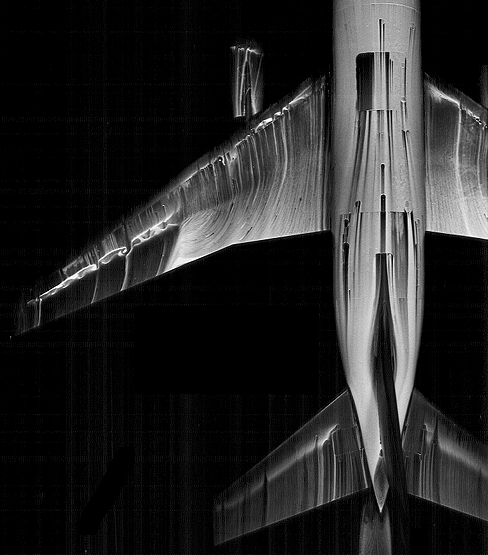
Flow over a swept wing behaves very differently than a straight fixed wing or an airfoil. Instead of flowing straight along the chord of the wing in a two-dimensional fashion, air is also directed along the wing, parallel to the leading edge. The above oil flow visualization on a swept wing airplane model shows this curvature of streamlines. As a result of this three-dimensional flow behavior, boundary layers on swept wings are subject to the crossflow instability, which manifests as co-rotating vortices aligned to within a few degrees of the streamlines. Triggering this boundary layer instability can lead to turbulence and higher drag for the aircraft.
Fano Flow
Adding polymers to fluids can lead to strangely counter-intuitive behavior. Here two examples of bizarre extensional flow, sometimes called Fano flow, are shown. First, in the “tubeless siphon” fluid is drawn into a syringe from the level of the free fluid surface. When the syringe is raised above the free surface of the fluid, the polymer-laden fluid continues to flow upward and into the syringe. A similar effect is shown in the “open channel siphon” where, once initiated, the flow up and over the side of a beaker continues after the free surface of the fluid has fallen below the level of the beaker’s spout. In both of these cases, the cross-linking and entanglement of polymers within the fluid makes it capable of exerting normal stress when extensionally strained (e.g. stretching a rubber band). In other words, when the syringe is drawn out of the pool, the stretching of the fluid causes the polymers to exert a force that counteracts the weight of the fluid column, enabling the flow to continue upward despite gravity.