Tag: vortices

  • Exoplanet Heating

    Exoplanet Heating

    WASP-96B is a tidally-locked exoplanet between the size of Saturn and Jupiter. This hot, massive planet lies close to its star, orbiting in less than three-and-a-half Earth days. A recent study shows that planets like these can have very different weather, depending on what depth their atmosphere absorbs heat at.

    Using numerical simulations, researchers took a detailed look at the possible atmospheric dynamics on this planet. When the atmosphere absorbed heat at a shallow depth — near the outer layers of the planet — a coupled vortex pair formed (left, below). These vortices promenaded westward and completed a circuit around the planet every 11-15 days.
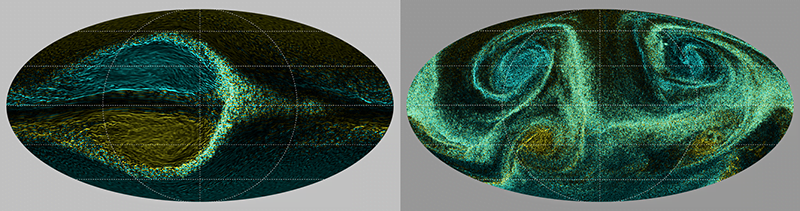
    Shallow heating on a hot Jupiter produces a pair of coupled vortices (left), but deeper heating in the atmosphere generates four more-chaotic vortices (right).
    Shallow heating on a hot Jupiter produces a pair of coupled vortices (left), but deeper heating in the atmosphere generates four more-chaotic vortices (right).

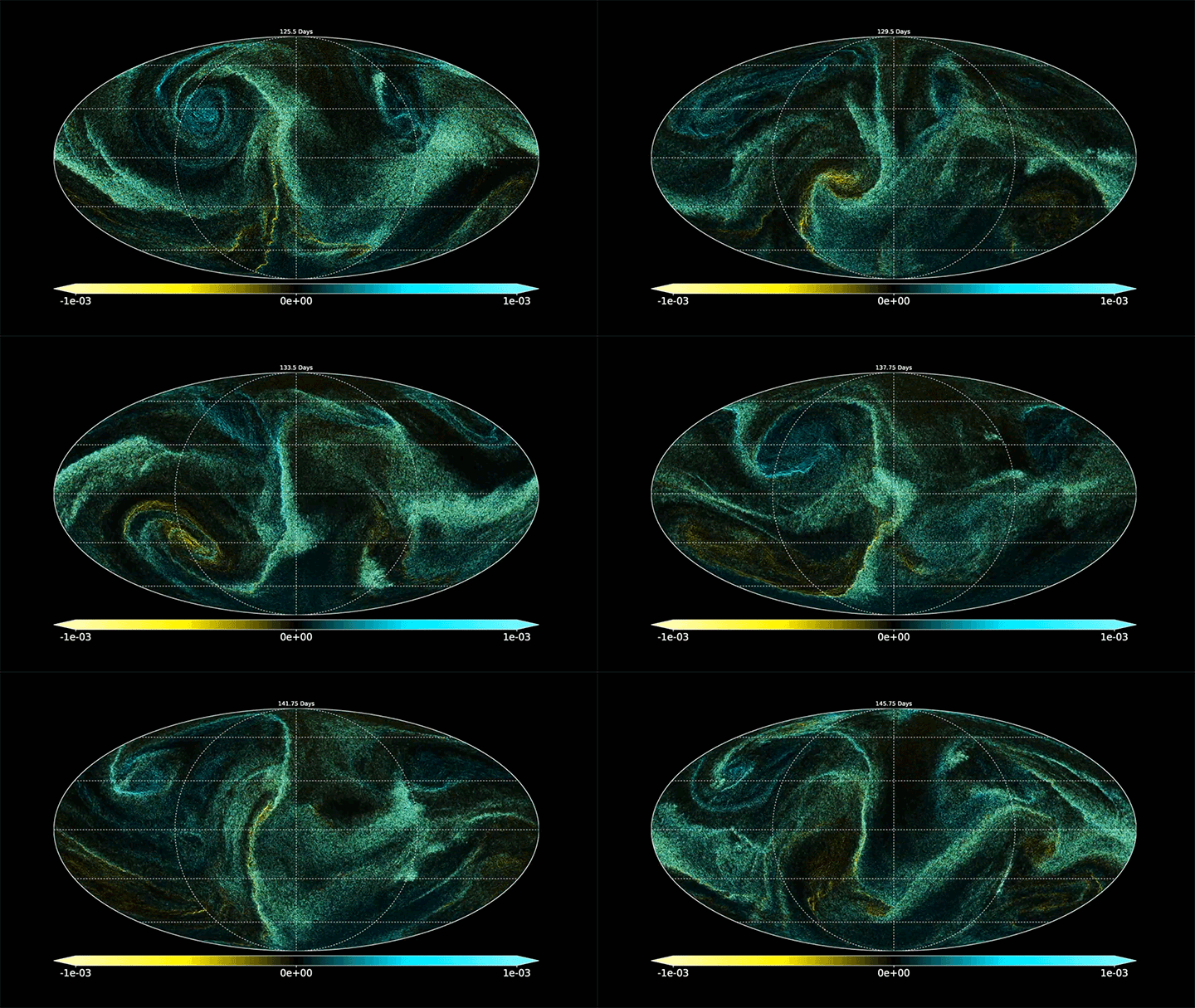
    In contrast, deeper heating produced a more-chaotic pattern of four vortices (right, above) that each lasted 3 to 15 days before disappearing, replaced by a new vortex. This atmosphere, they found, was very turbulent, with smaller-scale vortices as well.

    Since each weather pattern is visually distinct and carries its own brightness signature, the authors predict that additional observations of WASP-96b with the current generation of telescopes will show which type of heating dominates on the exoplanet. (Image and research credit: J. Skinner et al.; via APS Physics)
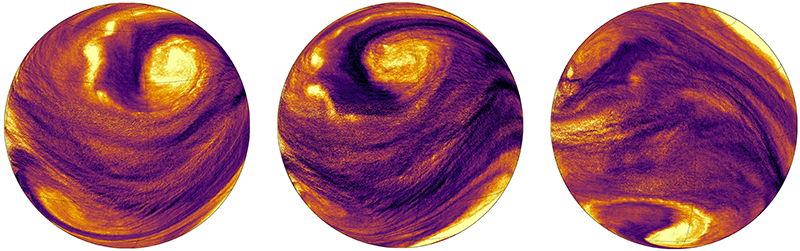
    Snapshots from a simulation of a deep-heated hot Jupiter. Each image shows the planet on a different day.
    Snapshots from a simulation of a deep-heated hot Jupiter. Each image shows the planet on a different consecutive day.
  • Featured Video Play Icon

    Walking in the Wake of a Cylinder

    A cylinder in a flow produces a series of alternating vortices known as a von Karman vortex street. Changing the flow speed and rotating the cylinder both allow researchers to tune the frequency of these shed vortices. What happens to an object in the wake?

    For a simple hydrofoil tethered to the cylinder, the object wends back and forth along the vortices. But when that hydrofoil sits at the end of a double-pendulum, something very interesting happens. The whole apparatus follows a consistent trajectory similar to a human walking gait. Researchers are using this motion to build a robot that will help physical therapy patients regain a natural walking style. (Image and video credit: A. Carleton et al.)

  • Featured Video Play Icon

    Listen to a Martian Dust Devil

    A lucky encounter led the Perseverance rover to record the first-ever sound of a dust devil on Mars. The rover happened to have its microphone on (something that only happens a few minutes every month) just as a dust devil swept directly over the rover. Check out the video above to see and hear what Perseverance captured.

    Using the rover’s instrumentation, researchers worked out that the dust devil was at least 118 meters tall and about 25 meters wide. The team was even able to determine the density of dust in the vortex from the sound of individual grain impacts captured in the acoustic signal! Serendipitous as the experience was, planetary scientists may now look to include microphones on more missions, since we now know how to get useful meteorological data from them. (Video credit: JPL-Caltech/NASA; image credit: LPL/NASA; research credit: N. Murdoch et al.; via AGU Eos; submitted by Kam-Yung Soh)

  • Featured Video Play Icon

    A Fractal Raft From a Spinning Top

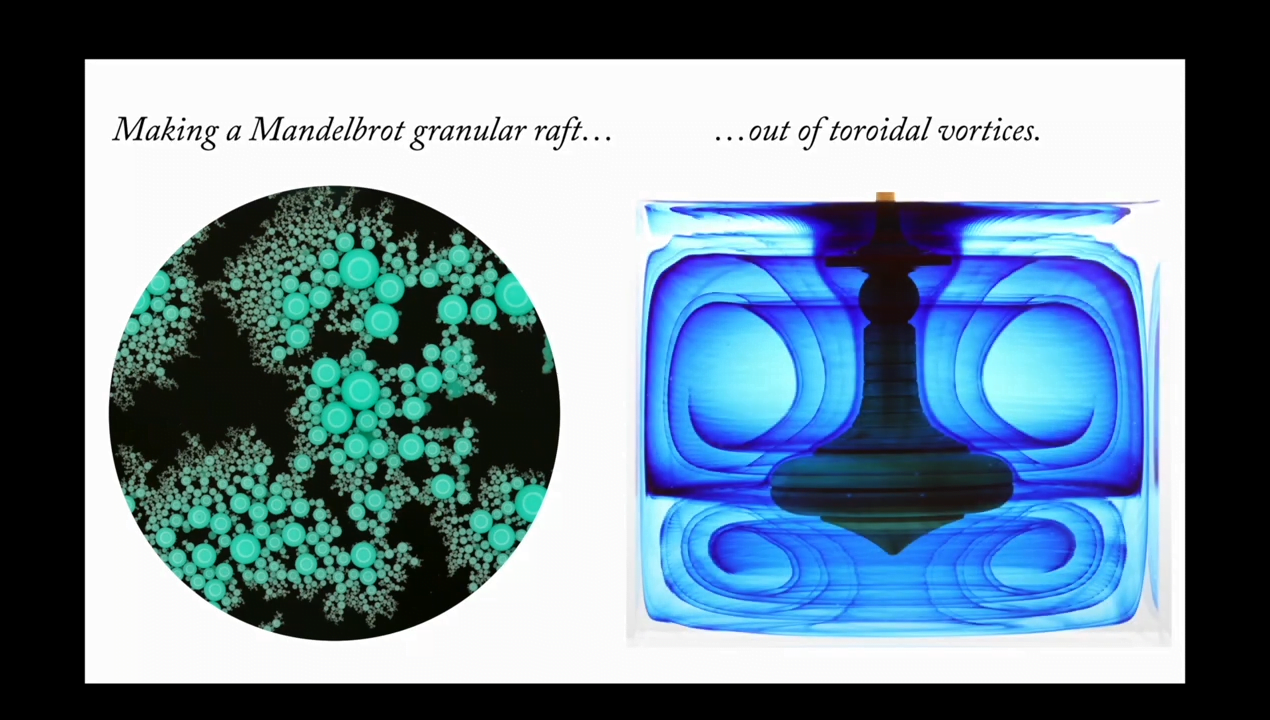
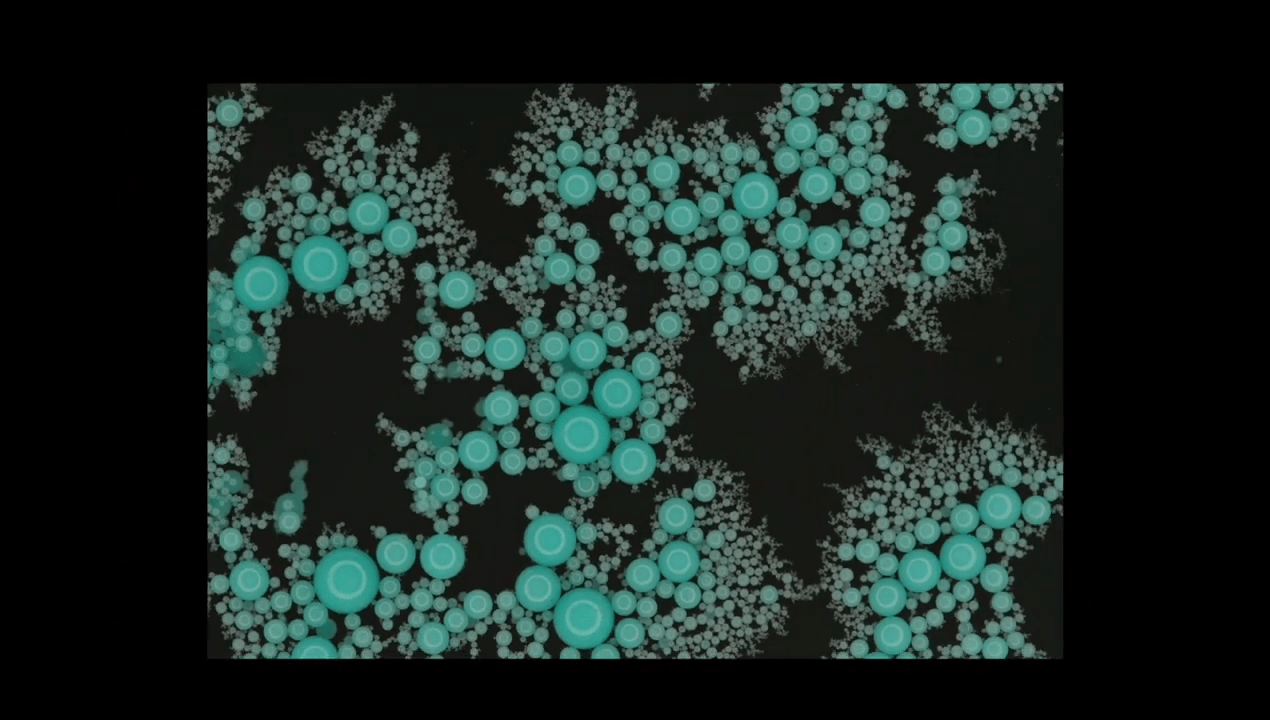
    File this one under Cool Things I Would Have Never Thought Of. In this video, researchers play around with the flow around a spinning top and end up creating a fractal, granular raft. By immersing a top in dyed fluid, they show the toroidal vortices that form around the spinning toy. Then, instead of dye, they add a stretchy elastomer compound that cures over time. The elastomer stretches into thin ligaments in the swirling flow around the top. Eventually, it breaks apart into spherical drops of all different sizes.

    Once the top is removed, the elastomer drops slowly float to the surface. Surface tension and the Cheerios effect draw the drops together, and because of their many sizes, the rafts that form are fractal. (Image and video credit: B. Keshavarz and M. Geri)

  • Mixing Effectively

    Mixing Effectively

    Mixing two fluids is a tougher task than you might think. One of my favorite asides from a fluids lecture concerned how to mix fruit into yogurt in an industrial setting. Mix too quickly, and you’ll obliterate the yogurt’s consistency, but mix too little and you may as well sell it as fruit-on-the-bottom. Apparently that particular problem got solved by sending the fruit and yogurt flowing through a series of specially-shaped ducts to slowly and carefully mix them together.

    In this study, researchers tackle a similar problem — mixing two fluids in a circular cross-section — through optimization. As you can see above, circular stirrers on their own don’t do a great job of mixing. So the researchers searched for the right combination of stirrer shape, mixing speed, and mixing trajectory to give the best mixing for a set mixing time and energy input. Their final stirrer shapes are anything but circular and often move in jerks and fits to help shed vortices that do the actual job of mixing. (Image and research credit: M. Eggl and P. Schmid; via APS Physics)

  • Spinning Off-Axis

    Spinning Off-Axis

    To make a vortex in the laboratory, researchers typically set a tank on a rotating platform and allow the water to drain out a hole in the center of the tank. In that case, a vortex forms over the drain (like in your bathtub!) and remains centered over the hole. In nature, though, vortices rarely follow such a simple path.

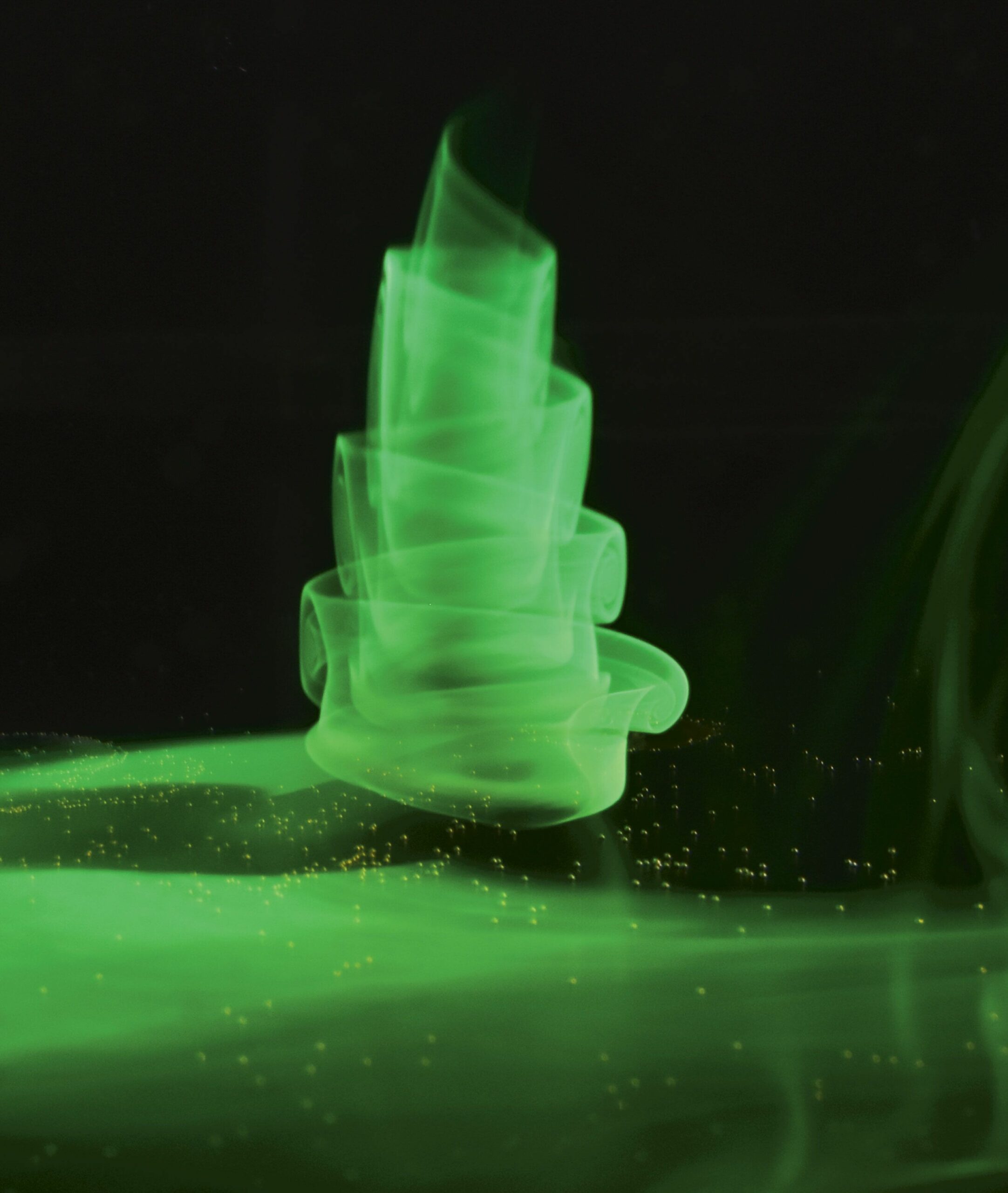
    In this experiment, researchers moved the drainage hole so that it is not aligned with the tank’s axis of rotation. Although the vortex forms over the drain (marked by a yellow dot in the lower image), it quickly moves away, following a roughly circular path around the axis until it comes to a stop. Green dye marks fluid from the tank’s bottom boundary layer, which eventually gets entrained up into the vortex. (Image and research credit: R. Munro and M. Foster; via Physics Today)

    Timelapse animation showing the development of the vortex. The yellow dot marks the location of the drain.
    Timelapse animation showing the development of the vortex. The yellow dot marks the location of the drain.

  • Tidal Vortices

    Tidal Vortices

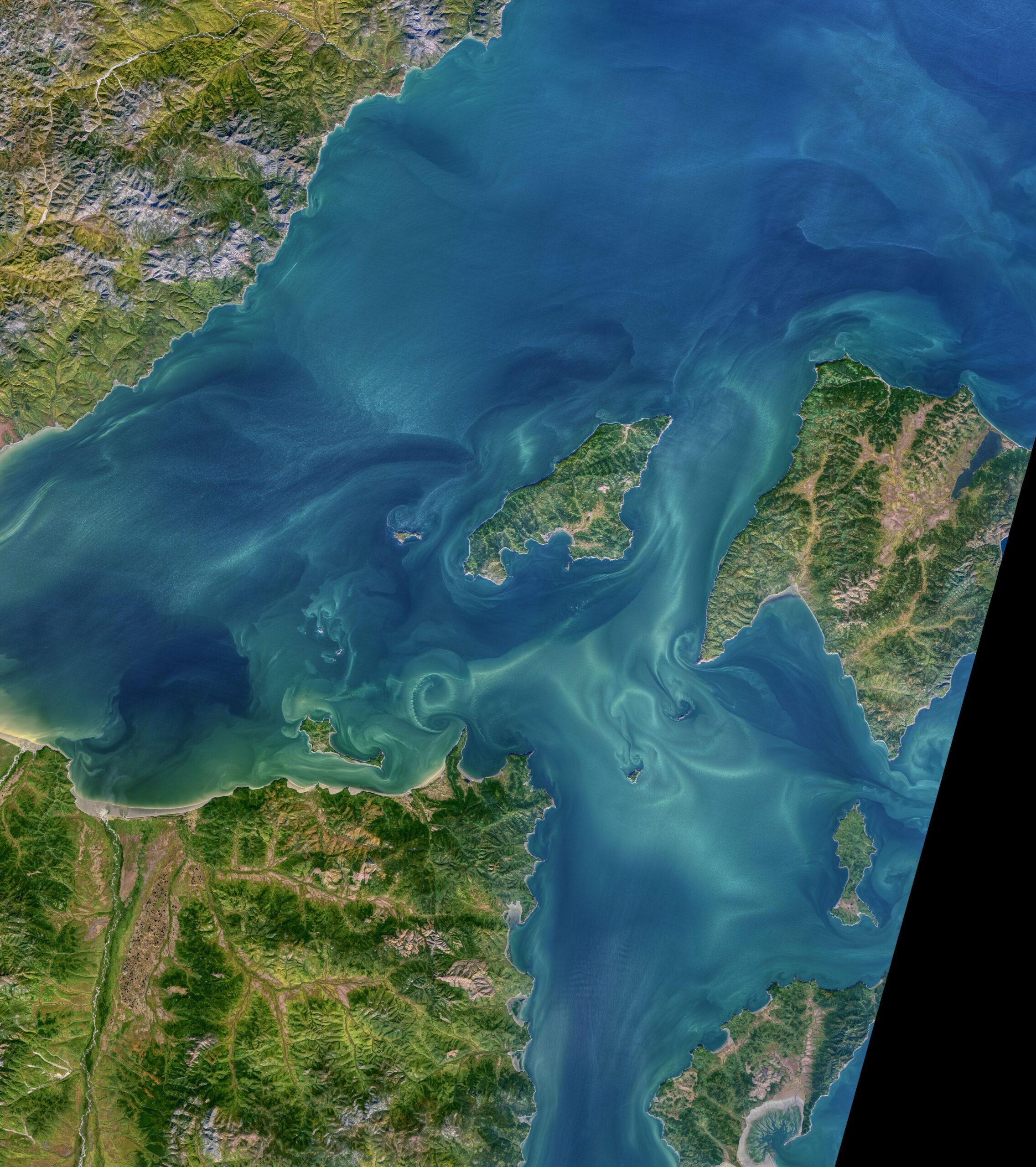
    Local topography in the Sea of Okhotsk funnels water to create some of the largest diurnal tides in the world — nearly 14 meters! The currents rushing past islands and outcrops create swirling vortices like the ones seen in this natural-color satellite image. In some places, you can even see multiple vortices, strung together into a von Karman vortex street. At high tide, the vortex streets stretch westward, but at low tide they point east. (Image credit: N. Kuring/NASA/USGS; via NASA Earth Observatory)

  • Surf’s Up!

    Surf’s Up!

    Inspired by honeybees and their ability to surf on capillary waves of their own making, researchers have developed SurferBot, a low-cost, untethered, vibration-driven surf robot. Built on a simple 3D-printed platform, the bot has a vibration motor powered by a simple coin cell battery. As the motor vibrates, it propels the bot forward (Image 2). With the motor placed off-center, the bot’s vibrations create larger capillary waves at the rear of the bot than at the front (Image 3). It’s this asymmetry that drives the robot forward. The flow pattern created by the bot’s propulsion is impressively strong (Image 4) and consists of a pair of counter-rotating vortices trapped ahead of the bot and a strong central jet in its wake.

    Best of all: SurferBot is a great platform for educational experimentation, costing <$1 apiece! (Image and submission credit: D. Harris; research credit: E. Rhee et al.)

  • Quantum Instability

    Quantum Instability

    In our everyday lives, two fluids moving past one another often form a wave-like pattern thanks to the Kelvin-Helmholtz instability. We see it in the curl of waves on the ocean, in clouds in the sky, and even in spirals of lava on Mars. Here researchers explore an analogous instability in the quantum world.

    By spinning a gas of ultracold atoms, the team observed a spontaneous transition from a needle-like configuration to a crystal made up of spirals. It’s a quantum Kelvin-Helmholtz instability! The authors found that wave’s phase is random; it arises purely from quantum interactions between the atoms. (Image, research, and submission credit: B. Mukherjee et al.; see also MIT News)

    The spinning cloud of ultracold atoms breaks up into a series of spirals.
  • Stingray Eyes

    Stingray Eyes

    With their flexible, flattened shape, rays are some of the most efficient swimmers in the ocean. But, at first glance, it seems as if their protruding eyes and mouth would interfere with that streamlining. A new study uses computational fluid dynamics to tackle the effects of these protrusions on stingray hydrodynamics.

    With their digital stingrays, the team found that the animal’s eyes and mouth created vortices that accelerated flow over the front of the ray and increased the pressure difference across its top and bottom surfaces. The result was better thrust and the ability to cruise at higher speeds. Overall, the ray’s eyes and mouth increased its hydrodynamic efficiency by more than 20.5% and 10.6%, respectively. The lesson here: looks can be deceiving when it comes to hydrodynamics! (Image credit: D. Clode; research credit: Q. Mao et al.)