Tag: vortices

  • Sea Sponge Hydrodynamics

    Sea Sponge Hydrodynamics

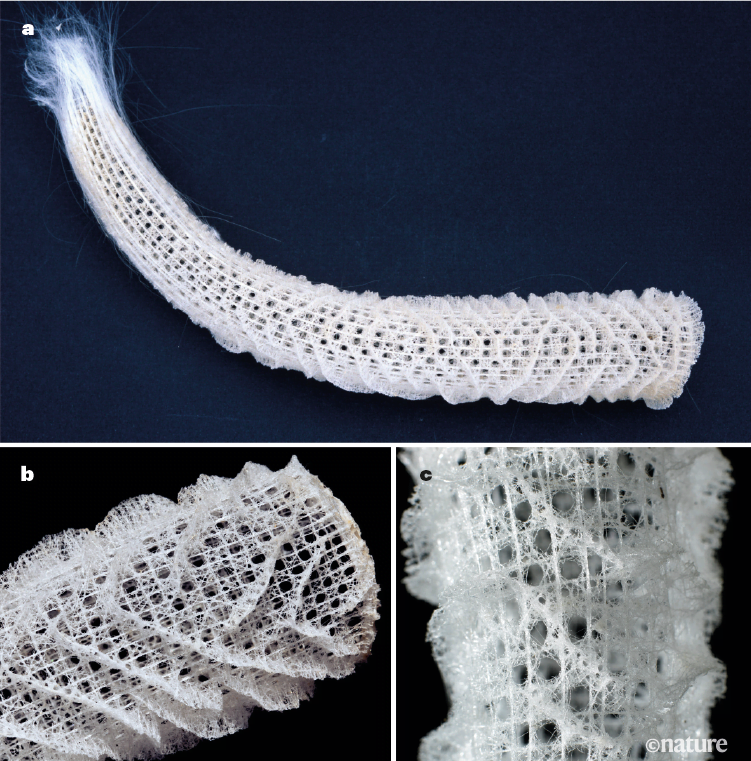
    The Venus’s flower basket is a sea sponge that lives at depths of 100-1000 meters. Its intricate latticework skeleton has long fascinated engineers for its structural mechanics, but a new study shows that the sponge’s shape benefits it hydrodynamically as well.

    The sea sponge’s skeleton is predominantly cylindrical, with tiny gaps that allow water to flow through it and helical ridges alongside its outer surface to strengthen it against the deep-sea currents surrounding it. Through detailed numerical simulations, researchers found that both of these features — the holes and the ridges — serve fluid mechanical purposes for the sponge. The porous holes of the sea sponge drastically reduce flow in the sponge’s wake (third image), which provides major drag reduction for the sea sponge. That drag reduction makes it easier for the sponge to stay rooted to the ocean floor.

    The helical ridges, on the other hand, create low-speed vortices within the sea-sponge’s body cavity (second image). Such vortices increase the time water spends inside the sponge, likely helping it to filter-feed more efficiently. The additional vorticity comes at the cost of slightly increased drag but not enough to outweigh the savings from its porosity. (Image and research credit: G. Falcucci et al.; via Nature; submitted by Kam-Yung Soh)

  • Space Hurricanes

    Space Hurricanes

    Researchers have observed their first “space hurricane” – a 1,000-km-wide vortex of plasma – in Earth’s upper atmosphere. Like conventional hurricanes, this storm featured precipitation (of electrons rather than rain), a calm eye at its center, and several spiral arms. Based on the group’s model, interactions between the solar wind and Earth’s magnetic fields drive the storm. Interestingly, the storm they observed occurred during a period of low solar and geomagnetic activity, which suggests that such space hurricanes could be frequent, both on Earth and in the upper atmospheres of other planets. (Image credit: Q. Zhang; research credit: Q. Zhang et al.; via Physics World)

  • Loopy Networks and Bird Lungs

    Loopy Networks and Bird Lungs

    When mammals breathe, air flows back and forth inside our lungs. But in birds that inhale and exhale get transformed into one-directional flow inside their lungs. To figure out how, researchers built loopy networks of pipes that turn oscillating flow into unidirectional flow.

    The simplest structure that does this is shown above. The main loop is driven by a pump that oscillates back and forth. A second loop connects through two T-junctions, oriented at 90-degrees to one another. Watch the particles in each loop carefully. Those in the bottom loop move back and forth, driven by the oscillating pump. But the particles in the upper loop only move in one direction! The key to this, the researchers found, are vortices that form at the T-junctions (last image). When the flow in the main loop changes direction, it creates vortices that block flow along one arm of the T-junction, thereby isolating the upper loop. (Image credit: bird – A. Mckie, others – Q. Nguyen et al.; research credit: Q. Nguyen et al.; via APS Physics; submitted by Kam-Yung Soh)

  • Inside Hydroplaning

    Inside Hydroplaning

    When a tire spins over a wet roadway, pressure at the front of the tire generates a lifting force; if that lift exceeds the weight of the car, it will start hydroplaning. To prevent this, the grooves of a tire’s tread are designed to redirect the water. Now researchers have visualized flow inside these grooves for the first time, using a version of particle image velocimetry (PIV). PIV techniques use fluorescent particles to track the flow.

    The results reveal a complicated, two-phase flow inside the tire grooves. As seen in the images above, bubble columns form inside the tire grooves. The team’s results suggest that the bubble columns depended on groove width, spacing, and intersections with other grooves. They also saw evidence of vortices inside some grooves. (Image credit: tires – S. Warid, others – D. Cabut et al.; research credit: D. Cabut et al.; via Physics World; submitted by Kam-Yung Soh)
  • Strings of Swirls

    Strings of Swirls

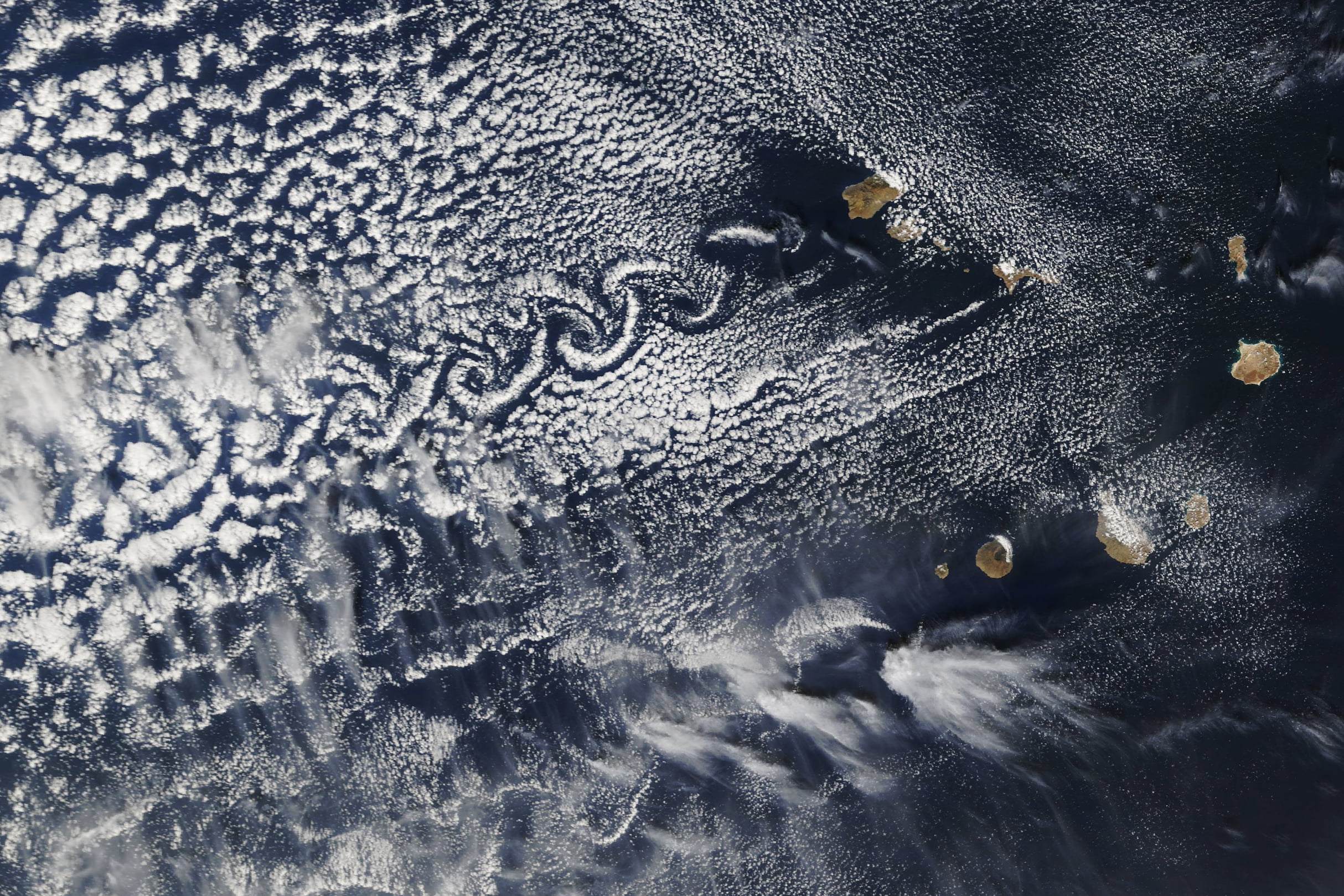
    Von Karman vortex streets are the rows of alternating vortices shed off isolated objects interrupting a flow. Here, the volcanic peaks of Cabo Verde disrupt an atmospheric flow accustomed to an empty ocean. In a steady wind, air wraps around the volcanoes and detaches first on one side, creating a vortex, then from the other side, making a vortex of the opposite rotation. Although these structures are always present, we only see them when they stir up the cloud layer, leaving these strings of swirls for hundreds of kilometers behind the islands. (Image credit: L. Dauphin/NASA; via NASA Earth Observatory)

  • Vortex Rings on V-Shaped Walls

    Vortex Rings on V-Shaped Walls

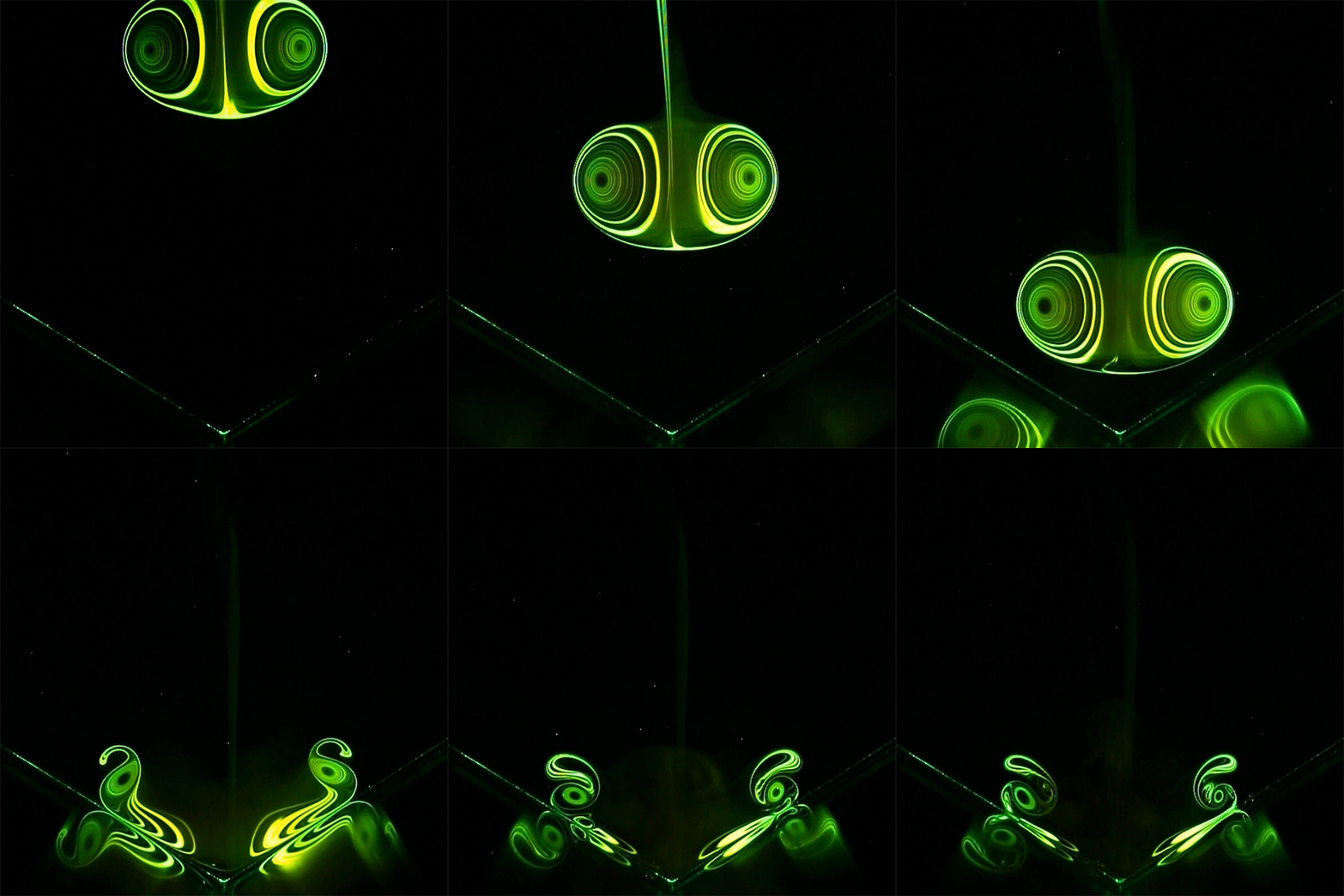
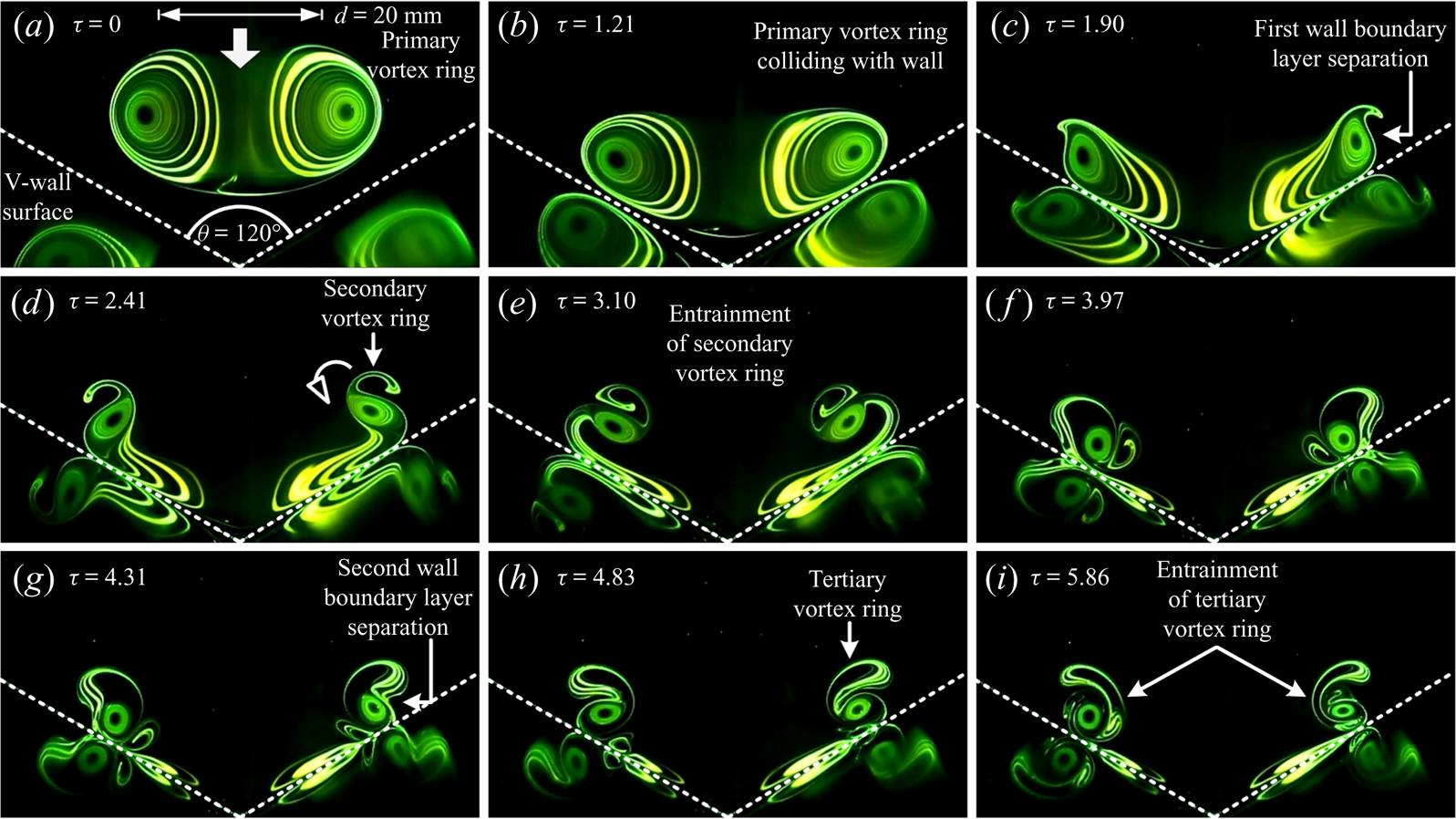
    Vortex ring impacts are eternally fascinating. Here, researchers explore what happens when a vortex ring encounters a V-shaped wall. Because the outer portions of the vortex ring hit the wall sooner than the inner ones, distortions begin there first.

    The vortex’s approach creates a pressure gradient that causes flow near the wall to separate, generating that first little hook in each arm of the vortex. Next, secondary vortices develop on either side and quickly get pulled into the original vortex. The whole process repeats a second time to generate tertiary vortices that continue the inward spiral. The impact appears even more complicated when viewed from the side of the valley (Image 2). Check out Image 3 for a point-by-point breakdown of the impact process. (Image and research credit: T. New et al.)

  • Flexible Filament Reduces Drag

    Flexible Filament Reduces Drag

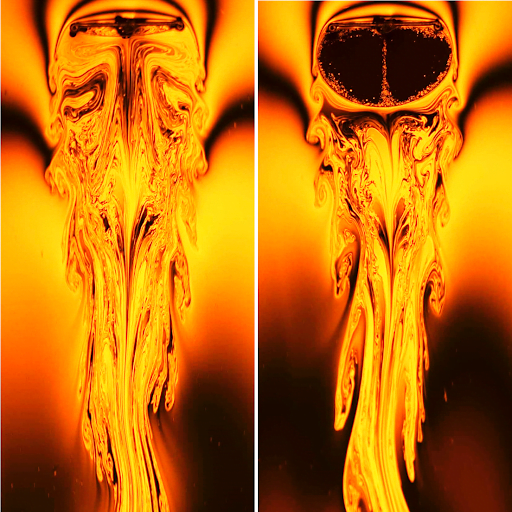
    Most shapes aren’t streamlined for fluid flow. We call these bulky, often boxy shapes, bluff bodies. Above, we see two examples of a bluff body, a flat plate, in a soap film. On the left, the plate sits perpendicular to the soap film’s top-to-bottom flow. Two large, counter-rotating vortices form behind the plate and a wide wake stretches behind it.

    On the right, we see the same flat plate but now a long, flexible filament is attached to either end. As the flow moves past, it deforms the filament, creating a rounded shape. Researchers found that, under the right conditions, this flexible afterbody could reduce drag on the object by up to 10%. (Image and research credit: S. Gao et al.)

  • Ghostly Chandeliers

    Ghostly Chandeliers

    Highlighter ink sinks from the surface of water, like upside-down green mushrooms.

    Under a black light, highlighter fluid creates ghostly trails as it drips through water. The vortices that form and break into this chandelier-like shape are the result of density differences between the ink and water. Since ink is heavier than water, it sinks, but as the two fluids flow past, they shear one another, forming elaborate shapes. Formally, this is known as the Rayleigh-Taylor instability. While you may be most familiar with it from pouring cream into coffee, it’s also a key to mixing in the ocean and the explosions of supernovas. (Image credit: S. Adams et al.; via Flow Vis)

  • Tornadoes of the Sea

    Tornadoes of the Sea

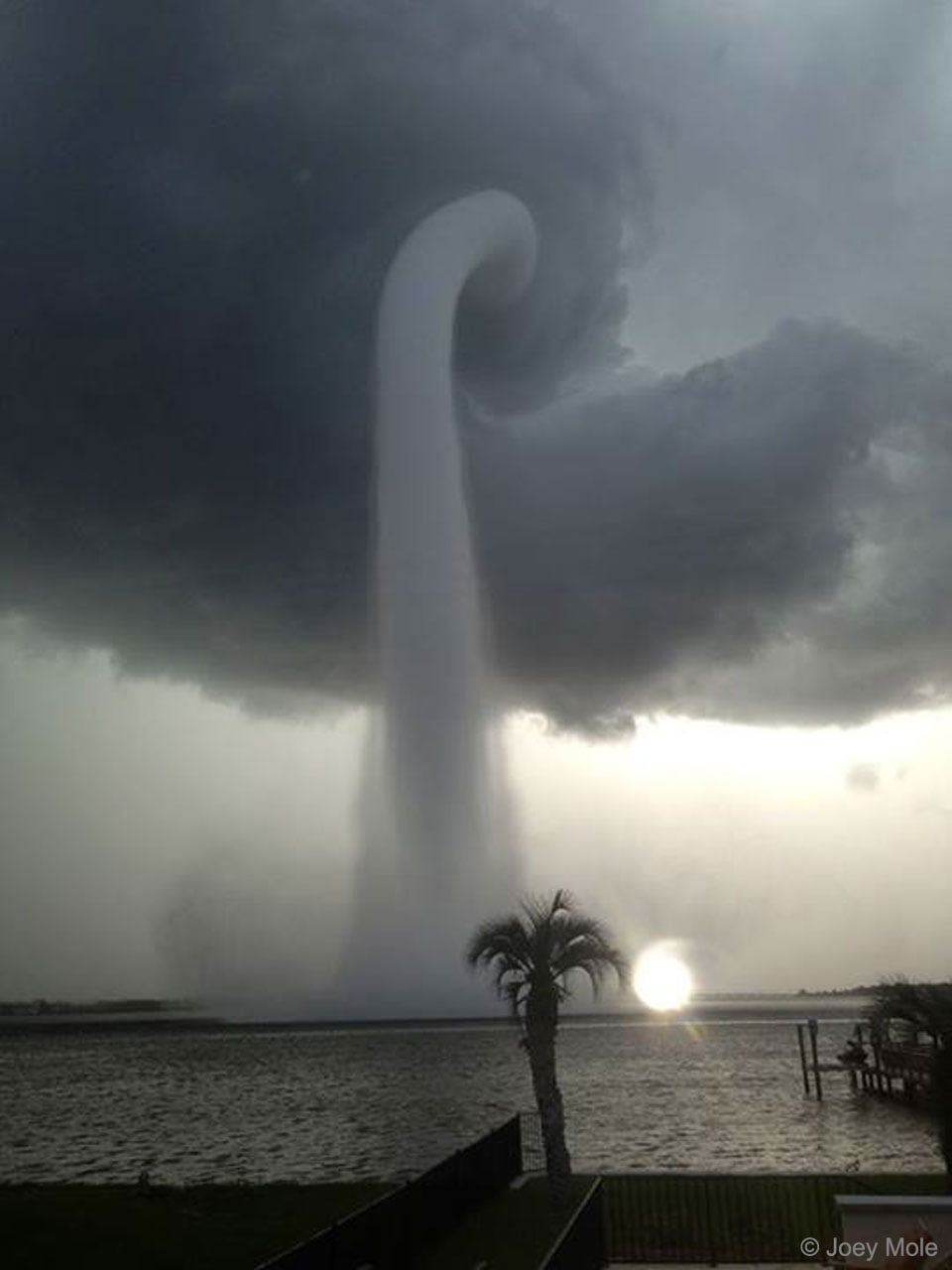
    This dramatic image shows a waterspout formed off the coast of Florida. Waterspouts come in two varieties: tornadic and fair-weather. Both types can be dangerous to anyone caught up in them, though the tornadic variety, which are usually associated with severe thunderstorms, is generally worse. Tornadic waterspouts can form top-down from a thunderstorm or when a tornado moves from land to water. Fair-weather waterspouts, on the other hand, typically form from the bottom, in a similar fashion to dust devils and other fair-weather vortices. (Image credit: J. Mole; via APOD)

  • Jovian Vortices

    Jovian Vortices

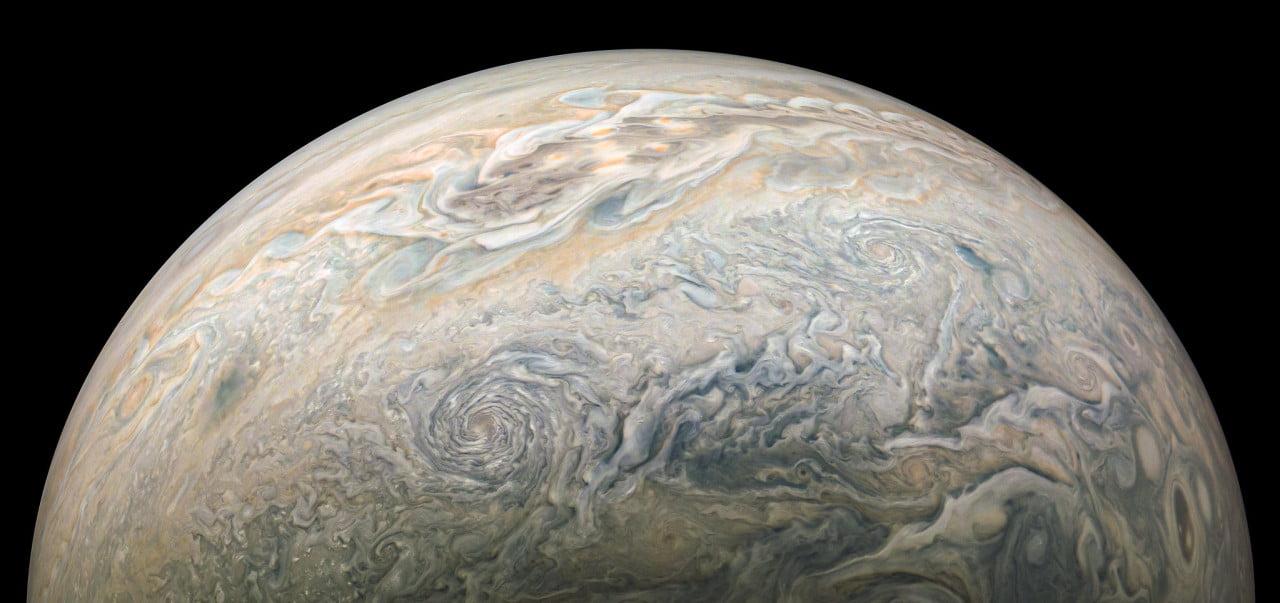
    Jupiter continues to mesmerize in the images from JunoCam. With enhanced contrast, the planet’s eddies look like swirls you could just lean forward and fall into. The complexity of the Jovian atmosphere’s mixing is just astounding. It’s like an ever-changing Impressionist painting brought to life. Check out full-size versions of these stunning images here and here. (Image credit: NASA/JPL-Caltech/SwRI/MSSS/Kevin M. Gill, 12; via Planetary Society; submitted by jpshoer)