Tag: vortices

  • Trails from a Delta Wing

    Trails from a Delta Wing

    Top-down view of green and red dyes streaming off a delta wing

    Rhodamine (red) and fluorescein (green) dyes highlight the complex flows around a delta wing. To visualize the flow, researchers painted the apex of the delta wing with rhodamine, which gets drawn into the core of the wing’s leading edge vortex. The green fluorescein dye was added to the wing’s trailing edge, where it gets pulled into the secondary structure of the vortices. A laser illuminates the flow, making even the most delicate wisps of dye shine. As the wake behind the wing develops, the dyes reveal growing instabilities along the vortices. Given time and space, these instabilities will grow large enough to destroy any order in the wake, leaving behind turbulence. (Image and research credit: S. Morris and C. Williamson; see also poster)

  • Featured Video Play Icon

    Reader Question: Inside a Vortex

    Reader embersofkymillo asks:

    Hey FYFD, could you do some analysis/explanations behind the physics of this vortex stuff? I love when you do spots on Slow Mo Guys vids and figured I’d share a recent one w you 

    I enjoy doing that, too! So let’s talk a little about vortices. What Dan’s tea stirrer is doing is creating a low-pressure core for a vortex. We can see just how strong that low pressure region is by the way it sucks the air-water interface down toward the spinning arms. Eventually the interface and stirrer meet, and what was once a single, smooth(ish) surface gets torn into a myriad of bubbles. (As an aside, those bubbles get loud.) 

    I also like the sequence of sugar cube drops because they make for some very cool splashes. Notice how the orientation of the cube’s edges as it hits determines the shape of the inital splash curtain. The asymmetry borne out of that impact actually follows through all the way through the seal of the cavity behind the cube. It reminds me of this oldie-but-goodie video on drops hitting different shapes. (Video and image credit: The Slow Mo Guys; submitted by embersofkymillo)

  • Featured Video Play Icon

    The Polar Vortex

    Every year or two, the Northern Hemisphere gets treated to a bout of intensely cold temperatures thanks to the polar vortex. What you may not realize, though, is that it’s not the polar vortex that causes this cold weather – it’s the vortex breaking down. As Simon Clark explains in this video, the polar vortices (one at each pole) are intense and powerful regions of circulation in the stratosphere, or mid-atmosphere. They’re largely responsible for keeping cold air trapped in the Arctic and Antarctic. But occasionally, this region of the atmosphere will suddenly get warmer – to the tune of increasing by 80 degrees Celsius in less than a week! When this happens, a polar vortex will deform and potentially even split into smaller vortices, as seen below. When this happens, the vortex loses its hold on the cold air near the surface, allowing Arctic air to sneak as far south as Texas. After a couple of weeks of affecting our weather, the polar vortex will typically reform and we’ll return to normal. In the meantime, stay warm! (Video and image credit: S. Clark; submitted by Nikhilesh T.)

  • Vortices and Ground Effect

    Vortices and Ground Effect

    Though typically unseen, the vortices that swirl from the tips of aircraft wings are powerful. Here you see a Hawker Sea Fury equipped with a smoke system used to visualize the vortices that form at the wingtip as high-pressure air from the bottom of the wing and low-pressure air from the top swirl together. As you can see, the vortices persist in the wake long after the plane passes. The size and strength of the vortices depend on the size and speed of the aircraft; this is why air traffic control requires smaller planes to wait longer to take off or land if there was just a larger aircraft on the runway.

    The other cool thing to note here is how the wingtip vortices move apart from one another in the animation above. In flight, wingtip vortices usually stay roughly parallel to one another, but they drift downward in the aircraft’s wake. Near the ground, though, the vortices cannot move down, so instead ground effect forces them apart from one another, as seen here. (Image and video credit: E. Seguin; via Kelsey C.)

  • Featured Video Play Icon

    Making a Square Vortex

    As someone who has played with her share of vortex cannons, I can assure you that messing around with smoke generators and vortex rings is a lot of fun. And in this video, Dianna gives things a little twist: she makes the vortex cannon’s mouth a square instead of a circle.

    Now, that doesn’t create a square vortex ring. (Vortex rings don’t really do 90-degree corners.) But it does make the vortex ring all neat and wobbly. Whenever you have two vortices near one another (or, in this case, two parts of a vortex line near one another), they interact. As Dianna shows with hurricanes, depending on the direction of rotation and their relative strength, nearby vortices can orbit one another or travel together in straight lines – or they can cause more complicated interactions, like in the case of the square-launched rings.

    I think there may also be some interesting effects here from vortex stretching, but that’s a topic for another day! (Video and image credit: D. Cowern/Physics Girl; see also: LIBLAB; submitted by Maria-Isabel C.)

  • Featured Video Play Icon

    Inside Hurricane Maria

    In addition to looking outward, NASA constantly monitors our own planet using a suite of satellites. In this video, they visualize data taken by the Global Precipitation Measurement Core Observatory of Hurricane Maria two days before it hit Puerto Rico. Instruments on board the satellite measure both liquid and frozen precipitation, giving scientists – and now the public – a glimpse into the heart of a developing hurricane. Be sure to take a look around; it’s a 360-degree video, and I bet it’s even more spectacular in VR. Having a trove of data like this helps researchers better understand the processes that influence a strengthening hurricane, which ultimately allows them to make better predictions about hurricane behavior in order to save lives. (Video credit: NASA; via Francesco C.)

  • Swirls of Color

    Swirls of Color

    These beautiful swirls show the wake downstream of a thin plate. Here water is flowing from left to right and dye introduced on the plate (upstream and unseen in the photo) curls up into vortices. The vortices in the top row rotate clockwise, while the vortices along the bottom rotate anti-clockwise. This pattern of alternating vortices is extremely common in the wakes of objects and is known as a von Karman vortex street. Similar patterns are seen in soap films, behind cylinders, in the wakes of islands, and behind spaceships.  (Image credit: ONERA, archived here)

  • How Mantas Filter But Never Clog

    How Mantas Filter But Never Clog

    Manta rays spend much of their time leisurely cruising through the water with their meter-wide mouths open. As they swim, they filter plankton, which makes up most of their diet, from the water. And they do so without ever clogging. 

    The inside of the manta’s mouth is lined with gill rakers (upper right), a series of comb-like teeth. When flow hits the leading edge of these (bottom), it creates a vortex that accelerates any particles caught in the flow. They essentially ricochet along the top of the gill rakers, getting led straight into the manta’s digestive system – while excess water gets deflected between the gill rakers and back out the manta’s gills. To drive this, all the manta has to do is swim; with the right flow speed, the shape of the gill rakers handles all the filtration with no additional effort. (Image credit: manta ray – G. Flood; gill rakers – M. Paig-Tran; flow vis – R. Divi et al., source; research credit: M. Paig-Tran et al.; via The Atlantic; submitted by Kam-Yung Soh)

  • The Sensitivity of a Seal’s Whiskers

    The Sensitivity of a Seal’s Whiskers

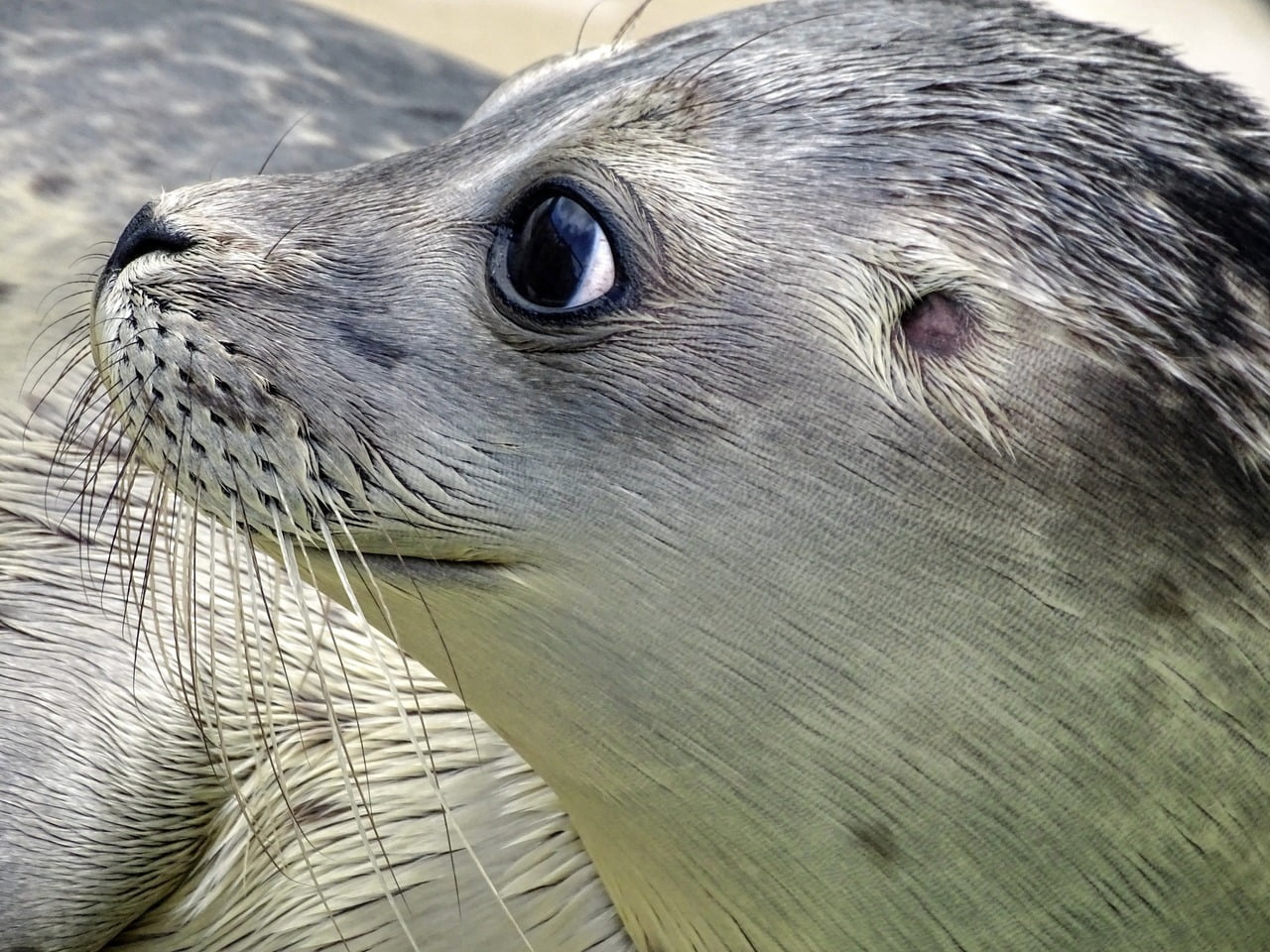
    Harbor seals and their brethren have a superpower that lets them track their prey even without sight or sound. It’s their whiskers, which are sensitive enough to follow the trail left by a single fish thirty seconds earlier. The secret to the whisker’s sensitivity lies in its shape. Instead of a uniform, circular cross-section, the seal’s whisker is oval-shaped and its width varies along the length in a wavy pattern. So unlike a straight cylinder, which vibrates when towed through water, the seal’s whiskers are unperturbed by their own movement. They shed only weak vortices and do not vibrate as a result.

    But, if you expose the whiskers to any external turbulence, like the vortices trailing a fish, the whisker ‘slaloms’ back-and-forth in time with the wake. That motion gets transmitted to the nerves in the seal’s cheek, carrying potential information about both the size and speed of the wake’s originator. Researchers hope similar bio-inspired whiskers could help underwater vehicles track schools of fish or locate underwater drilling leaks. (Image credit: M. Richter; video credit: MIT; research credit: H. Beem and M. Triantafyllou; via the Economist; submitted by Russ A. and Kam-Yung Soh)

  • The Swimming of a Dead Fish

    The Swimming of a Dead Fish

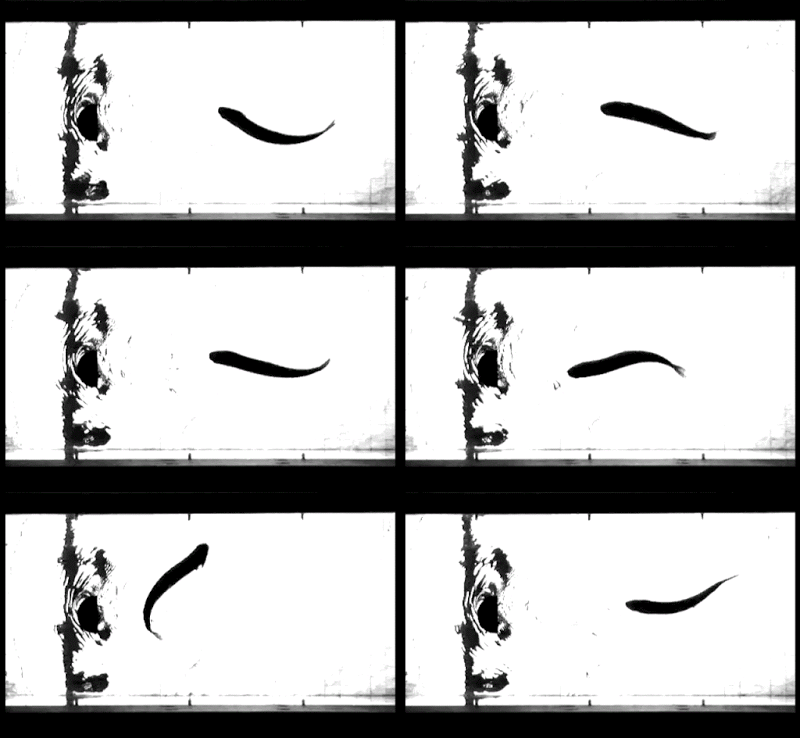
    When I was a child, my father would take me trout fishing, and I spent hours marveling from the riverbank at the trouts’ ability to, seemingly effortlessly, hold their position in the fast-moving water. As it turns out, those trout really were swimming effortlessly, in a manner demonstrated above. The fish you see here swimming behind the obstacle is dead. There’s nothing powering it, except the energy its flexible body can extract from the flow around it.

    The obstacle sheds a wake of alternating vortices into the flow, and when the fish is properly positioned in that wake, the vortices themselves flex the fish’s body such that its head and its tail point in different directions. Under just the right conditions, there’s actually a resonance between the vortices and the fish’s body that generates enough thrust to overcome the fish’s drag. This means the fish can actually swim upstream without expending any energy of its own! The researchers came across this entirely by accident, and one of the questions that remains is how the trout is able to sense its surroundings well enough to intentionally take advantage of the effect. (Image and research credit: D. Beal et al.; via PhysicsBuzz; submitted by Kam-Yung Soh)