Tag: turbulence

  • Eroding Grains

    Eroding Grains

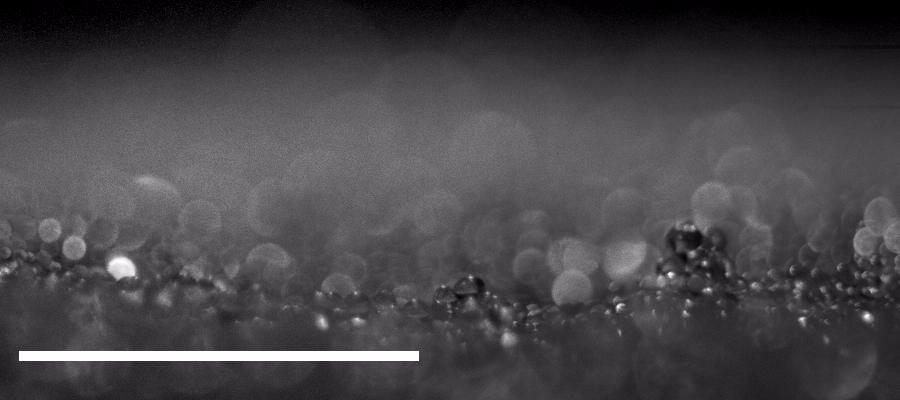
    When a spacecraft comes in for a landing (or a tag similar to what OSIRIS-REx did), there’s a turbulent jet that points straight into a bed of particles. How those particles react — how they erode and the crater that forms — depends on many factors, including the cohesion between particles. In these experiments, researchers investigated such a jet (in air) and its impact on particles with differing amounts of cohesion.

    When there is little cohesion between particles, erosion takes place a single particle at a time (Image 1). Once there’s some cohesion, the jet’s velocity has to be higher to trigger erosion (Image 2). Once erosion does begin, it includes both singular and clumped particles. In highly cohesive beds, velocities must be even higher to create erosion, which takes place with large clusters of particles flying off together (Image 3). (Image and research credit: R. Sharma et al.)

  • Featured Video Play Icon

    Peering Into the Gap

    This video offers a glimpse into turbulence developing in a classic flow set-up, a Taylor-Couette cylinder. The apparatus consists of two upright, concentric cylinders; the outer cylinder is fixed, and the inner one rotates. This video shows the gap between the cylinders, and it’s rotated so that the inner cylinder is at the bottom of the frame. Gravity points from left to right in the video. The fluid in the 8-cm gap between the cylinders is water, seeded with rheoscopic particles to visualize the flow.

    The video begins as the inner cylinder has just begun to rotate, dragging nearby fluid with it. A thin, laminar boundary layer forms at the bottom of the frame, growing as time goes on. A few seconds in, the boundary layer transitions to turbulence; look closely and you’ll see hairpin-shaped vortices appear. Just after that, the boundary layer becomes entirely turbulent and continues to slowly move upward to take over the full gap. The video is available in a full 4K resolution if you really want to get lost in the flow. (Video credit: D. van Gils)

  • Bubbles in Turbulence

    Bubbles in Turbulence

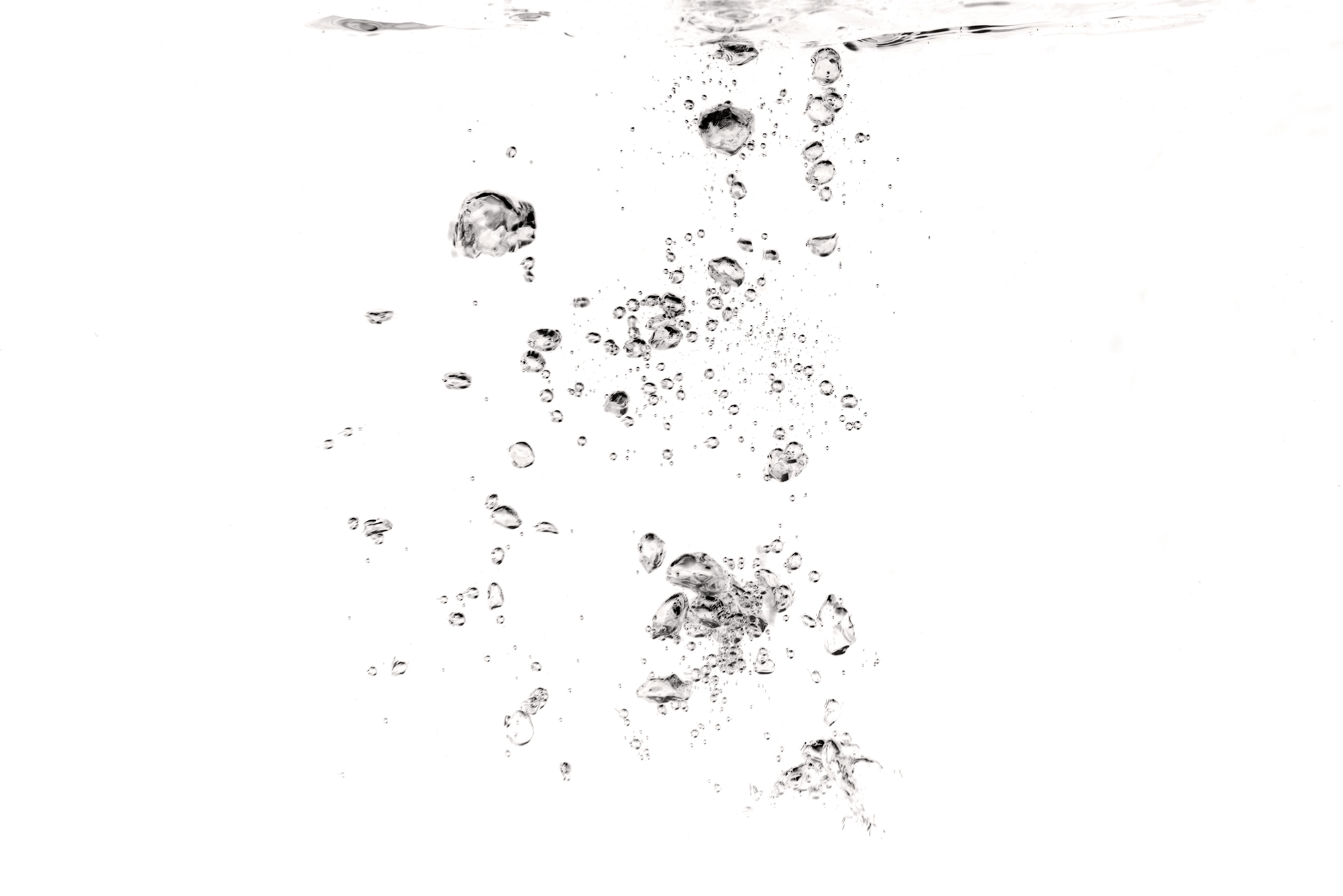
    In nature and industry, swarms of bubbles* often encounter turbulence in their surrounding fluid. To study this situation, researchers used numerical simulation to observe bubbles across a range of density, viscosity, and surface tension values relative to their surroundings. They found that density differences between the two fluids made negligible changes to the way bubbles broke or coalesced.

    In contrast, viscosity played a much larger role. More viscous bubbles were less likely to deform and break, thanks to their increased rigidity. When looking at small deformations along the bubble interface, both density and viscosity had noticeable effects. With increasing bubble density, they observed more dimples on the interface; increasing the viscosity had the opposite effect, making the bubbles smoother. (Image credit: Z. Borojevic; research credit: F. Mangani et al.)

    *We usually think of bubbles as air or another gas contained within a liquid. But this study’s authors use the term “bubble” more broadly to mean any coherent bits of fluid in a different surrounding fluid. Colloquially, this means their results apply to both bubbles and drops.

  • Featured Video Play Icon

    How Dunes Form

    On its face, the idea that sand and wind can come together to form massive mountainous dunes seems bizarre. But dunes — and their smaller cousins, ripples — are everywhere, not just on Earth but on other planetary bodies where fine particles and atmospheres interact. In this video, Joe Hanson gives a great overview of sand dynamics, beginning with what sand is, how it moves, and what it can ultimately form. It’s well worth a watch, even if you know a little about dunes already; I know I learned a thing or two! (Image and video credit: Be Smart)

  • Featured Video Play Icon

    Making Hurricanes

    With oceans warming, there’s more energy available to intensify hurricanes. And while our weather models have gotten better at predicting where hurricanes will go, they’re less good at predicting hurricane intensity, largely because capturing real data from storms is so difficult and dangerous. To address that shortfall, engineers build facilities like the one seen here, which simulates hurricane wind and water conditions so that scientists can study their interaction and better understand storm physics. Check out the full Be Smart video for a tour of the facility and a look at their work. (Image and video credit: Be Smart)

  • Featured Video Play Icon

    “Water III”

    In “Water III,” filmmaker Morgan Maassen explores the ocean from above and below. I love the sheer variety of fluid phenomena; yes, there are classic breaking barrel waves for surfing, but there are also rib vortices and bubble plumes and churning turbulence that wouldn’t be out of place in a stormy Midwestern sky. Enjoy! (Image and video credit: M. Maassen)

  • Featured Video Play Icon

    “Haboob: A Decade of Dust”

    From the right vantage point, an approaching dust storm — known as a haboob — can look downright apocalyptic. In this compilation of clips a decade in the making, photographer Mike Olbinski shows these storms in all their terrifying majesty. I love seeing how the cloud front overhead densifies as the dust below advances. Without these wide perspectives, it’s hard to appreciate an approaching haboob. When one blew through Denver a few years ago, I never saw it coming. My first clue was the tree in front of my office window whipping wildly back and forth just before the sky turned brown! I much prefer Olbinski’s versions. Congratulations, Mike, on a decade of haboob-chasing! (Image and video credit: M. Olbinski; submitted by jpshoer)

  • Using Turbulence in Flight

    Using Turbulence in Flight

    When small, heavy particles are in a turbulent flow, they settle faster than in a quiescent one. Their interactions with turbulent eddies sweep them along, extracting energy that lengthens their overall path but reduces the time necessary for them to fall. Using the same principles, researchers are finding ways for rotorcraft and other vehicles to extract energy from turbulence for more efficient flight.

    The technique forces a vehicle to behave like a heavy particle by sensing turbulent gusts from its own accelerations and adding forcing to those accelerations when they are in the desired direction of flight. In essence, the vehicle uses the turbulence of its surroundings to find helpful tailwinds. (Image credit: A. Soggetti; research and submission credit: S. Bollt and G. Bewley)

  • Stormy Skies

    Stormy Skies

    Photographer Mitch Dobrowner captures the majestic and terrifying power of storms in his black and white images. Towering turbulence, swirling vortices, and convective clouds abound. See more of his work at his website and Instagram. (Image credit: M. Dobrowner; via Colossal)

  • Turbulence in Flight

    Turbulence in Flight

    Eagles and other birds spend much of their lives in the turbulence of our atmospheric boundary layer. Some of their interactions with turbulence — like using topographical effects to aid their flight — are well-known, but much remains uncertain. One team of researchers looked at a tagged golden eagle’s flight data, compared with known wind conditions, and looked for evidence of turbulence’s influence. To do this, they drew on years of research into how turbulence interacts with inertial particles — particles that are heavier than the surrounding fluid and thus unable to follow the flow exactly.

    What they found is that turbulence seems to be baked into many aspects of the eagle’s flight. Even the basic accelerations of the eagle’s body during flight showed characteristics that match those of turbulent flows. The findings suggest that turbulence — rather than something to be avoided — is an integral part of flight for birds, an energy source they’ve learned to exploit. (Image credit: J. Wang; research credit: K. Laurent et al.; submission by G. Bewley)