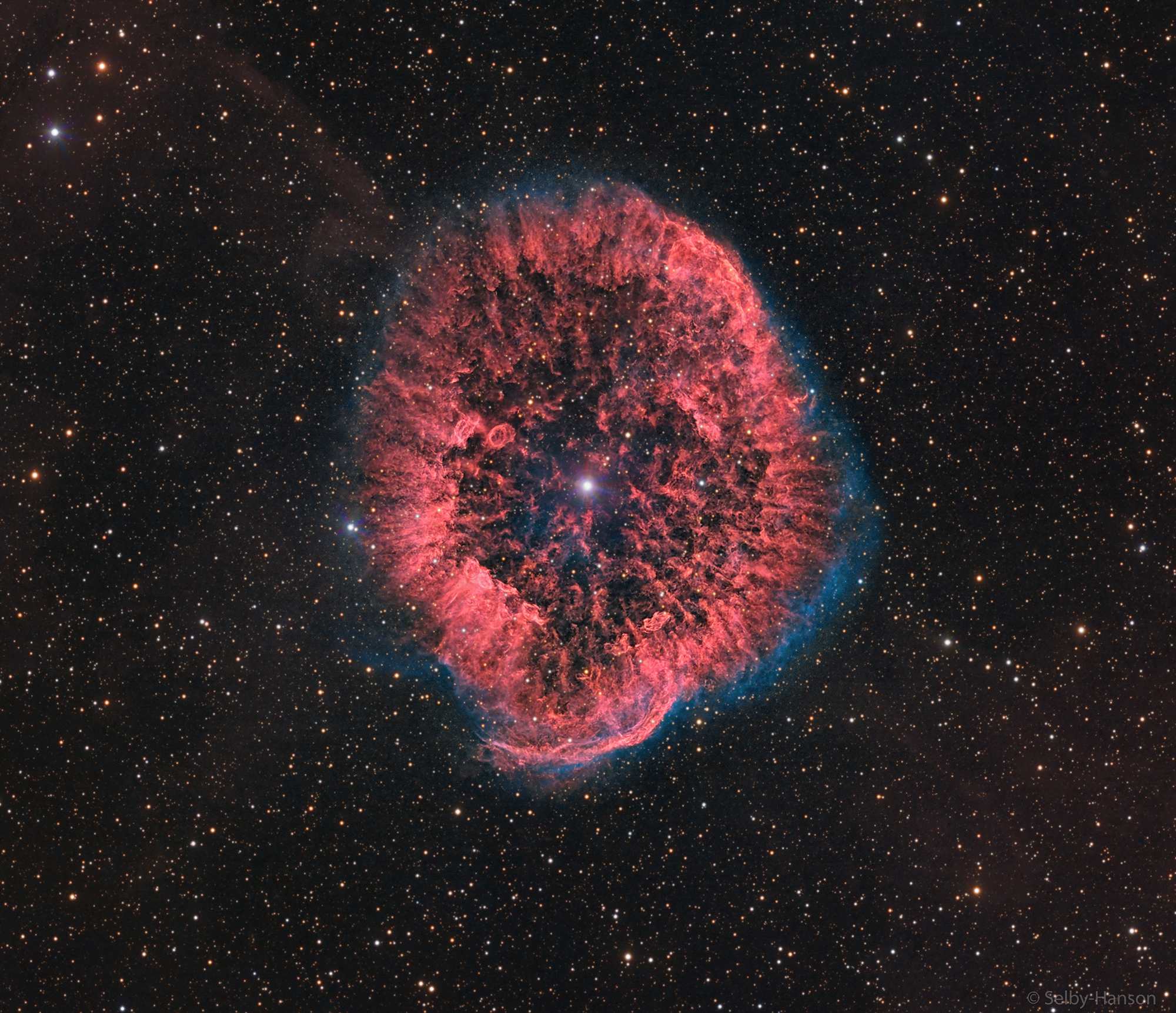
Stars about 100 times more massive than our sun live fast and die young. They burn through their hydrogen supply quickly, then start fusing heavier elements. As they do, their strong stellar winds start blowing off the exterior layers of the star. That’s the story behind WR 40, the star at the center of Nebula RCW 58. The nebula itself is made up of material blown off the star, carved into turbulent filaments by stellar winds. (Image credit: M. Selby and M. Hanson; via APOD)
Tag: turbulence

Exploding a Bubble
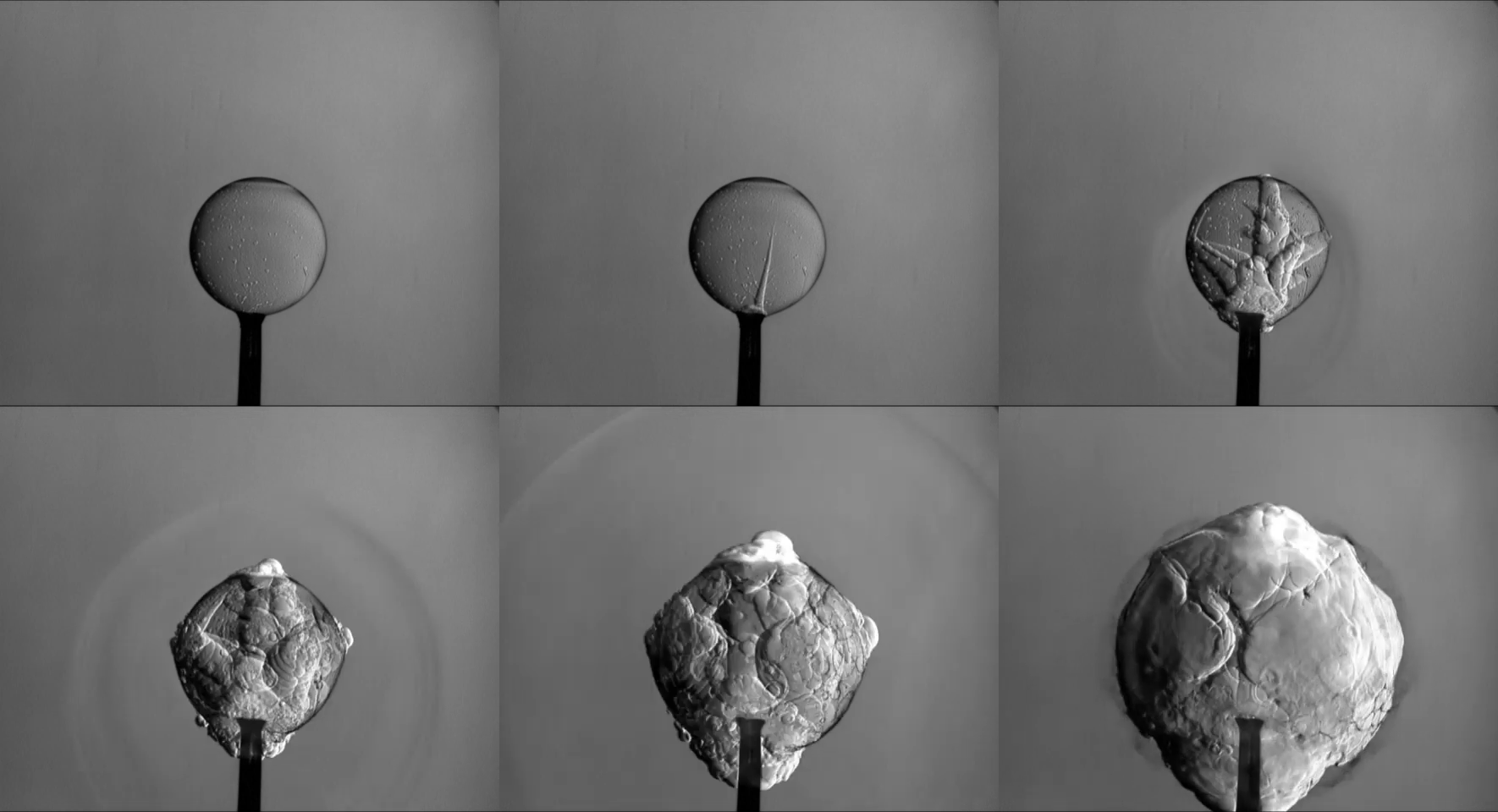
In this high-speed video, artist Linden Gledhill ignites a mixture of oxygen and hydrogen contained within a soap bubble. As neat as the video is, I decided to take a closer look at the initial detonation with this animation:

The ignition sequence within the bubble, slowed down further. Even here, it’s hard to appreciate just how fast ignition is; it lasts only a handful of frames, despite filming at 40,000 frames per second. But we can still pick out some very neat physics. The ignition begins with a spike-like jet but immediately forks into three ignition fronts that pierce the soap bubble. You can see the shadowy mist of the bubble bursting as the flame front expands. Watch the background carefully, and you can see a shock wave flying away from that moment of detonation.
Once the soap bubble is gone, the expanding flames begin to wrinkle and deform. Turbulence takes shape, eddying through the flames at a much slower speed than the initial detonation. This is where most of combustion takes place, with turbulence mixing the hydrogen and oxygen together to better enable burning. (Image and video credit: L. Gledhill)

Submarine Volcano
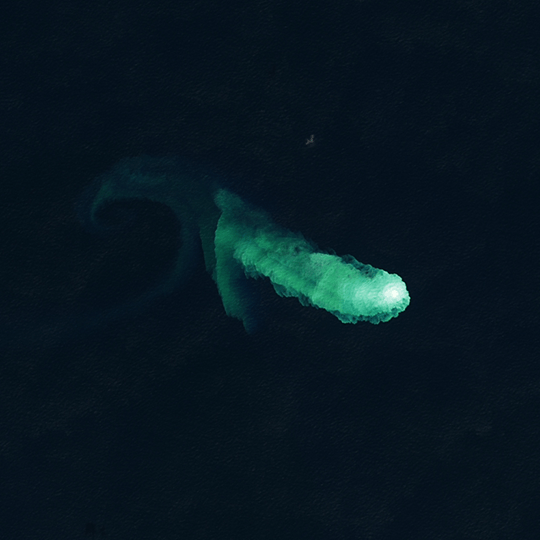
This pale green plume signals the activities of Kaitoku, an underwater seamount near Japan. Periodic activity picked up there in August 2022 and continued into the new year. The rising plume likely consists of superheated acidic seawater mixed with particulates, sulfur, and rock fragments. Underwater volcanoes like this one are thought to account for up to 80 percent of our planet’s volcanic activity. (Image credit: L. Dauphin; via NASA Earth Observatory)

“Dark Matter”


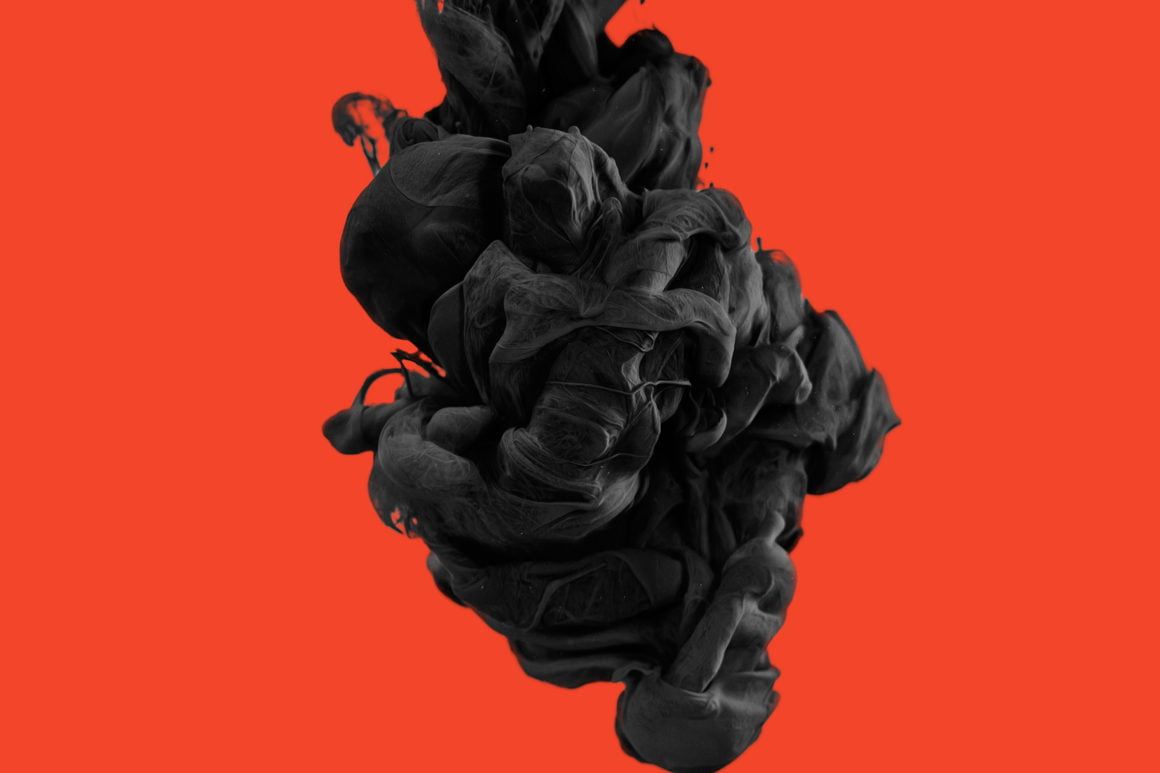

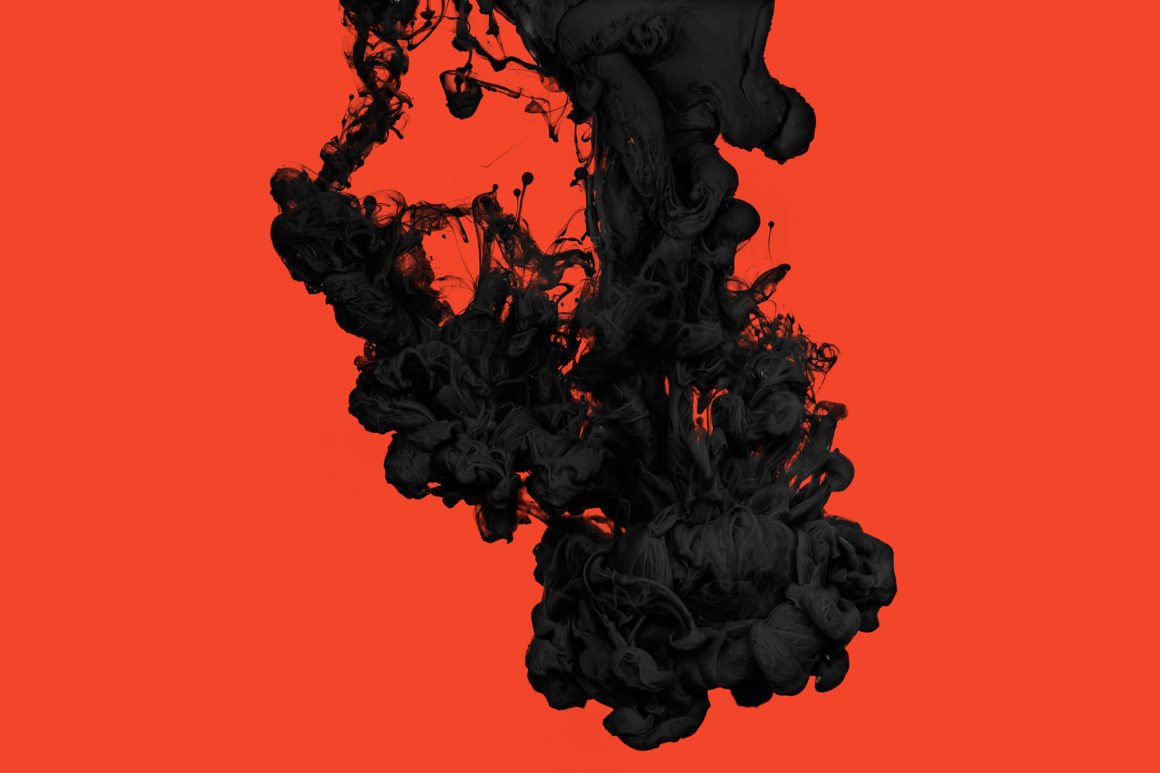


In “Dark Matter” photographer Alberto Seveso captures billowing black pigment against a bright red backdrop. Seveso excels at capturing the developing turbulence in sinking fluids. I’m always blown away by the texture in his images; it almost makes the fluid look fabric-like and solid. Look closely in some of these images and you can catch a few tiny Rayleigh-Taylor instabilities, too, as the denser pigment sinks through water. (Image credit: A. Seveso)

“Turbulence”


In his recent short film, artist Roman De Giuli explores turbulence using metallic paints and inks in a fishtank. The effects are beautiful: sparkling pigments dispersing in clouds, mushroom- and umbrella-shaped Rayleigh-Taylor instabilities, and lots of swirling eddies. It’s exactly the kind of eyecandy to kick off your weekend with! (Image and video credit: R. De Giuli)
Kelvin-Helmholtz Flows Downhill


Gravity currents carry denser fluids into lighter ones, like cold air drifting under your door in winter or dense fogs flowing downhill in San Francisco. Here, researchers visualize the situation using denser salt water flowing into fresh water. Once the gate separating the two fluids rises, the salt water slides down an artificial slope into the fresh water.
Very quickly the flow forms a Kelvin-Helmholtz instability due to the different flow speeds between the two fluids. Kelvin-Helmholtz waves form distinctive swirls and billows that are reminiscent of a cat’s eye. As the swirls rotate, they can flow over one another, and break up into turbulence. (Image and video credit: C. Troy and J. Koseff)
“The Dark Days”


“The Dark Days” is the third film in artist Thomas Blanchard’s N-UPRISING series. Like its siblings, this film features plants and insects, along with creeping — and sometimes overwhelming — fluid flows. The vivid colors of the orchids here make an uncomfortable juxtaposition with the air raid horns, sirens, and sounds of war that make up the soundtrack. It works well as a metaphor for life these days, where some of us can enjoy the new and the beautiful while others are caught up in war and suffering. (Image and video credit: T. Blanchard)
Exascale Simulations


Capturing what goes on inside a combustion engine is incredibly difficult. It’s a problem that depends on turbulent flow, chemistry, heat transfer, and more. To represent all of those aspects in a numerical simulation requires enormous computational resources. It’s not simply the realm of a supercomputer; it requires some of the fastest supercomputers in existence.
Exascale computing, like that used for the simulations in this video, is defined as at least 10^18 (floating-point) operations per second. For comparison, my PC has a recent, high-end graphics card, and it’s about a million times slower than that. These are absolutely gigantic simulations. (Image and video credit: N. Wimer et al.)

Beneath the Waves

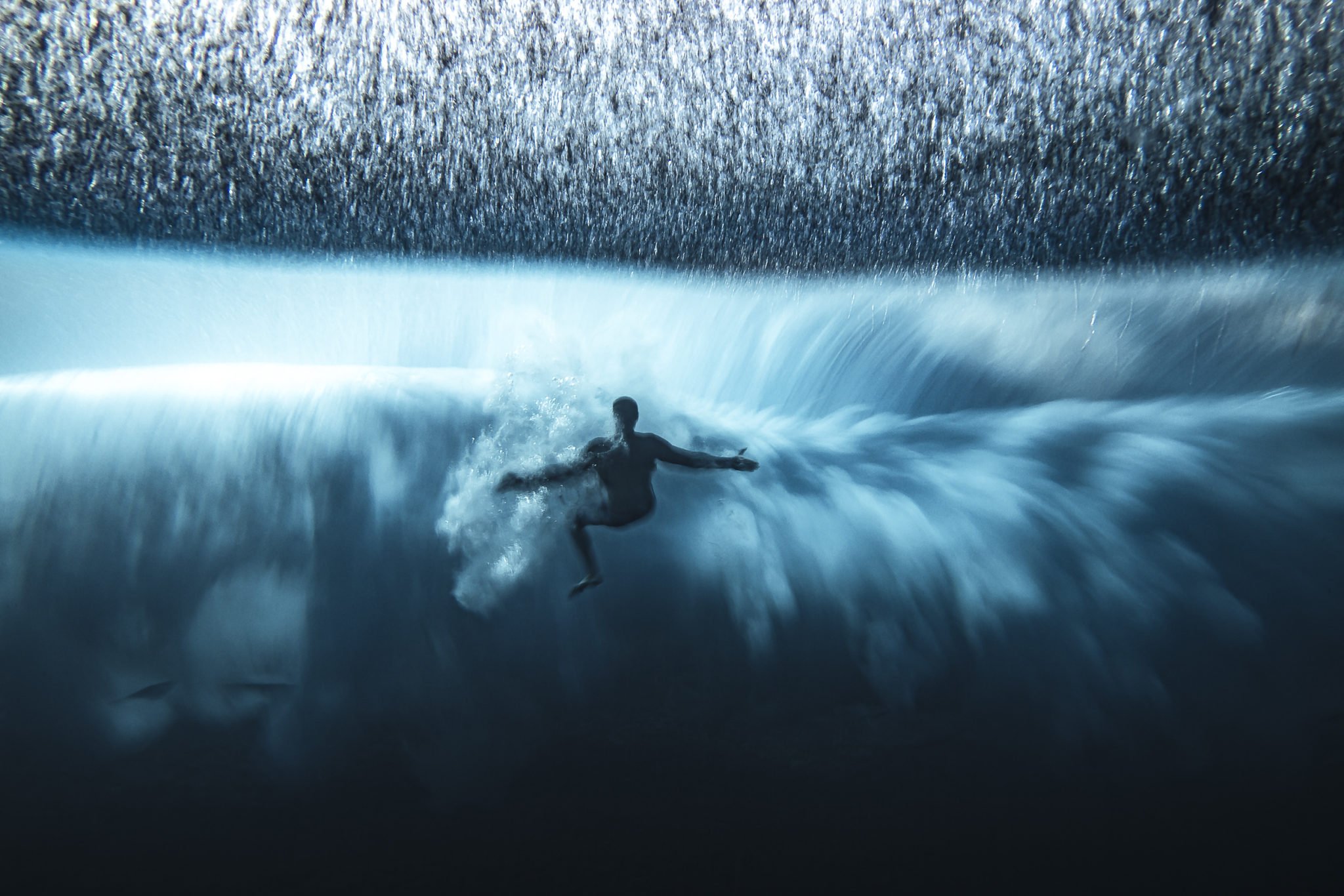

Surfing looks entirely different from below the wave. Photographer Ben Thouard captures his images by freediving and observing what goes on overhead. Whether the surfers nearby ride a barrel roll or bail into the churn, the results are incredible. You can find more of Thouard’s artwork on his website and Instagram. (Image credit: B. Thouard; via Oceanographic Magazine)
Turbulence From Vortex Rings


When vortex rings collide, they reconnect into smaller, rings that eventually break down into chaos. Here, researchers experiment with colliding multiple vortex rings — focusing on an eight-ring collision. When they collide rings over and over, it creates a zone of isolated turbulence at the heart of the collisions.
Many of the theories and predictions that exist around turbulence assume that the flow is homogeneous and isotropic; what this means is that the (statistical) characteristics of the flow are the same in every direction. In reality, this kind of flow isn’t always easily achieved, which makes testing theoretical predictions challenging.
What’s neat about this set-up is that you get this desired turbulence in a very controlled way. It’s easy to tune the size and energy of your vortex rings, and those tweaks allow you to observe what — if any — changes occur in the resulting turbulence. (Image and video credit: T. Matsuzawa et al.)