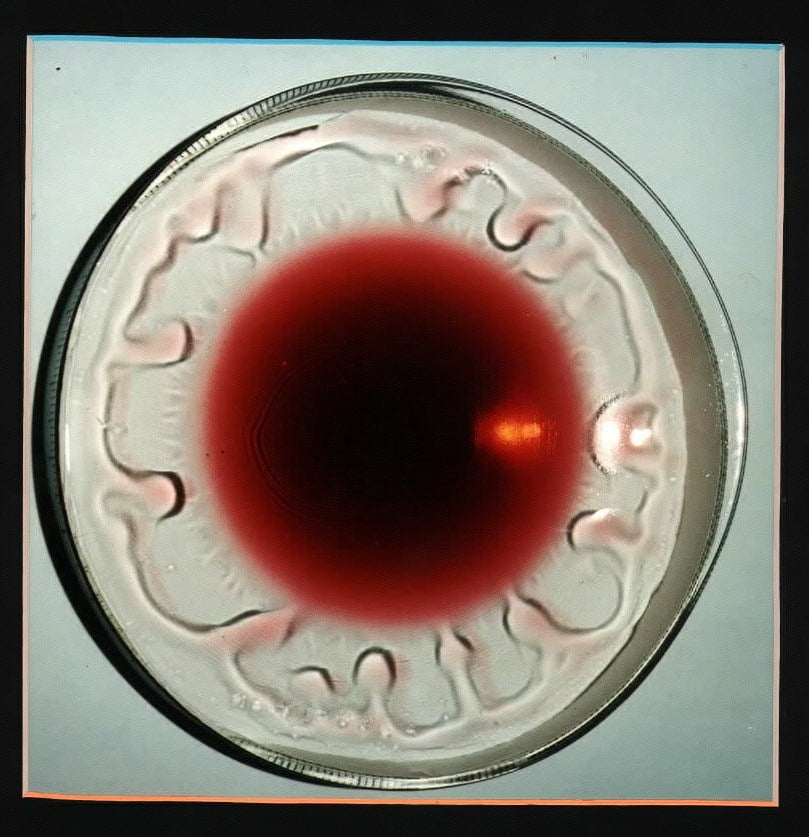
Astronauts are preparing an experiment on the Marangoni effect, in which a variation in surface tension can cause mass flow, for flight aboard the International Space Station. The effect, also responsible for causing tears of wine, will benefit from study in microgravity because competing effects like gravity-induced sedimentation and buoyant convection will be negligible. Astronaut Ron Garan reports more on the upcoming experiment on the Fragile Oasis blog.
Tag: surface tension

Crown Breakup
When a droplet falls into a pool of similar fluid, one often observes a crown-like impact effect. This student video shows high-speed footage of different fluids crowning and explores the effects of surface tension on crown breakup.
Microgravity Water Films
In this video astronaut Don Pettit demonstrates some interesting laminar flow effects using a water film in microgravity. By using a film, fluid motion is essentially confined to two dimensions. This is important because it prohibits the development of turbulence, which is a purely three-dimensional phenomenon. Doing the experiment in microgravity allows Pettit to leave the experiment for a long period of time without buoyant effects or similar disturbances. When he first stirs the film, the tracer particles show some signs of what looks like turbulent mixing, but soon the film rotates uniformly with streaks of gray caused by different concentrations of tracer particles. Pettit notes that he allowed the film to rotate overnight and it eventually all turned milky white. This is the effect of molecular diffusion of the tracer particles; without turbulence, the only way for mixing to occur is through the random motion of molecules. See more of Pettit’s Saturday Morning Science videos for additional microgravity fluid mechanics.
Superfluid Dripping
This high-speed video shows superfluid helium dripping and breaking up. Although superfluid has no viscosity, this does not prevent the Plateau-Rayleigh instability from breaking the helium into droplets once the mass of the liquid is too great for surface tension to contain.

Tears of Wine
Tears of wine are caused by the Marangoni effect, in which a gradient in surface tension causes mass flow. The water in the wine has a higher surface tension than the alcohol in the wine, causing the wine to be drawn away from regions of higher alcohol concentration. #
Microfluidics
The field of microfluidics–where fluids are constrained to the sub-millimeter scale–is increasingly important in fields like chemistry, molecular biology, and microtechnology. At the microscale, surface tension often has greater effects than in our everyday world. This video shows how adding small amounts of a polymer drastically changes droplet breakup.
Zero-G Water Bubbles
Astronaut Don Pettit narrates some of his experiments with air and water droplets in microgravity in this video. The lack of body forces and buoyancy in microgravity means that surface tension effects frequently dominate. Pettit’s demonstrations also involve some fun basic physics with bubble behaviors inside of water droplets. See more of Pettit’s Saturday Morning Science videos for additional microgravity fluid mechanics.

Water Balloon Photography
Photographer Edward Horsford uses high-speed photography to capture water balloons as they burst. On Earth, of course, gravity wins over surface tension, but the results are very different in microgravity. See the technical description for how Horsford gets his shots and look at more of his work on Flickr. (via NPR)
Convection in Cream and Liqueur
We are used to associating convection with differences in temperature, but what’s actually necessary for a Rayleigh-Taylor-type instability is a density variation (and a gravitational field). The solutal convection seen above when mixing liqueur with cream is caused by the interaction of density and surface tension. When the alcohol of the liqueur mixes with the cream, it forms a less dense alcohol-cream that tries to rise to the surface. The alcohol also breaks the surface tension of the cream, causing it to contract and open cells where the alcohol surfaces. As the alcohol evaporates, the alcohol-cream mixture gets denser and sinks back down where it can pick up more alcohol and start the process again. (via jshoer and io9)
Superhydrophobic Carbon Nanotubes
Carbon nanotubes form a superhydrophobic (super water repellent) surface that interacts with water droplets in interesting ways. The droplet is unable to wet the surface and thus the bounces along. When the impact velocities are too great for surface tension to hold the decelerating mass together, it breaks into many, smaller droplets that also bounce along the surface. # (via @JetForMe and @Vinnchan)


