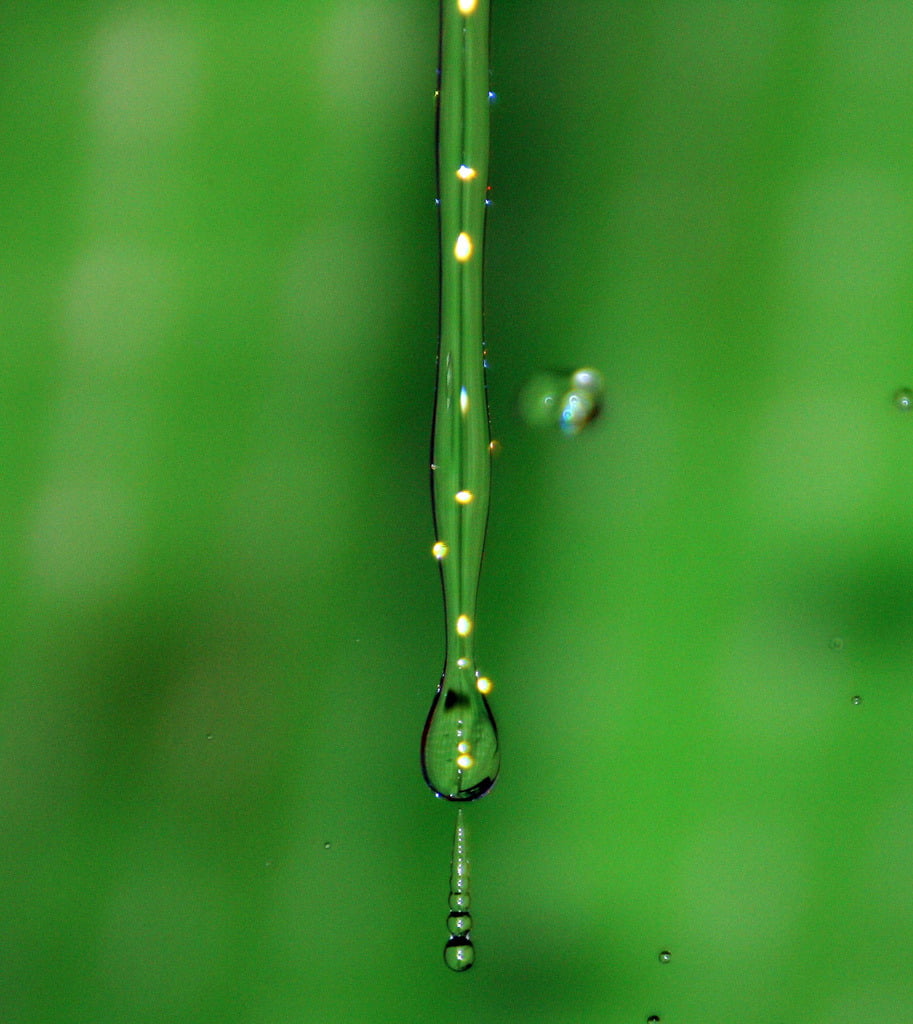
As a laminar column of water falls, slight perturbations cause waviness in the stream. Whenever the radius of the stream decreases, the pressure due to surface tension increases, causing fluid to flow away from the area of smaller radius. This outflow decreases the radius further and drives the stream to break into droplets. The mechanism is called the Plateau-Rayleigh instability. (Photo credit: Mahmoudreza Shirinsokhan)
Tag: surface tension

“Compressed 02”
This timelapse video shows the spreading of food coloring and a ferrofluid through soap suds surrounding a magnet. Capillary action, the same force that enables sap to flow up through a tree against gravity, helps draw the fluids through the interfaces between the soap bubbles without disturbing the suds. The magnet’s field provides a preferred direction for the ferrofluid flow. (via Gizmodo)

Bursting Bubbles
A soap bubble bursts when its surface tension is broken, and, although from our perspective, the bubble bursts instantly, the process is actually directional. The bubble disintegrates from the point of contact outward. See it in high-speed video here or see more photos here. (Photo credit: Richard Heeks) #
How Coffee Rings Form
Coffee rings (an ubiquitous feature of academia) are formed by the deposition of particles as the liquid evaporates. When a coffee drop evaporates, capillary action draws the coffee particles toward the edges of the drop, where they congregate into a ring. Research now suggests that this is due to the spherical nature of the particles. Ellipsoidal particles, in contrast, clump together and result in a uniform stain once their carrier liquid evaporates. The effect seems to be due to the particles’ effects on surface tension; the ellipsoidal particles deform the surface of the droplet as it evaporates such that they are not pulled to the edges. Adding a surfactant, like soap, that decreases surface tension caused the ellipsoidal particles to form rings just as the spherical particles do. (submitted by Neil K) #

Spiky Ferrofluid
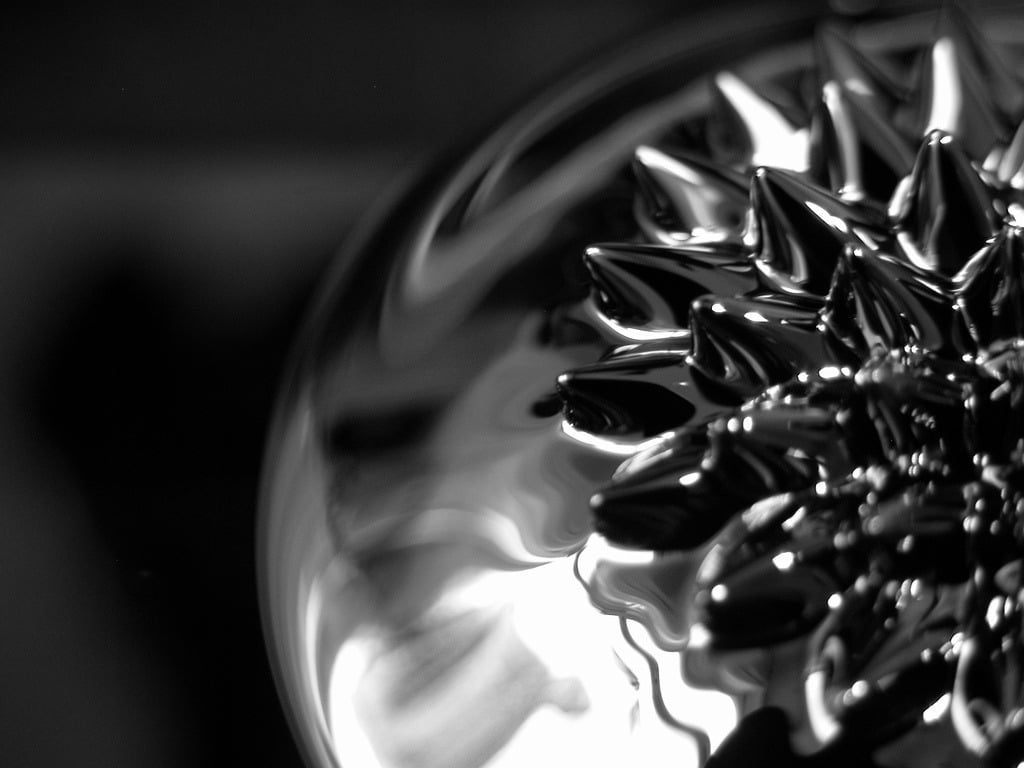
Ferrofluids consist of ferromagnetic nanoparticles suspended in a fluid. When subjected to strong magnetic fields, they develop a distinctive peak-and-valley formation due to the normal-field instability. The shape is a result of minimizing the magnetic energy of the fluid. Both gravity and surface tension resist the formation of these peaks. Ferrofluids, in addition to appearing in art exhibits, can be used as liquid seals, MRI contrast agents, and loudspeaker cooling fluids. (Photo credit: Maurizio Mucciola)
The Tibetan Singing Bowl
The vibration caused by rubbing a Tibetan singing bowl excites standing waves in a Faraday instability on the surface of water in the bowl. As the amplitude of excitation increases, jets roil across the surface, creating a spray of droplets, some of which actually bounce on the surface as it vibrates. For more see the BBC and SciAm articles.
High Hopes
This gorgeous high-speed video captures bubbles, droplets, wakes, cavitation, coalescence, jets, and lots of surface tension at 7000 fps. The authors unfortunately haven’t indicated whether this is air in water or something more viscous, but regardless there are some great phenomena on display here. # (via Gizmodo)
Solutal Convection
Solutal convection, rather than relying on temperature gradients, can occur due to gradients in concentration or in surface tension. While less spectacular than this previously posted video, this video contains a nice simplified explanation of the mechanism. And, as noted in the video, this is a demo you can do yourself at home.
Droplet Impact
As a droplet impacts a pool, it deforms the surface before rebounding in a Worthington jet and releasing secondary droplets as ejecta. Although we witness this act dozens of times a day, seeing it at 5,000 fps drastically alters one’s perspective.

Flowing Up a Waterfall
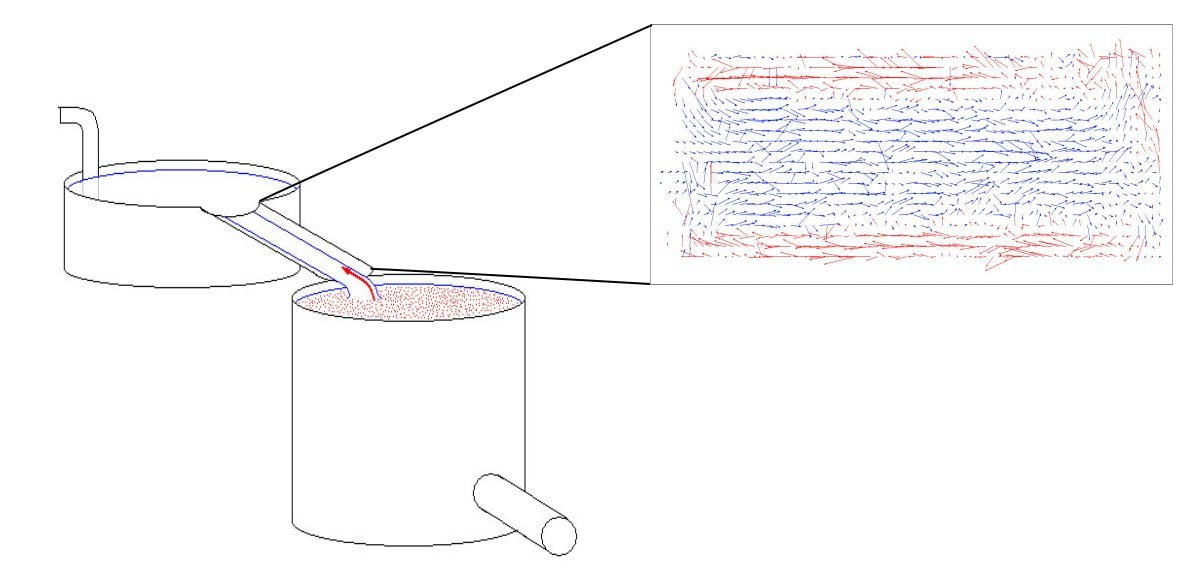
Tea-drinking physicists found that it’s possible for particles to flow up a short (< 1 cm) waterfall to contaminate pure upstream sources. Their apparatus is shown above, along with an inset showing the velocity field on the surface of the channel. The blue arrows indicate flow downstream and the red arrows indicate counterflow that carries particles upstream. The researchers suspect that Marangoni effects may play a role in setting up the counterflow. The finding could have implications for pollution control and manufacturing. # (submitted by Gabe)