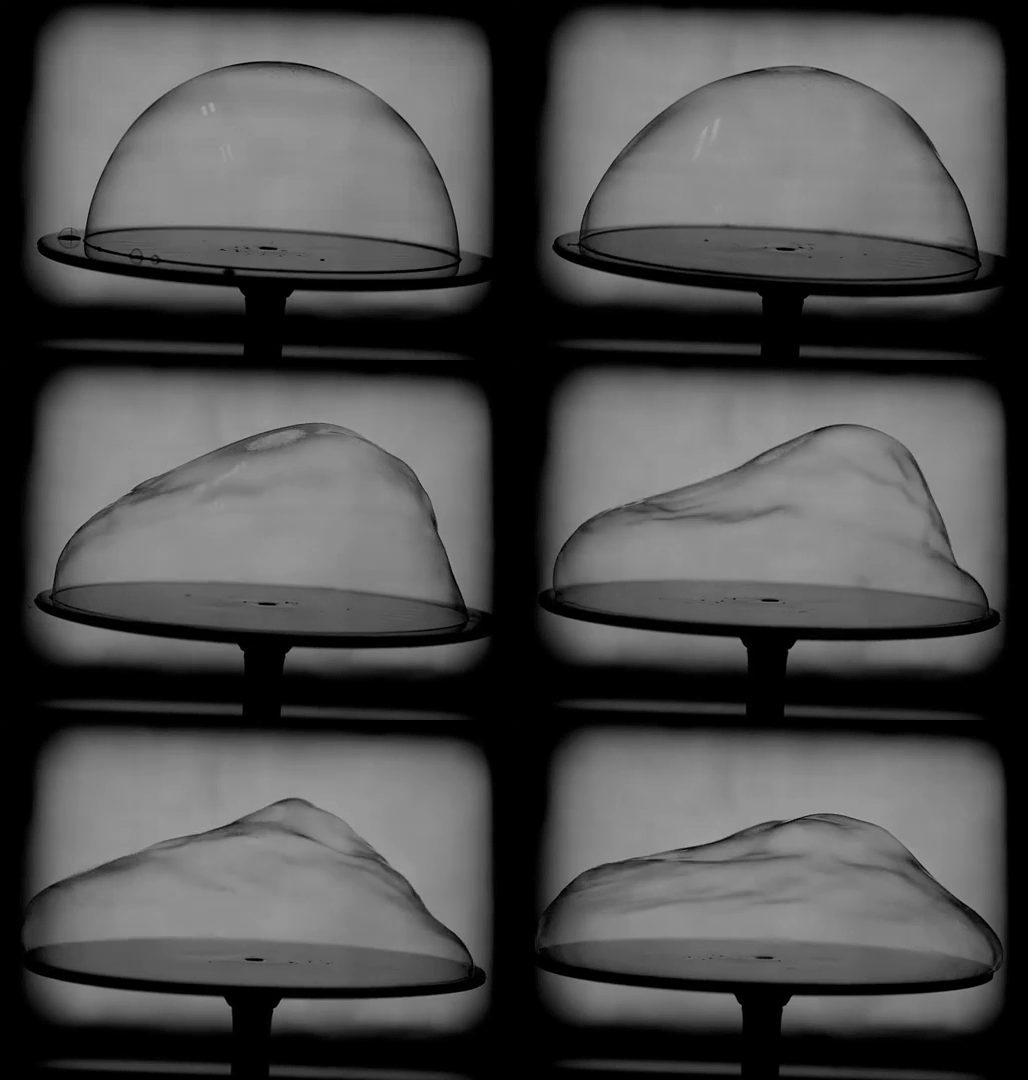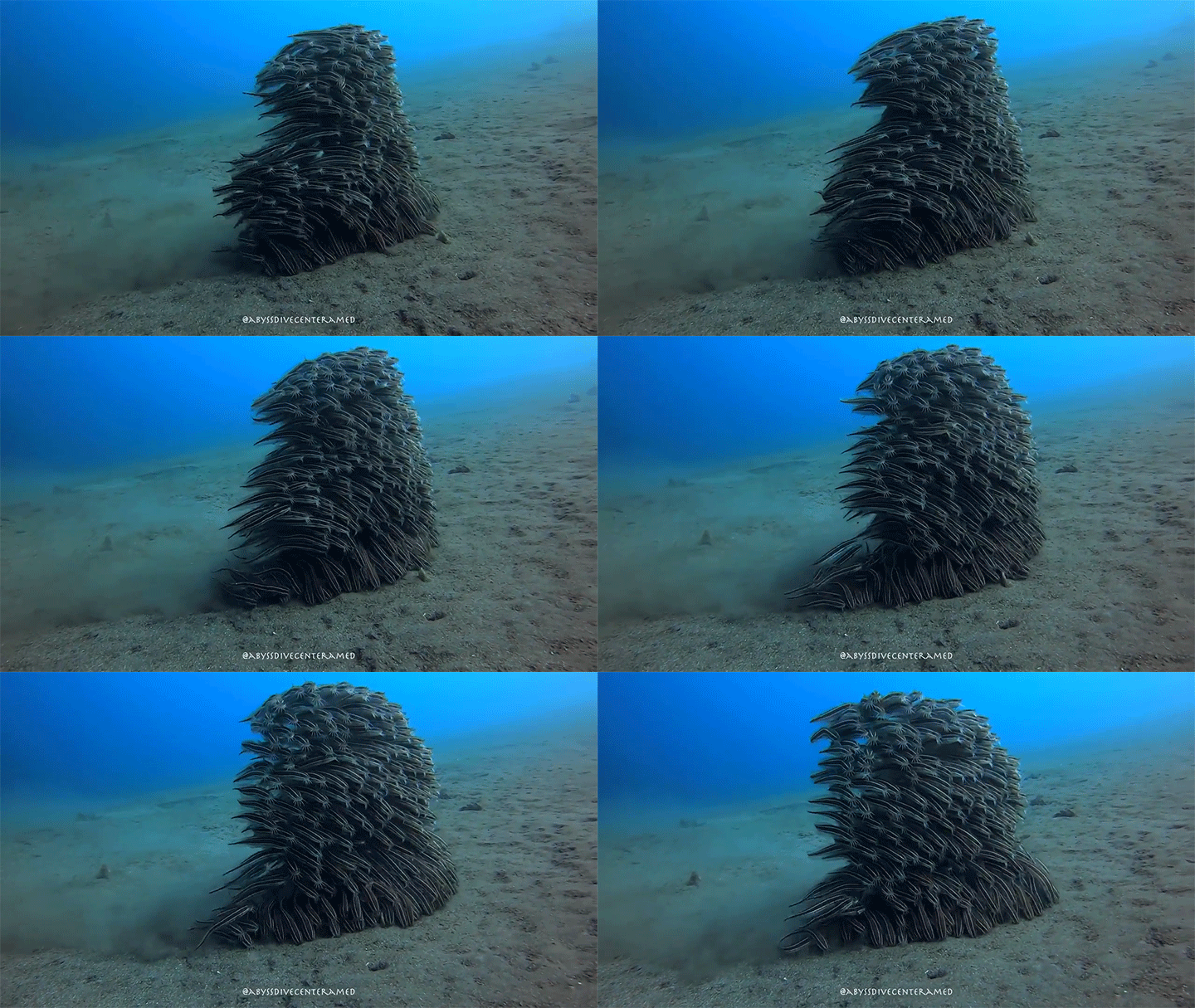
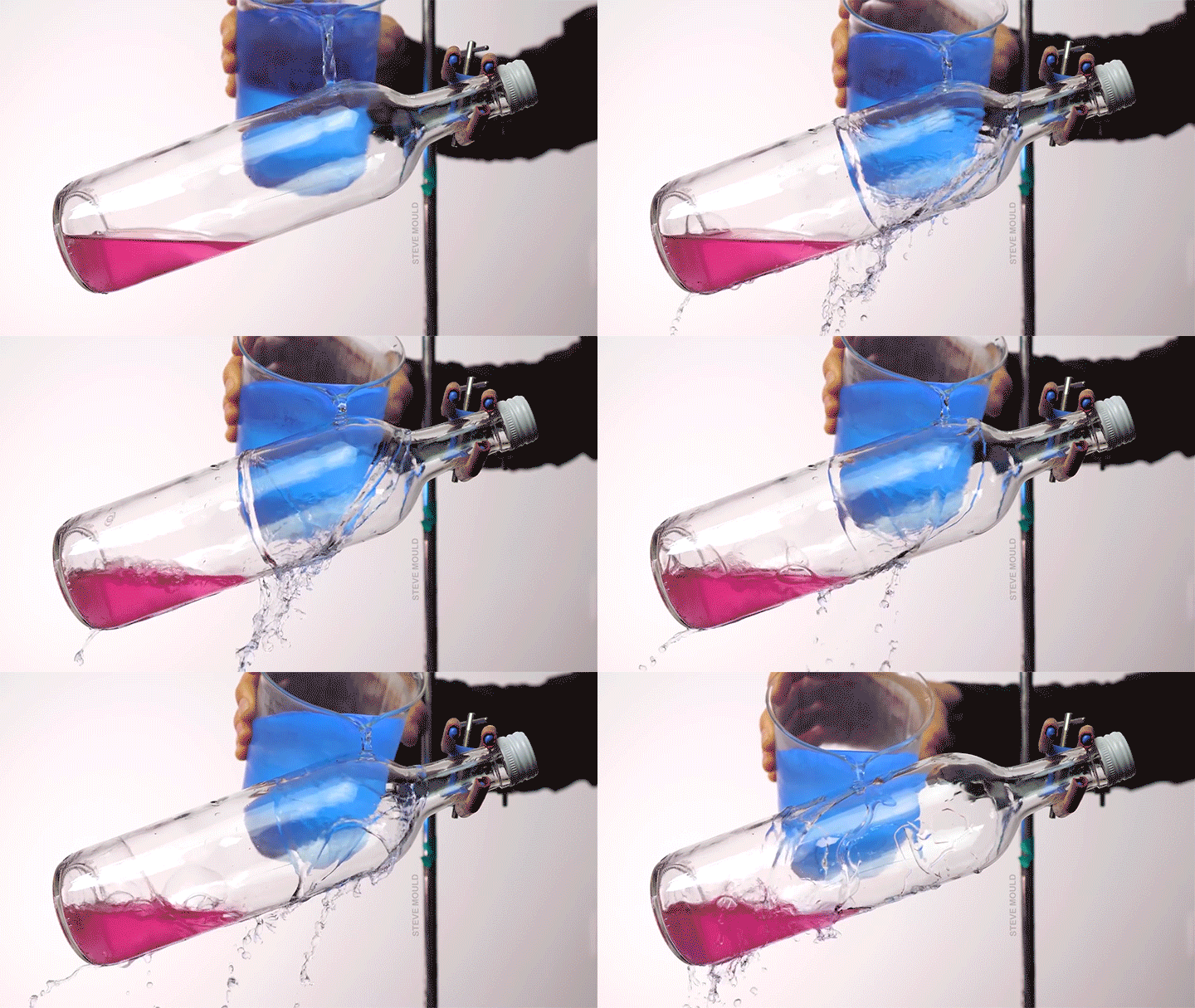
Some water-walking insects are able to leap off a watery interface. One way to model these creatures is with elastic hoops, which can also propel themselves off the water’s surface. In this video, researchers explore some of the factors that affect the jump, like hoop geometry, material, and hydrophobic coatings. Wider hoops jump better than thinner ones because they can store more elastic energy. Hydrophobic hoops also leap higher, because less energy gets wasted in splash creation. Since most water-walking insects have hydrophobic legs already, that’s a bonus for jumping off the surface! (Image, video, and research credit: H. Jeong et al.)
Tag: surface tension

Ejecting Water from a Smartwatch
Making electronics water-resistant can be a challenge, but as this Slow Mo Guys video demonstrates, engineers have some clever ways to deal with unwanted liquids. The Apple Watch, for example, uses its speakers to eject water that gets into the watch during immersion. As seen above, the vibration of the speakers ejects most of the water as tiny droplets. Occasionally, surface tension makes this tough and drops instead coalesce on the watch’s surface. To counter this tendency, the speakers sometimes pause, allowing water to collect before they begin vibrating again. (Video and image credit: The Slow Mo Guys)

The Vortex Beneath a Drop
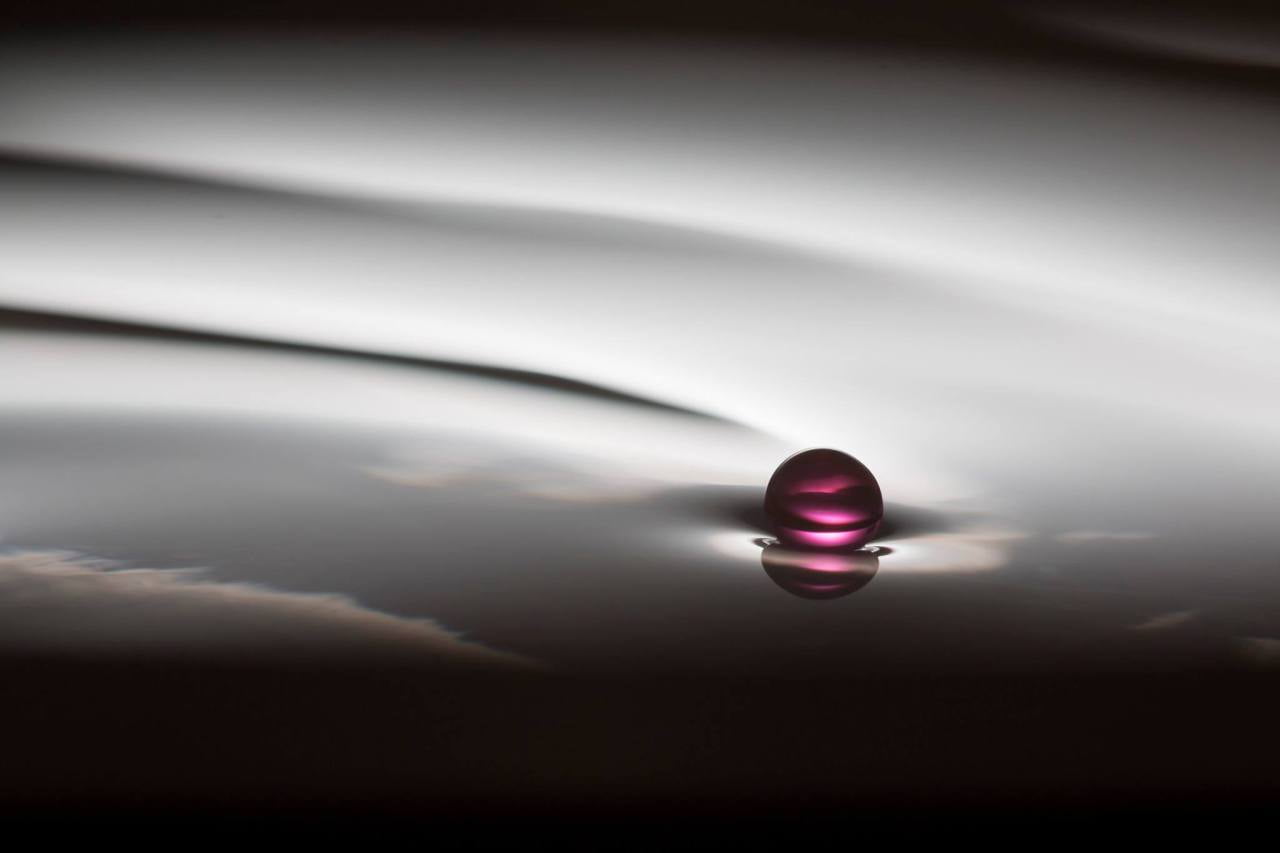
While we’re most used to seeing levitating Leidenfrost droplets on a solid surface, such drops can also form above a liquid bath. In fact, the smoothness of the bath’s surface, combined with mechanisms discussed in a new study, means that drops will levitate at a cooler temperature over a liquid than they will over a solid surface.
Researchers found that a donut-shaped vortex forms in the bath beneath a levitating droplet, but the direction of the vortex’s circulation is not always the same. For some liquids, the flow moves radially outward from beneath the drop. In this case, researchers found that the dominant force was shear stress caused by the vapor escaping from under the droplet.
With other droplet liquids, the flow direction instead moved inward, forming a sinking plume beneath the center of the drop. In this situation, researchers found that evaporative cooling dominated. As the liquid beneath the droplet cooled, it became denser and sank. At the same time, the lower temperature changed the bath’s local surface tension, creating the inward surface flow through the Marangoni effect. (Image credit: F. Cavagnon; research credit: B. Sobac et al.)

“As Above”
In Roman Hill’s “As Above,” we see expansive celestial landscapes: nebulae, the corona of a star, and expanding interstellar dust clouds. Except, in reality, we are watching fluids undergoing a chemical reaction, on a canvas only 8 square millimeters in size. It’s a fun — and beautiful — reminder that the patterns of physics repeat across many scales. (Video and image credit: R. Hill)

Measuring Contaminants in Drops and Bubbles
Rising bubbles and droplets are common in many chemical and industrial applications. But just a tiny concentration of contaminants on their surface can completely alter their behavior, disrupting coalescence and slowing down chemical reactions.
Historically, it’s been hard to measure the level of contamination in these some drops and bubbles, but a new study outlines a way to measure these small concentrations by perturbing the drops and watching how they deform. By analyzing how the drop shimmies and shakes, they’re able to measure its surface tension and, ultimately, the concentration of contaminants. (Image credit: S. Sørensen; research credit: B. Lalanne et al.; via APS Physics)

Marangoni Bursting
Placing a mixture of alcohol and water atop a pool of oil creates a stunning effect that pulls droplets apart. The action is driven by the Marangoni effect, where variations in surface tension (caused in this case by the relative evaporation rates of alcohol and water) create flow. David Naylor captures some great stills of the flow, including the only example of a double burst I’ve seen so far. For more on the science behind the effect, check out this previous post or the original research paper. (Image credit: D. Naylor; see also this previous post)

Particle-filled Splashes
Adding particles to a liquid can significantly alter its splash dynamics, as shown in this new study. In the first image, a purely-liquid droplet spreads on impact into a thin liquid sheet that destabilizes from the rim inward, ripping itself into a spray of droplets. At first glance, the particle-filled droplet in the second image behaves similarly; it, too, spreads and then disintegrates. But there are distinctive differences.
During expansion, the particles increase the drop’s effective viscosity, meaning that the splash sheet does not expand as far. That apparent viscosity increase is also part of why the drops the splash sheds are bigger than those without particles. The other part of that story comes from the retraction, where the variations in thickness caused by the particles and their menisci create preferential paths for the flow. As a result, the particle-filled splash breaks up faster and into larger droplets compared to its purely-liquid counterpart. (Image and research credit: P. Raux et al.)

Growing Metal Fingers
Eutectic gallium-indium alloy is a room-temperature liquid metal with an extremely high surface tension. Normally, that high surface tension would keep it from spreading easily. But once the metal oxidizes, the surface tension drops. When that oxidation is combined with an electric field, the metal spreads into fingers. The higher the voltage, the more complex the fingering patterns. (Image and video credit: K. Hillaire et al.)

Capsule Impact and Bursting
Nature and industry are full of elastic membranes filled with a fluid, from red blood cells to water balloons. A new study looks at how these capsules deform — and sometimes burst — on impact. The researchers created custom elastic shells that they filled with various fluids like water, glycerol, and honey, then used the impacts to build a model of capsule deformation.
They found that there’s significant overlap between droplet impacts and capsule impacts, with a few key differences; instead of surface tension, capsules resist deformation through their elastic shell’s surface modulus — a combination of its elasticity and thickness. Capsules, unlike droplets, can also burst. To study this, the researchers used water balloons, which they were able to pre-stretch more easily than their custom shells. They found that their model could accurately predict the conditions under which the balloons burst.
The authors hope the model will be helpful both in designing capsules intended to burst — like a fire-fighting projectile — and in creating safety measures to prevent capsule burst — like car-crash standards that protect from organ damage. (Image and research credit: E. Jambon-Puillet et al.; via Physics World; submitted by Kam-Yung Soh)

Expanding Water Beads
In this timelapse, we see hydrogel beads expanding as they absorb water. There are some interesting subtleties to the physics here. Notice how, in the Petri dish segments, the beads shift from a single crystalline structure to several smaller structures. I suspect those shifts are driven by the dropping water level, which changes how surface tension interacts with the beads’ shape to create attractive forces between beads.
Another interesting point comes as the beads expand through and out of the glass of water. Initially, the water level doesn’t change in the glass. This is because the water beads are taking up the same volume as the water that they’ve absorbed. But once the beads emerge past the water’s initial height, the water level drops dramatically. That’s because the beads are still absorbing what little water is left and continuing to expand in volume. (Image and video credit: Temponaut)