Tag: surface tension

  • Featured Video Play Icon

    Flying on Soap Films?

    YouTube channel Viral Video Lab has two videos showing 3D-printed gliders flying on wings formed from soap films. It’s a neat idea for a toy aircraft, though obviously not practical. But are the videos real? The channel features plenty of obviously fake concepts, like perpetual motion machines, and explicitly states in its About page that “videos shown on the channel may contain CGI effects.” They’re clearly not strangers to stretching the truth.

    Sadly, I don’t have the means to properly test the concept, but it at least seems plausible (although there are some flight sequences in the videos themselves that I don’t think are totally real). There are bubble solutions out there capable of making quite giant, long-lasting bubbles, though they are more complicated than the simple soap and water solution suggested in the video. And having essentially flat wings doesn’t preclude gliding, as long as you have a positive angle of attack. I’d be interested to see if someone with a 3D-printer can recreate the effect. Let me know if you give it a try! (Video credit: Viral Video Lab; via Gizmodo)
  • Featured Video Play Icon

    “Beyond the Horizon”

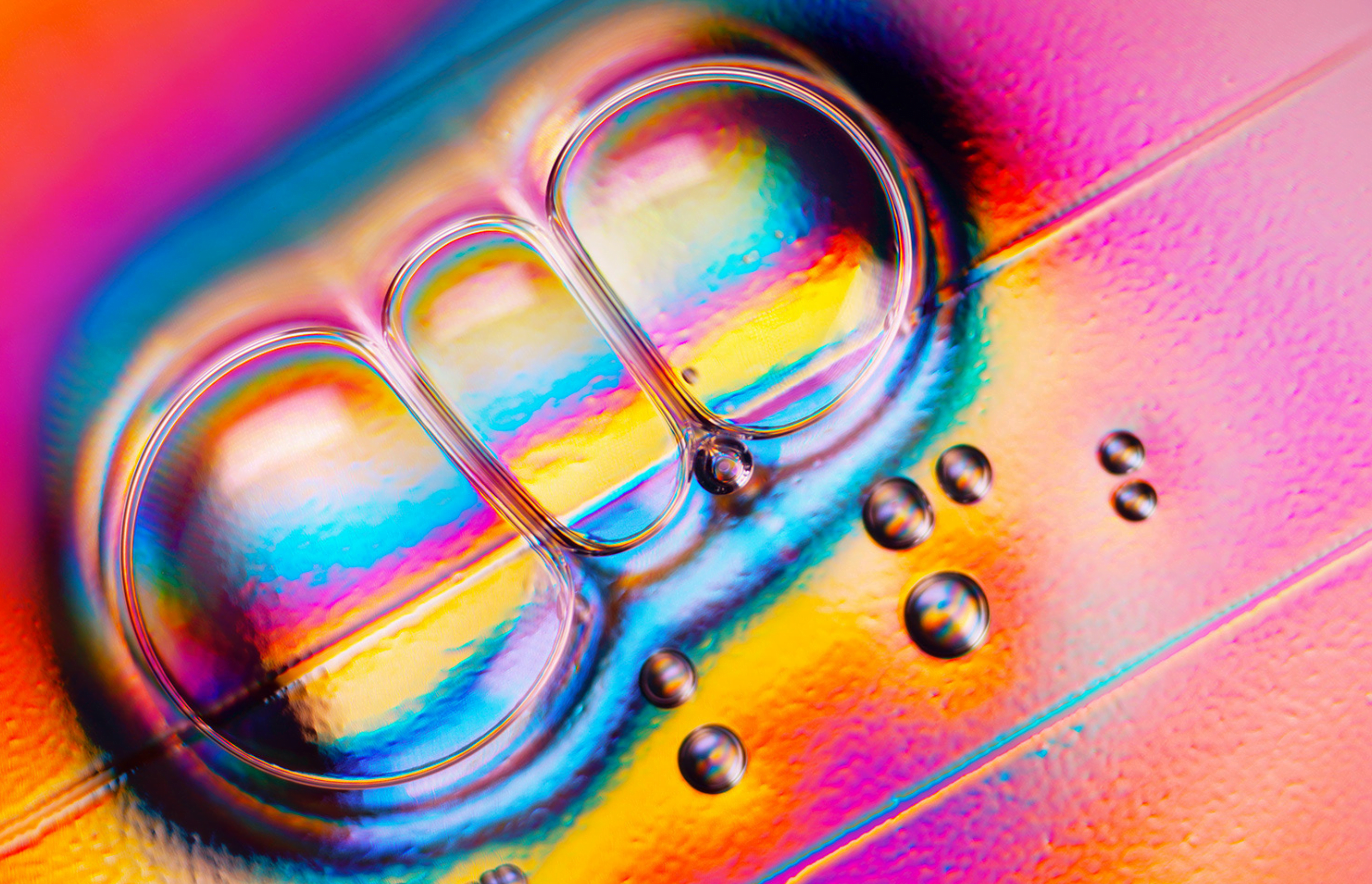
    Shifting bubbles and psychedelic colors abound in this abstract video from artist Rus Khasanov. He provides no specifics as to the materials he uses for this video, but my guess is they likely include oil, soap, and polarizing filters. It’s a fun and funky video! See more of Khasanov’s work on his website and Instagram. (Image and video credit: R. Khasanov)

  • Taking A Turn

    Taking A Turn

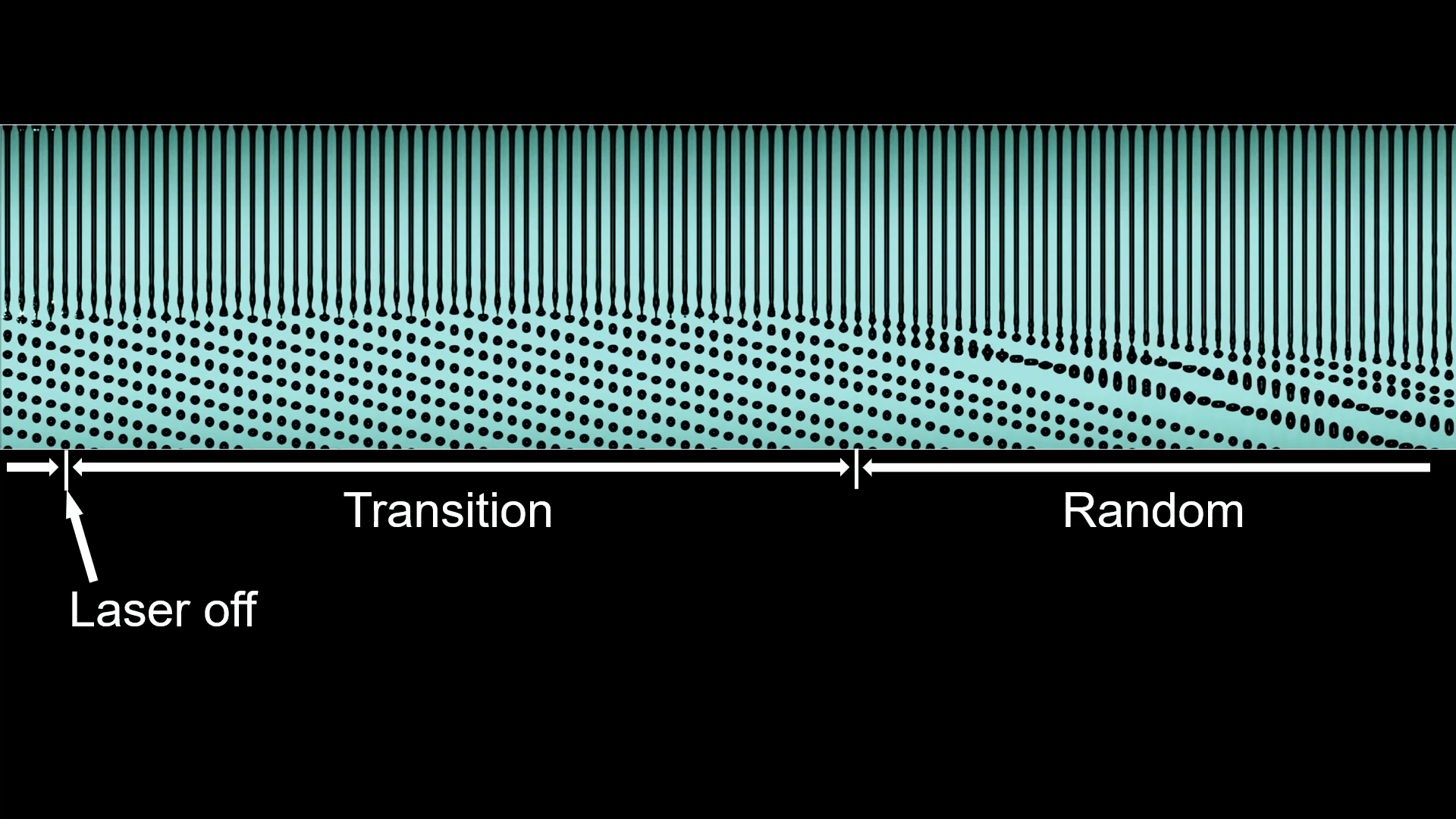
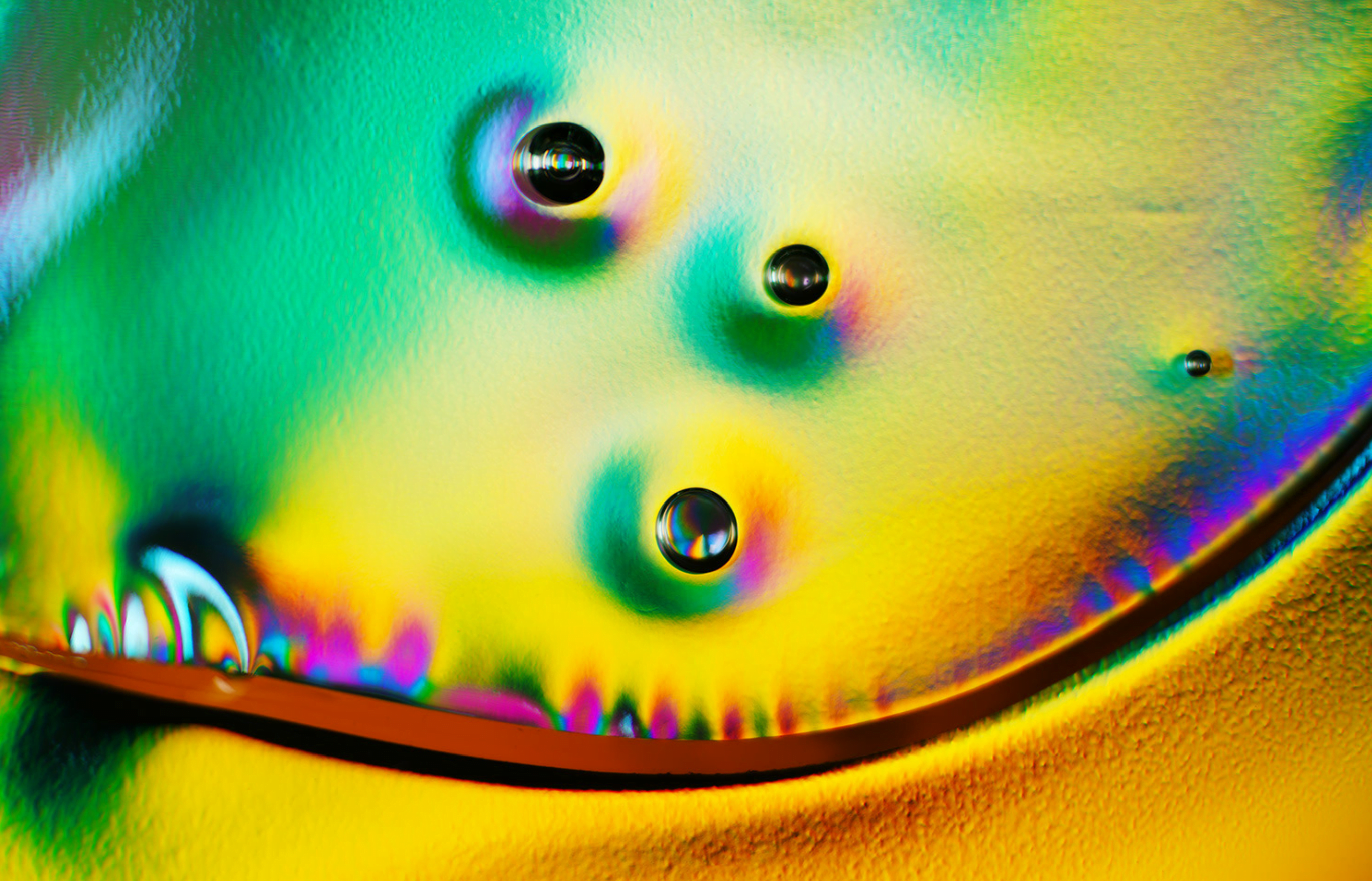
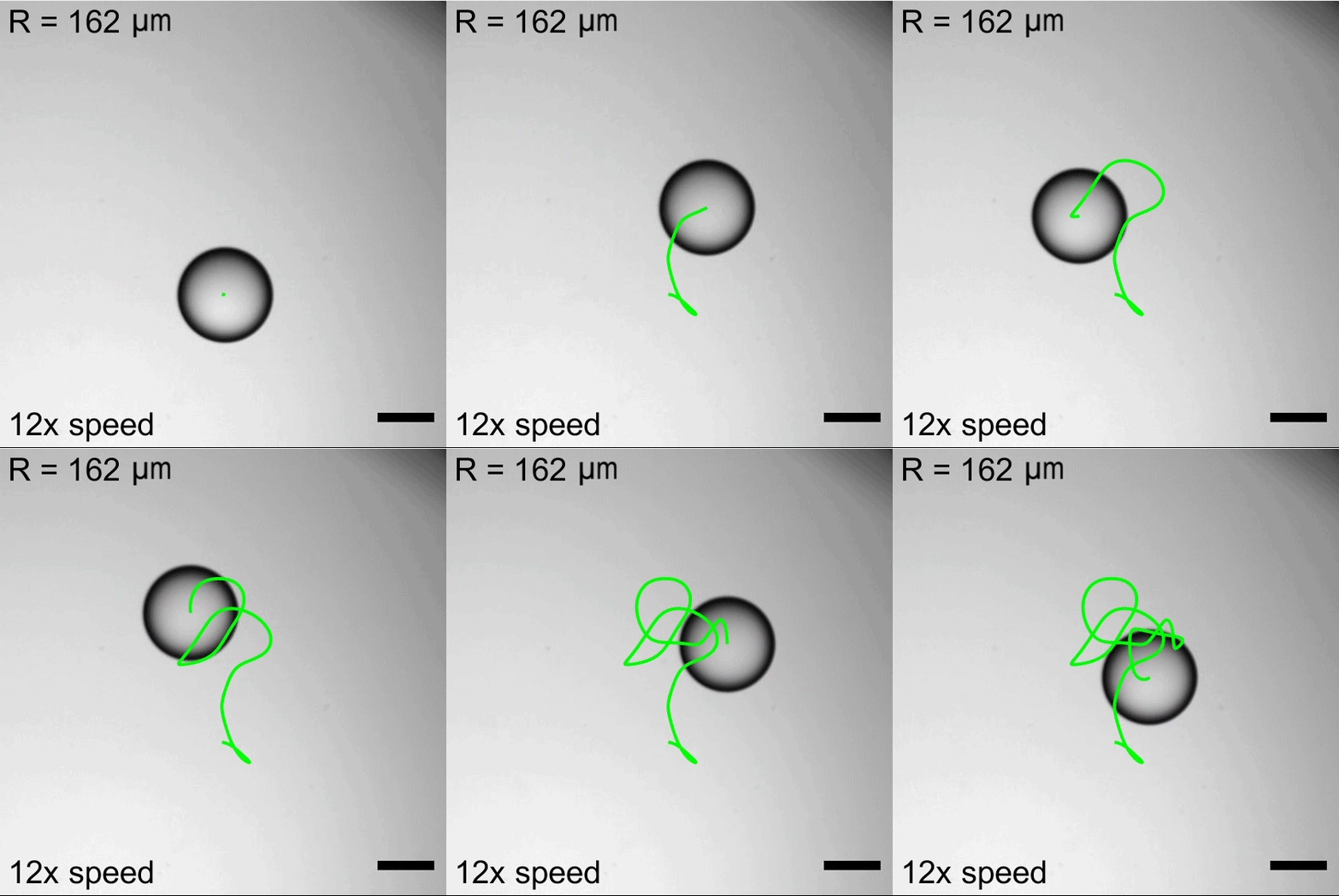
    Water droplets immersed in a mixture of oil and surfactants will move about, propelled by the Marangoni effect. Surfactant molecules congregate along the interface between the water and oil, but they do not do so uniformly. This uneven grouping causes variations in the surface tension, which in turn creates flows inside the droplet from areas of low surface tension to ones with higher surface tension. Those internal flows then dictate how the droplet as a whole moves.

    Researchers found that droplet trajectories in these systems depend on the droplet’s size. Small droplets move in relatively straight lines, whereas larger droplets take highly curved paths. The difference comes from the way surfactants get distributed around the drop’s interface. Larger drops are more sensitive to shifts in surfactant location, making them more prone to take changeable, curving paths. (Image credits: top – P. Godfrey, others – S. Suda et al.; research credit: S. Suda et al.; via APS Physics)

  • Why Creases Don’t Disappear

    Why Creases Don’t Disappear

    Flex your fingers and you’ll see your skin fold into well-defined creases. Many soft solids (including old apples) fold this way, and like your skin, the creases never fully disappear, even when the stress is removed. A recent study finds that surface tension and contact-line-pinning are critical to the irreversibility of these creases.

    The authors studied sticky polymer gel layers under a confocal microscope as the gel folded. In doing so, they found that surface tension dictates the microscopic geometry of a fold, causing the two sides of a surface to touch. They also found that completely unfolding a creased surface requires more energy than folding it in the first place did because the folded surfaces adhere to one another.

    When unfolded, the crease behaves somewhat like a droplet on a rough surface. Such droplets move in fits; their contact line stays pinned to the rough microscopic peaks of the surface until there’s enough energy to overcome that attachment and the contact line jumps to another position. Similarly, a creased surface cannot simply unfold smoothly. Adhesion ensures that part of the crease remains, serving as a starting point for the next fold-unfold cycle. (Image credit: C. Rainer; research credit: M. van Limbeek et al.; via APS Physics; submitted by Kam-Yung Soh)

  • Programmable Capillary Action

    Programmable Capillary Action

    Capillary action combines the cohesive forces within a liquid and the adhesive forces between a liquid and solid to enable a liquid to fill narrow spaces, even against the force of gravity. To control capillary action, researchers are 3D-printing what they call “unit cells,” tiny structures that water and other liquids can climb. There’s no pump raising the liquid through these structures, just capillary action.

    In a particularly neat demonstration of the technology, the researchers built a tree-like structure out of many open-walled unit cells and placed the “root” system in a closed reservoir. Capillary action drew liquid up the structure to the tips of its branches, where the dyed water evaporated. The process is similar to transpiration in trees, though in trees, capillary action provides much less of the lift. (Image and research credit: N. Dudukovic et al.; via Nature; submitted by Kam-Yung Soh)

  • Featured Video Play Icon

    Metallic Magma

    Metallic paint flows like silver lava in this macro video from Chemical Bouillon. The paint has been mixed with an unknown fluid (my guess is alcohol) to produce the flows we see here. My suspicion is that we’re seeing solutal convection where variations in surface tension create convective flow within the liquid. What do you think? (Video and image credit: Chemical Bouillon)

  • Featured Video Play Icon

    “Geodaehan”

    In “Geodaehan” Roman De Giuli’s macro fluid art mimics massive landscapes. The film takes us over deltas, rivers, glaciers, and landslides. Some look like earthbound locations, others look like something from Mars or Titan. All are, in fact, paint, ink, and glitter on paper! It’s truly incredible how artists capture large-scale fluid physics on such a tiny canvas. (Image and video credit: R. De Giuli)

  • “Liquid Skies”

    “Liquid Skies”

    “Liquid Skies” by Roman De Giuli is full of colorful but nebulous fluid imagery. The visuals consist of liquids like paint, ink, and alcohol filmed in macro atop paper. You can catch a behind-the-scenes glimpse of De Giuli at work here. (Image and video credit: R. De Giuli)

  • Featured Video Play Icon

    The Unsinkable Pygmy Gecko

    The Brazilian pygmy gecko is a tiny inhabitant of the Amazon rainforest, growing to no longer than 24 mm. But these tiny lizards have some incredible superpowers when it comes to surviving the rainforest’s deluges. The gecko’s surface is superhydrophobic — water repellent — thanks to millions of tiny hairs that create air pockets between water and the gecko’s skin. This superhydrophobic surface, combined with the gecko’s tiny stature, allow it to sit atop water, supported entirely by surface tension. (Image and video credit: BBC Earth)

  • Featured Video Play Icon

    “Flux Capacitor”

    Sandro Bocci’s short film “Flux Capacitor” explores the geometry and dynamics of soap films. When you dip wire models into soapy solution, the films that cling to the model can form complicated shapes as surface tension works to minimize the overall surface area. Bocci’s macro photography highlights the intense flows going on in the narrow regions where films meet. It’s a different take on soap films and neat to see! (Image, video, and submission credit: S. Bocci et al.)