Tag: surface tension

  • Collapsing Inside a Soap Film

    Collapsing Inside a Soap Film

    There’s a common demonstration of surface tension where a loop of string is placed in a soap film and then the film inside the loop is popped, making it suddenly form a perfect circle when the outer soap film’s surface tension pulls the string equally from every direction. In this video, researchers study a similar situation but with a few wrinkles.

    Here the loop of string is replaced with an elastic ring, which has more internal stiffness and starts out entirely round within the soap film. Then the researchers pop the outer film. That burst instantly creates a stronger surface tension inside the ring, which causes it collapse inward. As the researchers note, this is the equivalent situation to applying an external pressure on the outside of the ring. The form of the buckling ring and film depends on just how large this “pressurization” is.

    When the elastic ring is thickened to a band, popping the outer soap film makes the band wrinkle out of the plane.

    Thickening the elastic from a ring to a band alters the collapse, too. The thicker the elastic band, the harder it is to buckle in the plane of the soap film. So instead it wrinkles as the film collapses, which creates wrinkles in the soap film, too! (Image, video, and research credit: F. Box et al.; see also F. Box et al. on arXiv)

  • Featured Video Play Icon

    A Dance of Hydrogen Bubbles

    Hydrogen bubbles rise off zinc submerged in hydrocholoric acid in this short film from the Beauty of Science team. In high-speed video, the rise of the bubbles is stately and mesmerizing. Notice how the smallest bubbles appear as perfect spheres; for them, surface tension is strong enough to maintain that spherical shape even against the viscous drag of their buoyant rise. Larger bubbles, formed from mergers both seen and unseen, have a harder time staying round. In them, surface tension must battle gravitational forces and drag from the surrounding fluid. (Image and video credit: Beauty of Science; via Laughing Squid)

  • Whiskey Stains

    Whiskey Stains

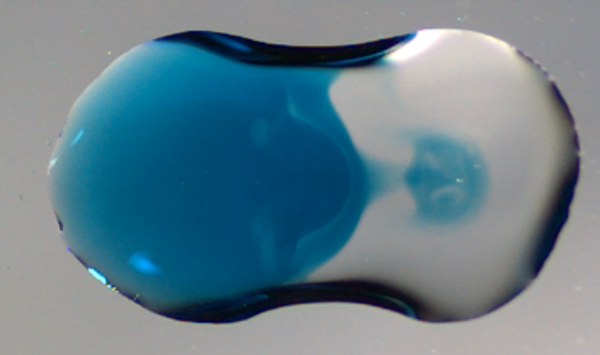
    Complex fluids leave behind fascinating stains after they evaporate. We’ve seen previously how coffee forms rings and whisky forms more complicated stains as surface tension changes during evaporation drive particles throughout the droplet. Now researchers are considering the differences between traditional Scottish whisky, which ages in re-used, uncharred barrels, and American whiskeys like bourbon, which are required to age in new, charred white oak barrels.

    When diluted, the American whiskeys form web-like patterns – seen above – that vary from brand to brand, like a fingerprint. The charring of the barrels allows American whiskeys to pick up more water-insoluble molecules compared to whisky aged in uncharred barrels. Since the webbed patterns form in American whiskey but not Scotch whisky, it’s likely those molecules play an important role in the evaporation dynamics and subsequent staining. (Image credit: S. Williams et al.; research credit: S. Williams et al.; via APS Physics; submitted by Kam-Yung Soh)

  • Featured Video Play Icon

    Inside Tears of Wine

    Pour wine or liquor into a glass, give it swirl, and you can watch as droplets form and dance on the walls. This well-known phenomena, often called “tears” or “legs” in wine, results from an interplay of surface tension and evaporation. Despite its common occurrence, researchers are still discovering interesting subtleties in the physics, as seen in new research on the subject.  

    Dianna walks you through the phenomenon step-by-step in this video. The key piece of physics is the Marangoni effect, the tendency of regions with high surface tension to pull flow from areas with lower surface tension. In the wine glass, evaporation creates this surface tension gradient by removing alcohol more quickly from the meniscus than the bulk. That sets up the gradient that lets the wine climb the glass. By preventing or delaying that evaporation, we can see other neat effects, too, like shock fronts that travel through the film. (Video credit: Physics Girl; research credit: Y. Dukler et al.)

  • Freezing Bubbles

    Freezing Bubbles

    Scientists have observed distinctive differences in the way soap bubbles freeze depending on their environment. If a bubble is surrounded by room temperature air but placed on a cold surface (top), it freezes from the bottom up, with a clear freeze front that slowly creeps upward.

    In contrast, bubbles in an isothermal environment – one where it’s equally cold everywhere – freeze with a snow-globe-like effect of ice crystals (bottom). This freezing mode is actually triggered by a Marangoni flow. As the thin bottom layer of the soap bubble begins to freeze, it releases latent heat. That local heating changes the surface tension enough to generate an upward flow. You can see the plumes form right as the bubble touches the surface. Those plumes lift up tiny ice crystals, which continue to grow, ultimately forming the snowy crystals we see take over the surface. (Image and research credit: S. Ahmadi et al.; submitted by Kam-Yung Soh)

  • Featured Video Play Icon

    Lensing in a Straw

    While doing the sort of experiment only a kid or a scientist would pursue – namely, staring down a straw – Dianna noticed that water in a straw creates a lens-like magnification effect as the straw moves or down. This happens thanks to the curvature of the air-water-straw interface. Because water has strong surface tension, it curves dramatically as it meets the wall of the straw, and moving the straw up or down will drag some of the fluid with it, enhancing the curvature. When light refracts across that interface, it gets bent the same way it would through a lens, thereby shrinking or magnifying the objects beneath. (Video credit: D. Cowern/Physics Girl)

  • Featured Video Play Icon

    “Aurora”

    In “Aurora”, artist Rus Khasanov uses fluids to create a short film full of psychedelic color and cosmic visuals. As in a soap bubble, the bright colors – as well as the pure black holes – come from the interference of light rays. The colors directly relate to the thickness of fluid, and they allow us to see all the subtle flows caused by variations in surface tension. (Video and image credit: R. Khasanov)

  • Transporting Droplets

    Transporting Droplets

    Transporting droplets easily and reliably is important in many microfluidic applications. While this can be done using electric fields, those fields can impact biological characteristics researchers are trying to measure. As an alternative, a group of researchers have developed the concept of “mechanowetting,” a technique that uses surface tension forces to hold droplets on a traveling wave.

    Now visually, it’s a bit tough to see what’s going on here. In the animations, it looks like the droplets are just sticking to a moving surface, but that’s an illusion. The surface the droplet is sitting on is fixed and unmoving. It’s a thin silicone film that covers a ridged conveyor belt. The belt underneath can (and does) move. This creates a traveling wave. Instead of that wave simply passing beneath the droplet, it triggers an internal flow and restoring force that helps the drop follow the wave. The effect is strong enough that small droplets are even able to climb up vertical walls or stick upside-down. (Image, research, and submission credit: E. de Jong et al.)

  • Featured Video Play Icon

    Ink Explosion

    Sometimes beautiful flows come from simple combinations. Here the artists of Chemical Bouillon combine ink and hydrocarbons to create lovely explosions of color. Eschewing quick cuts between views, they allow us to linger and explore the flow ourselves as it changes. Differences in surface tension drive streaming flows along the surface, but there seem to be some chemical reactions contributing as well. Watch along the edges and you may even see convection pulling ink down and back. The whole video is only 2 minutes long and worth a full watch. (Image and video credit: Chemical Bouillon)

  • Polygonal Droplets

    Polygonal Droplets

    Spheres are a special shape; they provide the smallest possible surface area necessary to contain a given volume. And since surface tension tries to minimize surface energy by reducing the surface area, drops and soap bubbles are, generally, spherical. There’s subtlety here, though: namely, what if reducing the surface area doesn’t minimize the surface energy?

    That’s the issue at the heart of this study. It looks at microscale oil droplets, like the ones above, that are floating in water and stabilized by surfactants. We’d expect droplets like these to be round, and above a critical temperature, they are. But as the temperature drops, the surfactant molecules along the droplet’s interface crystallize. The drop itself is still liquid, but interface is not.

    This changes the rules of the game. There’s no way for the surfactant molecules to form a sphere when solidified; they simply can’t fit together that way. So instead defects form along the interface and the drop becomes faceted. As the temperature drops further, the energy relationship between the water, oil, and surfactants continues shifting, causing the droplet to change shape – even to increase its surface area – all to minimize the overall energy. The effect is reversible, too. Raise the temperature back up above the critical point, and the interface “thaws” so that the drop becomes round again. (Image and research credit: S. Guttman et al.; via Forbes; submitted by Kam-Yung Soh)