
In December 2024, Parker Solar Probe made its closest pass yet to our Sun. In doing so, it captured the detailed images seen here, where three coronal mass ejections — giant releases of plasma, twisted by magnetic fields — collide in the Sun’s corona. Events like these shape the solar wind and the space weather that reaches us here on Earth. The biggest events can cause beautiful auroras, but they also run the risk of breaking satellites, power grids, and other infrastructure. (Image credit: NASA/Johns Hopkins APL/Naval Research Lab; video credit: NASA Goddard; via Gizmodo)
Tag: solar wind

See the Solar Wind
After a solar prominence erupts, strong solar winds flow outward from the sun, carrying energetic particles that can disrupt satellites and trigger auroras if they make their way toward us. In this video, an instrument onboard the ESA/NASA’s Solar Orbiter captures the solar wind in the aftermath of such an eruption. The features seen here extended 3 solar radii and lasted for hours. The measurements give astrophysicists their best view yet of this post-eruption relaxation period, and the authors report that their measurements are remarkably similar to results of recent magnetohydrodynamics simulations, suggesting that those simulations are accurately capturing solar physics. (Video and image credit: ESA; research credit: P. Romano et al.; via Gizmodo)

“Magic of the North”
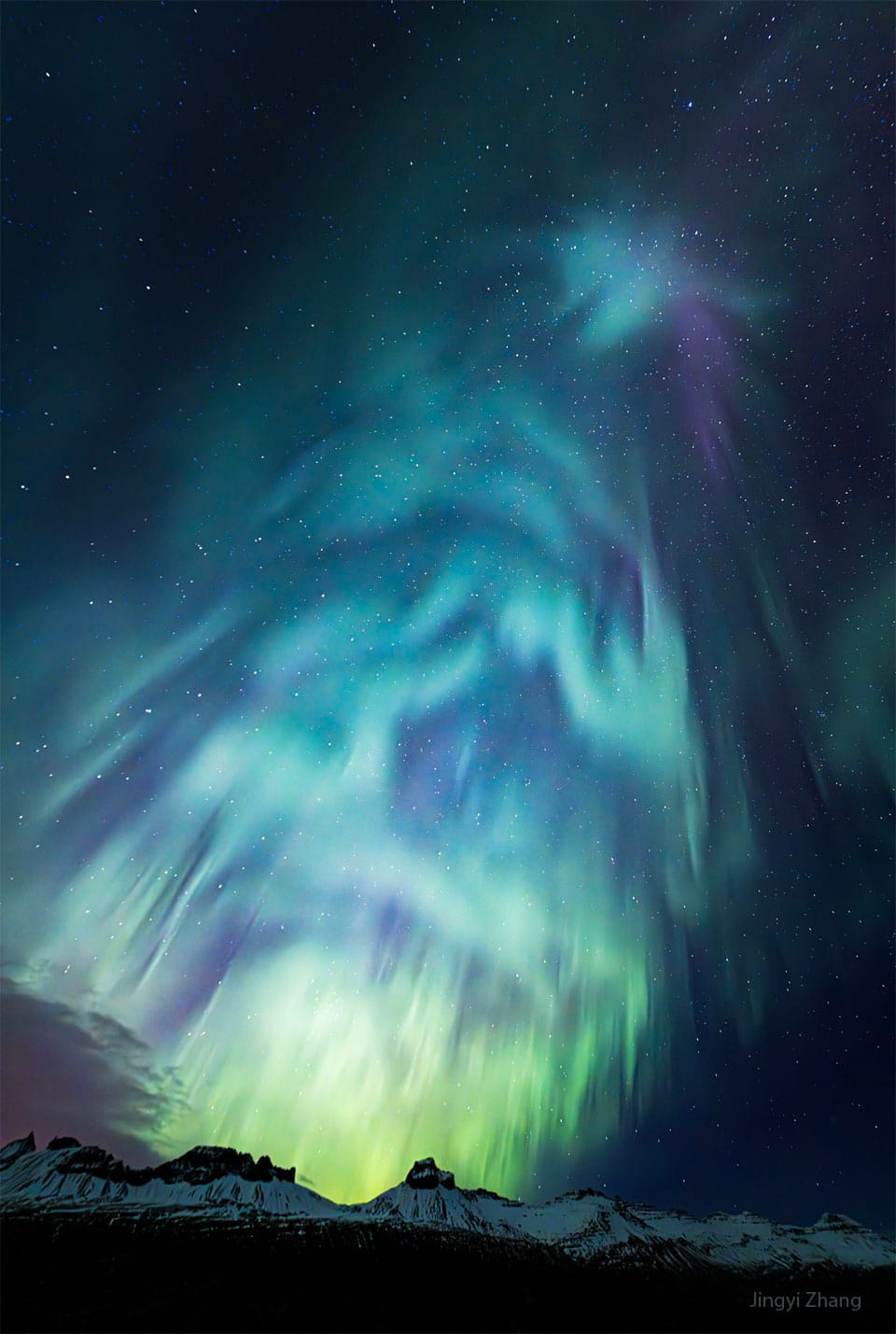
Fires glow above and below in this award-winning image from photographer Josh Beames. In the foreground, lava from an Icelandic eruption spurts into the air and seeps across the landscape as it slowly cools. Above, the northern aurora ripples through the night sky, marking the dance of high-energy particles streaming into our atmosphere, guided by the lines of our magnetic field. Throw in some billowing turbulent smoke, and it’s hard to get more fluid dynamical (or beautiful!) than this. (Image credit: J. Beames/NLPOTY; via Colossal)

Reinterpreting Uranus’s Magnetosphere
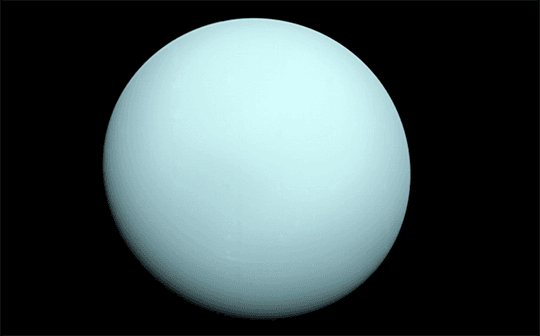
NASA launched the Voyager 2 probe nearly 50 years ago, and, to date, it’s the only spacecraft to visit icy Uranus. This ice giant is one of our oddest planets — its axis is tilted so that it rotates on its side! — but a new interpretation of Voyager 2’s data suggests it’s not quite as strange as we’ve thought. Initially, Voyager 2’s data on Uranus’s magnetosphere suggested it was a very extreme place. Unlike other planets, it had energetic energy belts but no plasma. Now researchers have explained Voyager 2’s observations differently: they think the spacecraft arrived just after an intense solar wind event compressed Uranus’s magnetosphere, warping it to an extreme state. Their estimates suggest that Uranus would experience this magnetosphere state less than 5% of the time. But since Voyager 2’s data point is, so far, our only look at the planet, we just assumed this extreme was normal. (Image credit: NASA; research credit: J. Jasinski et al.; via Gizmodo)

Hello, STEVE
A purple glow arcs across the night sky. Just another aurora, or is it? First described in 2018, this is a STEVE — Strong Thermal Emission Velocity Enhancement. (Yes, the name “Steve” came first and the acronym came later.) Scientists still aren’t entirely sure how to classify this glowing phenomenon. Although it looks similar to an aurora, its color spectrum is continuous between 400 and 700 nanometers; classic auroras, in contrast, have a discrete spectrum dependent on which atmospheric molecules are getting stimulated by the incoming solar wind. Scientists have noticed that STEVE appears before midnight and is accompanied by a fast 5.5 km/s westward ion flow. A dawnside equivalent with an eastward ion flow was reported just this year.
With newly identified phenomena like this, the research papers are fast and furious as the scientific community searches for consensus on exactly what STEVE is and how it’s formed. But this domain is not reserved for professional astronomers alone; citizen scientists were the first to identify STEVE and open projects like Aurorasaurus continue to provide valuable data and observations. (Image credit: K. Trinder/NASA; research credit: S. Nanjo et al.; via Gizmodo)

A Comet’s Two Tails
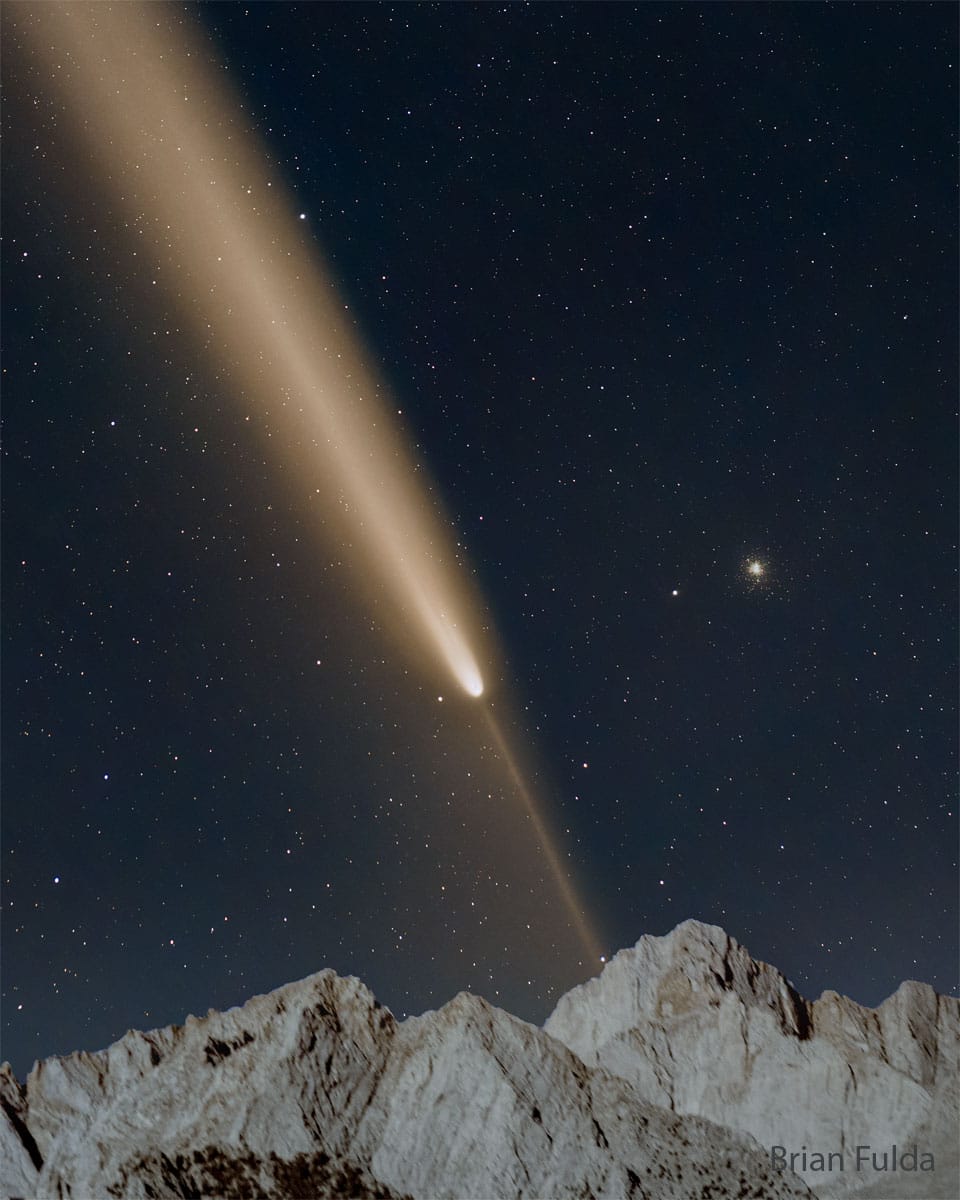
The bright tail of a comet doesn’t actually stream out behind it. Instead, the tail points away from the sun, showing off all the ice, dust, and gas blown off the comet by the solar wind. Because the tail is tied to the sun’s direction and not the comet’s trajectory, comets sometimes have a second tail, called the anti-tail. The anti-tail consists of material that came off the comet previously, so it does mark the comet’s previously traveled path. In this image of Comet Tsuchinshan-ATLAS from October 2024 the dimmer anti-tail points opposite of the brighter tail. That means the comet’s direction of travel is diagonally upward, from right to left. Since that aligns with its bright tail, we can tell that the comet is moving away from the sun in this photo. (Image credit: B. Fulda; via APOD)

Eerie Aurora
This surreal image comes from an aurora on Halloween 2013. Photographer Ole C. Salomonsen captured it in Norway during one of the best auroral displays that year. The shimmering green and purple hues are the glow of oxygen and nitrogen in the upper atmosphere reacting to high-energy particles streaming in from the solar wind. These geomagnetic storms can disrupt GPS satellites, compromise radio communication, and even corrode pipelines, but they also create these stunning nighttime displays. (Image credit: O. Salomonsen; via APOD)

Martian Auroras
Auroras happen when energetic particles — usually from the solar wind — interact with the atmosphere. Here on Earth, they’re most often found near the poles, where our strong global magnetic field converges, funneling particles down from space. Our neighbor Mars has no global magnetic field. Instead, its magnetic field is a hybrid of two sources: 1) induced magnetism from electric currents in the ionosphere and 2) patches of magnetized iron-rich crust. Together, they form an uneven and changeable field that deflects the solar wind less than one Mars radius above the planet’s surface. In contrast, Earth deflects the solar wind about 10-20 Earth radii away.
Discrete auroras (left panel) occur when electrons plunge down into the atmosphere on magnetic lines coming from Mars’ patchy crust. Global diffuse auroras (center panel) are caused by energetic solar storms that light up the whole atmosphere, sometimes for days at a time. In proton auroras (right panel), incoming solar protons steal electrons from native Martian hydrogen to form high-energy hydrogen atoms that cannot be magnetically deflected. Instead, they penetrate the planet’s bow shock and plunge into the atmosphere, creating a daytime aurora. (Image credit: UAE Space Agency/EMM/EMUS and NASA/MAVEN/IUVS; via Physics Today)

A Comet’s Tail
A comet‘s tail changes from day-to-day depending on how much material the comet is losing and how strong the solar wind it’s facing is. This image sequence shows Comet 12P/Pons-Brooks over nine days in 2024 from March 6th (top) through March 14th (bottom). The variations in the comet’s appearance are striking; some days show nearly no tail while others have long plumes with swirls of turbulence. It’s a reminder that, even if they appear unchanging in the moment you see one, a comet is in constant flux. (Image credit: Shengyu Li & Shaining; via APOD)

The Unusual Auroras of Mars
Earth, Saturn, and Jupiter have auroras at their poles, generated by the interaction of their global magnetic fields with the solar wind. Mars has no global magnetic field, only remnants of one frozen into areas of its crust; yet it, too, has auroras. Mars’s auroras are rarer and discrete. They occur most often over the southern hemisphere, and researchers now think they know why.
Four billion years ago, we think Mars had a global magnetic field, much like Earth does. But somehow the planet lost that field. The traces that remain are caught in the minerals of its crust, much like the ancient magnetic fields recorded in areas of the Earth’s sea floor. These magnetized regions of Mars’s crust, shown above as contours in pink and blue, are where the discrete auroras occur.
Using data from NASA’s MAVEN spacecraft, which orbits Mars, the team discovered a pattern. They found that auroras occur most often when the magnetic lines of the incoming solar wind run antiparallel to the magnetic field lines of the crust. This suggests that the auroras happen as a result of magnetic reconnection, a process where antiparallel magnetic field lines rearrange themselves, releasing energy as a result. Reconnection events provide an opportunity for electrons from the solar wind to accelerate into Mars’s atmosphere, exciting molecules there and generating the auroras. So far we’ve only caught the auroras in UV light, but hopefully one day we’ll see them in visible light as well. (Image credit: R. Lillis et al.; research credit: C. Bowers et al. and B. Johnston et al.; via APS Physics)