One of the key features of turbulent flows is that they contain many different length scales. Look at the plume from an erupting volcano, and you’ll see eddies that are hundreds of meters across as well as tiny ones on the order of millimeters. This enormous difference in scale is one of the major challenges in simulating turbulent flows. Since energy enters at the large scale and is passed to smaller and smaller scales before being dissipated at the tiniest scales of the flow, properly simulating a turbulent flow requires resolving all of these length scales. This is especially challenging for applications like the solar wind – the stream of charged particles that flows from the sun and gets diverted around the Earth by our magnetic field. The image above shows some of the turbulence in our solar wind. The structures seen in the flow range from the size of the Earth all the way to the scale of electrons! (Image credit: B. Loring, Berkeley Lab)
Tag: solar wind

Auroras From Space
NASA has released a jaw-dropping new compilation of Earth’s auroras viewed from the International Space Station. It’s available in up to 4K resolution, and I heartily recommend watching it fullscreen at the highest resolution you can comfortably manage. (To paraphrase: this is ultra high definition – it’s better resolution than real life!) I don’t think I’ve ever seen aurora footage that so clearly showed the fluid behavior of auroras when viewed from space. This flow-like quality is to be expected since the auroras occur due to ionized particles from the solar wind exciting atoms in our upper atmosphere in a magnetohydrodynamic dance that never gets too old to watch. (Video credit: NASA; via Gizmodo)
Boston area FYFDers: I’m giving a talk at Harvard tomorrow afternoon on science communication – Wed. April 20th, 4pm, Maxwell Dworkin, G115.

Saturnian Auroras

Earth is not the only planet in our solar system with auroras. As the solar wind–a stream of rarefied plasma from our sun–blows through the solar system, it interacts with the magnetic fields of other planets as well as our own. Saturn’s magnetic field second only to Jupiter’s in strength. This strong magnetosphere deflects many of the solar wind’s energetic particles, but, as on Earth, some of the particles get drawn in along Saturn’s magnetic field lines. These lines converge at the poles, where the high-energy particles interact with the gases in the upper reaches of Saturn’s atmosphere. As a result, Saturn, like Earth, has impressive and colorful light displays around its poles. (Image credit: ESA/Hubble, M. Kornmesser & L. Calçada, source video; via spaceplasma)

Aurora From Space
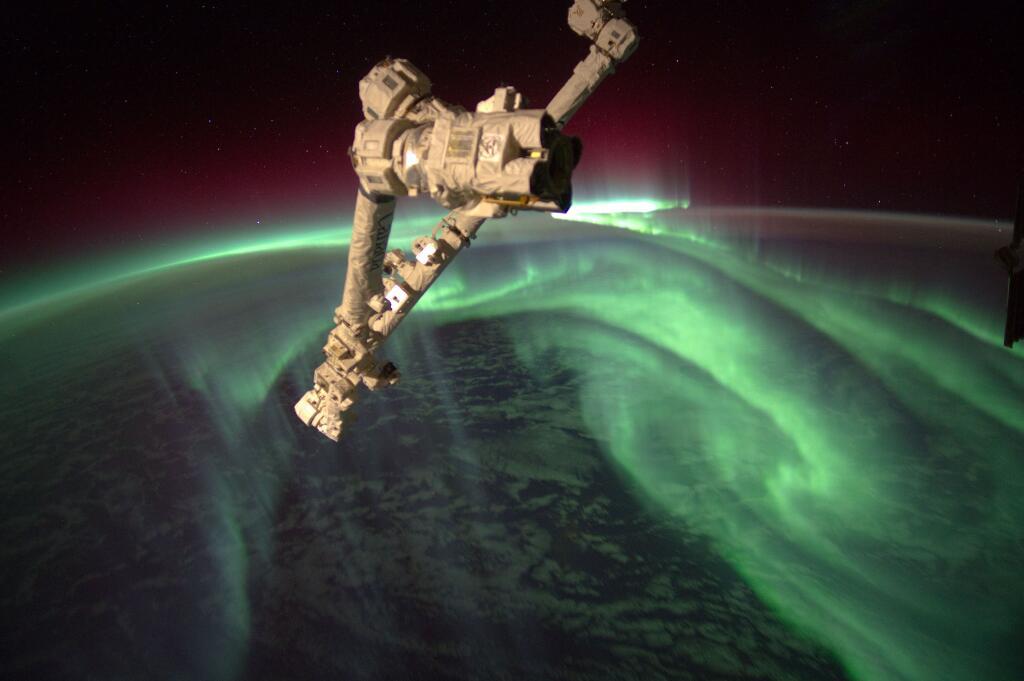
An aurora, as seen from the International Space Station, glows in green and red waves over the polar regions of Earth. These lights are the result of interactions between the solar wind–a stream of hot, rarefied plasma from the sun–and our planet’s magnetic field. A bow shock forms where they meet, about 12,000-15,000 km from Earth. The planet’s magnetic field deflects much of the solar wind, but some plasma gets drawn in along field lines near the poles. When these energetic particles interact with nitrogen and oxygen atoms in the upper atmosphere, it can excite the atoms and generate photon emissions, creating the distinctive glow. Similar auroras have been observed on several other planets and moons in our solar system. (Photo credit: NASA)

Solar Wind
Fluid dynamics appear at all kinds of scales. The animation above shows two comets, Encke and ISON, on their recent approach toward the sun. The darker wisps emanating from the right side of the image are part of the solar wind, a plasma stream continuously emitted by the sun’s upper atmosphere. Although the solar wind is very rarefied by terrestrial standards, its density is sufficient to whip the comets’ tails of gas and dust from side-to-side. Scientists use images like these to learn more about the structure of the solar wind based on its interaction with the comets. For more great images of ISON’s journey around the sun, check out NASA Goddard. (Image credit: K. Battams/NASA/STEREO/CIOC; submitted by John C)

Voyager Explores the Edge of the Solar System
Though unconventional by our terrestrial concepts of fluids, the solar wind and its interaction with objects in and around our solar system can be considered a form of fluid dynamics. This NASA video discusses discoveries made by the Voyager spacecrafts as they leave our solar system and pass into interstellar space. The solar wind, a rarefied stream of charged particles, streams outward from the Sun at supersonic speeds. Eventually, the pressure from the interstellar medium surrounding the solar system is sufficient to slow the solar wind to subsonic speeds, causing a termination shock much like the hydraulic jump that forms in a kitchen sink when you turn the faucet on.