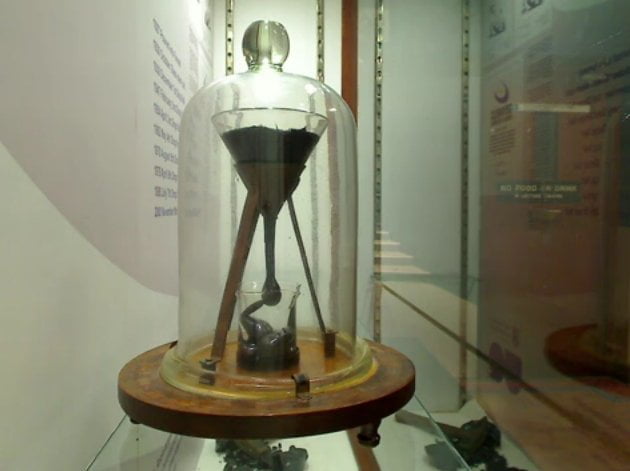
Sometimes everyday materials are more fluid than they seem. In 1927, Professor Thomas Parnell of the University of Queensland started what is now the longest continuously running laboratory experiment when he filled a sealed glass funnel with a sample of heated tar pitch. After allowing 3 years for the pitch to settle, the funnel’s stem was unsealed and the pitch has been slowly dripping ever since. Now, over 80 years later, the ninth drop is still just forming. No one has witnessed the fall of a pitch drop but the odds are good that someone will catch the ninth drop now that it has its own webfeed. The experiment, which won an Ig Nobel Prize in 2005, demonstrates the incredibly high viscosity of pitch, which the researchers estimated at 11 orders of magnitude larger than water at room temperature. (submitted by jshoer)
Tag: science

Icing on Airplane Wings

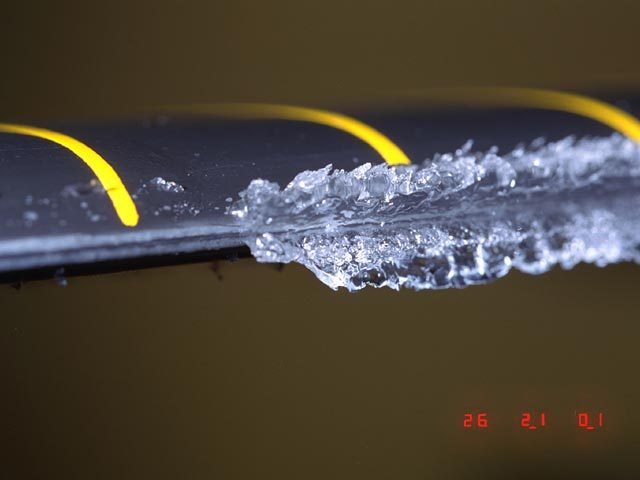
Icing on airplane wings remains little understood and a major hazard. These photos show examples of ice formation along the leading edge of a swept wing. If an aircraft flies through a cloud of supercooled water droplets, the droplets will freeze shortly after impact with the aircraft’s wings. As ice continues to build up in strange shapes, the aerodynamic profile of the wing changes, which can lead to disastrous effects as the stall and control characteristics of the wing shift. (Photo credit: NASA Glenn Research Center)

Breaking Water with Sound
Previously we saw how vibration could atomize a water droplet, breaking it into a spray of finer droplets. Here astronaut Don Pettit shows us what the process looks like in microgravity using some speakers and large water droplets. At low frequencies the water displays large wavelength capillary waves and vertical vibrations. Higher frequencies–like the earthbound experiment on much smaller droplets–cause fine droplets to eject from the main drop when surface tension can no longer overcome their kinetic energy. (submitted by aggieastronaut, jshoer and Jason C)
(Source: /)Surface Tension Floats Coins
Surface tension arises from intermolecular forces along the interface of a fluid, but despite its molecular origins, it can have some substantial macroscopic effects. Here researchers demonstrate how surface tension can hold up metal coins that would otherwise sink. Moreover, when multiple coins are set on the surface of the water, surface tension draws them together into a closely packed array because it reduces the surface energy by creating a single large well instead of many small ones. This is the same reason that your Cheerios tend to clump together on the surface of your milk when you’re eating breakfast! (Video credit: Lawrence Berkeley National Lab)
Portrait of Gas Giants
[original media no longer available]
Here raw footage from NASA’s Cassini and Voyager missions has been combined in a stunning portrait of Saturn and Jupiter. Watch as tiny moons create gravity waves in the rings of Saturn and observe the complicated relative motion between the cloud bands on Jupiter and the swirls and vortices that result. Fluid dynamics are truly everywhere. (Video credit: Sander van den Berg; submitted by Daniel B)
Salinity Near the Amazon
This numerical simulation shows the variation of salinity in the Atlantic Ocean near the mouth of the Amazon River over the course of 36 months. The turbulent mixing of the fresh river water and salty ocean shifts with the ebb and flooding of the river. Salt content causes variations in ocean water density, which can strongly affect mixing and transport properties between different depths in the ocean due to buoyancy. Understanding this kind of flow helps predict climate forecasts, rain predictions, ice melting and much more. (Video credit: Mercator Ocean)

Barchan Dunes
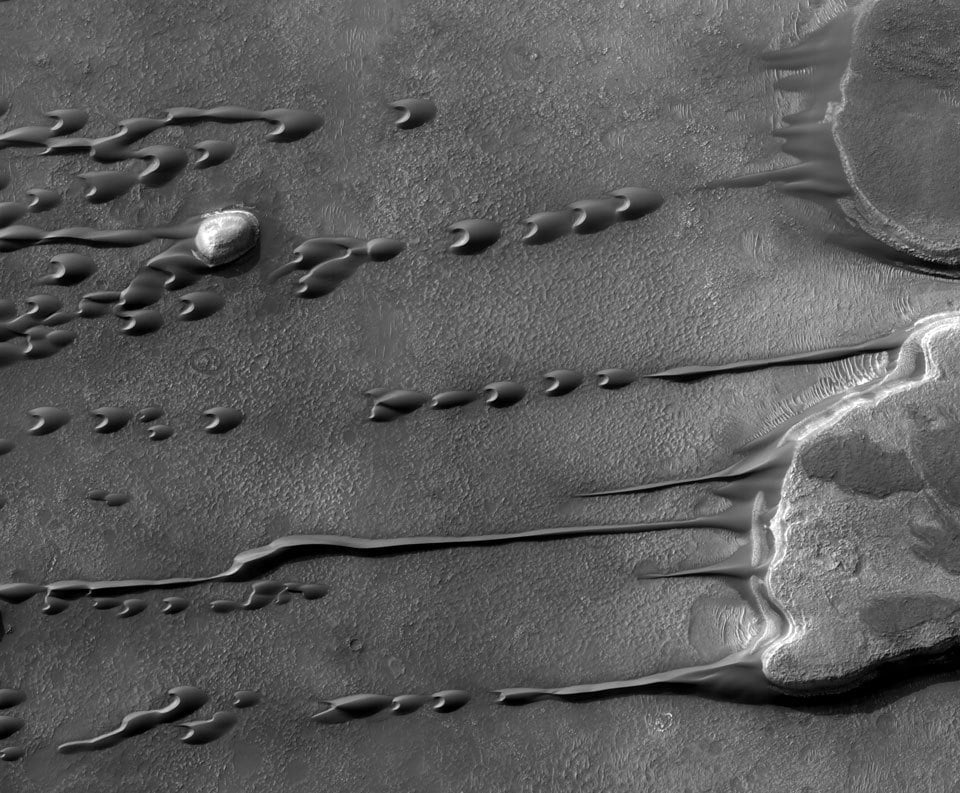
The winds of Mars create sand dunes that seem to flow like a liquid across the planet’s surface. Here the wind blows from right to left around the flat top mesas on the right side of the image. The dark, arc-shaped dunes formed in the wake of the mesas are called barchans and can move downstream remarkably intact, even able to cross paths with other dunes. (Photo credit: MRO, NASA; via APOD)

Helicopter Vortices
When conditions are just right, the low pressure at the center of a wingtip vortex can drop the local temperature below the dew point, causing condensation to form. Here vortices are visible extending from the tips of the propellers in addition to the wingtip. Because of the spinning of the propeller and the forward motion of the airplane, the prop vortices extend backwards in a twisted spiral that will quickly break down into turbulence. The same behavior can be observed with helicopter blades. (Photo credit: benurs)
Convective Cells
Convective cells form as fluid is heated from below. As the fluid near the bottom warms, its density decreases and buoyancy causes it to rise while cooler fluid descends to replace it. This fluid motion due to temperature gradients is called Rayleigh-Benard convection and the cells in which the motion occurs are called Benard cells. This particular type of convection is essentially what happens when a pot is placed on a hot stove, so the shapes are familiar. Similar shapes also form on the sun’s photosphere, where they are called granules.
Supercritical Fluids
A supercritical fluid exists without a distinct liquid or gas phase and forms when temperatures and pressures exceed the substance’s critical point. Here supercritical transition is demonstrated with an ampule of liquid chlorine. When immersed in a hot bath, the temperature and pressure inside the ampule rises until around 0:20 when the meniscus marking the interface between liquid and gas disappears. The chlorine is now in its supercritical state. Around 0:43 the hot bath is removed and the chlorine begins to cool, reverting to distinct phases of matter around 0:55.