Fluid flow near a surface–inside the boundary layer–can often be unstable. This image shows one possible instability, formed when a cylinder is rotated back and forth about its longitudinal axis. This oscillation and the curvature of the cylinder destabilize flow in the boundary layer, forming vortices that line the cylinder. This particular behavior is called a Görtler instability. To visualize it, threads soaked in fluorescing dye have been embedded into slits in the cylinder. The cylinder is oscillated in a water tank and ultraviolet light is used to fluoresce the dye for the image. (Photo credit: Miguel Canals/University of Hawaii)
Tag: science

Etna’s Eruption
After some rumblings in recent weeks, Italy’s Mt. Etna erupted overnight on February 19th, sending fountains of lava shooting into the dark. This impressive video from Klaus Dorschfeldt, a videographer for Italy’s National Institute for Geophysics and Vulcanology, shows the nighttime eruption, including the dark, turbulent outline of a pyroclastic flow of rock and hot gases escaping down the mountainside. Such flows can be devastating in their effect as they rush and spread down the mountain, flattening, burning, or engulfing everything in their path. When Mt. Vesuvius erupted in 79 A.D., it was the pyroclastic flow that buried the towns of Pompeii and Herculaneum. (Video credit: Klaus Dorschfeldt; via io9)

Fishbones
When two liquid jets collide, they can form an array of shapes ranging from a chain-like stream or a liquid sheet to a fishbone-type structure of periodic droplets. This series of images show the collision of two viscoelastic jets–in which polymer additives give the fluids elasticity properties unlike those of familiar Newtonian fluids like water. The jet velocities increase with each image, changing the behavior from a fluid chain (a and b); to a fishbone structure (c and d); to a smooth liquid sheet (e); to a fluttering sheet (f and g); to a disintegrating ruffled sheet (h), and finally a violently flapping sheet (i and j). The behavior of such jets is of particular interest in problems of atomization, where it can be desirable to break an incoming stream of liquid up into droplets as quickly as possible. (Photo credit: S. Jung et al.)
Laser-Induced Fluorescence
As demonstrated in the video above, lasers can be used to excite molecules into a higher energy state, which will decay via the emission of photons, causing the medium to glow. This laser-induced fluorescence is utilized in several techniques for measurements in fluid dynamics, including planar laser-induced fluorescence (PLIF) and molecular tagging velocimetry (MTV). In these techniques a flow is usually seeded with a fluorescing material–nitric oxide is popular for super- and hypersonic flows–and then lasers are used to excite a slice of the flow field. The resulting fluorescence can be used for both qualitative and quantitative flow measurements. Here are a couple of examples, one in low-Reynolds number flow and one in combustion. (Video credit: L. Martin et al./UC Berkeley)
Jump in a Lake
Ever wonder what would happen if every person on earth jumped into a lake at the same time? Wonder no more! Physicist Rhett Allain breaks it down over at Dot Physics.

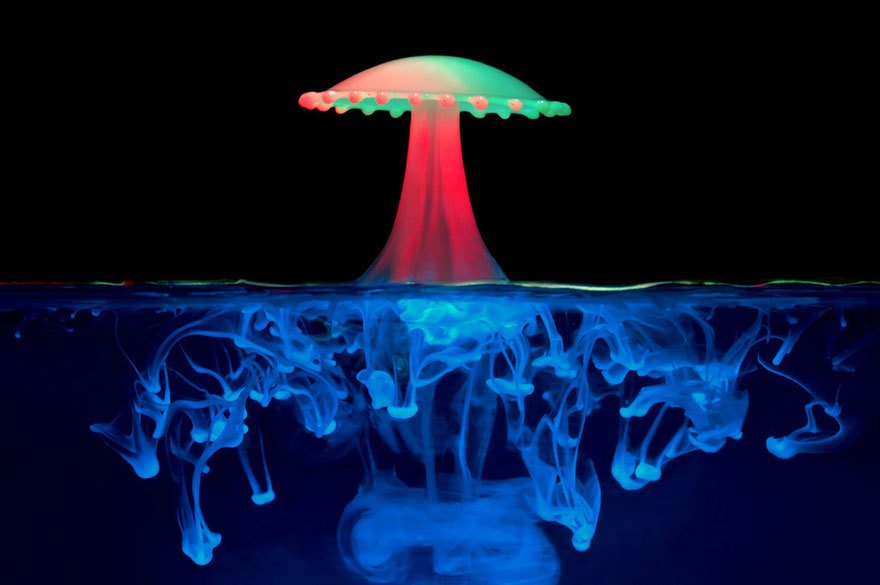
Liquid Sculptures
Artist Corrie White uses dyes and droplets to capture fantastical liquid sculptures at high-speed. The mushroom-like upper half of this photo is formed when the rebounding jet from one droplet’s impact on the water is hit by a well-timed second droplet, creating the splash’s umbrella. In the lower half of the picture, we see the remains of previous droplets, mixing and diffusing into the water via the Rayleigh-Taylor instability caused by their slight difference in density relative to the water. There’s also a hint of a vortex ring, likely from the droplet that caused the rebounding jet. (Photo credit: Corrie White)
The 9th Pitch Drop is Coming
Remember that 83-year-old pitch drop experiment designed to measure the viscosity of pitch? Well, rumor has it that the ninth drop is due to fall at any time. Will you catch it on the webcam?
Iceberg Calving
When sections of glaciers break off to create icebergs, scientists call it calving. Usually large sections of ice will break off and immediately capsize, with an energy equivalent to up to 40 kilotons of TNT. These large events are sufficient to cause measurable seismic signals. How hydrodynamic forces impact the contact and pressure forces between the calving iceberg and the glacier are still being researched, though recent laboratory experiments and numerical models suggest that hydrodynamics substantially increase these forces. The video above shows one of the largest calving events ever caught on camera, and the scale of the process is just stunning. (Video credit: Chasing Ice; additional information from J. C. Burton et al. 2012; submitted by jshoer)
Stalling
[original media no longer available]
At high angles of attack, the flow around the leading edge of an airfoil can separate from the airfoil, leading to a drastic loss of lift also known as stall. Separation of the flow from the surface occurs because the pressure is increasing past the initial curve of the leading edge and positive pressure gradients reduce fluid velocity; such a pressure gradient is referred to as adverse. One way to prevent this separation from occurring at high angle of attack is to apply suction at the leading edge. The suction creates an artificial negative (or favorable) pressure gradient to counteract the adverse pressure gradient and allows flow to remain attached around the shoulder of the airfoil. Suction is sometimes also used to control the transition of a boundary layer from laminar to turbulent flow.

Happy Valentine’s Day!
Here’s a potential flow field with heart-shaped streamlines, made just for you. Thank you to everyone for having helped made FYFD such a success over these 700 posts, whether by liking, reblogging, tweeting, or telling a friend. Happy Valentine’s Day!
For the curious among you, the flow is a superposition of uniform flow, two sources, and two sinks. The Matlab code is here. Have fun!