Pouring cream in coffee produces some of the most mesmerizing displays of fluid dynamics. The density difference between the two fluids sets up Rayleigh-Taylor instabilities that mushroom out and help create the turbulence that eventually mixes the drink. You can learn more about Rayleigh-Taylor instabilities in this FYFD video, and, if you need more awesome caffeine-filled examples of fluids, check out the coffee dynamics blog. (Video credit: S. Geraldine and L. Kang)
Tag: science

Waves Over the Rockies
These spectacular wave-like clouds are the result of the Kelvin-Helmholtz instability. When two layers of air move past one another at different velocities, an unstable shear layer forms at their interface. Disturbances in this shear layer grow exponentially, creating these short-lived overturning waves that quickly turn turbulent. The strong resemblance of these clouds to breaking ocean waves is no coincidence–the Kelvin-Helmholtz instability occurring between the wind and water is what generates many ocean waves. Kelvin-Helmholtz patterns are also common on other planets, like Jupiter, Saturn, and Mars. (Image credit: Breckenridge Resort; submitted by jshoer)

Deforming Soap Films
It’s the time of year when new Gallery of Fluid Motion videos start popping up online. We’ve already featured several and no doubt there will be more to come. Today’s post is a submission from Saad Bhamla, who gave this introduction to the work:
Soap bubbles occupy the rare position of delighting and fascinating both young children and scientific minds alike. Sir Isaac Newton, Joseph Plateau, Carlo Marangoni and Pierre-Gilles de Gennes, not to mention countless others, have discovered remarkable results in optics, molecular forces and fluid dynamics from investigating this seemingly simple system.
This video is a compilation of curiosity-driven experiments that systematically investigate the surface flows on a rising soap bubble. From childhood experience, we are familiar with the vibrant colors and mesmerizing display of chaotic flows on the surface of a soap bubble. These flows arise due to surface tension gradients, also known as Marangoni flows or instabilities. In this video, we show the surprising effect of layering multiple instabilities on top of each other, highlighting that unexpected new phenomena are still waiting to be discovered, even in the simple soap bubble.
As illustrated in the video, raising a bubble beneath the soap film moves surfactants in the film, which causes local differences in surface tension. Any time a difference in surface tension exists, fluid will flow from areas of low surface tension to ones with higher surface tension. This is called the Marangoni effect. On a soap bubble, this is visible in the chaotic swirling colors we see. In this system, Bhamla and his co-author found that by raising the bubble in steps, they could “freeze” the Marangoni-induced patterns created by the previous motion. (Video credit and submission: S. Bhamla et al.)

Re-Entry
Atmospheric re-entry subjects vehicles to extreme conditions. At high Mach numbers, the leading shock wave compresses the air so strongly that it reaches temperatures hotter than the surface of the sun. At these temperatures, oxygen and nitrogen molecules in the air dissociate, bathing a vehicle in a plasma of ionized gas molecules. Often these atoms chemically react with the surface materials of a vehicle causing ablation that removes mass from the vehicle while helping protect the vehicle substructure from re-entry heating. Tests in specialized ground facilities like arc-jet plasma tunnels are necessary to develop thermal protection systems capable of shielding a vehicle during hypersonic flight. (Image credit: D. Ponseggi/NASA)
Visualizing Vortices
Flow visualization can be a valuable tool for understanding fluid dynamics. In this video, we see how it can help elucidate the mechanisms of flapping flight. By dyeing vortices from the leading edge in red rhodamine and vortices from the trailing edge in green fluorescein, it’s possible to distinguish their competing effects for wings of different size. The speed and efficiency of a flapping wing depends on the vortices it sheds–these provide its lift and thrust. On a short wing, the leading edge vortex is significant and spins in a counter-clockwise (positive) direction. When it reaches the trailing edge, it meets a vortex spinning clockwise (negative). The interference of the two vortices weakens the shed vortex, thereby slowing the wing. Lengthening the wing weakens the leading edge vortex, which reduces its interference at the trailing edge and makes the longer wings more efficient. (Video credit: T. Mitchel et al.; via @AlbanSauret)

Nectar-Eating Bats


Nectar-eating bats have evolved to use several methods to drink. Some bats, like the Pallas’ long-tongued bat (top), use a lapping method. Hair-like papillae on the bat’s tongue increase the contact area with the nectar, helping to draw the fluid up in viscous globs as the bat repeatedly dips its tongue into the nectar. The orange nectar bat (middle and bottom), in contrast, has a tongue with a long central groove. This bat’s tongue stays submerged as it drinks. Researchers hypothesize that muscle action along the tongue, combined with capillary action in the narrow groove, allow the bat to actively pump nectar up to its mouth. It’s worth noting that the edges of the bat’s tongue do not curl around to touch, so the bat is definitely not using suction as one would with a straw. (Image credit: M. Tschapka et al., source)
Glow-Stick Ferrofluids
Ferrofluids create all kinds of fascinating shapes when exposed to magnetic fields. In this video, Dianna from Physics Girl shows off what happens when you combine a ferrofluid with glowsticks and explains how ferrofluids get some of their unique properties. Ferrofluids consist of tiny nanoparticles of magnetic material that are surrounded by surfactants and suspended in a carrier fluid. This creates a fluid whose shape depends on gravity, surface tension, and the local magnetic field. By manipulating the relative strength of these forces, you can create everything from spikes to maze-like patterns to whatever this is. (Video credit and submission: Physics Girl)

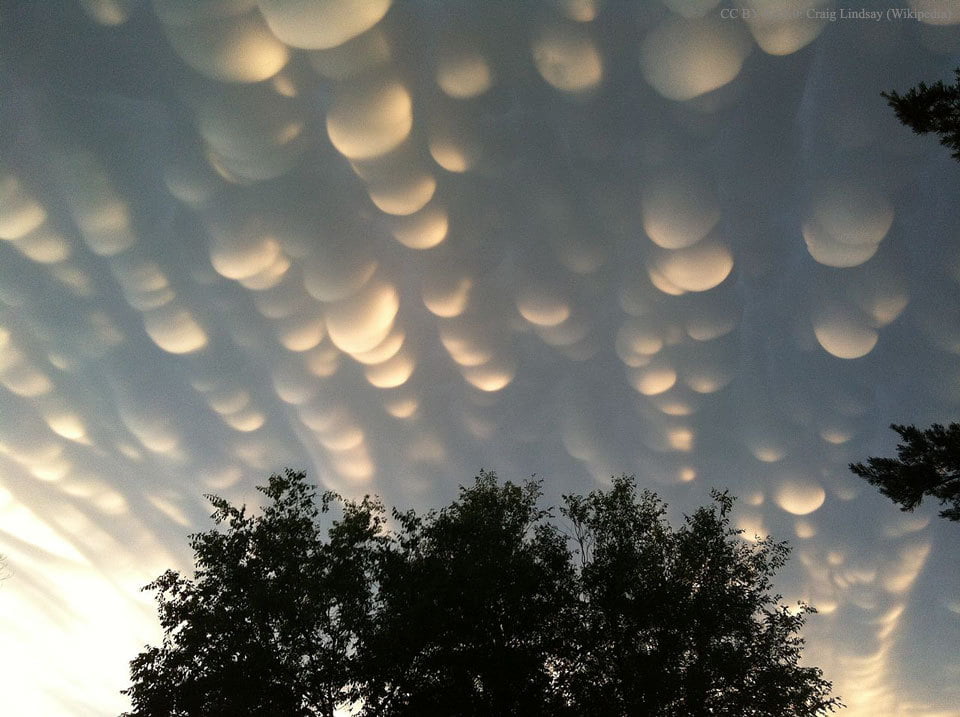
Mammatus Clouds
Mammatus clouds, the bubble-shaped protrusions sometimes seen underneath cumulus clouds, are a rare and dramatic type of cloud. The mammatus is typically short-lived, with lobes lasting only 10 minutes or so. Their rarity and short appearances are among the reasons why this cloud type has been little studied. As a result, there are many theories as to how the clouds form their distinctive, bulbous lobes, but, to my knowledge, there is no single widely accepted explanation. Mammatus often appear before or after severe thunderstorms and are associated with strong turbulence, so this may play a factor in their formation. (Photo credit: C. Lindsey; via APOD)
Bullet-Time Inferno
Remember the bullet time effect from The Matrix? This spectacular video gives you a similar effect with the turbulent flames created by firebreathers. To capture this level of detail, Mitch Martinez uses an array of 50 cameras placed around the performers, allowing him to reconstruct the full, three-dimensional representation of the flames. Similarly, some scientists use arrays of high-speed video cameras to collect 3D, time-resolved data about phenomena like combustion. Because these flows are so complex in terms of their fluid dynamics and chemistry, capturing full 3D data is important to help understand and model the flow better. (Video credit: M. Martinez; via Rakesh R.)
How Plants Move
Though most plants don’t move at speeds that we humans notice, many plants are remarkably active, as seen in the timelapse animations above. Much of this motion is driven by water flow inside the plant. The two plants above are phototropic–they move in response to light. The motion is actuated via a specialized motor cell called the pulvinus, which is located at the base of the leaf where it meets the stem. Unlike animal cells, plant cells have stiff outer walls that allow them to maintain an internal pressure–or turgor pressure–that differs from the outside environment. In fact, it’s not unusual for a plant’s cell to hold a pressure equivalent to 5 atmospheres! The plant manipulates this turgor pressure by controlling the transport of ions across cell membranes. Pump more ions into a cell, and osmosis will cause water to flow into the area of high solute (ion) concentration. This causes the cell to swell and raises the turgor pressure, resulting in the plant’s leaf moving. (Image credit: L. Miller and A. Hoover, source; additional research credit: J. Dumais and Y. Forterre)