Fire tornadoes, despite their name, are more like dust devils than your typical tornado. In nature, they’ll often form in wildfires, but here the Slow Mo Guys simulate one for the high-speed cameras using a ring of box fans set up to provide rotational flow, or vorticity, around a kerosene fire. As the fire burns, the warm air over the flame moves upward due to buoyancy. This creates a low-pressure area around the fire that draws in the spinning air from further out. Like an ice skater who pulls her arms in when spinning, the rotating air spins faster as it moves in toward the fire, resulting in a swirling turbulent vortex of flame. Hopefully it goes without saying, but, seriously, don’t try this at home. (Video credit: Slow Mo Guys; submitted by Chris S.)
Tag: science

Draining Soap Film
The brilliant colors of a soap film are directly related to the film’s thickness. Black regions, like the one in the upper right of this image, are the thinnest regions and may be less than 100 nanometers thick. (That’s smaller than the shortest wavelength of visible light!) The colors of the peacock-feather-like blooms along the bottom of the image demonstrate significant variations in film thickness. This is caused by uneven concentrations of surfactants in the film. The variations in concentration causes differences in local surface tension, which in turn moves fluid around within the film. This is known as a Marangoni effect. (Image credit: S. Berg and S. Troian)

Oil Film on Water
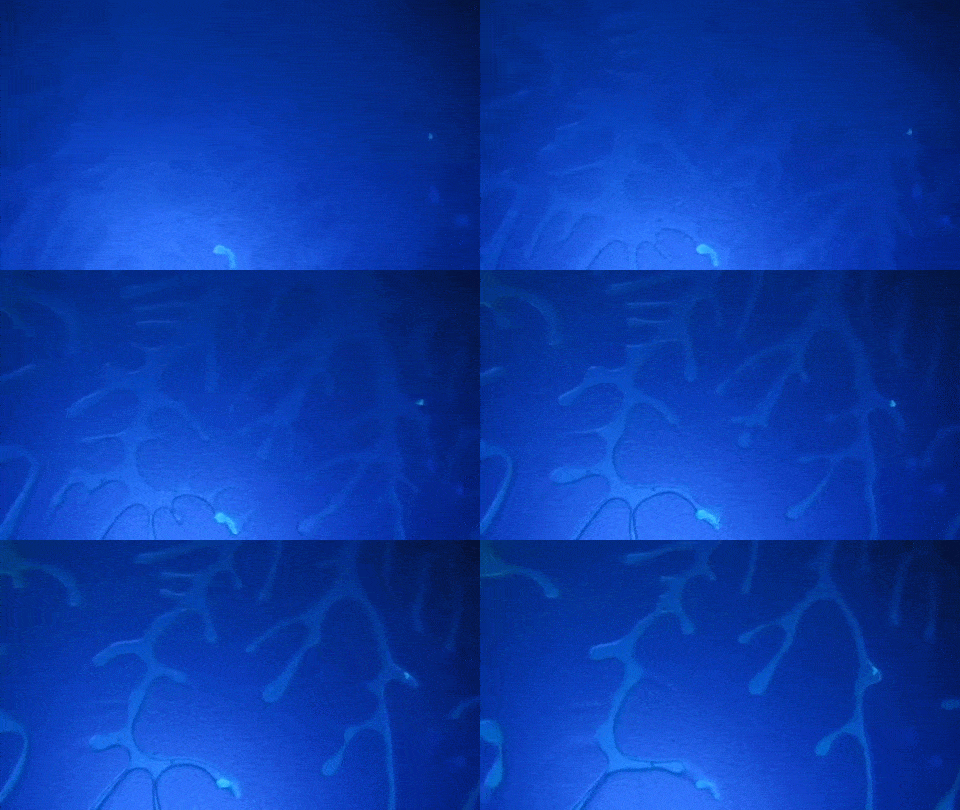
This award-winning short film features a thin layer of volatile oil on water. The oil evaporates quickest from shallow pools only microns deep, which appear bluish in the video. Surface instabilities along the edge of the pool create flow that draws oil in, generating the iridescent droplets seen floating among the evaporation pools. The droplets combine and coalesce as they come in contact with one another. Since droplets have a larger volume per surface area than the shallow pools, they evaporate more slowly. The behaviors observed here are important to applications like oil and fuel spills, which can persist longer if the floating fluid layer tends to form droplets. (Video credit: J. Hart; via txchnologist)

Jovian Belts and Zones
Jupiter’s colorful cloud bands alternate between dark belts and light zones. The bands mark convection cells in Jupiter’s atmosphere, and, like on Earth, powerful jet streams form due to this atmospheric heating and the planet’s rotation. The jet winds can even move in opposite directions, creating strong shear forces between neighboring cloud bands. The shear helps drive Kelvin-Helmholtz instabilities in the clouds, resulting in the regularly spaced waves and vortices seen along the edges of some bands. (Image credit: NASA/ESA; via APOD)

From Dripping to Beading
When water drips, it quickly breaks up into a string of smaller droplets due to a surface-tension-driven instability called the Plateau-Rayleigh instability. But adding just a tiny bit of polymer to the fluid changes the behavior entirely. Instead of breaking into droplets, a narrow filament dotted with tiny satellite droplets forms between the larger drops. This is known as the beads-on-a-string instability. The viscoelasticity the polymers add is one key to seeing this behavior. Polymers consist of large molecule chains that, when stretched, act a little like rubber bands–they pull back against the stretch, providing an elastic effect. Without this elasticity, the tiny filament connecting the drops would break up immediately. (Image credit: M. Berman, source; research credit: P. Bhat et al.)
Trampolining Droplet
Imagine a droplet sitting on a rigid surface spontaneously bouncing up and then continuing to bounce higher after each impact, as if it were on a trampoline. It sounds impossible, but it’s not. There are two key features to making such a trampolining droplet–one is a superhydrophobic surface covered in an array of tiny micropillars and the other is very low air pressure. The low-pressure, low-humidity air around the droplet causes it to vaporize. Inside the micropillar array, this vapor can get trapped by viscosity instead of draining away. The result is an overpressurization beneath the droplet that, if it overcomes the drop’s adhesion, will cause it to leap upward. For more, check out the original research paper or the coverage at Chemistry World. (Video credit and submission: T. Schutzius et al.)

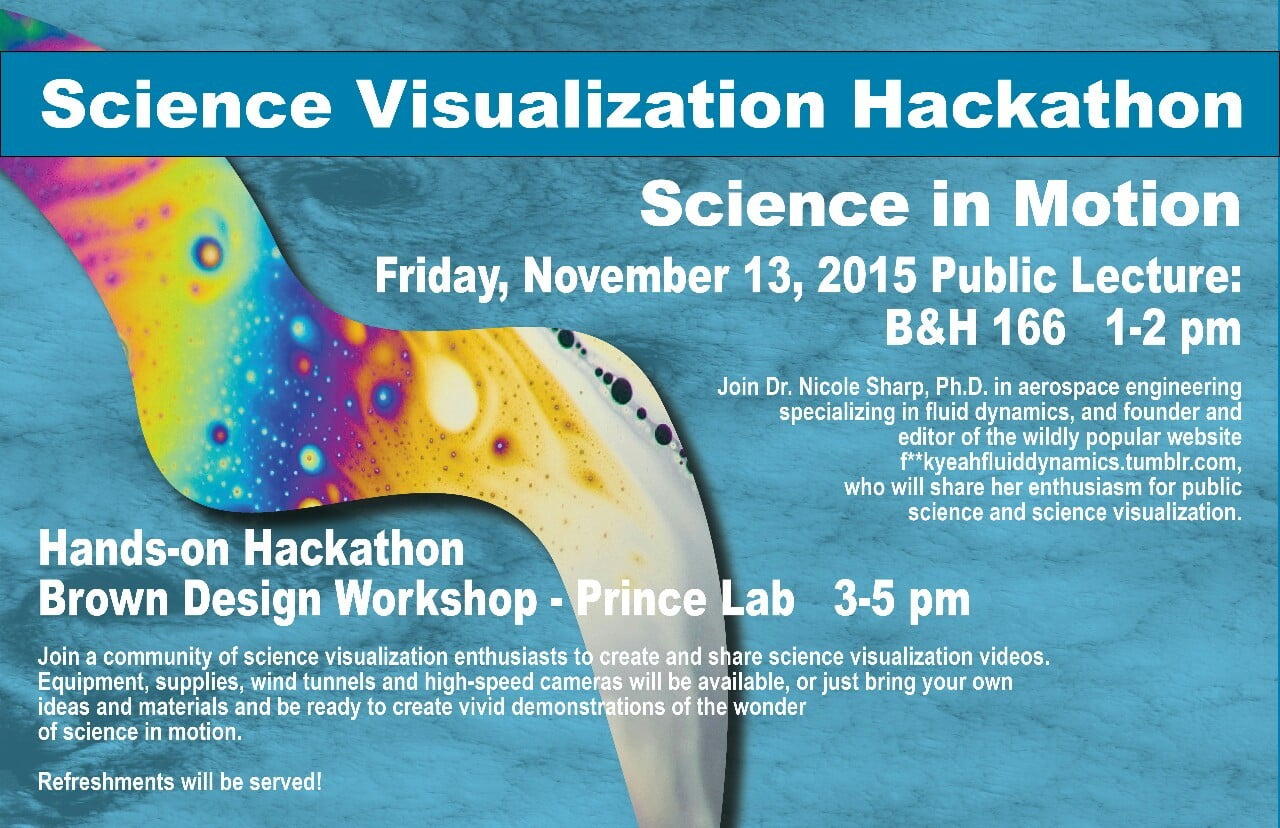
Science Hackathon
Just a heads-up that I’ll be at Brown University tomorrow giving a talk and then helping out with a science visualization hackathon. I’m super excited for the opportunity to have some hands-on flow visualization fun with folks!
The lecture is public, but I think only Brown students can register for the workshop.

Ignition
Shown here are the first instants after a bubble full of methane gas is ignited via laser. Using the schlieren optical method and a high-speed camera, scientists recorded the deflagration at 10,000 frames per second. Because schlieren imaging is very sensitive to small changes in density, we see not only the expanding flame front as the methane ignites but also the subtle waviness of the methane expanding into the surrounding air as the bubble bursts. (For comparison, check out what bursting a water balloon looks like at high-speed.) Be sure to head over to ScienceTake for the full schlieren video, and also check out this award-winning video of a match lighting made by the same researcher. (Image credit: V. Miller et. al.; full video: The New York Times; submitted by Rebecca M.)
ETA: An earlier version of this post mistakenly said the demo used a balloon full of methane rather than a bubble. Thanks to jump-first-think-later for the correction.
The Droplet Slide
One of the joys of science is the sense of discovery that can come even from looking at something seemingly simple. Take, for example, a water droplet sitting on a plate. If you slowly tilt the plate, the droplet’s shape will shift until a critical angle where it starts sliding down the plate. But what happens to two initially different droplets? As this video shows, tilting two droplets of initially different shapes and returning them to horizontal causes the droplets to assume the same shape. There’s a universal behavior at work here–like nature has a kind of reset button that makes gravity and surface tension work together such that a droplet will assume a preferred shape. For an experimentalist, it’s certainly a handy way to create repeatable experiments! (Video credit: M. Musterd et al.)
Viscous Fingers
Take a viscous fluid, like laundry detergent, and sandwich it between two plates of glass. Fluid dynamicists call this set-up a Hele-Shaw cell. If you then inject a less viscous fluid, like air, between the plates–or if you try to pry them apart–you’ll see a distinctive pattern of dendritic fingers form. This viscous fingering, also known as the Saffman-Taylor instability, occurs because the interface between the two fluids is unstable. Invert the problem, though–inject a more viscous fluid into a less viscous one–and no special shapes will form because the interface will remain stable. (Image credit: Random Walk Studios, source)