Popping a soap bubble is more complicated than what the eye can see. In high-speed video, we find that the action is very directional, with the soap bubble film pulling away from the point of rupture. As it does so, waves, like those in a flapping flag, appear along the surface and strings of fluid form along the edge of the film before breaking into droplets. This video takes matters a step further, looking at what happens to air inside a bubble when it pops. Those subtle waves and strings of fluid we see in the high-speed rupture have a distinctive effect on air inside the bubble. As the film pulls away, it leaves behind a rippled, wavy surface rather than a smooth sphere of foggy air. (Video credit: Z. Pan et al.)
Tag: science

Numerical Rayleigh-Taylor
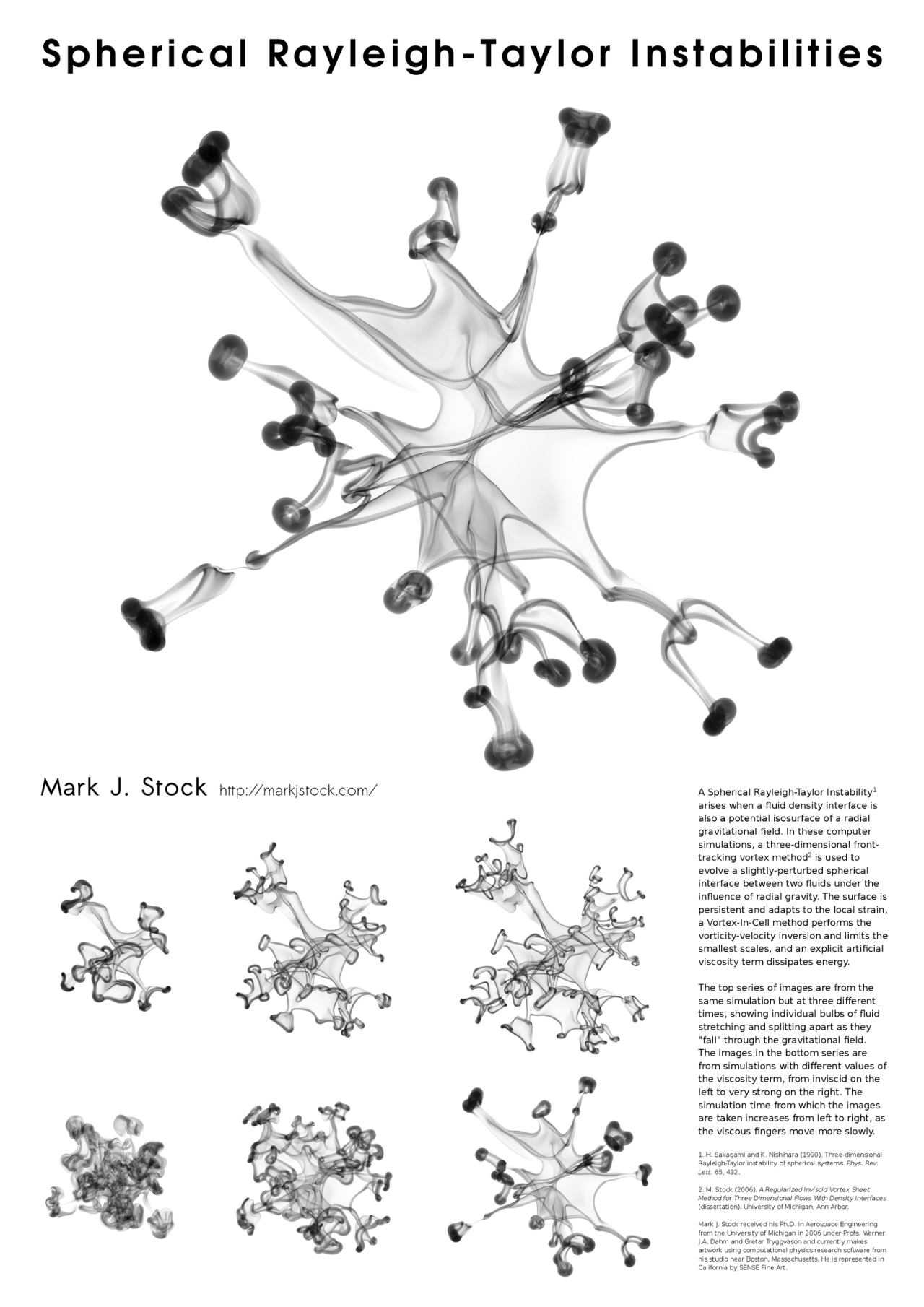
If you’ve ever dripped food coloring or ink into a glass of water, you’ve probably created a cascade of tiny vortex rings similar to the images above. This is the Rayleigh-Taylor instability, in which the heavier ink/food coloring falls under gravity into the less dense water. What’s shown above is a special case–one that no experiment can recreate. It’s a numerical simulation of a spherical Rayleigh-Taylor instability. Imagine a sphere of a dense fluid “falling” outward under the influence of a radial gravitational field. This is one of the interesting aspects of computational fluid dynamics–it can simulate situations that are impossible to create experimentally. That can be both a strength and a weakness, allowing researchers to probe otherwise unavailable physics or fooling the unwary into thinking they have captured something real. (Image credit: M. Stock)

“Monsoon II”
Every child learns about the water cycle in school, but an academic description of the process often lacks nature’s grandeur. In “Monsoon II” photographer Mike Olbinski captures the majesty of cloud formation and rainfall in a way that rekindles awe for the scale of the process. It begins with bright clouds popping up, the result of warm moist air rising from the ground and cooling at altitude. As more water vapor evaporates, rises, and condenses, water droplets collide in these clouds, coalescing and growing until they grow too large and heavy to stay aloft. These are the droplets that fall in sheets of rain, blurring the air beneath them. There’s an incredible beauty to watching rain fall from a distance; it looks calm and localized in a way that’s utterly at odds with the experience from inside the storm. (Video credit: M. Olbinski; submitted by jshoer)

Collecting Water in the Desert

Desert-dwelling plants like cactuses have to be efficient collectors of water. Many types of cactus are particularly good at gathering water from fog that condenses on their spines. Droplets that form near a spine’s tip move slowly but inexorably toward the base of the spine so that the cactus can absorb them. The secret to this clever transport lies in the microstructure of the spine’s surface. The
Gymnocalycium baldianum cactus, for example, has splayed scales along its spines. Capillary interactions with the scales result in differences in curvature on either side of the droplet. Curved fluid surfaces generate what’s known as Laplace pressure, with a tighter radius of curvature causing a larger Laplace pressure. Because the curvature of the droplet varies from the base side to the tip side of the spine, the difference in Laplace pressures across the droplet creates a force that drives the droplet toward the spine’s base. (Image credit: C. Liu et al., source)
The Tightrope Dancers
Boiling is a process most of us don’t pay much attention to. But it can be remarkably entertaining and beautiful. This award-winning video shows boiling on and around a heated wire immersed in oil. Depending on the diameter of the wire and the power used to heat it, the researchers observe several different regimes of behavior. In one, vapor bubbles form on the wire and interact with one another: bouncing, merging, and dancing back and forth. When the bubbles become large enough, their buoyancy lifts them upward. In another regime, the wire is hot enough for film boiling. Like the Leidenfrost effect, film boiling occurs when a surface is so hot that it instantly vaporizes any liquid near it. The vapor layer then acts like coating, insulating the remaining liquid from the hot surface. The bubbles formed on the wire in this regime are mesmerizing, rising in periodic patterns or shifting back and forth gobbling up lesser bubbles. (Video credit: A. Duchesne et al.)

Hiding in the Sand

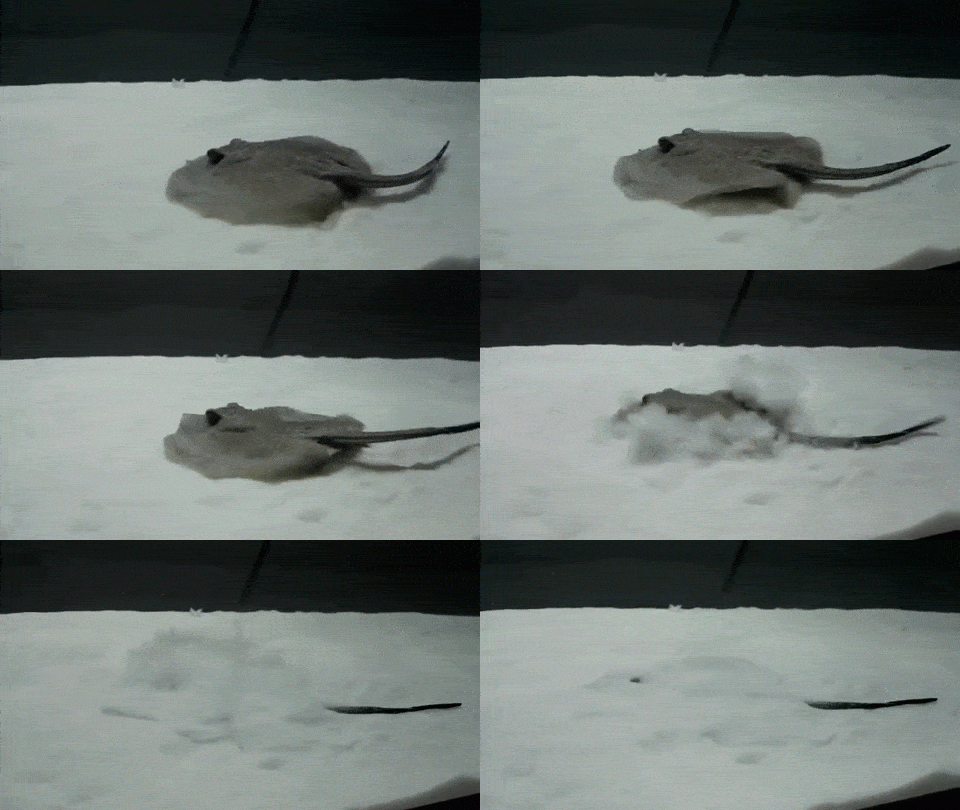


Flounders, stingrays, and other flat, bottom-dwelling fish often hide under sand for protection. These fish move by oscillating their fins or the edge of their bodies. They use a similar mechanism to bury themselves–quickly flapping to resuspend a cloud of particles, then hitting the ground so that the sand settles down to cover them. Researchers have been investigating this process by oscillating rigid and flexible plates and observing the resulting flow. When the flapping motion exceeds a critical velocity, the vortex that forms at the plate’s edge is strong enough to pick up sand particles. Understanding and controlling how and when these vortex motions kick up particles is useful beyond the ocean floor, too. Helicopters are often unable to land safely in sandy environments because of the particles their rotors lift up, and this work could help mitigate that problem. (Image credits: TylersAquariums, source; Richmondreefer, source; A. Sauret, source; research credit: A. Sauret et al.)

Icebergs and Caramel
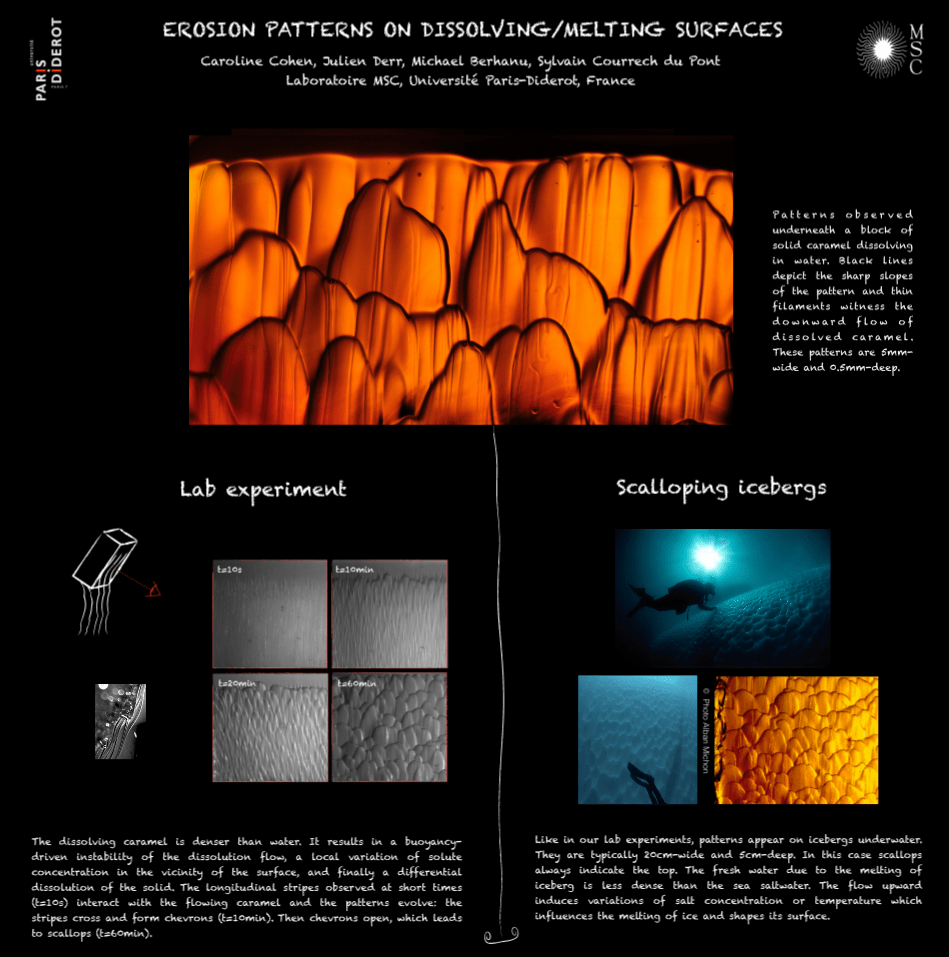
What do icebergs and caramel have in common? Both have similar scalloped erosion patterns as they dissolve. When caramel dissolves in water, the denser caramel sinks in the buoyant water. An initially smooth surface will first form lines, then the flowing caramel and the uneven surface interact, forming chevrons, followed by larger scallops. A similar process happens with melting icebergs. The meltwater from an iceberg is less dense than the surrounding seawater, so it will rise as it melts. This causes variations in the salt concentration and temperature near the iceberg, which cause it to melt differently in different spots, ultimately leading to the same scallop shapes observed in the caramel. Check out the full-size PDF of the poster here. (Image credit: C. Cohen et al.)
Drinking in Space
Earlier this year, the Capillary Beverage experiment launched to the International Space Station with new open-topped “Space Cups” for astronauts to test. Now those of us back on Earth are getting a glimpse of the cups in microgravity action. The geometry of the cups is wide on the back-end with a tightening v-shape near the mouth. This shape guides the liquid by using capillary action to wick it toward the spout.
One of the key goals of the experiment was to observe how the liquid drained–what shape it assumed in the cup and where and how much liquid was left behind. The researchers want to compare the real-life performance of the cups with their numerical models and simulations, which will help design future microgravity liquid transport systems for fuel, waste management, and other applications.
Although the experiments have a wider purpose, the space cups also do a great job allowing astronauts to drink from more than just pouches. Check out the gallery demo above to see how they hold up against astronaut silliness! (Video and image credits: NASA/IRPI LLC, GIF source)
The Fluidic Oscillator


A fluidic oscillator is a device with no moving parts that sprays a fluid from side to side. The animations above illustrate how they work. A nozzle funnels a fluid jet through a chamber with two feedback channels. When the jet sweeps close to one side of the chamber, part of the fluid is directed along the feedback channel and back toward the inlet. That flow feeds into a recirculating separation bubble in the middle of the chamber. As that bubble grows, it pushes the jet back toward the other feedback channel, continuing the cycle. Many automobiles use fluidic oscillators in their windshield washer sprays. Check out the award-winning full video from the Gallery of Fluid Motion. (Image credit: M. Sieber et al., source)