Tag: polymer effects

  • Bonbon Coatings

    Bonbon Coatings

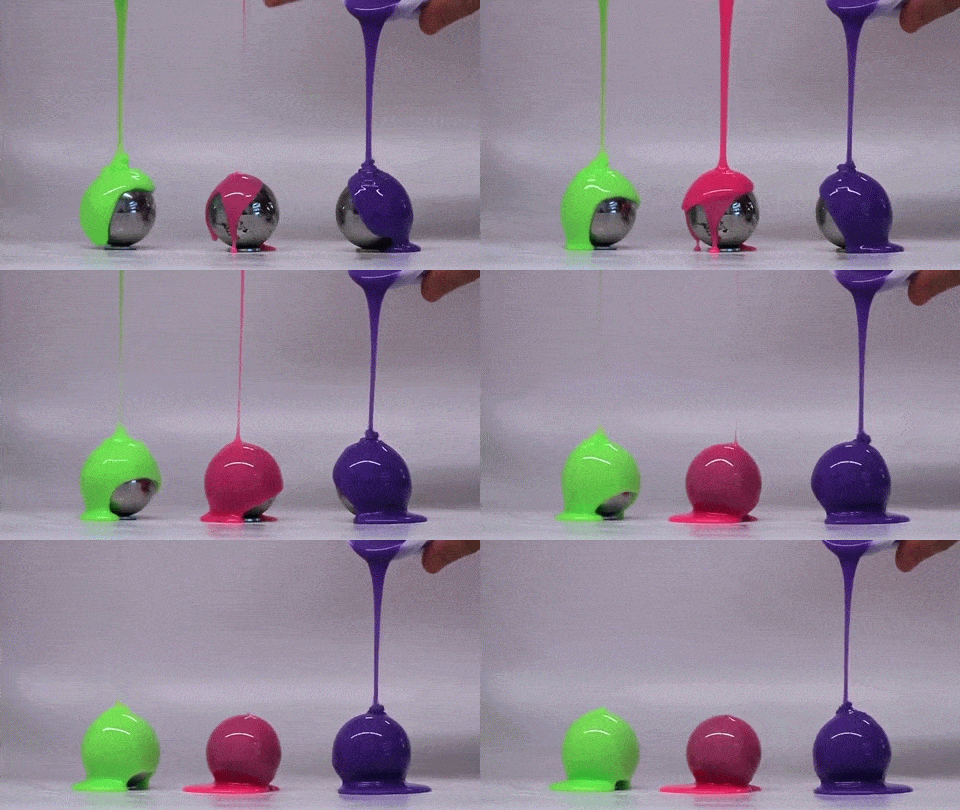
    If you’ve ever bitten into a chocolate-covered bonbon, you may have noticed that the candy’s chocolate coating is remarkably uniform. Inspired by this observation, a group of engineers have investigated how viscous fluids poured over a curved surface flow and solidify; their findings were published this week.

    Rather than heated chocolate, the group used polymer-filled fluids that cure and harden over time. Interestingly, they found that the final shell is quite uniform and that its thickness does not depend on the pouring technique. Instead, they can predict the final shell thickness based on the radius of the mold and the rheological properties of the fluid–specifically its density, viscosity, and curing time. The reason for this is that the time it takes for the fluid to drain and coat the mold is much shorter than the time it takes for the polymer to cure. As a result, the amount of fluid that sticks to the mold depends on geometry and fluid properties – not how the fluid was poured.

    Amateur confectioners rejoice: pouring uniform chocolate coatings may be easier than you thought!  (Image credit: MIT News, video; research credit: A. Lee et al.)

  • Rotating Jet

    Rotating Jet

    This photo, one of the winners of the Engineering and Physical Sciences Research Council’s (EPSRC) annual photography contest, shows a rotating viscoelastic jet. Rotating liquid jets are common to many manufacturing processes, and their sometimes-wild appearance comes from a balance of gravitational forces and centrifugal force against surface tension. But because this fluid contains a small amount of polymer additive, surface tension has the additional aid of some elasticity to help hold the jet together and keep the globules and ligaments you see from flying off. As centrifugal forces fling the fluid outward, it stretches the polymer chains within the fluid, and they pull back against that tension like a stretched rubber band. To see some of the other contest winners–including other fluids entries!–check out the Guardian’s run-down. (Image credit and submission: O. Matar et al., ICL press release)

  • Melted Polymers

    Melted Polymers

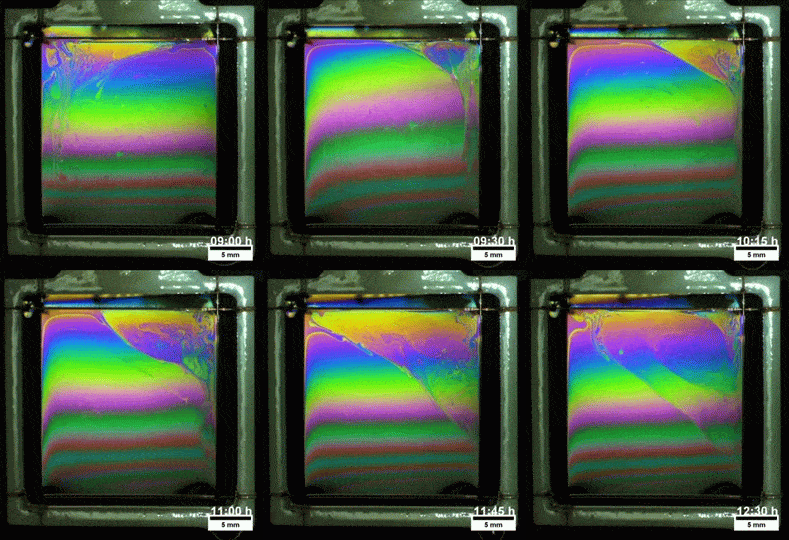
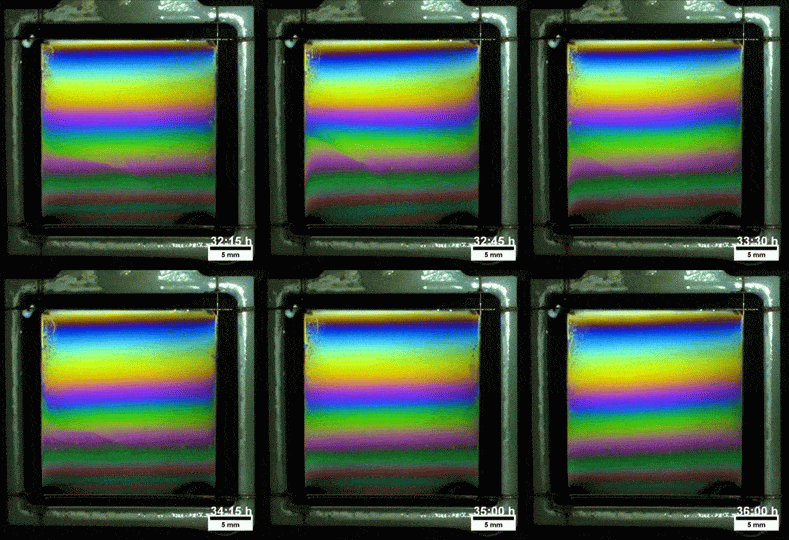
    What you see here, despite appearances, is not a soap film. On the contrary, this is a thin vertical film made up of melted polymers. Like a soap film, it is extremely thin, varying from a few nanometers at its thinnest to several hundred nanometers at the thickest point. But unlike a freestanding soap film, this polymer film can last for more than a day before the film breaks. Researchers attribute the long life of the films to structural forces inside the fluid.

    They observed that the films remain highly stratified, varying smoothly in thickness from their thinnest point at the top to the thickest point at the bottom. They hypothesize that the geometry of the film preferentially traps the polymer’s molecules in preferred orientations, which reinforces the stratification and helps stabilize the film. For more, check out the research paper. (Image credit: T. Gaillard et. al., source; via KeSimpulan)

  • From Dripping to Beading

    From Dripping to Beading

    When water drips, it quickly breaks up into a string of smaller droplets due to a surface-tension-driven instability called the Plateau-Rayleigh instability. But adding just a tiny bit of polymer to the fluid changes the behavior entirely. Instead of breaking into droplets, a narrow filament dotted with tiny satellite droplets forms between the larger drops. This is known as the beads-on-a-string instability. The viscoelasticity the polymers add is one key to seeing this behavior. Polymers consist of large molecule chains that, when stretched, act a little like rubber bands–they pull back against the stretch, providing an elastic effect. Without this elasticity, the tiny filament connecting the drops would break up immediately. (Image credit: M. Berman, source; research credit: P. Bhat et al.)

  • Featured Video Play Icon

    Extinguishing Flames

    Putting out fires can be a difficult, water-intensive task. In this video, scientists demonstrate how using a non-Newtonian fluid can make it easier to extinguish and suppress flames. Where water tends to splatter and scatter against an object, a yield-stress fluid can cling and coat to smother the flame. The fluid used here is water with a 0.1% polymer additive, which is enough to significantly change the fluid’s rheological properties. Pre-treating flammable objects with the fluid is also effective at suppressing combustion, raising additional possibilities for using such techniques in fighting the spread of wildfires. (Video credit: B. Blackwell et al.)

  • Self-Pouring Fluids

    Self-Pouring Fluids

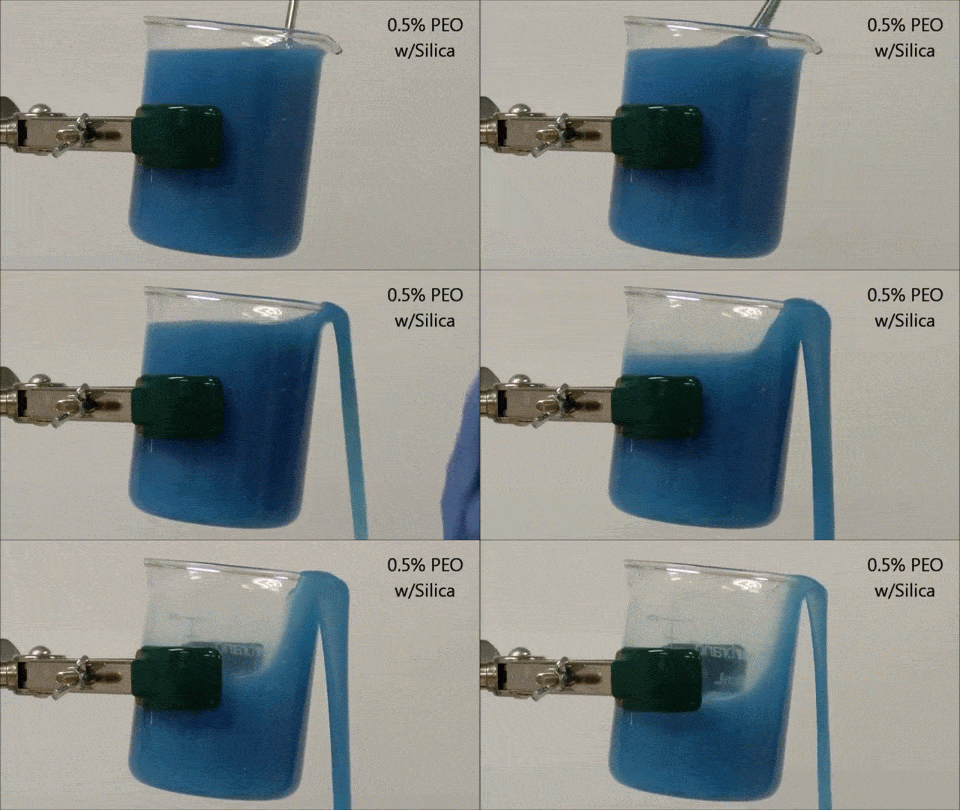
    Non-Newtonian fluids are capable of all kinds of counter-intuitive behaviors. The animations above demonstrate one of them: the tubeless or open siphon. Once the effect is triggered by removing some of the liquid, the fluid quickly pours itself out of the beaker. This is possible thanks to the polymers in the liquid. The falling liquid pulls on the fluid left behind in the beaker, which stretches the polymers in the fluid. When stretched, the polymers provide internal tension that opposes the extensional force being applied. This keeps the fluid in the beaker from simply detaching from the falling liquid. Instead, it flows up and over the side against the force of gravity, behaving rather more like a chain than a fluid!  (Image credit: Ewoldt Research Group, source)

  • Sharkskin Instability

    Sharkskin Instability

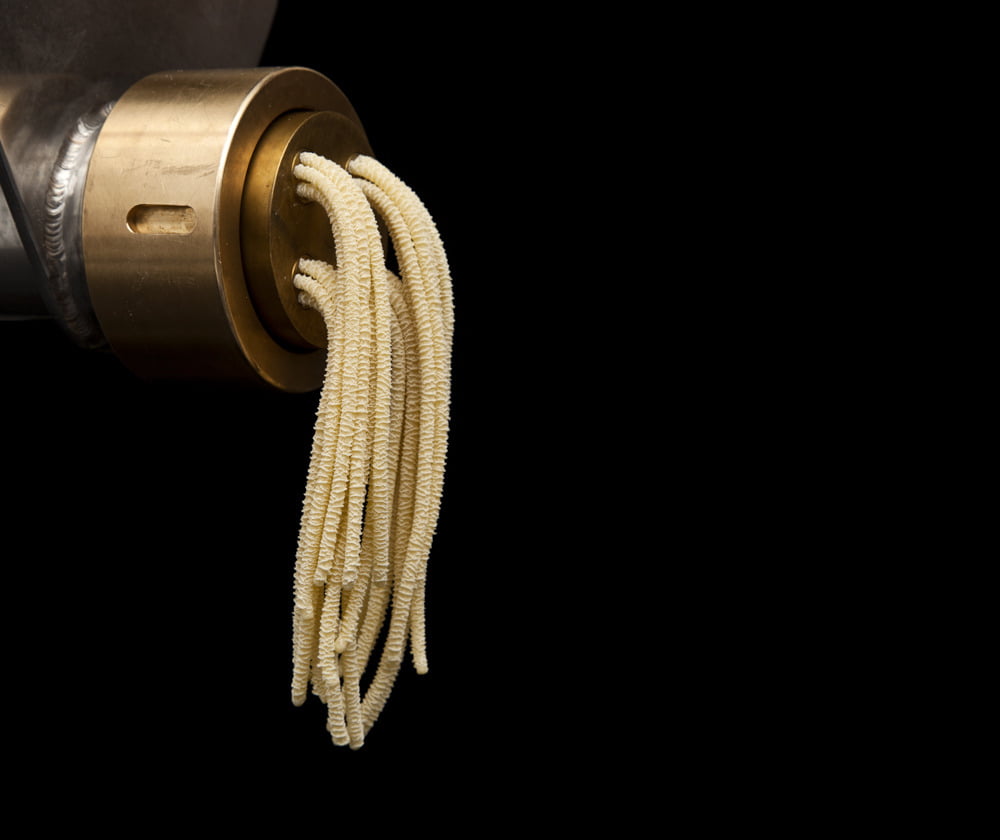
    Homemade spaghetti noodles exhibit a roughened surface that’s the result of viscoelastic behavior known as the sharkskin instability. It’s usually observed in the industrial extrusion of polymer plastics. In the case of spaghetti, the long, complex polymer molecules necessary for the instability come from the proteins in eggs. The characteristically rough surface of the extruded material is caused by the transition from flow through the die to air. Inside the die, friction from the walls exerts a strong shear force on the outer part of the fluid while the inner portion flows freely. When the material exits the die, the sudden lack of friction on the outer portion of the fluid causes it to accelerate to the same velocity as the middle of the flow. This acceleration stretches the polymers until they snap free of the die; after the strained polymers relax, the material keeps a rough, saw-tooth pattern. In industry, the sharkskin instability can be prevented by regulating temperature or flow speed. In the case of spaghetti, though, Modernist Cuisine suggests the roughness is desirable because it helps trap the pasta sauce. Bon appetit!  (Image credit: Modernist Cuisine)

  • Melt Fracture in Plastics

    Melt Fracture in Plastics

    Liquid plastics are often extruded–or pressure-driven through a die–during manufacturing. Early on manufacturers discovered that they could only extrude plastic at low flow rates, otherwise the plastic’s surface begins undulating in what became known as melt fracture. These corrugations result from the viscoelasticity of the plastic. Viscoelastic fluids have a response to deformation that is part viscous–like any fluid–and part elastic. At low flow rates, viscous forces dominate in the plastic, but at higher speeds, elasticity increases and the polymers in the plastic get stretched along the direction of flow. In response to this stretching, the polymers exert normal stresses, much like a rubber band that’s being stretched. Because this force acts only along the flow direction, different parts of the fluid are experiencing different forces, and these internal stresses cause the plastic to change shape. (Image credit: D. Bonn et al.)

  • Beading Fluids

    Beading Fluids

    Adding just a few polymers to a liquid can substantially change its behavior. The presence of polymers turns otherwise Newtonian fluids like water into viscoelastic fluids. When deformed, viscoelastic fluids have a response that is part viscous–like other fluids–and part elastic–like a rubber band that regains its initial shape. The collage above shows what happens to a thinning column of a viscoelastic fluid. Instead of breaking into a stream of droplets, the liquid forms drop connected with a thin filament, like beads on a string. In a Newtonian fluid, surface tension would tend to break off the drops at their narrowest point, but stretching the polymers in the viscoelastic fluid provides just enough normal stress to keep the filament intact. If the effect looks familiar, it may be because you’ve seen it in the mirror. Human saliva is a viscoelastic liquid! (Image credit: A. Wagner et al.)

  • Featured Video Play Icon

    Bubbles With Tails

    In water and other Newtonian fluids, a rising bubble is typically spherical, but for non-Newtonian fluids things are a different story. In non-Newtonian fluids the viscosity–the fluid’s resistance to deformation–is dependent on the shear rate and history–how and how much deformation is being applied. For rising bubbles, this can mean a teardrop shape or even a long tail that breaks up into fishbone-like ligaments. The patterns shown here vary with the bubble’s volume, which affects the velocity at which it rises (due to buoyancy) and thus the shear force the bubble and surrounding non-Newtonian fluid experience. (Video credit: E. Soto, R. Zenit, and O. Manero)