Tag: polymer effects

  • Beads on a String

    Beads on a String

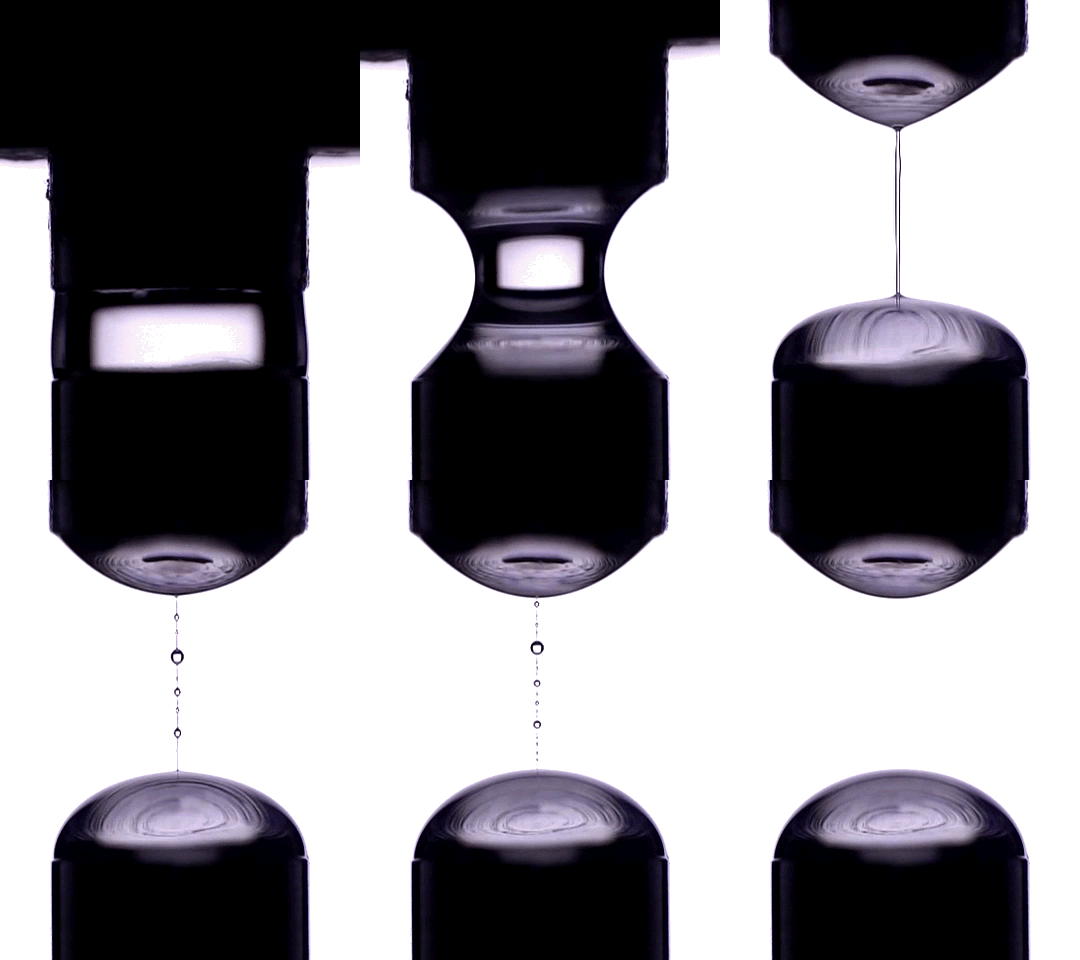
    Adding just a small amount of polymers to a liquid can drastically change its behavior. The polymers make the liquid viscoelastic, meaning that, under deformation, the liquid shows behaviors that are both viscous (like all fluids) and elastic (i.e. able to resume its original shape, like a rubber band). These properties are particularly identifiable under extensional loading, like in the animation above. Under these loads, the polymers in the fluid stretch and rearrange, creating an internal compressive stress that acts opposite the imposed tensile stress. It’s this balance of forces, along with ever-present surface tension that creates the beads-on-a-string effect seen above. (Image credit: B. Keshavarz)

    ETA: As usual, Tumblr gave me issues with an animated GIF. It should be fixed now. Sorry!

  • Featured Video Play Icon

    Shocking Droplets

    Typical liquid drops will break apart into long, stretched ligaments and a spray of tiny droplets when deformed. But with just a small addition of polymers, these same liquids become viscoelastic and capable of some pretty incredible behaviors. This video shows a viscoelastic drop being struck by a shock wave that passes from right to left. The droplet is smashed and deformed, then stretches into jellyfish-like sheet of liquid. But incredibly, the elastic forces in the droplet are enough to hold it together. Researchers are interested in understanding these behaviors for many applications, including preventing accidental explosions caused by explosive fuels atomizing in air. (Video credit: T. Theofanous et al.)

  • Featured Video Play Icon

    Mixing While Laminar

    Although turbulent flows are known for their mixing efficiency, in manufacturing there can often be a need to mix laminar fluid streams without the increased shear stress of a turbulent flow. This can be particularly important for polymeric liquids, where too much shear stress could damage the polymer chains. One possibility is using a static mixer, such as the one demonstrated in this video, which, when placed in pipe flow, will deflect the pipe’s contents in such a way as to produce efficient mixing over a short distance. Here two streams of high-viscosity epoxy are mixed through such a static mixer, hardened, and then ground to show the mixing at each level of the static mixer. (Video credit: Sulzer)

  • Viscoelastic Fingers

    Viscoelastic Fingers

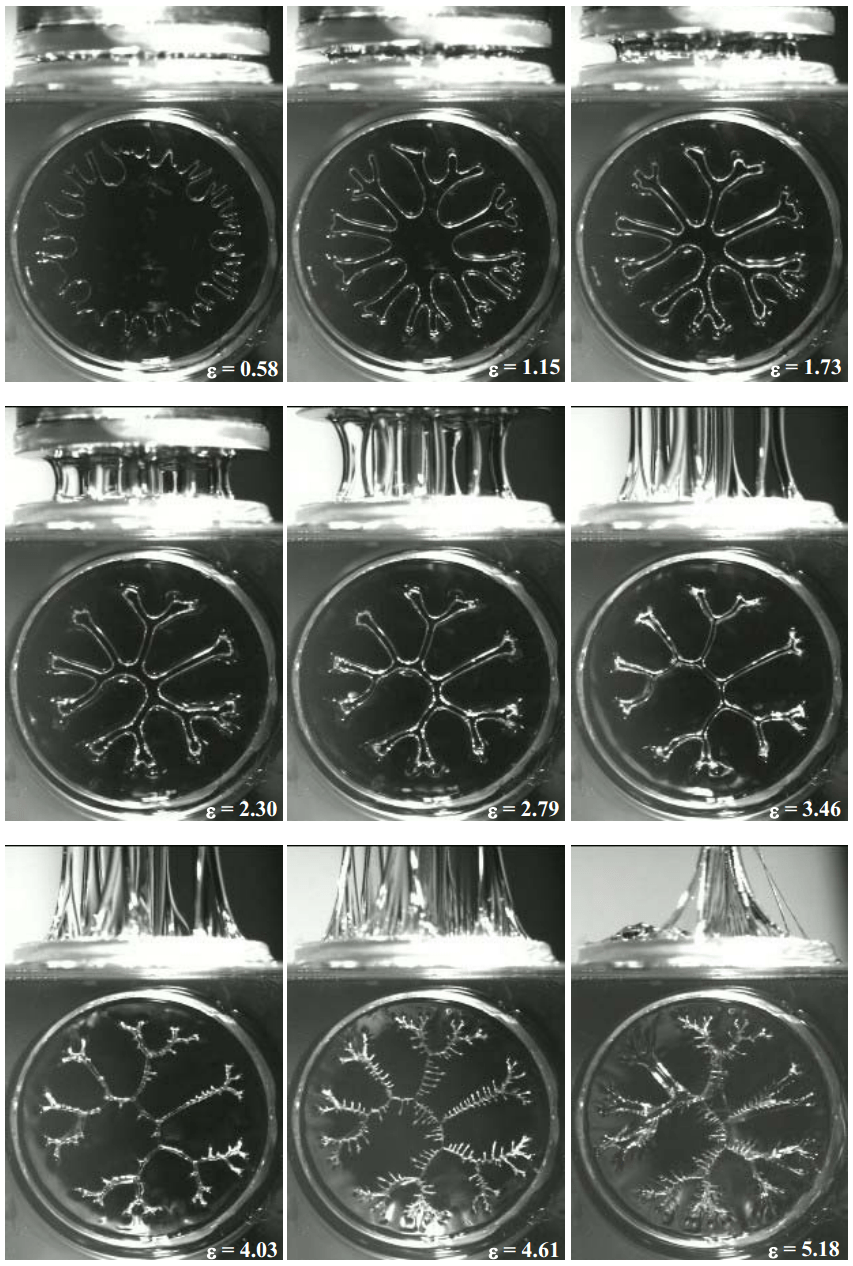
    This series of photos shows two plates with a thin layer of polymer-laced, viscoelastic liquid.  As the two plates are separated, complex instabilities form.  The lower section of each photograph shows the fluid on the plate, with finger-like Saffman-Taylor instabilities forming as air rushes in between the gap in the plates. As the separation increases, the polymers in the liquid stretch under the increased strain, inducing elastic stresses in the fluid that cause the formation of secondary structures. (Photo credit: R. Welsh, J. Bico, and G. McKinley)

  • Featured Video Play Icon

    The Gobbling Drop

    A little polymer goes a long way when it comes to changing a fluid’s behavior. Normally, a falling jet of fluid will develop waviness and be driven by surface tension and the Plateau-Rayleigh instability to break up into a stream of droplets. We see this at our water faucets all the time. But when traces of a polymer are dissolved in water, the behavior is much different. The viscoelasticity of the polymer chains creates a force that opposes the thinning effects caused by surface tension. So, instead of thinning to the point of breaking into droplets, a drop is able to climb back up the jet until it reaches a critical mass where it reverses direction, accelerates downward due to gravity and eventually breaks off the jet. Then the whole process begins again with a new terminal drop. (Video credit: C. Clasen et al)

  • Featured Video Play Icon

    Fano Flow

    Adding polymers to fluids can lead to strangely counter-intuitive behavior. Here two examples of bizarre extensional flow, sometimes called Fano flow, are shown. First, in the “tubeless siphon” fluid is drawn into a syringe from the level of the free fluid surface.  When the syringe is raised above the free surface of the fluid, the polymer-laden fluid continues to flow upward and into the syringe.  A similar effect is shown in the “open channel siphon” where, once initiated, the flow up and over the side of a beaker continues after the free surface of the fluid has fallen below the level of the beaker’s spout. In both of these cases, the cross-linking and entanglement of polymers within the fluid makes it capable of exerting normal stress when extensionally strained (e.g. stretching a rubber band). In other words, when the syringe is drawn out of the pool, the stretching of the fluid causes the polymers to exert a force that counteracts the weight of the fluid column, enabling the flow to continue upward despite gravity.

  • Featured Video Play Icon

    Viscoelastic Fluids in Space

    In honor of astronaut Don Pettit’s launch to the International Space Station (and in the hope that he’ll do more neat microgravity fluids demonstrations while in space!), here’s a look a the behavior of viscoelastic fluids in microgravity. The elasticity of these fluids means that, when strained, the fluid deforms instantaneously and then returns to its initial shape when the strain is removed. Pettit demonstrates both Plateau-Rayleigh instability behavior, where a column of fluid breaks apart due to surface tension variations, and die swell, where a fluid jet expands beyond the diameter of nozzle from which it was extruded. Such swelling is commonly caused by the stretching and relaxation of polymers in the fluid as they react to forces caused by the nozzle opening.

  • Featured Video Play Icon

    The Barus Effect

    Non-Newtonian fluids are full of all kinds of unusual behaviors. Here a highly viscoelastic non-Newtonian fluid exhibits the Barus effect, in which extruding the fluid causes the falling jet to swell to several times larger than the diameter of the opening through which it was extruded. This is caused by the stretching and relaxation of polymers in the fluid as it passes through the opening.

  • Featured Video Play Icon

    Microfluidics

    The field of microfluidics–where fluids are constrained to the sub-millimeter scale–is increasingly important in fields like chemistry, molecular biology, and microtechnology. At the microscale, surface tension often has greater effects than in our everyday world. This video shows how adding small amounts of a polymer drastically changes droplet breakup.

  • Featured Video Play Icon

    The Weissenberg Effect

    Non-Newtonian fluids exhibit all kinds of odd behaviors, even climbing up a spinning rod! This is known as the Weissenberg effect and is associated with polymers in the fluid.