Peering from directly above, landscapes take on a whole different aspect. That idea is the heart of Vadim Sherbakov’s “Serenity,” filmed by drone. From seething waters and meandering rivers to eroded landscapes and twisting ice, there’s lots of fluid dynamics on display here. (Video and image credit: V. Sherbakov)
Massive black holes drag and warp the spacetime around them in extreme ways. Observing these effects firsthand is practically impossible, so physicists look for laboratory-sized analogs that behave similarly. Fluids offer one such avenue, since fluid dynamics mimics gravity if the fluid viscosity is low enough. To chase that near-zero viscosity, experimentalists turned to superfluid helium, a version of liquid helium near absolute zero that flows with virtually no viscosity. At these temperatures, vorticity in the helium shows up as quantized vortices. Normally, these tiny individual vortices repel one another, but a spinning propeller — much like the blades of a blender — draws tens of thousands of these vortices together into a giant quantum vortex.
Here superfluid helium whirls in a quantum vortex.
With that much concentrated vorticity, the team saw interactions between waves and the vortex surface that directly mirrored those seen in black holes. In particular, they detail bound states and black-hole-like ringdown phenomena. Now that the apparatus is up and running, they hope to delve deeper into the mechanics of their faux-black holes. (Image credit: L. Solidoro; research credit: P. Švančara et al.; via Physics World)
Mount Etna has long been known for its smoke rings, but thanks to the opening of a new vent on the volcano’s southeast crater, it’s now making more rings than ever. Etna’s smoke rings are, more precisely, vortex rings — produced in the same way dolphins, swimmers, and whales make vortex rings: a sudden push of air through a roughly circular opening. It’s likely that Etna and other volcanoes make far more rings than those we see; we’re limited to noticing only the ones that entrain smoke and condensation to make them visible. (Video and image credit: The Straits Times; via Colossal)
Some 20,000 years ago, a massive star blew off a ring of dust and gas that expanded into the surrounding interstellar medium. Later, in 1987, the star exploded as supernova 1987A. That explosion lit the surrounding area, revealing a clumpy ring astronomers have struggled to explain. But a new team believes they have a fluid dynamical answer: the Crow instability.
Closer to home, we see the Crow instability when an airplane’s contrails break up. It happens when two vortices that rotate in opposite directions are close to one another. Any wobble in one vortex is enhanced by the influence of its neighbor. Eventually, this breaks the original vortices apart and causes them to reform as a series of smaller vortex rings.
A comparison between an image of SN 1987A and an illustration of the vortex ring interaction thought to create that shape.
In what seems to be a tradition now, a group at MIT imagined how the Millennium Falcon would perform if it lost its engines during atmospheric flight. Their hypothetical scenario took place in the Battle of Endor, with the Falcon flying at an altitude of 2 kilometers.* Could Han Solo and Chewbecca safely glide the craft down?
Using computational fluid dynamics, the group found the Millennium Falcon has a glide ratio of only 1.8, meaning it travels forward 1.8 kilometers in the time it takes to lose one kilometer of altitude. Its namesake bird, on the other hand, has a glide ratio of 10. The Corellian freighter might not be the best glider out there, but the team estimated that it could safely manage its 3.6 kilometer glide down. (Image credit: S. Costa et al.; see also X-Wing Re-entry and AT-AT Flow)
*I’m definitely overthinking this, but now I’m really wondering what atmospheric characteristics they used for Endor. And what’s Endor’s gravity like?
Seabirds like gannets and boobies are engineered for diving. They fly to a certain altitude, locate fish underwater, and then fold themselves into a streamlined projectile. With this, they plunge into the water at high-speed, positioned to protect themselves from the forces of impact. Under the water, they dart among their prey, hunting with singular purpose. Photographer Kat Zhou’s “Divebomb” captures the underwater side of this behavior, while showing off the energetic bubbles (and bubble rings!) created by the birds. (Image credit: K. Zhou; via UPY 2024 and Colossal)
Soft materials tend to be sticky, and once they’re adhered to a surface, they’re often harder to remove than they were to attach — think of Scotch tape stuck to a desk. This difficulty separating sticky things — known as adhesionhysteresis — has been attributed to various causes, like energy lost to viscoelasticity or age-related chemical bonding. But a new study shows that both those explanations are unnecessary.
Instead, the difficult removal comes from the way two surfaces separate in fits and starts. No two surfaces are perfectly smooth, and soft surfaces are able to conform to all the nooks and crannies of their partner surface. That molding results in a lot of surface contact, all of which must break for the materials to detach. That peeling doesn’t take place smoothly. Instead, the two surfaces part a little at a time in discrete jumps, as shown in the image above. The colors in the illustration show how much energy is dissipated in each jump, with darker colors indicating higher energy. The team found that this stick-slip mechanism is enough to account for the struggles we have un-sticking objects. They’re now looking at how water affects these narrow meeting places between sticky surfaces. (Image and research credit: A. Sanner et al.; via Physics World)
To fly stably, parachutes need to deform and allow some air to pass through their canopy. In this video, researchers investigate kirigimi parachutes, inspired by a form of paper art that uses cuts to create three-dimensional shapes. After laser-cutting, these disks are dropped — or placed in a wind tunnel — to observe how they “fly” at different speeds. Sometimes they flutter or bend; other shapes elongate in the flow. (Video and image credit: D. Lamoureux et al.; via GoSM)
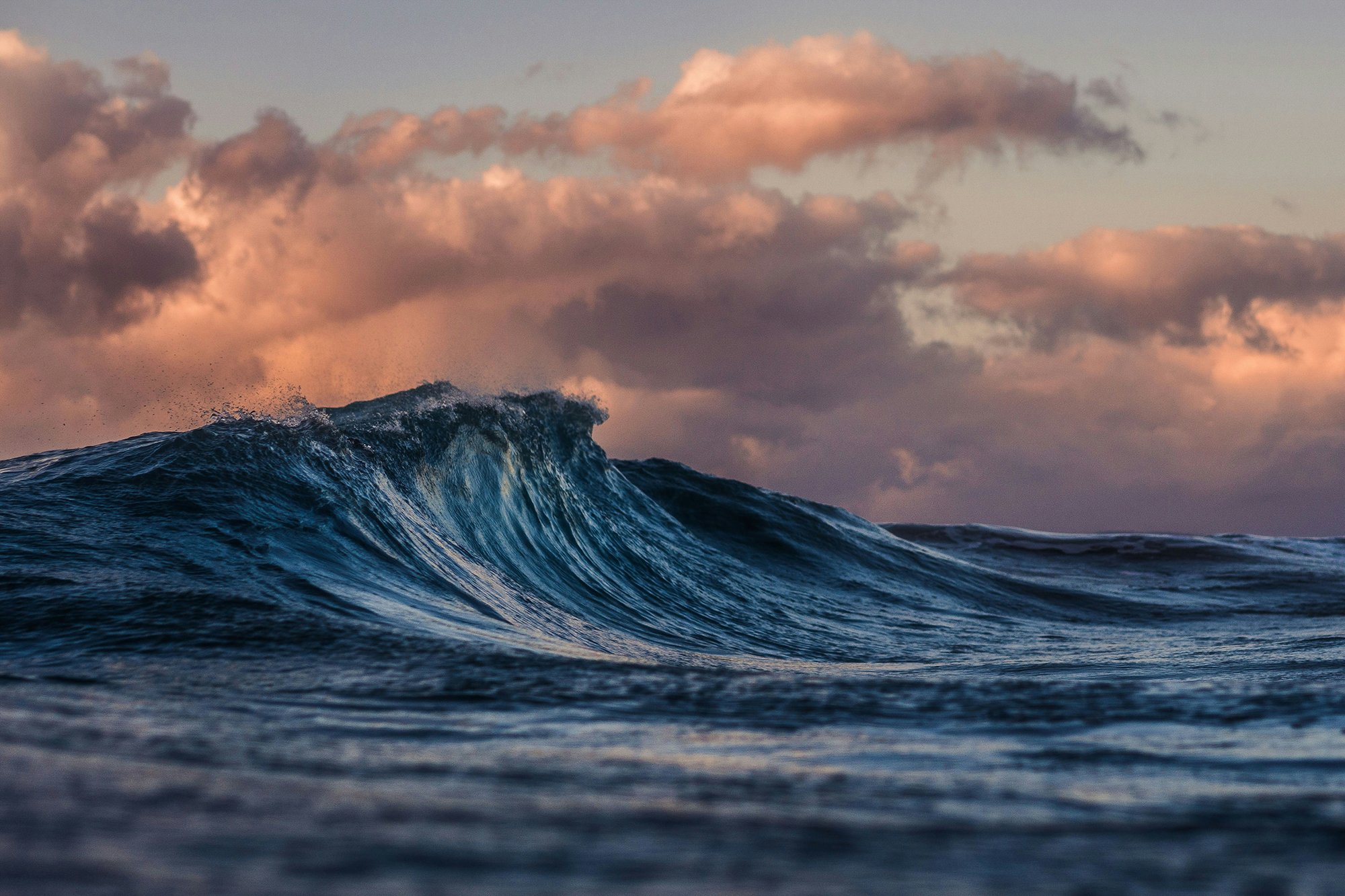
Rogue waves — rare waves much larger than any surrounding waves — have long been a part of sailors’ tales, but their existence has only been confirmed relatively recently. The exact mechanisms behind them are still a matter of debate. Laboratory experiments with mechanically-produced waves have created miniature rogue waves, but we still lack real-world observations of their formation.
To that end, researchers sailed the Southern Ocean, known for its rough waves, during austral winter and observed the state of the wind and waves nearby using stereo cameras. They found that young wind-driven waves tend to be steeper, and they move slower than the wind, as they’re still drawing energy from it. Older waves, in contrast, were shorter, less steep, and less likely have white caps from breaking. Overall, they found that strong winds could more easily drive young waves into the nonlinear growth that leads to rogue waves. (Image credit: S. Baisch; research credit: A. Toffoli et al.; via APS Physics)
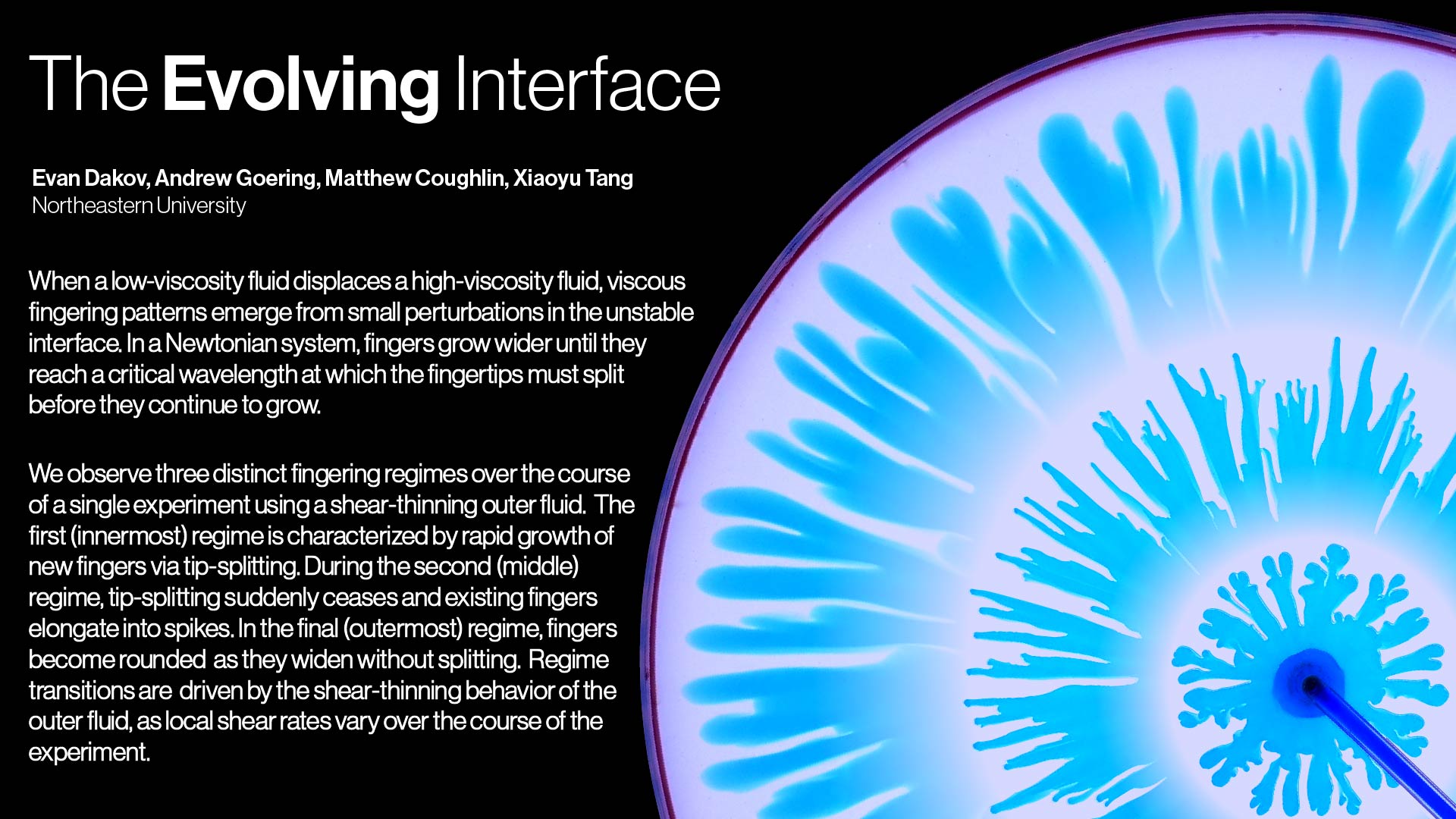
If you sandwich a viscous fluid between two plates and inject a less viscous fluid, you’ll get viscous fingers that spread and split as they grow. This research poster depicts that situation with a slight twist: the viscous fluid (transparent in the image) is shear-thinning. That means its viscosity drops when it’s deformed. In this situation, the fingers formed by the injected (blue) fluid start out the way we’d expect: splitting as they grow (inner portion of the composite image). But then, the tip-splitting stops and the fingers instead elongate into spikes (middle ring). Eventually, as the outer fluid’s viscosity drops further, the fingers round out and spread without splitting (outer arc of the image). (Image credit: E. Dakov et al.; via GoSM)


_(SN1987a-1).jpg)
