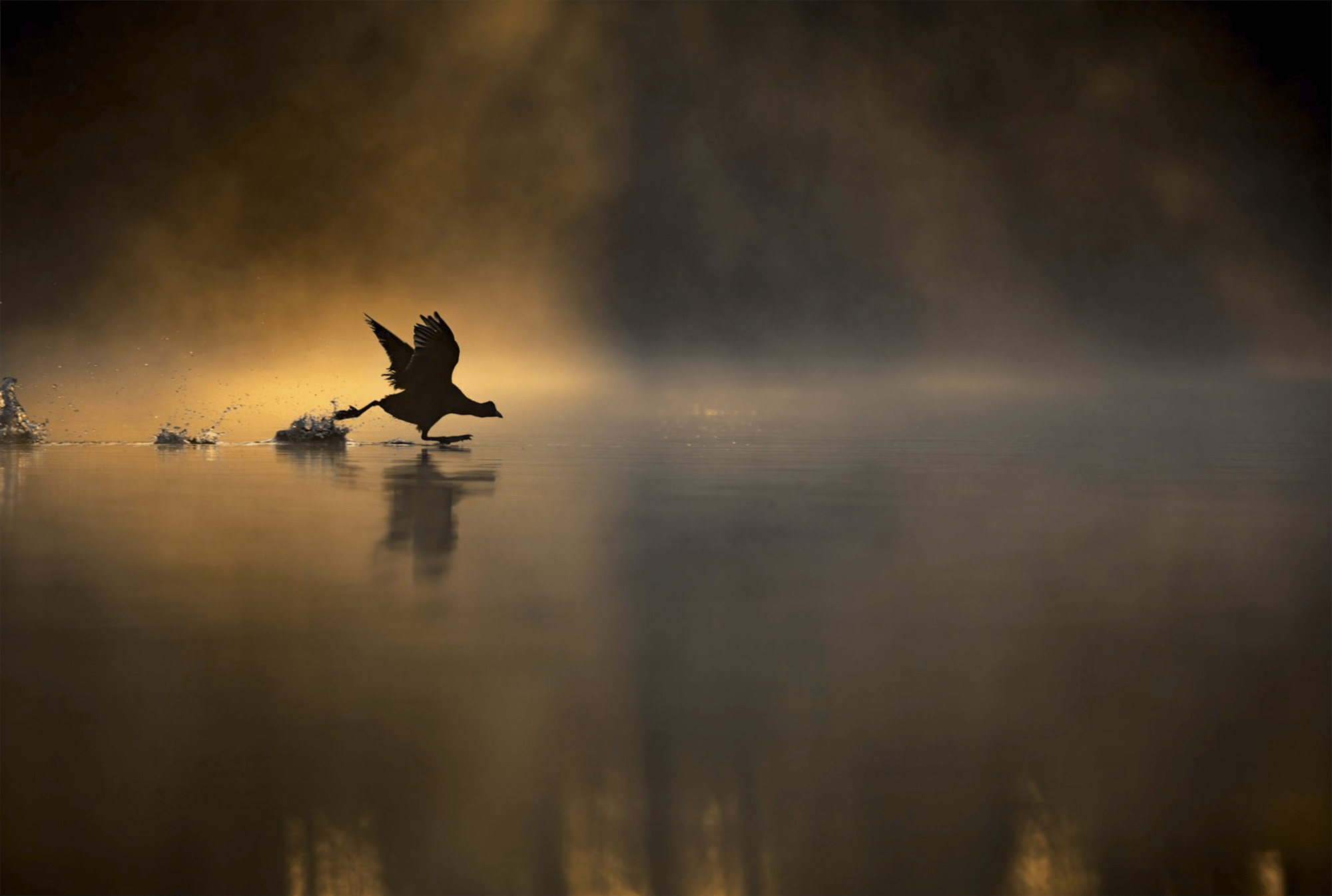
In the early morning light, young photographer Max Wood captured this coot escaping a fight. With wings flapping, the bird runs across the water surface. Each slap and stroke of a foot provides a portion of the vertical force needed to stay atop the water; lift from its wings provides the rest. With enough speed, the bird will take off. Some birds, however, are born water-walkers; certain species of grebe don’t need to use their wings to run on water. (Image credit: M. Wood; via BWPA)
Tag: physics

Our Sun’s Corona Unfurled
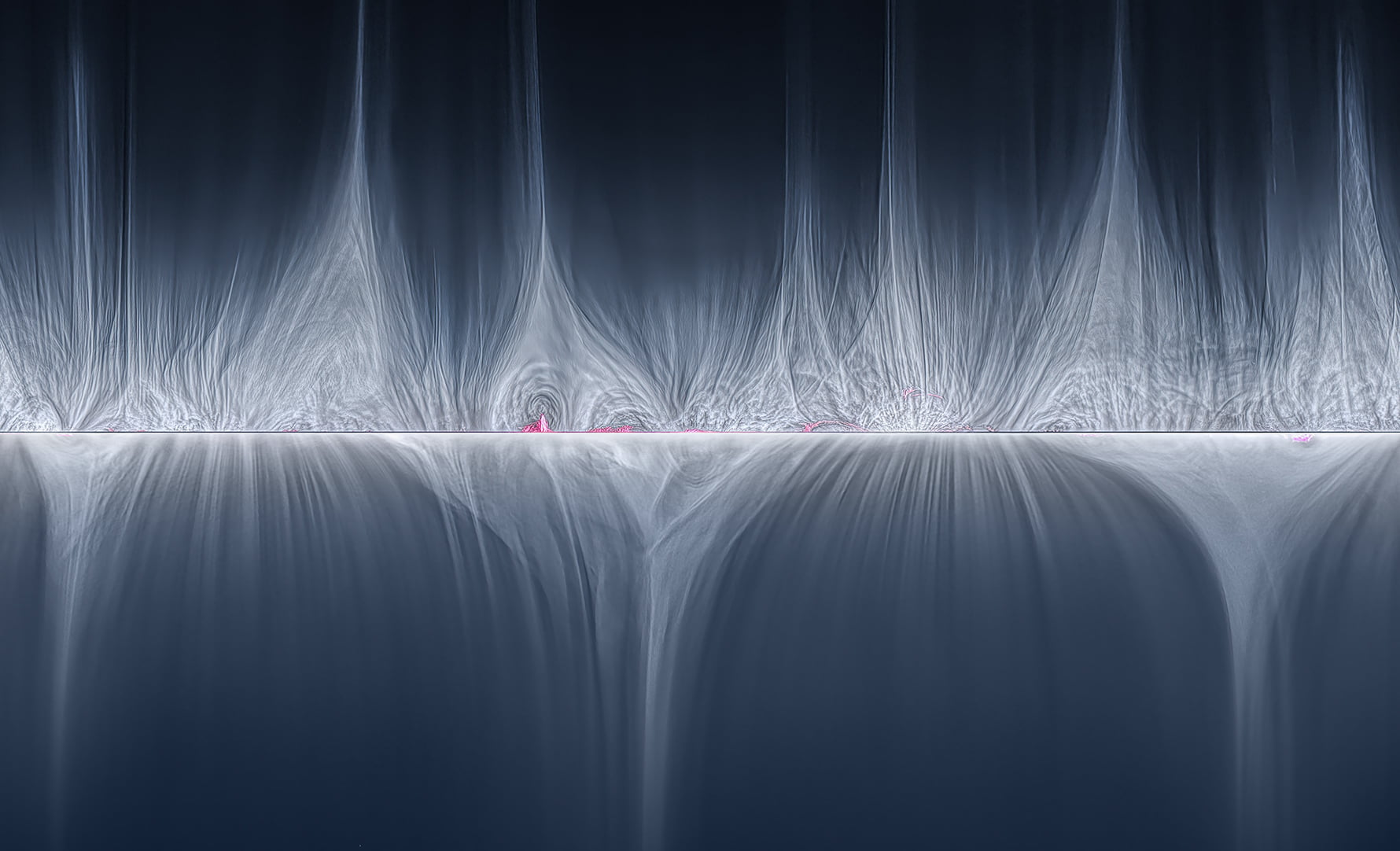
This clever image is actually two solar eclipses stacked atop one another. The bottom half of the image shows the sun‘s corona — its wispy, dramatic outer atmosphere — during the a 2017 total solar eclipse, and top half shows a 2023 total solar eclipse. In both, the corona has been unwrapped from around the sun’s circumference and project instead into a rectangle.
The 2017 eclipse took place near the minimum of the sun’s solar cycle and appears relatively tranquil. The 2023 eclipse, in contrast, came near solar cycle’s maximum and shows a far more chaotic and turbulent environment. Notice the bright pink solar prominences dotting the mid-line and the field of shadowy plasma loops above them. (Image credit: P. Ward; via APOD)

Microfluidics in Medicine
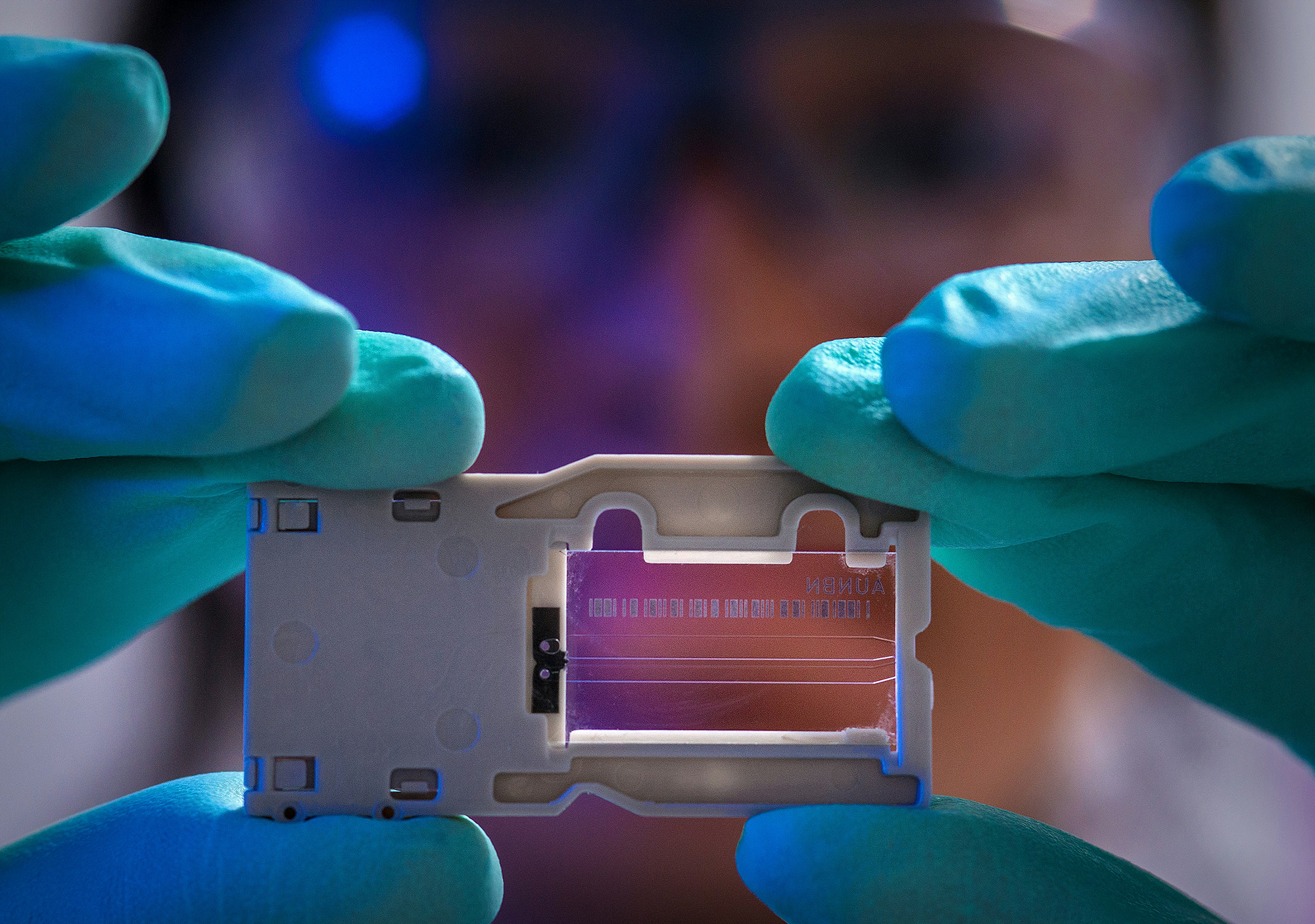
In the late 1990s and early 2000s, the Human Genome Project spent years decoding DNA from a handful of donors. The work was painstaking and slow, given DNA sequencing technology of the time. Today the same analysis goes much faster (and is much cheaper), thanks largely to microfluidic devices that automate steps that once had to be done by hand. Microfluidic devices have also made their way into medical diagnostics — pregnancy tests, at-home COVID tests, and blood glucose strips used by diabetics are common examples — as well as experimental biology. The Scientists has a nice review covering some of the many ways these devices have revolutionized the field. (Image credit: CDC; see also The Scientist; submitted by Marc A.)

Exciting a Flame in a Trough


A viewer sent Steve Mould his accidental discovery of this odd flame behavior. In these 3D-printed troughs, a flame lit in lighter fluid will rocket around the track repeatedly as it burns the local supply of gaseous lighter fluid. As Steve shows in his video, this system is an excitable medium and the trick works for a whole array of 3D-printed shapes. Check out the full video above. (Video and image credit: S. Mould)

Wind Sculptures


Vibrantly colored fabrics move in the breeze in artist Thomas Jackson’s outdoor installations. During the golden hours, he captures that movement in photographs like these. Jackson uses tulle, silk, and other everyday objects in his projects, and when finished, he takes a “leave no trace” approach, removing all materials and recycling them into new projects. Find more work on his website and Instagram. (Image credit: T. Jackson; via Colossal)

Gigapixel Supernova
Eleven thousand years ago, a star exploded in the constellation Vela, blowing off its outer layers in a spectacular shock wave that remains visible today. Today’s image is a piece of a 1.3-gigapixel composite image of the supernova remnant, captured by the Dark Energy Camera of the Víctor M. Blanco 4-meter Telescope at Cerro Tololo Inter-American Observatory in Chile. Below is a labeled version of the image, identifying the original star — now a fast-spinning pulsar that packs our sun’s mass into an object only kilometers across — its shock wave, and other features. To explore the full-sized image, see NOIRLab. (Image credit: CTIO/NOIRLab/DOE/NSF/AURA; via Colossal)

A labeled version of the image shows the shock wave and other features. How Ferns Spread Themselves


Ferns don’t rely on pollen and pollinators to spread. Instead, they use a little water and a lot of ingenuity, as shown in this video from Deep Look. Peer underneath a fern and you’ll find leaves dotted with spores. As they mature, water evaporates from the sporangium, eventually triggering a catapult that launches the spores. Those spores grow little gametophytes that produce the fern’s sperm and eggs; given a little rain or a nice puddle, the sperm and eggs can find each other and trigger the birth of a new baby fern. (Video and image credit: Deep Look)

Kelvin-Helmholtz and the Sun
Kelvin-Helmholtz instabilities (KHI) are a favorite among fluid dynamicists. They resemble the curls of a breaking ocean wave — not a coincidence, since KHI create those ocean waves to begin with — and show up in picturesque clouds, Martian lava coils, and Jovian cloud bands. The instability occurs when two layers of fluid move at different speeds and the friction between them causes wrinkles that grow into waves.
Scientists have long suspected that KHI could occur in solar phenomena, too, like the coronal mass ejections that drive space weather. The Parker Solar Probe, a spacecraft designed to explore the sun, caught evidence of a series of turbulent eddies during a 2021 coronal mass ejection, and a recent study of those observations shows that the series of vortices are consistent with KHI. Put simply, the team found that the features are spaced and aligned as we’d expect for KHI and, during the probe’s measurements, the features grew at the rate Kelvin-Helmholtz eddies would. Although the instability itself may be common in the sun’s corona, it’s unlikely that we’ll see it often, simply because conditions need to be just right for them to be visible. (Image credit: NASA/Johns Hopkins APL/NRL/Guillermo Stenborg and Evangelos Paouris; research credit: E. Paouris et al.; via Gizmodo)
Fediverse Reactions
-

“Bulging Balloons”
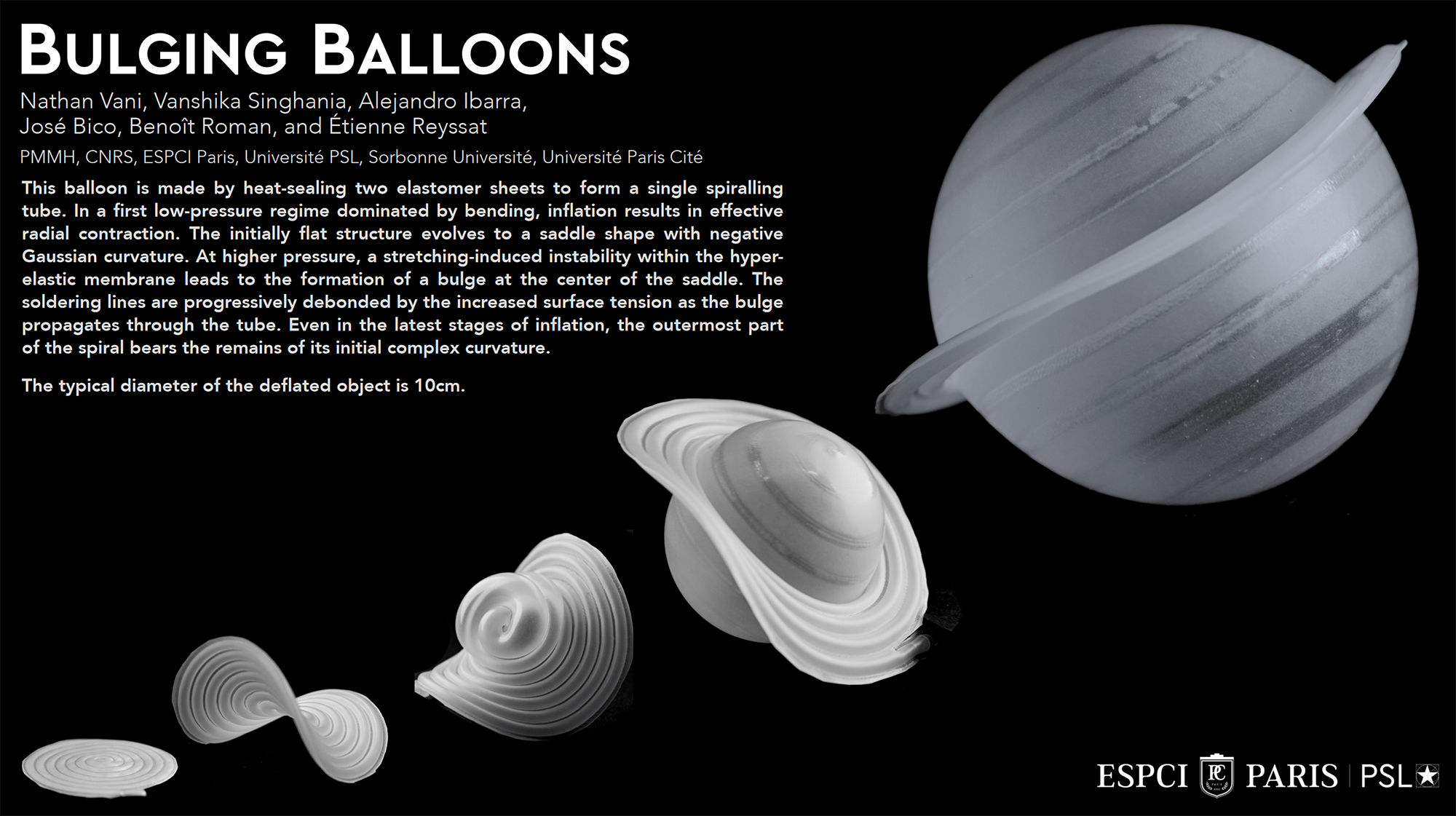
This planet-like balloon started out as two elastomer sheets, heat-sealed together into a spiraling tube. As the balloon was inflated, it changed from flat to a saddle-like shape. With more air, the pressure inside increased, triggering an instability that caused the middle of the balloon to bulge. As inflation continued, the central bulge expanded, unbonding layer after layer of the seal. Even late in inflation, the balloon maintains hints of its original shape in the form of a ring around the Jovian bulge in the middle. (Image credit: N. Vani et al.)
Fediverse Reactions
-
“Serenity”


Peering from directly above, landscapes take on a whole different aspect. That idea is the heart of Vadim Sherbakov’s “Serenity,” filmed by drone. From seething waters and meandering rivers to eroded landscapes and twisting ice, there’s lots of fluid dynamics on display here. (Video and image credit: V. Sherbakov)
Fediverse Reactions
-