Printed pages from inkjet printers tends to curl up over time. Researchers found that this long-term curl correlates with the migration of glycerol — one of the solvents used in inkjet ink — through the paper’s fiber layers toward the unprinted side. The glycerol migration makes the cellulose fibers in the paper swell up, causing the curl. Changing the solvent used in inkjet inks could stop the curl but would likely lead to printing issues, since the glycerol helps the tiny droplets wind up in the right place on the page. Another solution? Print on both sides of the page! (Image credit: Lunghammer – TU Graz; research credit: A. Maass and U. Hirn; via Physics World)
Tag: physics

Bubbles Encased in Ice
If you’ve ever made ice in a freezer, you’ve probably noticed the streaks of frozen bubbles inside the ice. In its liquid state, water is good at dissolving various gases — like the carbon dioxide in sparkling water. During freezing, though, those gases cannot remain in solution; the water simply doesn’t have space between its crystalline ice lattice for non-water molecules. So the gases are forced out of solution, where they form bubbles. The final shape of the frozen bubble depends on the interplay between the speed of a bubble’s growth and how quickly the ice freezes. Here, the researchers used polarized light to outline the bubbles in color, highlighting the wide array of possible shapes. (Image credit: J. Meijer and D. Lohse; via GoSM)

How Moths Confuse Bats
When your predators use echolocation to locate you, it pays to have an ultrasonic deterrence. So, many species of ermine moths have structures on their wings known as tymbals. These areas have a band of ridges, and, when the moth’s wing lifts or falls, the ridges buckle one-by-one. A nearby bald patch on the wing acts as an amplifier, making these ultrasonic snaps louder. Altogether, the mechanism deters prowling bats anytime the moth flaps its wings — without any additional effort on the moth’s part. Since the moths have no ears, they presumably don’t even know that they’re making the sound! (Image credit: Wikimedia/entomart; research credit: H. Mendoza Nava et al.; via APS Physics)

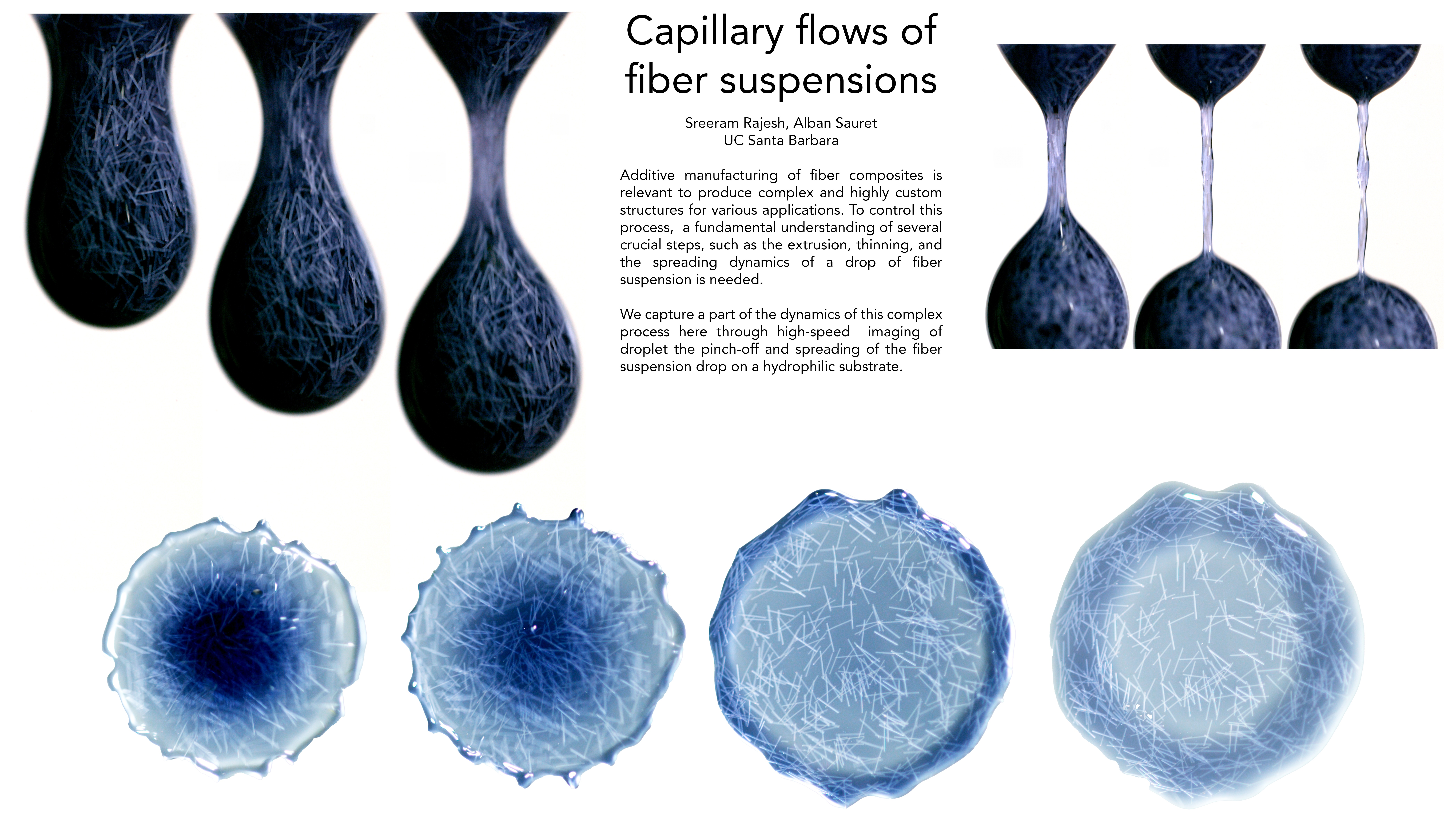
Drops of Fiber Suspensions
To 3D print with fiber-infused liquids, we need to understand how these drops form, break-up, and splash. That’s the subject of this research poster, which shows drops of a fiber suspension forming and pinching off along the top of the image. In the lower half of the image, drops of the suspension hit a hydrophilic surface and spread. How the drop and its fibers spread will affect the final properties of the printed material. (Image credit: S. Rajesh and A. Sauret; via GoSM)

“Ferro Field”
Ferrofluid forms a labyrinth of blobs and lines against a white background in this award-winning photo by Jack Margerison. Ferrofluids are a magnetically-sensitive fluid, typically created by suspending magnetic nanoparticles in oil. Depending on the ferrofluid’s surroundings that and the applied magnetic field, all sorts of patterns are possible from spiky crowns to wild mazes. (Image credit: J. Margerison from CUPOTY; via Colossal)

Floating in Sync


Objects on a vibrating liquid bath can interact with each other through the waves they make as they bounce. Here, researchers look at three-armed spinners interacting in pairs and in larger groups. A pair of spinners can synchronize so that they spin together or so that they spin in opposing phases. With more spinners, more complex patterns are possible. The spinners can even “freeze” one another by forming a pattern of standing waves that keep them locked in their orientation. (Video and image credit: J. Barotta et al.; via GoSM)

Mimicking Plant Movement
Many plants control the curvature of their leaves by selectively pumping water into cells that line the outer surface. This swelling triggers bending. Engineers created their own version of this structure by 3D-printing trapezoidal shapes onto a fabric. Then, they heat sealed a second layer of fabric over this, creating airtight channels. When inflated, these channels make the structure bend, allowing them to create complex shapes by selectively inflating different areas. (Image credit: T. Gao et al.; via GoSM)
The Channel Tunnel


To celebrate the 30th anniversary of the Channel Tunnel, Practical Engineering takes a look back at the construction and operation of this incredible piece of infrastructure. This 30-mile-long underwater tunnel began construction in the 1980s, using giant Tunnel Boring Machines to drill out three tunnels, starting from either side and, incredibly, meeting in the middle. All that construction underground (and underwater) is no simple feat, as Grady discusses. He also takes a look at some of the operational challenges of the design, including managing heat and air pressure build-up. (Image and video credit: Practical Engineering)

Reapproaching Supersonic Air Travel
Before the Concorde even began regular flights, protests over its sound levels caused the U.S. and many other countries to ban overland commercial supersonic flight. Those restrictions have stood for fifty years. But NASA and Lockheed Martin Aeronautics are hoping to make supersonic air travel a possibility again with their experimental X-59 aircraft, designed to have a much quieter sonic boom.
In supersonic flight, every curve, bolt, and bump generates a shock wave, and these waves tend to coalesce at the front and back of the aircraft, creating strong leading and trailing shocks. It’s these shock waves that are responsible for the double sonic boom that rattles windows and startles those of us on the ground. The X-59 reduces its noise by spreading out those shock waves, a feat designers managed with heavy reliance on computational fluid dynamics. They used wind tunnel studies mainly for validation, since iterating designs in the wind tunnel was far slower than working computationally. With the initial aircraft built, the team will now do test flights and, starting in 2026, will fly over the public and solicit feedback on whether the aircraft is acceptably quiet. (Image credit: NASA; via Physics Today)

The sound of the X-59’s sonic boom compared to other familiar sound levels. “Color Show”


Brightly colored paints and inks mix and flow in artist Roman De Giuli’s “Color Show.” De Giuli typically creates this fluid art in thin layers atop paper. He’s a master of the form, manipulating surface tension gradients to create streaming flows, dendritic patterns, and feathery wisps. If this kind of art is your jam, he offers an app full of live wallpapers* for Android phones. See more of his work on his website and on Instagram. (Video and image credit: R. De Giuli)
*Not sponsored, I just like his art!