Bernoulli’s principle describes the relationship between pressure and velocity in a fluid: in short, an increase in velocity is accompanied by a drop in pressure and vice versa. This photo shows the results left behind by oil-flow visualization after subsonic flow has passed over a cone (flowing right to left). The orange-pink stripes mark the streamlines of air passing around the Pitot tube sitting near the surface. The streamlines bend around the mouth of probe, leaving behind a clear region. This is a stagnation point of the flow, where the velocity goes to zero and the pressure reaches a maximum. Pitot tubes measure the stagnation pressure, and, when combined with the static pressure (which, counterintuitively, is the pressure measured in the moving fluid), can be used to calculate the velocity or, for supersonic flows, the Mach number of the local flow. (Photo credit: N. Sharp)
Tag: physics

Falcon vs. Raven
Earth Unplugged has posted some great high-speed footage of a peregrine falcon and a raven in flight. Notice how both birds draw their wings inward and back on the upstroke. By doing so, they decrease their drag and thus the energy necessary for flapping. On the downstroke, they extend their wings fully and increase their angle of attack, creating not only lift but thrust. The falcon boasts an incredibly streamlined shape, not only along its body but also along its wings. In contrast, the raven has broader wings with large primary feathers that fan out near the tips. Splaying these large feathers out decreases the strength of the bird’s wingtip vortices, thereby reducing downwash and increasing lift, much the same way winglets do on planes. That extra lift and control the big primaries provide is important for the raven’s acrobatic skill. (Video credit: Earth Unplugged; via io9)

101 Signals
Welcome, Wired readers! I’m stunned, honored, and very grateful to see FYFD featured on this year’s 101 Signals science recommendations, especially given how much I admire many of the others on that list! The premise of FYFD is simple: every weekday I post a new photo or video and a brief explanation of the fluid dynamics and physics therein. Topics include everything from chip-sized microfluidics to astrophysics, from super-slow-moving flows to hypersonic planetary re-entry, from the aerodynamics of cycling to the bizarre behavior of cyrogenic superfluids. You can find a little bit of just about anything here. Jump into the visual archive and take a look around. I’m also always happy to answer reader questions on Tumblr or by email. Happy reading! – Nicole
Vibrating Droplets
When still, water drops sitting on a surface are roughly hemispherical, drawn into that shape by surface tension. But on a vibrating surface, the same water drop displays many different shapes, like those in the video above. Researchers have observed more than 30 different mode shapes by varying the driving frequency. The metal mesh placed beneath the glass on which the drops sit helps the researchers determine the drop’s shape. As the drop deforms, the mesh appears to distort due to the refraction of light through the changing shape of the drop’s water-air interface. The distortion allows observers to visualize (and in some experiments even reconstruct) the shape of the drop’s surface. Understanding this kind of droplet behavior is valuable for many applications, including ink-jet printing and microfluidic devices. (Video credit: C. Chang et al.; via Science)

Elastic Walls and Viscous Fingers
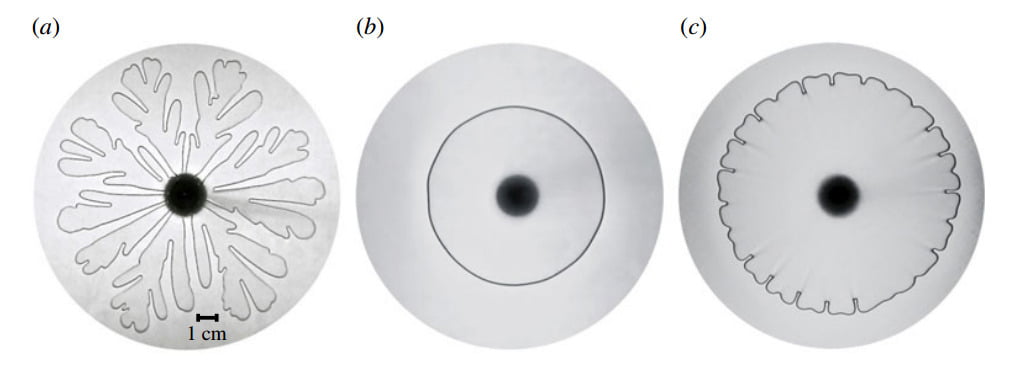
The Saffman-Taylor instability, characterized by the branchlike fingers formed when a less viscous fluid is injected into a more viscous one, is typically demonstrated between two rigid walls, as in part (a) of the figure above. But what happens if one of the rigid walls forming the Hele-Shaw cell is replaced with an elastic wall? This is the case for (b) and (c) in the figure. The flexibility of the wall causes the expansion of the air-fluid interface to slow down relative to the rigid wall case and causes the interface to move toward a narrowing fluid-filled gap (as opposed to a constant thickness one). Both of these effects reduce the viscous instability mechanism that drives the fingering instability. With a high enough mass flow rate as in ©, there is still some instability in the interface, but it is dramatically reduced. (Photo credit: D. Pihler-Puzovic et al.)
Granular Gases
Vibrating particles or granular materials can produce many fluid-like behaviors. In this video, researchers demonstrate how a granular gas made up of particles of two sizes behaves at different conditions. By tweaking the amplitude of the vibration, they alter how the particles cluster in a divided container. At large vibrational amplitudes, the particles behave much like a gas–energetic and spread out. At lower amplitudes, though, the particle density and the number of particle collisions increases. Each collision dissipates some of a particle’s energy; more collisions means less energy available to escape. As a result, the particles cluster, forming an attractor that draws in additional particles over time. (Video credit: R. Mikkelson et al.)
Rebounding Off Dry Ice
Droplet rebound is frequently associated with superhydrophobic surfaces but can also be generated by very large temperature differences. For very hot substrates, a thin layer of the drop vaporizes on contact via the Leidenfrost effect and helps a drop rebound by preventing it from wetting the surface. This video shows almost the opposite: a water droplet hitting solid carbon dioxide (-79 degrees C). Upon contact, the solid carbon dioxide sublimates, creating a thin layer of gas that separates the droplet from the surface. You can also see the vortex ring that accompanies the drop’s impact. Water vapor near the carbon dioxide surface has condensed into tiny airborne droplets that act as tracer particles that reveal the vortex’s formation and the rebounding droplet’s wake. (Video credit: C. Antonini et al.; Research paper)
Navigating the Interface
Walking on water may be the stuff of legend at human scales, but it’s a fact of everyday life for many smaller species. Waxy, hydrophobic coatings typically make such insects’ points of contact (feet, legs, etc.) water-repellent, and their light weight can be supported by surface tension. Navigating the interface between air and water is more complicated, though, and these creatures have evolved several mechanisms to help. Some, like water striders, use appendages they insert below the surface for propulsion. At 0:49 in the montage above, you can see flow visualization of the vortices generated by a stroke. Other insects release a chemical in their wake that lowers the local surface tension and drives them away via the Marangoni effect. For more, see here and especially this Physics Today article. (Video credit: D. Hu and J. Bush)

Fluids Round-up – 11 August 2013
Time for another fluids round-up! Here are your links:
- Back in January 1919, a five-story-high metal tank full of molasses broke and released a wave of viscous non-Newtonian fluid through Boston’s North End. Scientific American examines the physics of the Great Molasses Flood, including how to swim in molasses. If you can imagine what it’s like to swim in molasses, you’ll know something of the struggle microbes experience to move through any fluid. They also discusses some of the strange ways tiny creatures swim.
- In sandy desert environments, helicopter blades can light up the night with so-called helicopter halos. The effect is similar to what causes sparks from a grinding wheel. Learn more about this Kopp-Etchells effect.
- Check out this ominous footage of a tornadic cell passing through Colorado last week.
- If you want more of a science-y look to your drinkware, you should check out the Periodic TableWare collection over on Kickstarter.
- Finally, wingsuits really take the idea of gliding flight to some crazy extremes. Check out this video of in-flight footage. Watch for the guy’s wingtip vortices at 3:16 (screencap above)! (submitted by Jason C)
(Photo credit: Squirrel)
Contaminants Flowing Uphill
Here’s an example of some baffling fluid dynamics. Researchers have found that, when pouring a fluid from one container into a lower one containing a fluid with floating particulates, it’s possible for the floating particles to travel upstream against gravity and the flow. The phenomenon is driven by surface tension. The particulates floating in the lower container decrease the fluid’s surface tension relative to the pure fluid pouring in from above. This creates a gradient in surface tension that, via the Marangoni effect, drives a small flow upstream, in the direction of the greater surface tension. In the video above, this flow takes the form of two recirculating vortices in the pouring channel, oriented such that their upstream velocities run along the outside of the channel. Occasionally this flow draws particulates up the waterfall and into the recirculating zones, creating upstream contamination. We reported this previously, but the researchers have now released videos demonstrating the effect, including in pipettes and a water flume. Usually it’s taken for granted that matter cannot move upstream, so this could be a game-changer, especially at small scales where surface tension already dominates. For more, see their paper. (Video credit: S. Bianchini et al.)