Tag: numerical simulation

  • Prehistoric Filter Feeders

    Prehistoric Filter Feeders

    Earth’s earlier ages are filled with enduring mysteries about the plants and creatures that lived and died long before humanity. Many of these organisms, like the aquatic Ernietta shown above, are known only from scattered fossil remains. Yet fluid dynamics is helping us understand how Ernietta lived and fed some 545 million years ago.

    Ernietta were sack-like organisms consisting of stitched-together tubular elements. They had no way to move around and no obvious method for transporting nutrients into their bodies. Scientists hypothesized that they likely used one of two feeding methods: either Ernietta relied on its surface area to extract nutrients directly from the water or its shape enabled it to trap larger particles to feed on from the flow. To decide between these modes, scientists turned to computational fluid dynamics.

    By modelling both single Ernietta and small groups, they found that the shape of the organism generates a rotating current inside the bag that pulls flow down along one side and back up the other. Moreover, being near one another enhanced this effect, helping downstream Ernietta catch more particles than they otherwise would. All in all, the results suggest not only Ernietta’s likely feeding method but also that they lived in colonies and practiced one of the earliest known examples of communal feeding! (Image credit: D. Mazierski, source; research credit: B. Gibson et al.; via ArsTechnica; submitted by Kam-Yung Soh)

  • Urban Centers During Hurricanes

    Urban Centers During Hurricanes

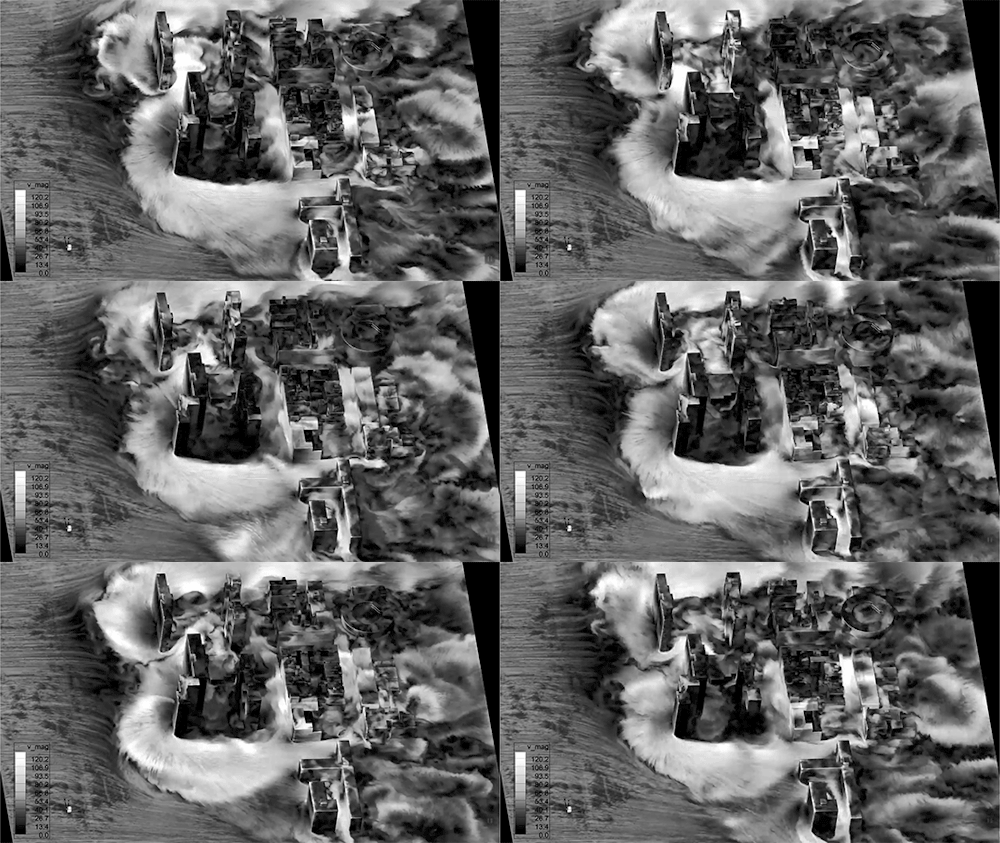
    As the climate warms, many urban centers are facing stronger and more frequent storms. Some, like New York City, are using numerical simulations to better understand the interactions of their complicated urban geometries with hurricane force winds. 

    Above you see a simulation showing predicted wind speeds in a Lower Eastside neighborhood. The incoming wind speed (from the left) is roughly 60 m/s (~134 mph), but the speeds around and between buildings are as much as 2 times higher than that. That means that, even if a storm is Category 3 or 4, there will be areas of a neighborhood that receive sustained winds well beyond the range of a Category 5 hurricane. Urban planners need this sort of data both for devising building requirements and for understanding what storm conditions warrant mandatory evacuations for residents. (Video and image credit: X. Jiang et al.)

  • Earth, Moon, and Magma Ocean

    Earth, Moon, and Magma Ocean

    Among objects in our solar system, the Moon is rather unusual. It’s the only large moon paired with a rocky planet, and only Pluto’s Charon boasts a larger size relative to its planet. Chemically speaking, the Moon is also extremely similar to the Earth, which is part of why scientists theorized that the moon coalesced after the proto-Earth collided with a Mars-sized object. But lingering questions remained, like why the Moon is rich in iron oxide compared to the Earth.

    A new study tweaks the idea of the giant impactor by adding a magma ocean to the proto-Earth. In the early days of the solar system, collisions were so common that larger bodies (> 2*Mars) probably maintained a molten ocean. By simulating collisions with and without a magma ocean and studying the final composition of these simulated Earth-Moon-systems, the researchers found that a molten ocean not only matches the expected size and orbital characteristics of the two bodies, but the results reflect the actual chemical make-up of the  real Earth and Moon, too! (Image credits: moon – N. Thomas, impact simulation – N. Hosono et al.; research credit: N. Hosono et al.; via Ars Technica; submitted by Kam-Yung Soh)

  • Anak Krakatoa Tsunami

    Anak Krakatoa Tsunami

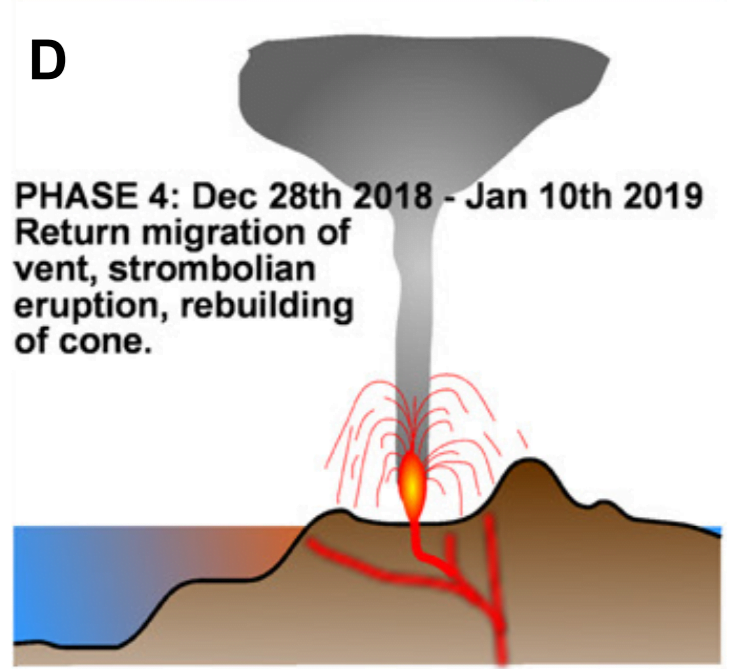
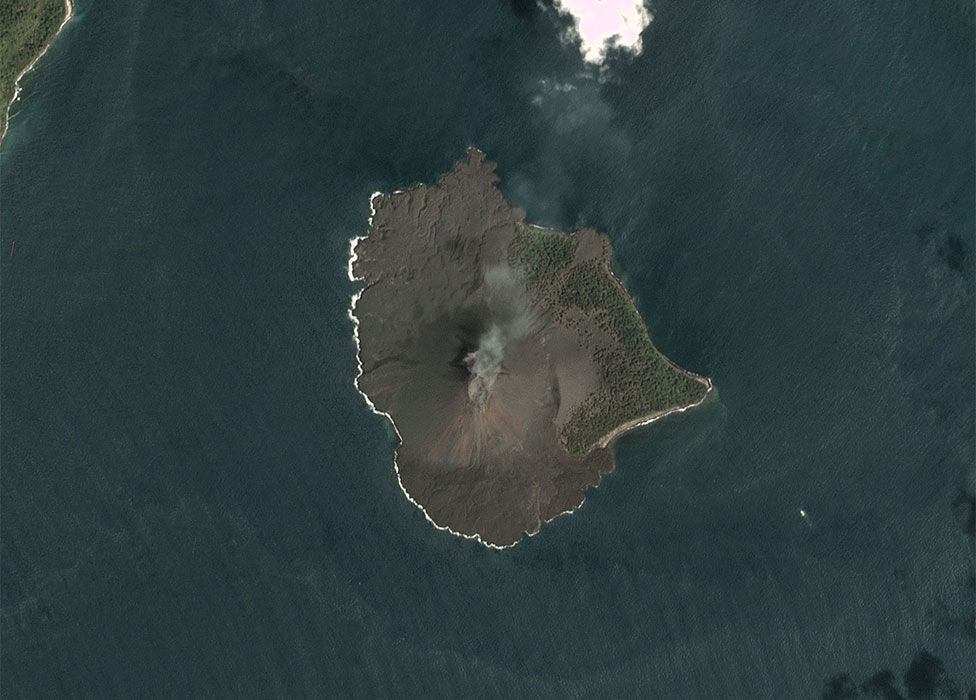
    In late December 2018, a landslide on the island Anak Krakatoa triggered a deadly tsunami in Indonesia. The island (upper left, pre-landslide) lost an estimated 300 meters of height in the landslide, dramatically altering its appearance (upper right; post-landslide). Much of the slide occurred underwater, dumping material into a crater left by the famous 1883 eruption of Krakatoa

    The slide displaced a massive amount of water, creating a tsunami that spread, refracting around nearby islands and reflecting off shorelines in complicated patterns. A new numerical simulation, shown above, models the post-slide tsunami based on terrain data and fluid physics. Its wave predictions match well with the high-water readings from nearby islands. The scientists hope that such models, combined with monitoring, will help save lives should a future eruption trigger more tsunamis.

    For a full picture of both the recent Anak Krakatoa eruption and its famous predecessor, check out this video. (Image credits: satellite views before and after landslide – Planet Labs; simulation – S. Ward, source; via BBC News; submitted by Kam-Yung Soh)

  • Featured Video Play Icon

    Breaking

    As waves fold over and break, they trap air, creating bubbles of many sizes. The smallest of these bubbles can be only a few microns across and persist for long times compared to larger bubbles. When they burst, they create tiny droplets that can carry sea salt up into the atmosphere to seed rain. Understanding how these bubbles form and how many there are of a given size is key to predicting both oceanic and atmospheric behaviors. Numerical simulations like the one featured in the video above reveal the dynamic collisions that create these tiny bubbles and help researchers learn how to model the tiniest bubbles so that future simulations can be faster. (Image and video credit: W. Chan et al.)

  • Coalescence at the Smallest Scales

    Coalescence at the Smallest Scales

    The coalescence of two water droplets happens so quickly, it’s essentially impossible to see, even with high-speed cameras. For this reason, researchers have turned to simulating molecular dynamics – essentially building computer programs that model the actions of all the molecules contained in the water droplets. Viewed this way, the very first contact between drops comes from thermal fluctuations – the random jumping of molecules across the separating gap. Once the bridge starts to form, it continues to grow, driven by thermal forces and opposed by surface tension. Eventually, this thermal regime gives way to the more familiar hydrodynamic one, where the bridge is large enough for flow to drive its growth. (Image credits: experiment – S. Nagel et al.; simulation – S. Perumanath et al.; research credit: S. Perumanath et al.; submitted by Rohit P.)

  • Sorting Blood Cells

    Sorting Blood Cells

    Many diseases – like sickle-cell anemia and malaria – are accompanied by changes in the stiffness of red blood cells. And while microfluidic devices capable of sorting blood cells by size exist, few have made microfluidic devices capable of sorting blood cells by their deformability. But a new set of simulations suggests we could do so relatively easily.

    Existing devices sort blood cells by size using an array of tiny posts – kind of like a cellular pachinko machine. Through simulation, researchers found that by changing the shape of these posts – specifically by turning them from circles into sharper triangles –  they could sort the red blood cells by their stiffness. Because the sharp corners create large local stresses in the fluid, the blood cells get deformed when passing the corner. That ends up deflecting stiffer cells into a different stream. Build a whole array of posts and you can sort the blood cells by their degree of stiffness – ideally allowing you to isolate the most diseased cells. (Image and research credit: Z. Zhang et al.; via APS Physics)

    ETA: Added a clarification: some researchers, like Beech et al., have investigated deformability-based sorting devices.

  • Simulating Solar Flares

    Simulating Solar Flares

    Few topics in fluid dynamics are more mathematically complicated than magnetohydrodynamics – the marriage between electromagnetism and fluids. That mathematical complexity, along with the vast range of scales necessary to describe physical systems like our sun, means that, until now, researchers had to simplify their assumptions when simulating solar physics. But now, for the first time, a group has built a comprehensive, three-dimensional simulation capable of generating realistic solar flares. This is what you see above.

    Solar flares occur when a tangle of magnetic loops near the sun’s surface break and reconnect, releasing enormous magnetic energy and spewing a fountain of ionized plasma into the corona. They’re a danger particularly to satellites in orbit, so being able to simulate these events realistically is a major advance toward understanding the physics of space weather. (Image and video credit: NCAR & UCAR Science; research credit: M. Cheung et al.; via Bad Astronomy; submitted by Kam-Yung Soh)

  • Inside a Heart

    Inside a Heart

    You may not give it much thought, but there is important fluid dynamics happening inside you every moment of every day, especially inside your heart. Of the four chambers of the heart, the left ventricle has the thickest walls, reflecting its important task: pumping oxygenated blood throughout the body. In a healthy heart (top of poster; click here for the full-size version), a vortex ring and trailing jet fill the ventricle when the mitral valve opens. Then the ventricle contracts and pumps blood out the aortic valve and into the rest of the body.

    But for individuals with a leaking aortic valve (bottom of poster), things look different. Blood leaks back through the aortic valve at the same time that the mitral valve opens to allow freshly oxygenated blood back in. The two inflows disrupt mixing in the chamber, and, instead of pumping fully-oxygenated blood into the body, the left ventricle has to struggle to pump a less-oxygenated mixture into the body. (Image credit: G. Di Labbio et al.)

    ETA: (Research paper: G. Di Labbio et al., arXiv)

  • Growing Droplets

    Growing Droplets

    The moisture in clouds eventually condenses into droplets that grow into raindrops and fall. Some steps in this process are well understood, but others are not. In particular, scientists have struggled with the problem of how droplets grow from about 30 microns to 80 microns, where they’re big enough to start falling and merging.

    Laboratory experiments and numerical simulations (below) have shown that turbulence can help drive small water drops together. When droplets are tiny and light, they simply follow the air flow. But when they’re a little heavier, turbulent eddies (seen in orange below) act like miniature centrifuges, flinging larger water droplets (shown in cyan below) out into clusters, where they’re more likely to collide with one another.

    Although this effect has been seen in experiments and simulation, it’s been difficult to capture in clouds themselves. But a new set of test flights (above) confirms that this mechanism is present in the wild as well! (Image credit: UCAR/NCAR Earth Observing Laboratory, P. Ireland et al., source; research credits: M. Larsen et al., P. Ireland et al.; via APS Physics; submitted by Kam-Yung Soh)

    image