Tag: numerical simulation

  • Inside Avalanches

    Inside Avalanches

    Avalanches have traditionally been difficult to model and predict because of their complex nature. In the case of a slab avalanche, the sort often triggered by a lone skier or hiker, there is a layer of dense, cohesive snow atop a layer of weaker, porous snow. The presence of the skier can destabilize that inner layer, causing a fracture known as an anticrack to propagate through the slab. Eventually, it collapses under the weight of the overlying snow and an avalanche occurs.

    What makes this so complicated is that the snow behaves as both a solid – during the initial fracturing – and as a fluid – during the flow of the avalanche. Researchers are making progress, though, using new models capable of simulating the full event (shown above) by leveraging techniques developed and used in computer animation for films. That’s right – the physics-based animation used in films like Frozen is helping researchers understand and predict actual avalanche physics! (Image and research credit: J. Gaume et al.; via Penn Engineering; submitted by Kam-Yung Soh)

  • Merging Black Holes

    Merging Black Holes

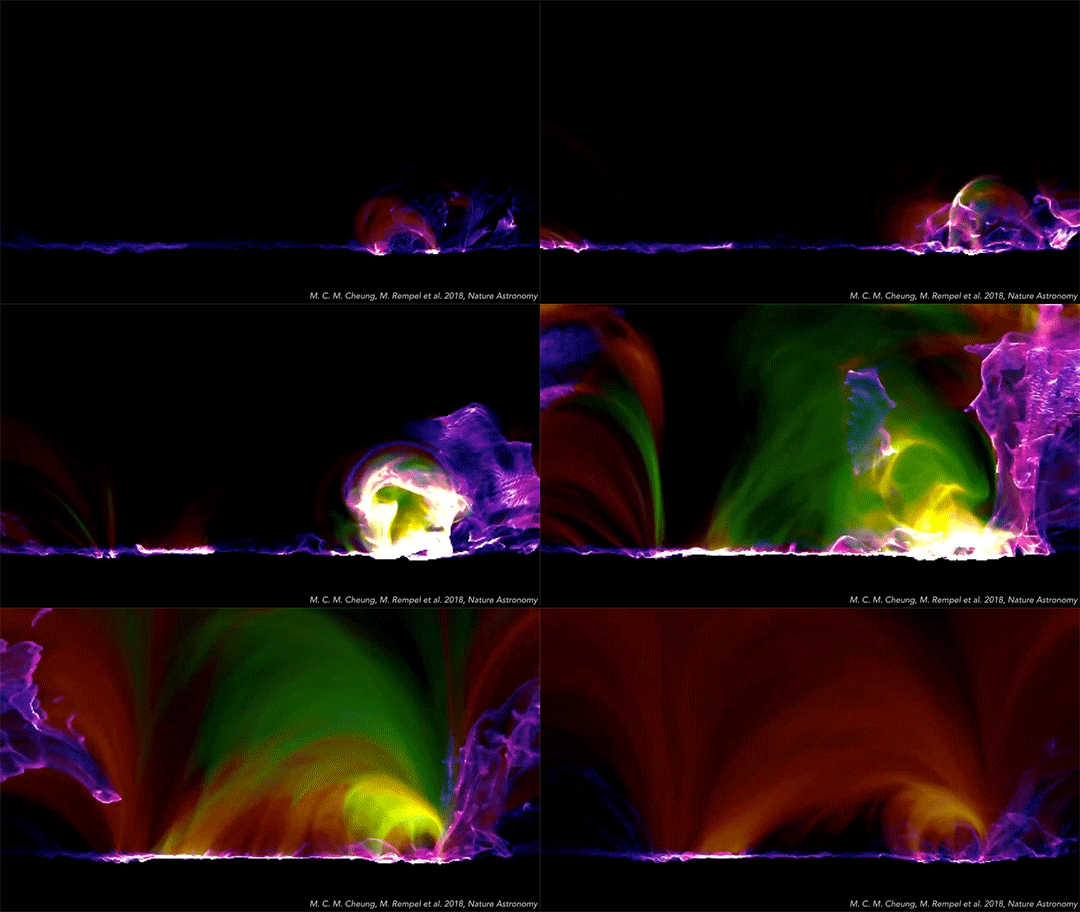
    At the heart of many galaxies, including our own, lies a supermassive black hole millions of times the mass of our sun. Scientists have yet to observe the merger of two such black holes, but using simulations, they are trying to learn what such collisions might look like. Simulations like the one shown here require combining relativity, electromagnetism, and, yes, fluid dynamics to capture what happens during the in-spiral.

    Supermassive black holes like these are surrounded by gas disks that flow around them. Magnetic and gravitational forces heat the gas, causing it to emit UV light and, at times, high energy X-rays, both of which may be observable.

    Gravitational wave detectors, similar to LIGO, may also measure evidence of supermassive black hole mergers, but physicists expect that will require a next-generation observatory, like the space-based LISA to be launched in the 2030s.   (Image and video credit: NASA Goddard; research credit: S. d’Ascoli et al.; submitted by @lh7)

  • The Protection of the Peloton

    The Protection of the Peloton

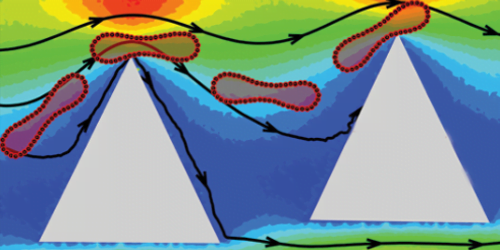
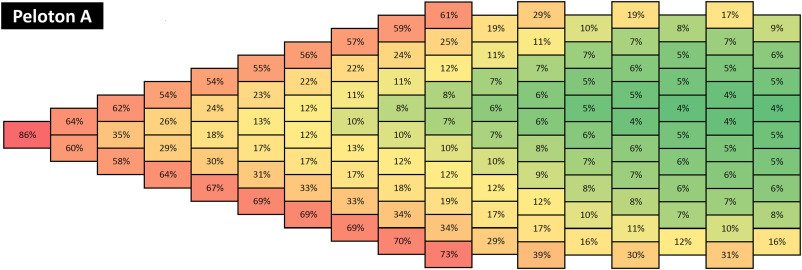
    It’s well-known by professional cyclists that sitting in the middle of the peloton requires little effort to overcome aerodynamic drag, but now, for the first time, there’s a scientific study to back that up. Researchers built their own quarter-scale peloton of 121 riders to investigate the aerodynamic effect of cycling in such a large group versus riding solo. Through wind tunnel studies and numerical simulation, they found that riders deep in the peloton can experience as little as 5-10% of the aerodynamic drag of a solo cyclist. 

    Tactically, this means teams should aim to position their protected leader or sprinter mid-way in the pack, where they’ll receive lots of shelter without risking one of the crashes common near the back of the peloton. It also suggests that teams wanting to isolate another team’s leader should try to push them toward the outer edges of the peloton rather than letting them sit in the middle. It will be interesting to see whether pro teams shift their race strategies at all with these numbers in hand.

    Of course, this study considers only a pure headwind. But other groups are looking at the effects of side winds on cyclists. (Image credit: J. Miranda; image and research credit: B. Blocken et al.; submitted by 1307phaezr)

  • Featured Video Play Icon

    Swimming, Cycling, and Sailing

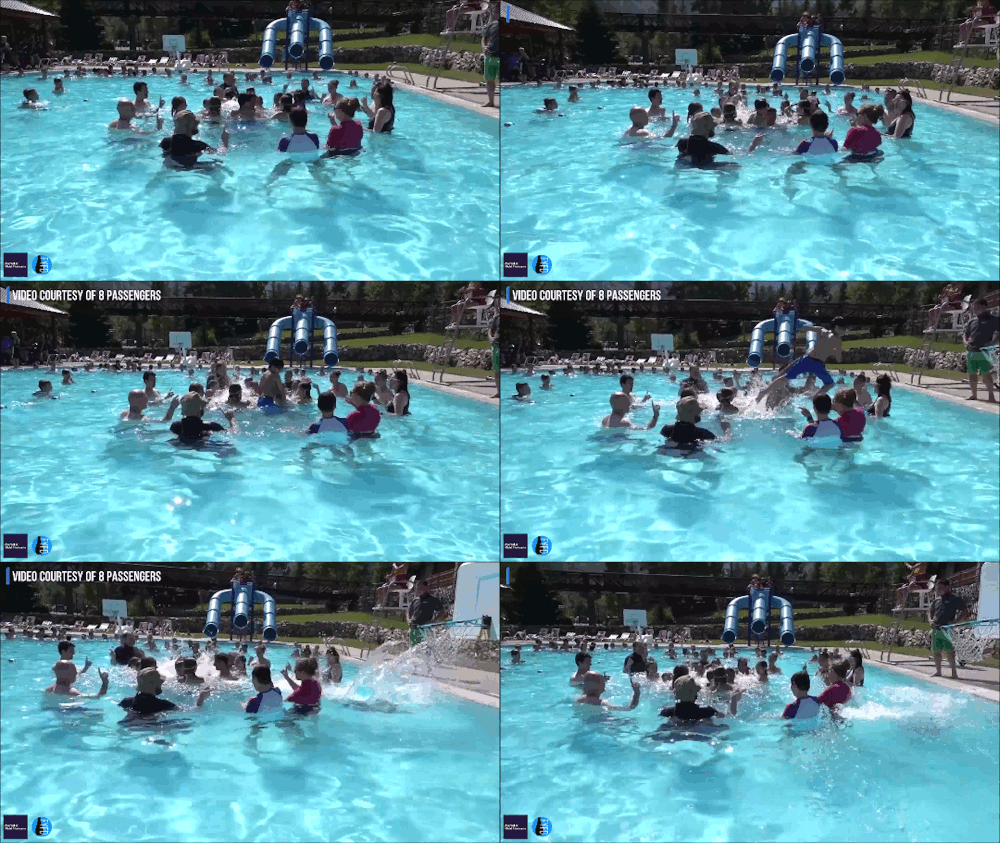
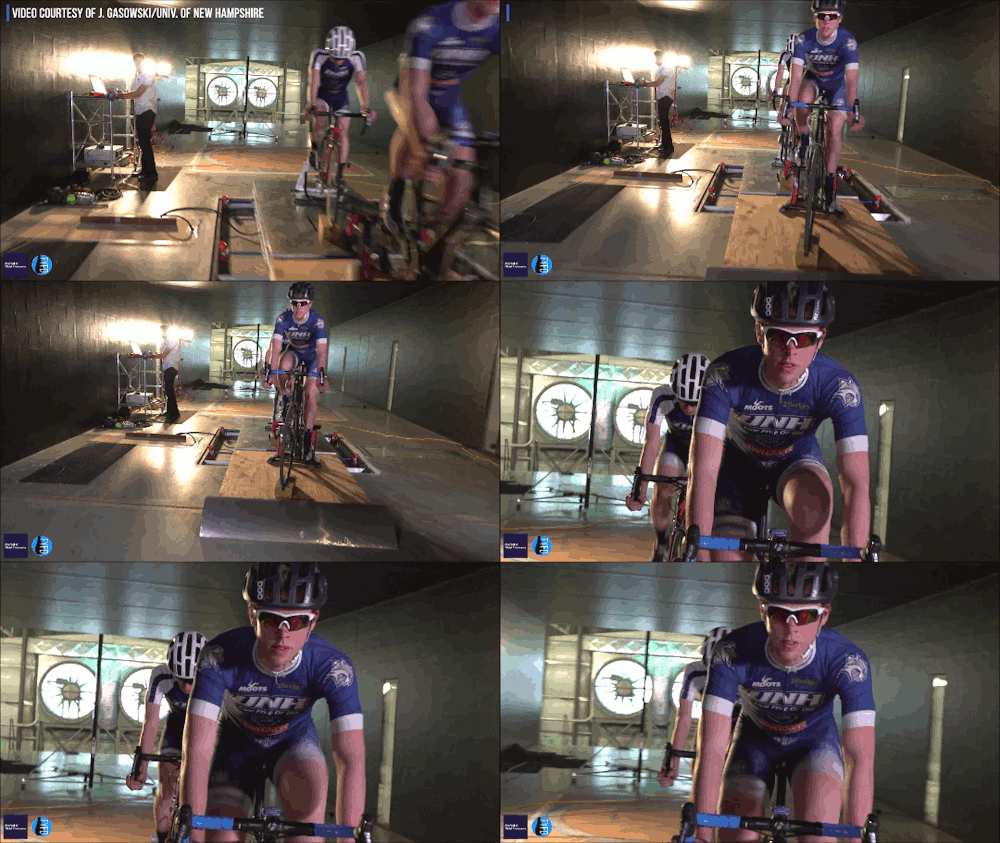
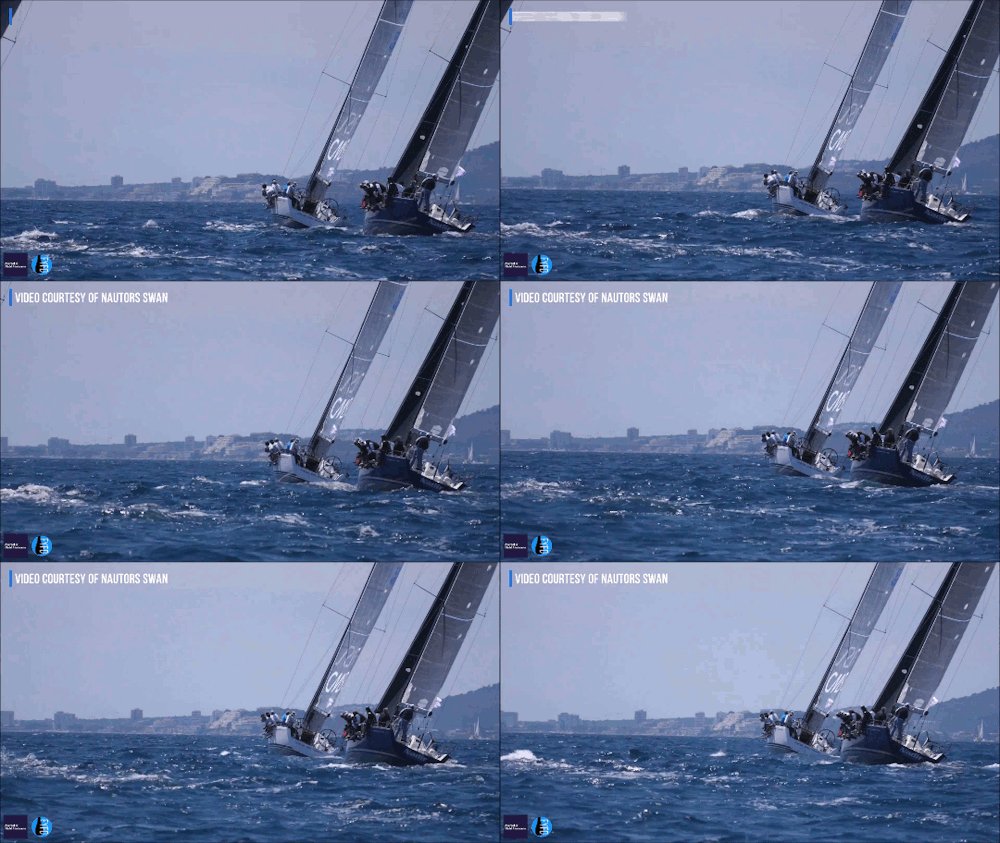
    Summer brings with it lots of great sports, and whether you love riding a bike, sailing a boat, or just hanging out at the pool, our latest FYFD/JFM video has something for you. Want even more sports physics? Check out the Olympic series we did for the London and Rio games. And if you’re looking for more of the latest fluids research, don’t miss the rest of our video series. (Video and image credit: N. Sharp and T. Crawford)

  • Breaking With a Wave

    Breaking With a Wave

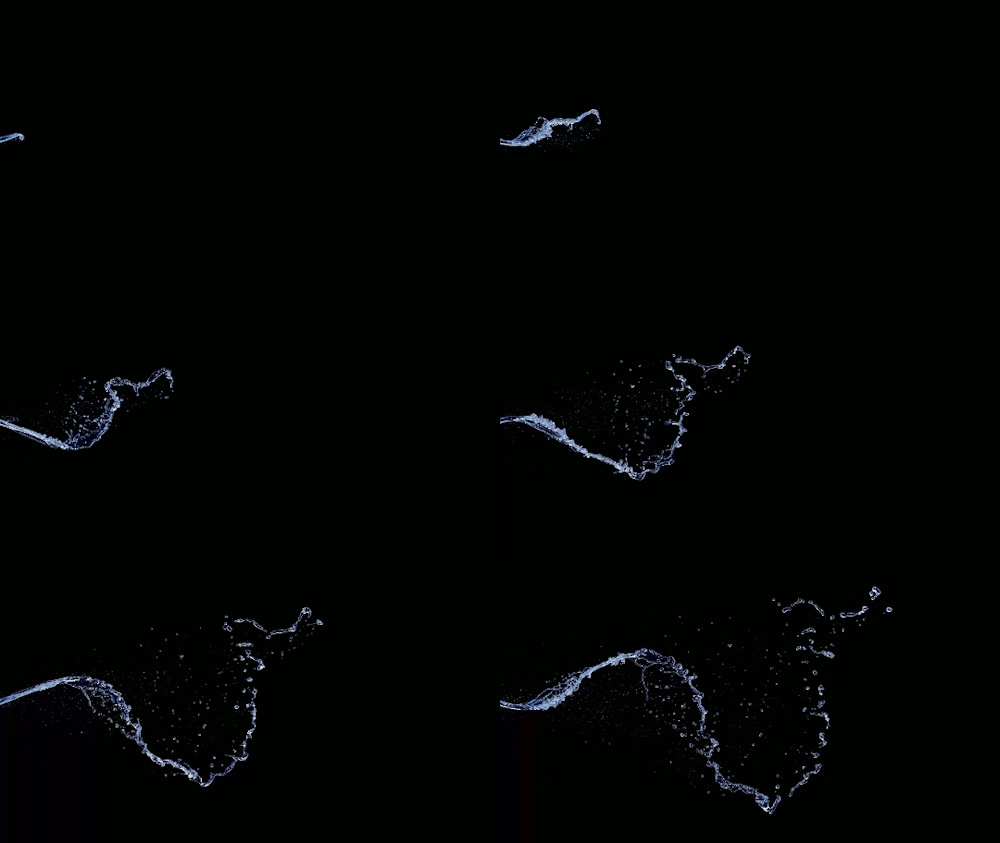
    For rocket combustion and other applications, like watering your lawn with a hose, a stream of fluid may need to be broken up into droplets. While simply spraying a liquid jet will make it break up, waving that jet back and forth will break it up faster. A recent study simulated this problem numerically to determine the exact mechanisms driving that break-up. The researchers found two major culprits.

    The first is a Kelvin-Helmholtz, or shear-based, instability. When a jet leaves the nozzle, there’s friction between it and the comparatively still air surrounding it. This creates tiny ripples in the surface that eventually grow into the distortions we can see, and it’s found in all jets, regardless of their side-to-side motion.

    The second culprit, which is only found in the oscillating jet, is a Rayleigh-Taylor instability. By moving the jet side-to-side, you’re driving the dense liquid into less dense air, which creates a different set of disturbances that also help break up the jet. The final result: swinging the jet side-to-side breaks it into smaller droplets faster. (Image and research credit: S. Schmidt et al.)

  • Forming Europa’s Bands

    Forming Europa’s Bands

    Jupiter’s icy moons, Europa and Ganymede, are home to subsurface oceans. These moons also experience strong tidal forces from their parent planet and sibling moons that squeeze and deform them over time. A new study focuses on the bands, seen in red in the top image of Europa, that form as a result of these deformations. By simulating (bottom image) both the convective currents within the Europan ocean and the deformation of the ice over time, scientists are able to study how these geological surface features may have formed. Over the course of about a million years, material from the interior ocean works its way up into the center of a band. Because this process takes so long, the researchers point out that any attempt to collect material from the bands will yield “fossil” ocean material – essentially a glimpse of Europa’s ocean as it existed a million years ago rather than how it exists today! (Image credit: NASA; image and research credit: S. Howell and R. Pappalardo, source; submitted by Kam-Yung Soh)

  • Flying Backwards

    Flying Backwards

    Spend a summer afternoon floating in a kayak and chances are you’ll see some impressive aerial acrobatics from dragonflies. One of the dragonfly’s superpowers is its ability to fly backwards, which helps it evade predators and take-off from almost any orientation. To do this, the dragonfly rotates its body so that it is nearly vertical, thereby changing the direction it generates lift. In engineering terms, this is “force-vectoring,” similar to the techniques used by helicopters and vertical-take-off jets. 

    Scientists found that backwards-flying dragonflies could generate forces two to three times their body weight, in part due to the strong leading-edge vortices (bottom image) formed on the forewings. They also found that the hind wings are timed so that their lift is enhanced by catching the trailing vortex of the first pair of wings. Engineers hope to use what they’re learning from insect flight to build more capable flying robots. (Image and research credit: A. Bode-Oke et al., source; via Science)

  • Featured Video Play Icon

    Martian Bees, Canopies, and Dandelion Seeds

    The latest FYFD/JFM video is out! May brings us a look at the incredible flight of dandelion seeds, numerical simulations that reveal the flow above forest canopies, and a look at bee-inspired flapping wing robots being developed for exploring Mars! Learn about all this in the video below, and, if you’ve missed other videos in the series, you can catch up here. (Image and video credit: N. Sharp and T. Crawford)

  • Hydrofoils and Stability

    Hydrofoils and Stability

    Today’s fastest boats use hydrofoils to lift most of a boat’s hull out of the water. This greatly reduces the drag a boat experiences, but it can also make the boat difficult to handle. One style of hydrofoil boat, called a single-track hydrofoil, uses two hydrofoils in line with one another to support and steer the boat. The pilot can steer the lead hydrofoil into the direction of a fall to correct it. Stability-wise, this is the same way that you keep a bicycle upright. On a boat, the situation is a bit tougher to manage, and, like riding a bike, it takes practice. A group of students published a full mathematical model for the dynamics of this kind of boat, which allows designers to test a prototype’s stability early in the design process and enables student teams to use computer simulators to train their pilots to drive a boat before putting them out on the water, similar to the way that airplane pilots train. (Image credit: TU Delft Solar Boat Team, source; research credit: G. van Marrewijk et al., pdf; via TU Delft News; submitted by Marc A.)

  • Snowmelt

    Snowmelt

    Much of the rain that falls on Earth began as snow high in the atmosphere. As it falls through warmer layers of air, the snowflakes melt and form water droplets. The details of this melting process have been difficult to capture experimentally, but a new computational model may provide insight. The basic process has a couple stages. As snow begins to melt, surface tension draws the water into concave areas nearby. When those regions fill up, the water flows out and merges with neighboring liquid, forming water droplets around a melting ice core.

    Although this same sequence was observed for many types of snow, scientists also observed some important differences between rimed and unrimed snowflakes. Rime forms when supercooled water droplets freeze onto the surface of a snowflake. Lightly rimed snow still looks light and fluffy, like the animation above, but heavily rimed snow forms denser and more spherical chunks. Because there are lots of porous gaps in heavily rimed snow, water tends to gather there during initial melting. Rimed snow was also more likely to form one large water droplet rather than breaking into multiple droplets like snow with less rime. For more, check out NASA’s video and the Bad Astronomy write-up. (Image credit: NASA, source; research credit: J. Leinonen and A. von Lerber; via Bad Astronomy; submitted by Kam Yung-Soh)