Tag: numerical simulation

  • Using Electric Fields to Avoid Dripping

    Using Electric Fields to Avoid Dripping

    Anyone who’s painted a room at home is familiar with the frustration of drips. At certain inclinations, practically every viscous liquid develops these gravity-driven instabilities. They’re troublesome in manufacturing as well, where viscous films are often used to coat components and unexpected drips can ruin the process.

    To avoid this, researchers are adding electric fields into the mix. For dielectric fluids — liquids sensitive to electric fields — this addition acts like extra surface tension, stabilizing the film and preventing drips from forming. The researchers’ mathematical models predict the electric field strength necessary for a given fluid layer depending on its inclination. (Image credit: stux; research credit: R. Tomlin et al.; via APS Physics)

  • Inferring Flows with Neural Networks

    Inferring Flows with Neural Networks

    Fluid dynamicists have long used flow visualization methods to get a qualitative sense for flows, but it’s rare to derive much quantitative data from this imagery. But that may soon change thanks to a new computational technique, called Hidden Fluid Mechanics, that uses data from flow visualizations combined with physics-informed neural networks to derive the underlying velocities and pressures in a flow.

    The technique relies on two important ideas. One is that the dye, smoke, or other method of visualizing the flow does not alter the underlying flow; it’s just something carried along by the fluid. In other words, the flow behaves exactly the same whether or not you inserted dye or smoke.

    The second key idea is that the Navier-Stokes equations — which are derived from conservation of mass, momentum, and energy — accurately describe the physics of a flow. That assumption is critical to the technique since it uses those equations to constrain the flow fields the algorithm reconstructs.

    So here, roughly speaking, is what the algorithm actually does: researchers feed it concentration data from a flow visualization — essentially how much smoke or dye is present at every point in space and time — and the neural network reconstructs, based on the Navier-Stokes equations, what velocity and pressure field would produce that concentration data.

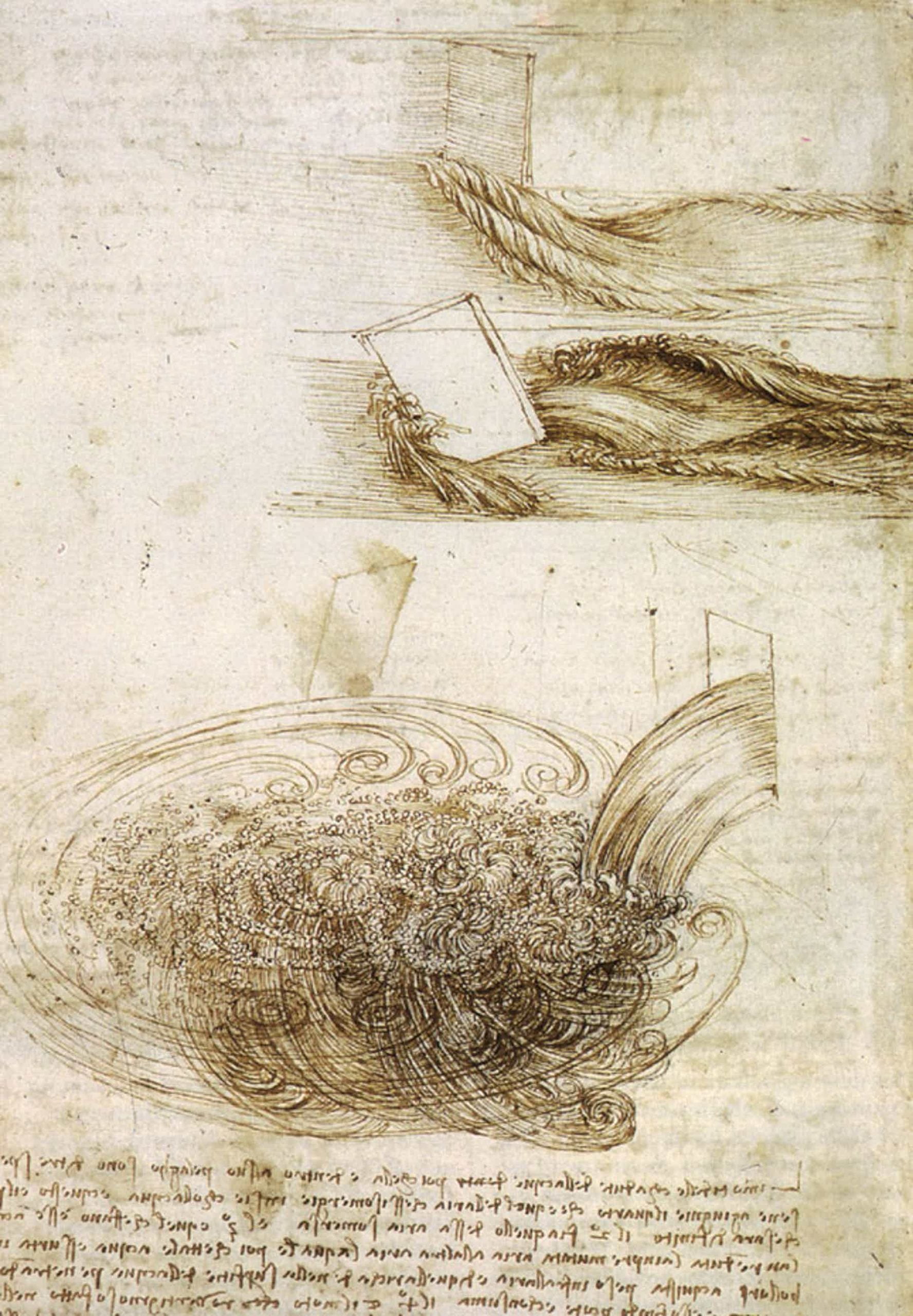
    The researchers demonstrate the capabilities of their algorithm by comparing its results to flows where all the information is known. The first image in the gallery above shows concentration data for the flow in an aneurysm. The full flow field is known already from a numerical simulation, but the researchers gave their new algorithm only the concentration data. From that, it reconstructed the streamlines for the aneurysm’s flow, shown in the second image as “Learned”. The “Exact” streamlines on the left are taken from the original numerical simulation data. As you can see, the results are remarkably similar. (Image credit: drawings – L. da Vinci, others – M. Raissi et al.; research credit: M. Raissi et al.; submitted by Stuart H.)

  • Kneading Dough

    Kneading Dough

    Kneading bread dough is something of an art. The process binds flour, water, salt, and yeast into a network that is both elastic and viscous. It also traps pockets of air that will determine the texture of the final loaf. Underknead and the bubbles won’t form; overknead and the result will be a dense loaf that doesn’t rise in the oven.

    Capturing all of that physics in a realistic model is tough, but researchers have done so and validated their digital dough against experiments. The group focused on simulating industrial mixers, which knead dough with a moving, spiral-shaped rod rotating around a stationary vertical one. They found the industrial set-up did not mix as well as kneading by hand, but that could be improved by swapping the stationary rod for a second spiral one. (Image credit: G. Perricone; research credit: L. Abu-Farah et al.; via Physics World; submitted by Kam-Yung Soh)

  • Adapting to the Flow

    Adapting to the Flow

    Simulating fluid dynamics computationally is no simple task. One of the major challenges is that flows typically consist of many different lengthscales, from the very large to the extremely tiny. In theory, correctly capturing the physics of the flow requires computing all of those scales, and that means having a very close, dense grid of points at which the physics must be calculated during every time step of a simulation. Even for a relatively simple flow, this quickly balloons into a prohibitively expensive problem. It simply takes a computer far too long to calculate solutions for so many points.

    One technique that’s been developed to save time is Adaptive Mesh Refinement. You can see an example of it above. The background is a grid of points that are far from one another in places where the flow isn’t changing and are tightly spaced in areas where the rising flames are most changeable. Adaptive Mesh Refinement algorithms automatically change these grid points on the fly, adding more where they’re needed and subtracting them where they aren’t. The end result is a much faster computational result that doesn’t sacrifice accuracy. Check out the videos below for some examples of this technique in action. (Video and image credit: N. Wimer et al.)

  • Featured Video Play Icon

    Creating Biofuel

    One production technique for biofuel converts agricultural waste through pyrolysis. These systems heat biomass particles in a mixture of sand and nitrogen gas until the biomass particles release tar and syngas, a key ingredient of biofuel. All this heating and mixing takes place in a fluidized bed, where the injected nitrogen gas helps the particle mixture move like a fluid.

    Building prototypes of these systems can be costly, so industry has largely relied on computational studies to predict performance. But capturing the complicated physics behind turbulent gas and particle interactions is tough, and some models discard key information in favor of faster and cheaper simulations. In this study, the authors found that clustering between particles has a major effect on syngas production, something that industrial studies must account for. 

    This is one of the challenges of computational fluid dynamics; although the codes have become more and more accessible over time, getting reliable results still requires a solid understanding of the strengths and limitations of each model used. (Image, video, and research credit: S. Beetham and J. Capecelatrosource; submitted by Jesse C.)

  • Featured Video Play Icon

    Modeling Oobleck

    Oobleck – that peculiarly behaved mixture of cornstarch and water – continues to be a favorite of children and researchers both. Oobleck flows like a liquid when deformed slowly, but try to move it quickly and it will seize up like a solid. This sudden change depends on the tiny particles of cornstarch suspended in the liquid. When they’re given time, electrostatic forces between the particles help them repel one another and keep the liquid flowing. But under sudden impacts, the particles get jammed together and the friction between neighboring grains makes the viscosity of the fluid increase by orders of magnitude. 

    Researchers are now able to model these particle interactions numerically, which will help them predict how oobleck and similar substances will behave in applications like body armor or pothole repair. (Video credit: MIT; via MIT News; research credit: A. Baumgarten and K. Kamrin)

  • Bay of Fundy Tides

    Bay of Fundy Tides

    Canada’s Bay of Fundy has some of the wildest tidal flows in the world. Every six hours, the flow direction through the strait shifts and tidal currents rise to several meters per second. This creates distinct jets a couple kilometers long that pour from one side of the strait to the other. 

    What you see here is a numerical simulation of the flow using a technique called Large Eddy Simulation (or LES, for short). It’s one method used by fluid dynamicists to model turbulent flows without taking on the complexity of the full Navier-Stokes equations. At large lengthscales, like those of the jets and eddies we see above, LES uses the exact physics. But when it comes to the smaller scales – like the flow nearest the shores or the bottom of the strait – the simulation will approximate the physics in order to make calculations quicker and easier. Models like these make large-scale problems – including modeling our daily weather patterns – possible. (Image credit: A. Creech, source)

  • Anak Krakatoa Landslide

    Anak Krakatoa Landslide

    Last December, the collapsing flank of the Anak Krakatoa volcano caused a deadly tsunami in Indonesia. Using satellite imagery, scientists have now constructed a timeline of the island’s dramatic restructuring. In the process, they found that the landslide that triggered the tsunami was likely much smaller than originally estimated.

    Their evidence shows that the landslide and tsunami (Image B) occurred before the eruption that destroyed the volcano’s cone. In fact, the landslide seems to have created a vent that opened directly underwater, which explains the increased violence of the eruption in late December and the eventual destruction of the volcano’s cone (Image C). After that, the underwater vent closed off and the eruption returned to its quieter state as the volcano began rebuilding its cone (Image D).

    The key finding here is that the initial landslide contained roughly a third of the material originally estimated. That means our tsunami models have been seriously underestimating the catastrophic potential of smaller volcanic landslides. Hopefully the lessons we learn from Anak Krakatoa will help us avoid future tragedies. (Image and research credit: R. Williams et al.; via BBC; submitted by Kam-Yung Soh)

  • Cavitation Collapse

    Cavitation Collapse

    The collapse of a bubble underwater doesn’t seem like a very important matter, but when it happens near a solid surface, like part of a ship, it can be incredibly destructive. This video, featuring numerical simulations of the bubble’s collapse, shows why. 

    When near a surface, the bubble’s collapse is asymmetric, and this asymmetry creates a powerful jet that pushes through the bubble and impacts the opposite side. That impact generates a shock wave that travels out toward the wall. As the bubble hits its minimum volume, a second shock front is generated. Both shock waves travel toward the wall and reflect off it, generating high pressure all along the surface. (Image and video credit: S. Beig and E. Johnson)

  • Blowing Smoke

    Blowing Smoke

    It’s unusual – but not entirely unheard of – to see volcanoes blowing smoke rings during inactive periods. But given their unpredictability, scientists had not studied this phenomenon in much depth. In a recent presentation, though, a group unveiled results from numerical studies of volcanic vortex rings. They found that the decreasing pressure on rising magma allows dissolved gases to emerge as bubbles. If the magma has the right viscosity, those bubbles can merge into one big pocket that depressurizes explosively in the vent. As the hot gases burst upward, the walls of the vent cause them to curl up into a vortex ring, provided the vent is fairly circular and uniform. That sends the roiling vortex up into the atmosphere, where it cools, condenses, and becomes visible.

    The need for a circular vent matches observations of volcanic vortex rings in nature, like the infrared image shown above. Volcano watchers find that vortex rings only form from some vents, and the more circular the vent, the more likely it can produce vortex rings. (Image credit: B. Simons; research credit: F. Pulvirenti et al.; via Nat Geo; submitted by Kam-Yung Soh)