Tag: microgravity

  • Forming Asteroids

    Forming Asteroids

    Amidst the swirling gas and dust surrounding young stars, asteroids and planets form. Just how these bodies come together – especially before they are massive enough to exert any significant gravitational potential – is an open question. Researchers are trying to better understand the physics involved by studying how clusters of granular material behave when impacted. 

    Above you see footage from two experiments. Both take place in a drop tower under vacuum conditions. That means the effects of air drag and gravity are removed, just like in space. On the left, the cluster is made up of soft clumps of dust; on the right, the cluster contains hard glass beads. Surprisingly, the researchers found that the two different materials behave the same way. They were able to describe both sets of impacts with exactly the same model. This suggests there may be an underlying universal behavior behind all of these granular materials, though the researchers note more experiments are needed. (Image and research credit: H. Karsuragi and J. Blum; via APS Physics)

  • Making Champagne for Space

    Making Champagne for Space

    Humanity’s ongoing quest to enjoy beloved beverages in space has a new entry: champagne. French champagne maker Mumm has announced a new line with specially designed bottles to dispense champagne in microgravity. The bottles feature an internal piston that allows users to release the contents from the bottle in a controlled manner. Rather than pouring the champagne, one dispenses a blob which can then be caught in the special cups that go with it. They’re shaped somewhat like a miniature coupe. 

    It certainly looks like a fun way to celebrate in microgravity, although it’s unclear to me that they’ve tested the after effects of consumption. Historically, astronauts have avoided carbonated beverages in orbit because the lack of gravity can cause unpleasant side effects with all those bubbles. (Image credits: Mumm Champagne, source; via Wired)

  • Featured Video Play Icon

    Hair-Washing in Microgravity

    I imagine that the most common questions astronauts get come in the form, “How do you do X in space?” In this video, astronaut Karen Nyberg demonstrates how she washes her hair in space. Using no-rinse shampoo, the process is not terribly different from on Earth: wet the hair, work in the shampoo, add a little more water, and use a towel and comb to work it through all the hair. The big difference is that Nyberg’s hair sticks almost straight up the whole time. That’s an effect of microgravity, obviously, but there are fluid forces at play, too, namely elastocapillarity.

    Hair typically feels quite different when it’s wet. Strands bunch together and feel stiffer. This is because of the water trapped in the narrow space between individual hairs. The water’s fluid characteristics (capillarity) affect the solid hairs and change their elastic properties – hence elastocapillarity. We see this on Earth, of course, but the effect is especially noticeable without gravity pulling the wet hair down. (Video credit: K. Nyberg/NASA; via APOD; submitted by Guillaume D.)

  • Blowing Bubbles in Space

    Blowing Bubbles in Space

    Blowing bubbles in your fruit juice is a bad idea when you’re in space, as astronaut Jack Fischer demonstrates. On Earth, gravity dominates water’s behavior, except when things are very small. But in microgravity, a liquid’s other characteristics become more obvious. Adhesion between the straw and juice guides it up and onto Fischer’s face. Surface tension is strong enough to hold the expanding juice bubble together. Capillary action, the ability of fluids to climb up narrow spaces, is far more apparent in microgravity as well, although it’s not important for this demo. We sometimes forget how powerful these forces can be, but microgravity is a good reminder that fluids are more complicated than we think. (Image credit: J. Fischer, source)

  • Featured Video Play Icon

    Flames in Freefall

    Gravity is such an omnipresent force in our lives that we frequently forget how strongly it affects our daily experiences and how differently nature behaves without it. A wonderful example of this is the simple flame of a candle. On Earth, a candle flame is tear-drop-shaped and elongated, burning hotter near the bottom and glowing yellow from soot at the top. But, as Dianna demonstrates with her free-fall experiment, this shape is due entirely to the effects of gravity. Buoyant forces make the hot air near the candle rise, pulling in cooler air and fresh oxygen at the base while stretching out the flame. In microgravity – or free-fall – flames are instead spherical, their shape driven by molecular and chemical diffusion. Check out the full video to see more effects of acceleration on flames. (Video credit: Physics Girl)

  • Capillary Action in Microgravity

    Capillary Action in Microgravity

    On Earth, gravity dominates over many fluid effects, but in microgravity a different picture emerges. This animation shows a two-channel apparatus partially filled with silicone oil being dropped. While in free-fall, the liquid experiences microgravity conditions and the height of the fluid in the two connected channels changes. The oil meniscus climbs up the walls of the tubes thanks to capillary action. This is the result of intermolecular forces between the liquid and solid walls. Capillary action is most effective in narrow tubes where surface tension and the adhesion between the liquid and solid can actually propel liquid up the walls, as seen here. On Earth we mostly ignore capillary action, except in very small spaces, but for space systems, it is a major force to reckon with in designing flows. (Image credit: NASA Glenn Research Center, source)

  • Featured Video Play Icon

    Sloshing in Space

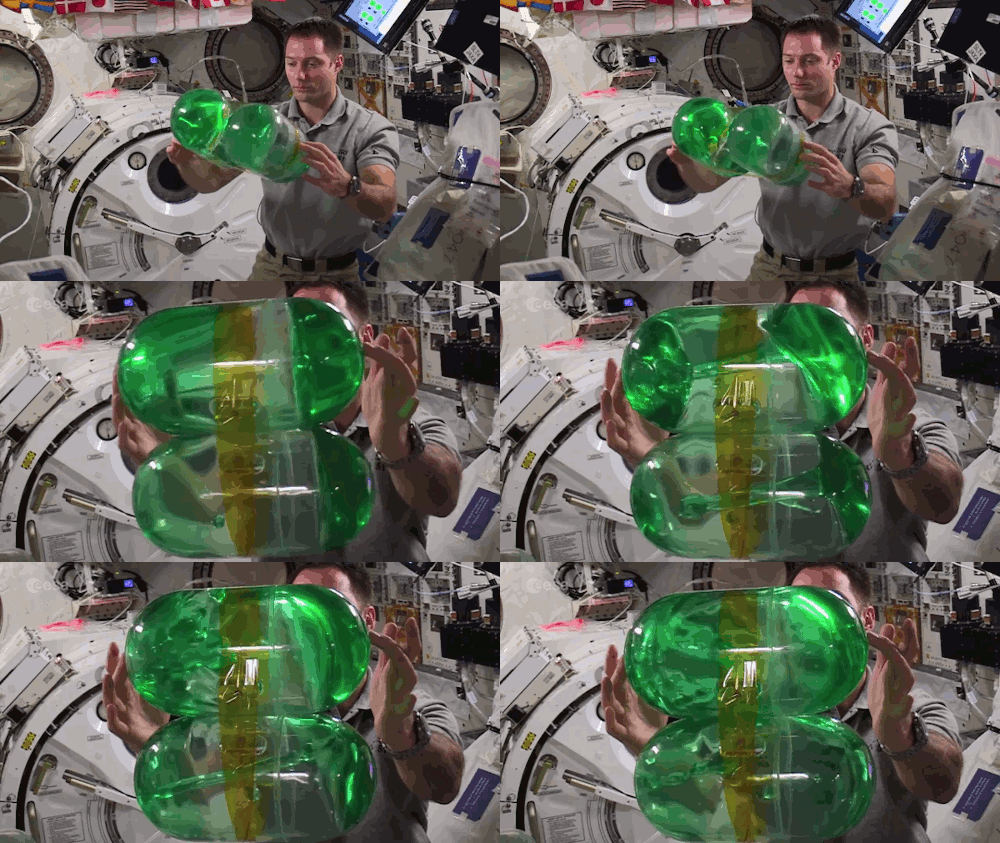
    Last month, French astronaut Thomas Pesquet posted a video of some experiments he did on the International Space Station exploring the movement of fluids in microgravity. He filmed the experiments as part of the SPHERES Slosh project. Sloshing is the technical term for how liquids respond to the motion of their container, and it’s a tough problem whether you’re carrying a full coffee mug on Earth or dealing with a partially-emptied fuel canister in orbit.

    Here on Earth, gravitational forces dominate how fluids respond, but in microgravity, surface tension is a more powerful player. Pesquet’s demonstrations help scientists here on Earth better understand and model how liquids respond to movement in space. One major application for this is in spacecraft fuel tanks, which engineers must be able to design so that they empty themselves consistently with or without the added complications of spinning, maneuvering, or impulsive kicks of acceleration. (Video and image credit: ESA; submitted by gdurey)

  • Microgravity Can Change Vision

    Microgravity Can Change Vision

    In recent years, astronauts have reported their vision changing as a result of long-duration spaceflight. Pre- and post-flight studies of astronauts’ eyes showed flattening along the backside of the eyeball, and scientists hypothesized that the redistribution of body fluids that occurs in microgravity could be reshaping astronauts’ eyes by increasing the intracranial pressure in their skulls.

    A new study tested this hypothesis with the first-ever measurements of intracranial pressure during microgravity flights and during extended microgravity simulation (a.k.a. bedrest with one’s head pointed downward). The authors found that humans here on Earth experience substantial changes in intracranial pressure depending on our posture – while upright we experience much lower intracranial pressure than we do when we’re lying flat. In both microgravity flights and simulation, patients had intracranial pressures that were higher than earthbound upright values but lower than what is experienced when lying flat on Earth.

    Since we humans on Earth spend about 2/3rds of our time upright and 1/3rd prone, our bodies are accustomed to regular variations in intracranial pressure. In space, astronauts don’t receive that regular unloading of intracranial pressure we have when we’re upright. So now researchers suggest that it is the lack of daily variation in intracranial pressure that is the culprit behind astronauts’ vision changes – not the absolute value of the pressure itself. (Image credit: NASA; N. Alperin et al.; research credit: J. Lawley et al.)

  • Featured Video Play Icon

    Avoiding Coalescence

    If you watch closely as you go about your day, you may notice drops of water sometimes bounce off a pool of water instead of coalescing. Fluid dynamicists have been fascinated by this behavior since the 1800s, but it was Couder et al. who explained that these droplets can bounce indefinitely as long as the thin air layer separating the drop and pool is refreshed by vibrating the pool. In this video, Destin teams up with astronaut Don Pettit to film the phenomenon in beautiful high-speed. My favorite part of the video starts around 8:18, where Destin shows Don’s experiments with this effect in microgravity. It turns out that the cello produces just the right frequencies to create a cascade of bouncing water droplets, much like a Tibetan singing bowl turned back on itself! (Video credit: Smarter Every Day; submitted by Destin and effyeahjoebiden)

  • Featured Video Play Icon

    Coffee-Making in Space

    In this video, Kjell Lindgren demonstrates his technique for making coffee aboard the Space Station. Astronauts usually drink coffee reconstituted from powder, or, on special occasions, enjoy a beverage from their special espresso machine. But Lindgren uses a pour-over method by attaching a pod of coffee grounds to the underside of a Capillary Beverage Experiment cup – a specially-designed 3D printed cup that uses capillary action and surface tension to guide fluids. Then, by forcing hot water from a syringe through the grounds and into the cup, he gets a result that’s not too different from the way many people enjoy their coffee here on Earth. I must say, though, that my favorite part of this video is how he just starts spinning to separate the air and water in the syringe! (Video credit: NASA; via IRPI LLC)