Tag: microgravity

  • Featured Video Play Icon

    Fluids Round-Up

    Time for another fluids round-up! Here’s some of the best fluid dynamics from around the web:

    – Band Ok Go filmed their latest music video in microgravity, complete with floating, splattering fluids. Here they describe how they did it. Rhett Allain also provides a write-up on the physics.

    – Scientists are trying to measure the impact of airliners’ contrails on climate change. (pdf; via @KyungMSong)

    – Researchers observing the strange moving hills on Pluto suspect they may, in fact, be icebergs.

    – The best angle for skipping a rock is 20-degrees. Related: elastic spheres skip well even at higher angles. (via @JenLucPiquant)

    – Fluid dynamics and acoustics have some fascinating overlaps. Be sure to check out “The World Through Sound” series at Acoustics Today, written by Andrew “Pi” Pyzdek, who also writes one of my favorite science blogs.

    – Over at the Toast, Mallory Ortberg explores the poetry of the Beaufort wind scale.

    Could dark matter be a superfluid? (via @JenLucPiquant)

    – Understanding the physics of the perfect pancake is helping doctors treat glaucoma. (submitted by Maria-Isabel)

    – Van Gogh’s “Starry Night” shows swirling skies, but just how turbulent are they? (submitted by @NathanMechEng)

    – The physics (and fluid dynamics!) of throwing a football – what’s the best angle for a maximum distance throw? (submitted by @rjallain)

    (Video credit: Ok Go)

    Thanks to our Patreon patrons who help support FYFD!

  • Featured Video Play Icon

    Fluids Round-up

    Here’s to another fluids round-up, our look at some of the interesting fluids-related stories around the web:

    – Above is a music video by Roman Hill that relies on mixing and merging different fluids and perturbing ferrofluids for its visuals as it re-imagines the genesis of life.

    – GoPro takes viewers inside a Category 5 typhoon with 112 mph (180 kph; 50 m/s) winds.

    – Astronaut Scott Kelly demonstrates playing ping pong with a ball of water in space. (via Gizmodo)

    – See fluid dynamics on a global scale with Glittering Blue. (via The Atlantic)

    – To make a taller siphon, you have to find a way to avoid cavitation.

    – Speaking of siphons, Randall Munroe tackles the question of siphoning water from Europa over at What If? (submitted by jshoer)

    – The Mythbusters make a giant tanker implode using air pressure.

    – Sixty Symbols explores how tiny things swim.

    – What happens when you bathe in 500 pounds of putty? Let’s just say that bathing in an extremely viscous non-Newtonian fluid is not recommended. (via Gizmodo)

    (Video credit and submission: R. Hill et al.)

    Don’t forget to check out our Patreon page. Please help support FYFD by becoming a patron. 

  • Swimming in Microgravity

    Swimming in Microgravity

    For years, I have wondered what a fish swimming in microgravity would look like. Finally, my curiosity has been rewarded. Here is a sphere of water in microgravity, complete with a fish. Personally, I am impressed that, despite the fish’s best efforts, the surface tension of the water is strong enough to keep it confined. This may not bode well for microgravity swimming pools at space hotels. (Video credit: IRPI LLC, source)

  • Drinking in Space

    Drinking in Space

    Earlier this year, the Capillary Beverage experiment launched to the International Space Station with new open-topped “Space Cups” for astronauts to test. Now those of us back on Earth are getting a glimpse of the cups in microgravity action. The geometry of the cups is wide on the back-end with a tightening v-shape near the mouth. This shape guides the liquid by using capillary action to wick it toward the spout.

    One of the key goals of the experiment was to observe how the liquid drained–what shape it assumed in the cup and where and how much liquid was left behind. The researchers want to compare the real-life performance of the cups with their numerical models and simulations, which will help design future microgravity liquid transport systems for fuel, waste management, and other applications.

    Although the experiments have a wider purpose, the space cups also do a great job allowing astronauts to drink from more than just pouches. Check out the gallery demo above to see how they hold up against astronaut silliness! (Video and image credits: NASA/IRPI LLC, GIF source)

  • Featured Video Play Icon

    Carbonation in Space

    Astronauts don’t typically drink soda or other carbonated beverages while in space. The reason is probably apparent if you watch this new video of an effervescent tablet in water on the space station (or, you could watch the older classic one from Don Pettit). Unlike on Earth, where the carbon dioxide bubbles are buoyant and rise to the surface, the bubbles in a fluid in microgravity are randomly distributed. Those few bubbles that happen to be located along the edge of the water sphere will sometimes burst, creating the halo of tiny droplets you see in the video. In the case of sodas, though, the bubbles’ behavior creates a foamy mess, and, after ingestion, the bubbles are stuck travelling through the astronaut’s digestive system instead of getting burped out. Sounds rather unpleasant to me. (Video credit: NASA; submitted by entropy-perturbation and buckitdrop)

    ——————

    LAST CALL: Help us do some science! I’ve teamed up with researcher Paige Brown Jarreau to create a survey of FYFD readers. By participating, you’ll be helping me improve FYFD and contributing to novel academic research on the readers of science blogs. It should only take 10-15 minutes to complete. You can find the survey here.

  • Get Your Own Space Coffee Cup

    Get Your Own Space Coffee Cup

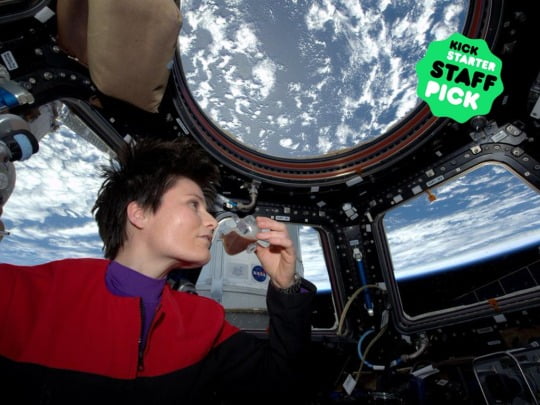
    A few weeks ago, we reported on the espresso machine NASA and the ESA sent to astronauts aboard ISS. The Capillary Beverage Experiment, known colloquially as the “Space Coffee Cup”, is an accompanying project that aims to use our understanding of fluid behavior in microgravity to design an open cup that simulates earthbound drinking experiences. As you can see above, astronauts are already enjoying drinks with it. The cup’s special shape is optimized so that surface tension can replace the role gravity plays in drinking on Earth. Where we pour drinks on Earth, the cup wicks liquid to the spout using surface-tension-driven capillary action. Right now there are only a handful of 3D printed cups on-orbit and here on Earth, but the company that designed them wants to manufacture glass versions for use here on the ground. So if you’d like your own space coffee cup, be sure to check out their Kickstarter campaign! (Video credit: IRPI LLC; image credit: NASA/IRPI LLC; Kickstarter project link)

    ETA: To those who have been asking, that’s European astronaut Samantha Cristoforetti, who is (clearly) a Star Trek fan. I believe she’s doing a tribute to Captain Janeway’s coffee. (Black.)

  • Espresso in Space

    Espresso in Space

    The International Space Station resupply mission launched yesterday included a long-awaited fluid dynamics experiment that offers astronauts a taste of home: the ISSpresso espresso machine. Built by two Italian companies, the specially-designed espresso maker contains a non-convectional heating system and high-pressure piping to safely enable proper brewing using real coffee while in microgravity. The machine is also ruggedized to withstand launch forces; prototypes were even dropped in drop towers to simulate microgravity brewing conditions. The machine dispenses the brewed espresso into plastic packets, but another experiment aboard the ISS, Capillary Effects of Drinking in Microgravity, includes 3D-printed cups designed to allow orbiting astronauts to sip their beverages from open containers without spilling. They’re an improvement on a design created by astronaut Don Pettit in 2008 while in orbit. The cup’s sharp interior angle causes surface tension and capillary action to wick liquid upward to the spout. (Image credits: Lavazza; NASA/Portland State University/A. Wollman)

  • Coalescence in Microgravity

    Click through to see.

    Microgravity is a wonderful playground for fluid dynamics. Here astronaut Reid Wiseman demonstrates the interplay of forces involved in coalescence. When smaller droplets hit with insufficient force, they bounce off the water sphere. But if they hit hard enough to overcome surface tension, they coalesce with the sphere. I think the space station needs a high-speed video camera; I’d like to see this behavior at a few thousand frames per second! (Video credit: R. Wiseman/NASA)

  • Featured Video Play Icon

    Inside a Water Blob

    This new video from the Space Station shows once again that astronauts have the most fun job on–or off–the planet. In it, the Expedition 40 crew members submerge a GoPro camera in a microgravity water blob. Here on Earth, we’re used to surface tension being a minor or secondary force with most fluids we experience daily. This is because gravity often provides the overwhelming effect. But in microgravity, those effects are absent, and forces like surface tension and adhesion dominate water’s behavior. This both why the crew can make such a large water sphere hold together, and why one astronaut eventually gets his hands stuck in the sphere.  (Video credit: NASA; submitted by jshoer)

  • Flames in Space

    Flames in Space

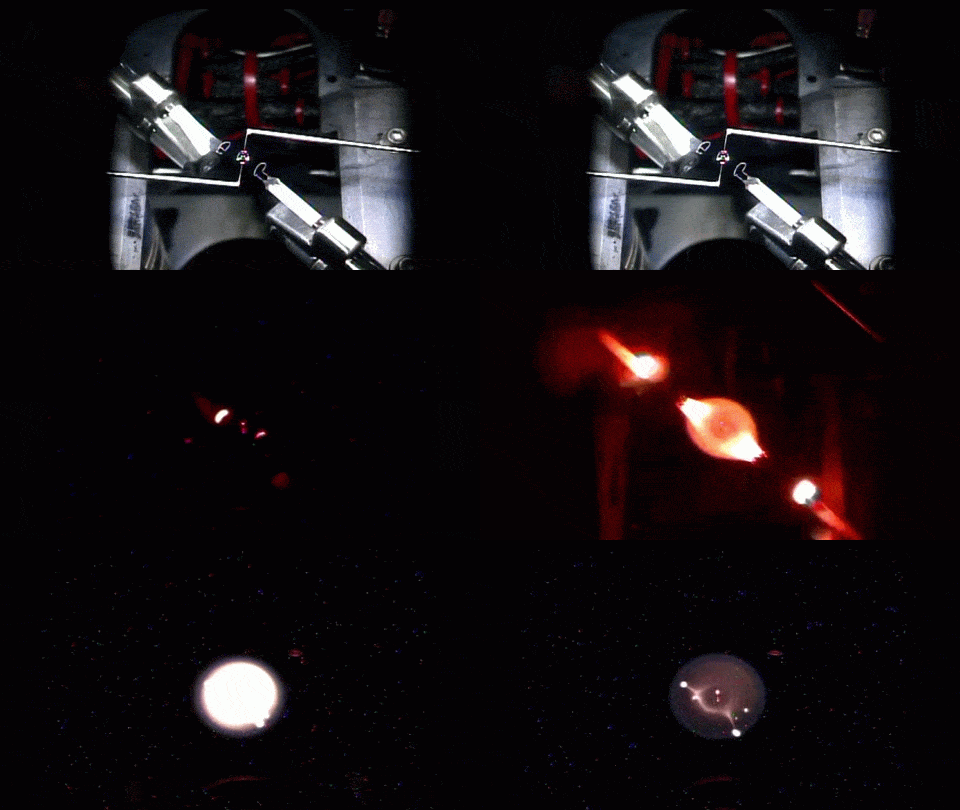
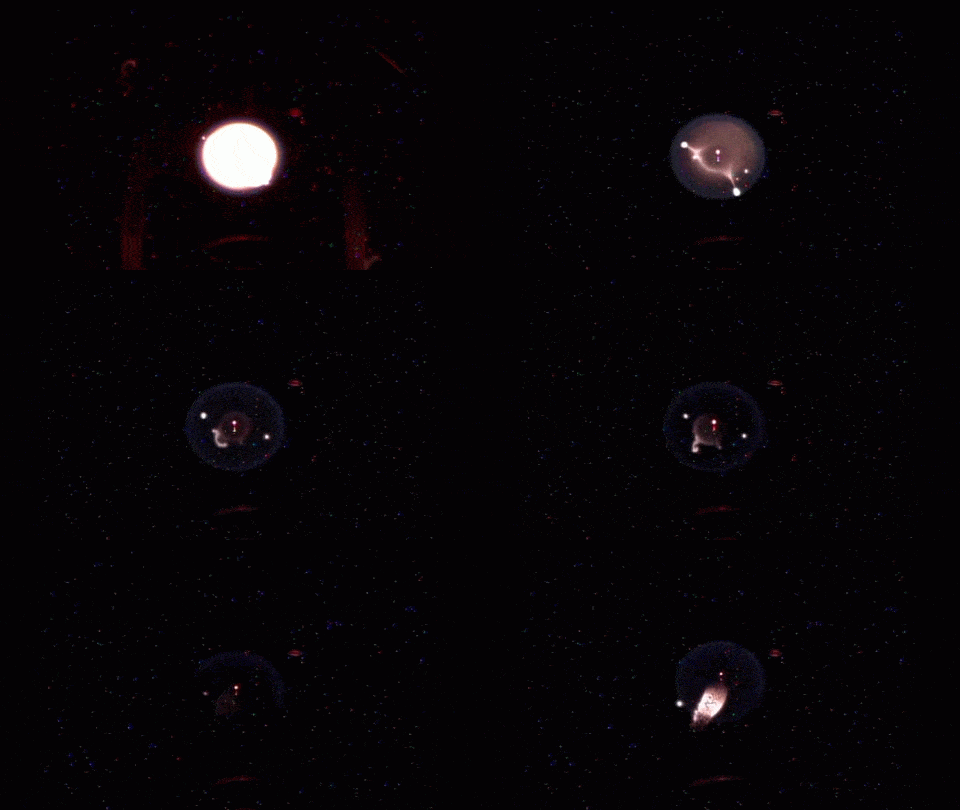
    The jellyfish-like light show in the animations above shows the life and death of a flame in microgravity. The work is part of the Flame Extinguishment Experiment 2 (FLEX-2) currently flying aboard the International Space Station. When ignited, the fuel droplet creates a blue spherical shell of flame about 15 mm in diameter. The spherical shape is typical of flames in microgravity; on Earth, flames are shaped like teardrops due to the effects of buoyancy, which exists only in a gravitational field. The bright yellow spots and streaks that appear after ignition are soot, which consists mainly of hot-burning carbon. The uneven distribution of soot is what causes the pulsating bursts seen in the middle animation. When soot products drift back onto the fuel droplet, it causes uneven burning and flame pulses. The final burst of flame in the last animation is the soot igniting and extinguishing the flame. Fires are a major hazard in microgravity, where oxygen supplies are limited and evacuating is not always an option. Scientists hope that experiments like FLEX-2 will shed light on how fires spread and can be fought aboard spacecraft. For more, check out NASA’s ScienceCast on microgravity flames. (Image credits: NASA, source video; submitted by jshoer)